June 18, 2026
The Economics Behind One of North America's Most Watched Gold Development Projects
Few sectors reveal investor psychology as clearly as gold development. When commodity prices surge, the market re-examines assets that once sat quietly in feasibility limbo, suddenly recognising the embedded leverage that long-term holders understood all along. That dynamic is playing out with particular force in Québec's Abitibi region, where a polymetallic deposit of exceptional scale is undergoing a fundamental financial reappraisal driven by a structurally different gold price outlook.
The Falco Horne 5 gold project feasibility study, updated in mid-2026, has reframed this underground asset from a compelling mid-tier development opportunity into something approaching tier-one scale by any conventional measure. Understanding what has changed, what has stayed the same, and what remains uncertain is essential for investors, analysts, and industry observers trying to evaluate where this project sits in the global gold development landscape.
When big ASX news breaks, our subscribers know first
A Deposit With Uncommon Geological Credentials
The Horne 5 project occupies ground in Rouyn-Noranda, Québec, a city whose mining pedigree extends back over a century. The deposit is classified as a volcanogenic massive sulphide deposits (VMS) system, a geological formation type associated with ancient submarine volcanic activity that concentrates metals across multiple commodity groups simultaneously.
What distinguishes Horne 5 from most other VMS deposits in Canada is its sheer scale. The reserve base exceeds 6.1 million gold-equivalent ounces, supported by a further 3.2 million gold-equivalent ounces in mineral resources that sit outside the current mine plan. Very few undeveloped polymetallic deposits in North America can match that combined inventory.
The geological credibility of Horne 5 is reinforced by its location on the same Abitibi greenstone belt that hosted the historic Horne Mine, which produced more than 11 million ounces of gold throughout its operational life before closure. That geological precedent is not incidental. It provides a natural proof of concept for the mineralisation style and metal endowment that characterises the deposit sitting directly below the former operation.
VMS deposits carry specific metallurgical characteristics that matter to project economics. The polymetallic nature of the ore means that gold, silver, copper, and zinc are recovered simultaneously, with each metal contributing to revenue and allowing by-product credits to reduce the effective cost of gold production. This structural cost advantage is one of the more underappreciated features of VMS-hosted gold projects compared to single-commodity epithermal or orogenic gold deposits.
From 2017 to 2026: A Feasibility Study Timeline That Reflects Market Cycles
The Horne 5 feasibility study history spans nearly a decade, with each iteration reflecting the commodity price assumptions prevalent at the time.
The original feasibility study, completed in 2017, established the foundational technical parameters and mine design. A comprehensive update followed in 2021, incorporating revised commodity assumptions and updated financing structures more relevant to the conditions of that period. The most recent iteration, completed in Q2 2026, represents the most substantial revision, responding to a gold price environment that bears little resemblance to either prior study period.
This study lineage matters for understanding the financial evolution. The changes between 2021 and 2026 are not primarily driven by resource expansion or engineering improvements. The mine plan, production profile, and operational structure remain largely consistent. What has changed is the commodity price deck applied to the same underlying asset, producing dramatically different financial outcomes.
The 2026 Feasibility Numbers in Full Context
The financial metrics from the updated Falco Horne 5 gold project feasibility study are among the most striking to emerge from any Canadian development project in the current cycle. Furthermore, reviewing the definitive feasibility study parameters in detail helps contextualise why these numbers carry such weight with institutional analysts.
Study-by-Study Financial Comparison
| Metric | 2021 Feasibility Study | 2026 Updated Study (Base Case) | Change |
|---|---|---|---|
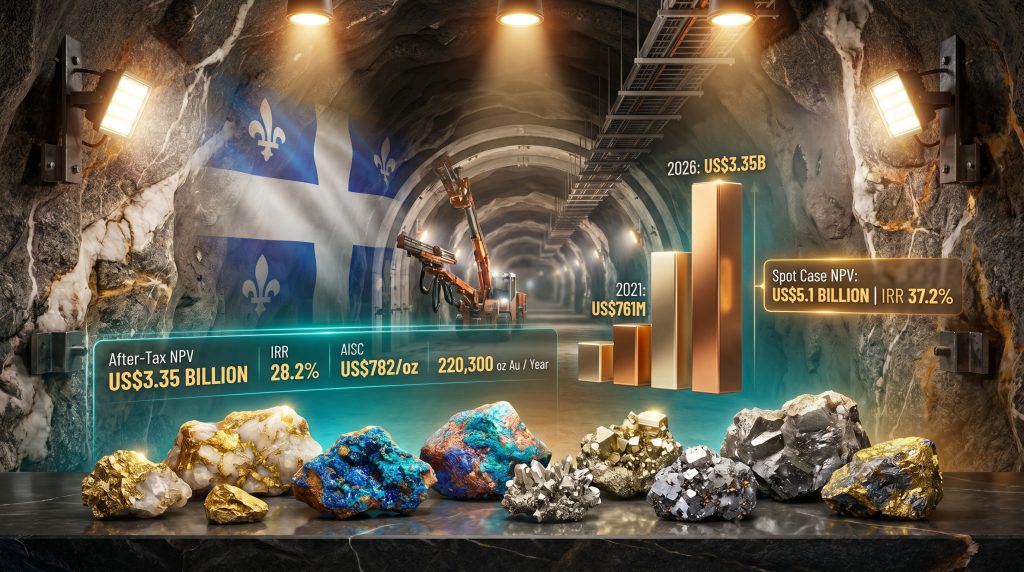
| After-Tax NPV (5% discount) | US$761M | US$3.35 billion | +244% |
| After-Tax IRR | 18.9% | 28.2% | +9.3 percentage points |
| Payback Period | Not disclosed | 3.3 years | — |
| AISC (per oz) | US$587/oz | US$782/oz | +33% |
| Base Case Gold Price | US$1,600/oz | US$3,600/oz | +125% |
| Annual Gold Production | ~220,300 oz | ~220,300 oz | Unchanged |
The 244% NPV expansion is the headline figure, but the stability of the production profile is arguably more instructive. Annual gold production of approximately 220,300 ounces has not changed between studies. This means the operational thesis, the mining method, the processing approach, and the recoveries have all held firm. The financial transformation is purely a function of gold's structural repricing over the intervening five years.
Commodity Price Assumptions Underpinning the Base Case
- Gold: US$3,600/oz
- Silver: US$50/oz
- Copper: US$4.80/lb
- Zinc: US$1.35/lb
Spot-Price Scenario: What Current Markets Imply
| Metric | Base Case | Spot Price Scenario | Uplift |
|---|---|---|---|
| After-Tax NPV | US$3.35 billion | US$5.1 billion | +53% |
| After-Tax IRR | 28.2% | 37.2% | +9.0 percentage points |
| Payback Period | 3.3 years | 2.6 years | -0.7 years |
The spot case uses a gold price of US$4,500/oz, silver at US$75/oz, copper at US$6.40/lb, and zinc at US$1.60/lb. The resulting NPV of US$5.1 billion places Horne 5 in a category typically reserved for large operating mines rather than development-stage assets.
It is worth noting that the base case gold price of US$3,600/oz is itself below prevailing spot levels at the time of the study's release, meaning the base case represents a degree of conservatism rather than an optimistic projection.
Cost Positioning: Why First-Quartile AISC Matters
An all-in sustaining cost of US$782 per ounce places Horne 5 within the first quartile of global gold producers by cost efficiency. For investors unfamiliar with the significance of AISC quartile positioning, this deserves elaboration.
The global gold mining industry spans a cost range of roughly US$600/oz at the low end to well above US$2,000/oz for high-cost operations. The first quartile, generally representing the bottom 25% of producers by cost, tends to remain profitable across all but the most severe gold price downturns. First-quartile producers generate outsized margins during gold price strength and maintain viability during downturns that render higher-cost peers uneconomic.
The increase from US$587/oz in the 2021 study to US$782/oz in 2026 reflects genuine cost inflation across the mining industry in labour, energy, consumables, and materials. This cost escalation is consistent with what has been observed across the broader sector. Crucially, the 2026 AISC still represents first-quartile positioning despite that inflation, because by-product credits from silver, copper, and zinc have also grown substantially in line with commodity price appreciation.
The by-product credit mechanism in polymetallic gold mining is a structural cost reducer that pure gold mines cannot replicate. Every dollar increase in copper and silver prices lowers the net cost per ounce of gold produced, creating a natural inflation hedge embedded in the project's cost structure.
Lifetime Cashflow and the Scale of the Financial Opportunity
- Total after-tax cashflow over the 15-year mine life: US$6.4 billion
- Average annual after-tax cashflow: US$542 million
- Average annual gold production: 220,300 payable ounces
- Initial capital and pre-production expenditure: US$1.75 billion
The US$1.75 billion upfront capital requirement is the most significant financial challenge facing the project at this stage. At that scale, financing typically involves a combination of project debt, equity raising, and potentially streaming or royalty arrangements. Streaming deals, where a precious metals streaming company provides upfront capital in exchange for the right to purchase future production at below-market prices, have become a common financing mechanism for projects of this scale and are particularly well-suited to polymetallic assets with multiple metal revenue streams.
The next major ASX story will hit our subscribers first
Gold Price Sensitivity: The Leverage Embedded in Horne 5
One of the more important analytical frameworks for evaluating Horne 5 is its sensitivity to gold price movements. The project's financial architecture creates a near-linear relationship between gold price changes and NPV outcomes. However, understanding how broadly this leverage compares across gold mining stocks helps contextualise the scale of Horne 5's price sensitivity.
Gold Price Sensitivity Table
| Gold Price Scenario | Estimated After-Tax NPV |
|---|---|
| Base Case (US$3,600/oz) | US$3.35 billion |
| US$3,700/oz | ~US$3.45 billion |
| US$4,100/oz | ~US$3.85 billion |
| Spot Case (US$4,500/oz) | US$5.1 billion |
Each US$100/oz movement in the gold price translates to approximately US$100 million in after-tax NPV, making Horne 5 one of the purest gold price leverage vehicles among development-stage Canadian assets. For investors constructing portfolios with gold price exposure, this sensitivity profile creates a differentiated return characteristic compared to producing miners with established cost bases and hedging programmes.
The Polymetallic Dimension: Beyond Gold
Categorising Horne 5 as a gold project understates the complexity and strategic breadth of what the deposit actually produces. The copper output is particularly significant in the current industrial context. In addition, broader copper market trends reinforce why co-product revenue from base metals is attracting renewed attention from project financiers.
Copper demand is forecast to grow substantially through 2035, driven by electric vehicle manufacturing, grid infrastructure expansion, and renewable energy installations. A project producing copper as a meaningful co-product is effectively participating in two commodity super-cycles simultaneously, one driven by monetary demand for gold and one driven by physical demand from decarbonisation infrastructure.
Silver's dual role as both a monetary reserve asset and an industrial input in solar panel manufacturing and electronics adds further demand complexity. Zinc, while a less prominent commodity in the current cycle, contributes consistent by-product revenue that reduces the effective gold AISC in all price environments.
This multi-metal revenue profile also reduces project-level commodity concentration risk. A project generating meaningful revenue from four distinct metals is inherently more resilient to single-commodity price shocks than a mono-metal operation.
Socioeconomic Contribution: The Fiscal and Employment Case
Projected Socioeconomic Impact
| Impact Category | Projected Figure |
|---|---|
| Direct construction jobs | Up to 900 |
| Permanent operational jobs | ~500 |
| Total taxes and mining duties (lifetime) | More than US$4.4 billion |
| Mine life | 15 years |
A fiscal contribution exceeding US$4.4 billion in taxes and mining duties over the project's life positions Horne 5 as one of the most significant single-asset revenue generators in Québec's mining sector by this measure. The permanent employment base of approximately 500 workers concentrated in the Rouyn-Noranda region represents a material contribution to regional economic stability in a community with deep historical ties to the mining sector.
Falco's leadership has articulated that Horne 5 supports Québec's energy transition and economic decarbonisation objectives through the production of critical and strategic minerals, a framing that aligns with broader provincial resource policy priorities. For further detail on the project's community engagement approach, Falco's official project page outlines the company's socioeconomic commitments in full.
Environmental Authorization: The Final Regulatory Gate
The project is currently advancing through Québec's environmental authorization process. The provincial Ministry of the Environment has indicated that completion of its environmental acceptability analysis is anticipated in Fall 2026, with a ministerial decree expected to follow.
Environmental authorization represents the final major regulatory requirement before construction financing can be formally structured and committed. Québec's environmental review process, governed by the provincial Mining Act and Environment Quality Act, provides a defined pathway that, while thorough, is considered more transparent and predictable than review processes in many other jurisdictions.
For investors, the key risk in this phase is timing rather than outcome. Any extension beyond the Fall 2026 target pushes the 2031 commercial production date, which has a compounding effect on NPV through time-value discounting. Each year of delay at a 5% discount rate reduces the present value of future cashflows meaningfully, even if the underlying economics remain unchanged.
Competitive Positioning Among Canadian Gold Development Peers
How Horne 5 Compares
| Attribute | Horne 5 (Falco Resources) | Typical Canadian Peer |
|---|---|---|
| After-Tax NPV (2026) | US$3.35B to US$5.1B | US$500M to US$2B |
| Annual Gold Production | 220,300 oz | 100,000 to 300,000 oz |
| AISC | US$782/oz | US$900 to US$1,200/oz |
| Mine Life | 15 years | 10 to 20 years |
| Polymetallic By-Products | Yes (Cu, Ag, Zn) | Often single-commodity |
| Jurisdiction | Québec, Canada (Tier 1) | Varies |
The combination of NPV scale, first-quartile cost positioning, polymetallic revenue diversification, and Tier 1 jurisdictional profile creates a differentiated investment proposition. Development-stage projects in equivalent size categories are frequently located in jurisdictions carrying elevated political, permitting, or sovereign risk premiums that Québec simply does not carry.
Key Risks and Catalysts to Monitor
Primary Risk Factors
- Environmental authorization timing: Any delay beyond Fall 2026 pushes the 2031 production target and compresses NPV through discounting
- Capital cost inflation: The US$1.75 billion pre-production estimate carries construction-phase escalation risk, particularly in labour and structural steel
- Gold price reversal: A sustained decline toward US$2,500/oz would materially compress NPV, though first-quartile AISC provides a meaningful buffer
- Financing structure complexity: Securing project finance for a US$1.75 billion development without a major mining company partner requires robust and sustained capital markets conditions
Catalysts That Could Re-Rate the Asset
- Receipt of the final ministerial environmental decree, expected late 2026
- Announcement of a strategic partnership, streaming arrangement, or royalty financing agreement
- Exploration results demonstrating resource expansion beyond the current 15-year mine plan
- Sustained gold price strength keeping NPV above the US$4 billion threshold
Frequently Asked Questions: Falco Horne 5 Gold Project Feasibility Study
What is the Horne 5 project?
Horne 5 is a large-scale underground polymetallic gold project located in Rouyn-Noranda, Québec, Canada, developed by TSX-V-listed Falco Resources Ltd. The deposit hosts over 6.1 million gold-equivalent ounces in reserves and ranks among the largest undeveloped gold-polymetallic systems in North America.
What did the 2026 updated feasibility study establish?
The updated study produced a base case after-tax NPV of US$3.35 billion, representing a 244% increase over the 2021 study, alongside an IRR of 28.2% and a payback period of 3.3 years, using a base gold price of US$3,600/oz. The full feasibility study documentation provides a comprehensive breakdown of the underlying assumptions and technical parameters.
What is Horne 5's all-in sustaining cost?
The 2026 study reports an AISC of US$782 per ounce, placing the project in the first quartile of global gold producers by cost efficiency, supported materially by by-product credits from silver, copper, and zinc.
When is commercial production targeted?
Production is targeted for 2031, subject to receipt of environmental authorization from the Québec government, which is anticipated in late 2026.
What metals does Horne 5 produce alongside gold?
The deposit produces silver, copper, and zinc as significant co-products, contributing to by-product cost reductions and aligning the project with critical mineral supply chains associated with energy transition infrastructure.
What is the project's total lifetime cashflow?
The 2026 study projects US$6.4 billion in total after-tax cashflow over the 15-year mine life, averaging US$542 million annually.
This article is intended for informational purposes only and does not constitute financial or investment advice. Readers should conduct their own due diligence and consult qualified financial advisors before making any investment decisions. Forward-looking statements, financial projections, and NPV estimates are subject to change based on commodity prices, regulatory outcomes, and project development factors. Past performance of comparable assets does not guarantee future results.
Want to Identify the Next Major ASX Mineral Discovery Before the Market Does?
Discovery Alert's proprietary Discovery IQ model delivers real-time alerts on significant ASX mineral discoveries, transforming complex geological and commodity data into actionable investment insights — much like the structural advantages embedded in large-scale polymetallic projects such as Horne 5. Explore historic discoveries and their exceptional market returns, then begin your 14-day free trial to position yourself ahead of the broader market.