July 20, 2026
The Structural Fault Line Beneath India's External Accounts
Every major economy carries a hidden vulnerability that only becomes visible under stress. For India, that vulnerability has a single address: the global crude oil market. The relationship between falling oil prices and India trade deficit dynamics is far more complex than headline numbers suggest. When prices spike, the consequences reverberate across the rupee, inflation, public finances, and GDP growth simultaneously. When prices fall, the relief is real but rarely complete.
When big ASX news breaks, our subscribers know first
India's Oil Import Dependency: A Structural Condition, Not a Cyclical Problem
India imports more than 85% of the crude oil it consumes, placing it among the most energy-import-dependent major economies on the planet. Unlike countries that can partially offset external price shocks through domestic production adjustments, India has virtually no meaningful buffer between global benchmark prices and its external accounts.
This dependency creates a direct transmission mechanism: when crude prices rise, the petroleum import bill expands immediately, widening the merchandise trade deficit almost mechanically. Before the most recent Middle East disruption, approximately half of all Indian crude imports originated from West Asian suppliers, creating a concentrated geographic exposure that amplified the impact of Hormuz-related tensions. Understanding current crude oil prices is therefore essential for assessing India's external account health at any given moment.
The numbers that emerged from May 2026 illustrate how severe this transmission can be:
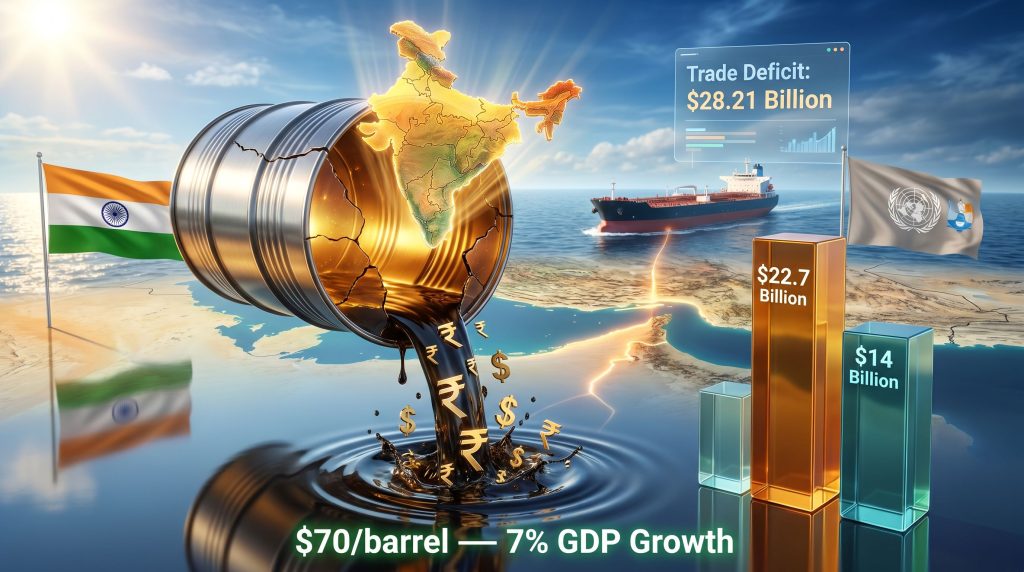
- India's merchandise trade deficit stood at $28.21 billion in May, marginally narrowed from $28.38 billion in April
- Petroleum imports reached $22.7 billion in May alone, compared to just $14 billion in the same month of the prior year, representing a 62% year-on-year surge
- The near-doubling of the petroleum import bill effectively absorbed gains from stronger export performance across other merchandise categories
Key Structural Insight: Petroleum products represent the single largest import category within India's merchandise trade framework. This means crude oil price movements carry a disproportionate influence on the headline deficit that no other import category can replicate or offset.
The Hormuz Factor: How a Chokepoint Became a National Economic Risk
Why the Strait of Hormuz Matters More to India Than Almost Any Other Economy
The Strait of Hormuz is the world's most critical maritime chokepoint for seaborne crude flows, handling a substantial share of global oil exports at any given time. For India, whose refinery infrastructure was built around the consistent availability of Middle Eastern grades, any disruption to Hormuz transit creates simultaneous pressure on both supply volumes and spot prices.
During the recent West Asian conflict period, Indian refiners faced a compounding problem: higher spot prices and constrained supply availability at the same time. This is not simply a pricing event. It is a supply architecture shock that forces refiners to source alternative grades from longer distances at higher freight costs, while also competing against other displaced buyers in a tighter global market. Consequently, the impact on oil markets from such geopolitical disruptions has proven particularly acute for India.
The geopolitical risk premium embedded in benchmark prices during a Hormuz disruption represents a cost that has no domestic policy solution. India cannot drill its way out of this exposure, cannot subsidise its way to price immunity, and cannot hedge the full volume of its import requirements in futures markets without distorting those markets significantly.
The Indian Basket Price and Its Fiscal Significance
India tracks its own reference price known as the Indian Basket, which is a weighted average of the crude grades the country actually imports. This basket price is closely watched by policymakers because it directly determines the foreign exchange outflow associated with petroleum imports each month.
When the Indian Basket price surged during the Hormuz crisis, the fiscal consequences were immediate and multi-layered:
| Metric | Prior Year (May 2025) | May 2026 | Change |
|---|---|---|---|
| Petroleum Imports | ~$14 billion | $22.7 billion | +62% |
| Trade Deficit (April 2026) | N/A | $28.38 billion | Elevated |
| Trade Deficit (May 2026) | N/A | $28.21 billion | Marginally narrowed |
| Indian Basket Crude Price | Baseline | Significantly elevated | Shock-driven |
Why Falling Oil Prices Alone Will Not Fix the Trade Deficit
The Broken Historical Pattern
Conventional macroeconomic logic has long held that lower crude prices automatically compress India's trade deficit. The logic is simple: if oil is cheaper, the import bill contracts, the deficit narrows, the rupee stabilises, and the economy benefits. That relationship held reasonably well across several commodity cycles. Recent data, however, reveals that the connection is far more complicated and potentially breaking down at a structural level.
Critical Insight: India's net petroleum trade position deteriorated in FY27 not solely due to rising import costs, but also because refined petroleum product exports declined sharply even as import volumes continued rising. This decoupling between the import cost story and the export revenue story fundamentally changes the calculus.
The data from recent months tells a revealing story, and the India energy import structure adds a further layer of complexity to how price movements translate into deficit outcomes:
- Refined oil exports fell 22.2% in July before deteriorating further to a 37.6% decline in August
- In August, a $6 per barrel decline in crude prices reduced India's oil import bill to approximately $11 billion, the lowest petroleum import figure in three years
- Yet the overall merchandise trade deficit widened to $29.7 billion in August, because the gains on the import side were more than offset by weakness in refined petroleum exports and a separate softening in gems and jewellery exports
This is the structural trap: India's trade position in petroleum is not just about what it pays to import crude. It is equally about what it earns by exporting refined products. When refinery margins compress or international demand for Indian refined products weakens, falling oil prices provide only partial relief.
Structural vs. Cyclical Deficit Drivers: A Framework for Investors
| Driver Type | Factor | Impact on Deficit |
|---|---|---|
| Cyclical | Crude oil price decline | Reduces import bill temporarily |
| Cyclical | Hormuz reopening | Restores supply, lowers spot premium |
| Structural | Declining refined oil exports | Widens net petroleum trade position |
| Structural | Rising oil import volumes | Increases gross import bill regardless of price |
| Structural | Gems and jewellery export weakness | Widens overall merchandise deficit |
| Forward Risk | CRISIL FY27 Brent forecast: $90-$95/barrel | Materially widens oil trade deficit in medium term |
Furthermore, analysts tracking oil trade geopolitics have noted that structural vulnerabilities in India's export base compound the impact of any cyclical price movements in crude benchmarks.
The U.S.-Iran Diplomatic Framework: Catalyst or Temporary Relief?
What a Hormuz Reopening Would Mean in Practice
A tentative diplomatic agreement between the United States and Iran carries significant implications for Indian energy economics if it holds. The restoration of full Hormuz transit would achieve two simultaneous outcomes: removing the geopolitical risk premium currently embedded in benchmark prices and restoring the supply proximity advantage that Indian refiners historically enjoyed from West Asian crude.
India's Commerce Secretary Rajesh Agrawal indicated publicly that resolution of the West Asian conflict would address a substantial portion of the economic pressures currently facing the country, directly linking geopolitical stability to macroeconomic outcomes. Global Trade Research Initiative founder Ajay Srivastava similarly noted that the diplomatic agreement carries immediate economic relief potential, given how significantly the conflict exposed the depth of India's dependence on West Asian energy supply chains.
Beyond the trade deficit, a sustained oil price decline toward the $70 per barrel range would generate cascading macroeconomic benefits across multiple dimensions:
- Trade deficit compression through a lower petroleum import bill
- Rupee stabilisation as foreign currency demand for oil payments eases
- Consumer price moderation as fuel and transport costs fall through to inflation indices
- Fiscal relief through reduced energy subsidy obligations
- GDP growth acceleration with some analysts suggesting $70 oil could support a return to a 7% annual growth trajectory
According to analysis from Investing.com, falling oil prices could provide meaningful relief to India's trade deficit, though the structural export challenges outlined above mean the benefit will not be automatic or complete.
The Tanker Market as a Leading Indicator
One less commonly observed signal worth tracking is the behaviour of very large crude carrier (VLCC) freight rates. During peak Hormuz uncertainty, VLCC earnings approached extraordinary levels as tanker owners capitalised on rerouting demand and risk premiums. As Hormuz reopening prospects improve and Middle Eastern crude flows normalise, freight rate compression will follow. This provides an additional cost reduction for Indian importers that extends beyond the benchmark price movement alone. Freight cost savings on Middle Eastern routes compared to alternatives like Russian Arctic grades or Brazilian pre-salt crudes are meaningful at scale.
India's Supply Diversification Strategy: Progress, Limits, and Hidden Costs
The Russian Crude Pivot and Its Complexities
India's strategic acceleration toward Russian crude during the Hormuz crisis intensified a trend that had already been building since 2022. Indian state-owned and private refiners absorbed record volumes of discounted Russian grades, exploiting the price differential that sanctions-related complications created. However, while this strategy delivered genuine cost savings, it introduced a new set of structural complexities that deserve serious analytical attention.
| Supply Source | Key Advantage | Primary Limitation |
|---|---|---|
| Russia (Urals/ESPO) | Deep price discounts, high volumes | Sanctions risk, freight costs, payment complexity |
| Venezuela | Discounted heavy crude | Sanctions exposure, infrastructure constraints |
| Brazil (pre-salt) | High quality, Atlantic Basin origin | Longer freight routes, premium pricing |
| Middle East (restored) | Proximity, established infrastructure | Geopolitical concentration risk remains |
- Russian crude payment mechanisms, often settled in non-dollar currencies through intermediary arrangements, introduce settlement risk and banking complexity that add friction costs not fully reflected in the headline price discount
- Venezuelan heavy crude requires specialised refinery configurations; not all Indian refineries are equipped to process it optimally without blending adjustments
- Brazilian pre-salt grades are genuinely high quality but involve substantially longer voyage times, which ties up working capital in transit inventory and increases freight cost per barrel
The oil price shock experience of recent periods has, in addition, accelerated conversations within India about long-term energy security planning and the real costs of reactive supply diversification.
Investor Insight: Geographic supply diversification reduces concentration risk but does not reduce India's fundamental volume dependency on imported oil. The gross import bill remains structurally exposed to global price movements regardless of which supplier provides the barrels.
The next major ASX story will hit our subscribers first
Scenario Pathways for India's Trade Deficit Over the Next 12 Months
Three Trajectories Worth Monitoring
Scenario 1: Sustained Geopolitical Resolution (Base Case Optimistic)
Hormuz remains fully operational, the U.S.-Iran framework holds, and Brent crude stabilises in the $70-$75 per barrel range. India's petroleum import bill contracts meaningfully from May's $22.7 billion level. If export performance in refined products and gems and jewellery recovers concurrently, the trade deficit could narrow toward a $22-$24 billion monthly range. Rupee appreciation pressures ease, inflation moderates, and the 7% GDP growth pathway reopens.
Scenario 2: Partial Relief, Structural Drag Persists (Base Case Neutral)
Oil prices decline modestly but refined product exports remain soft. The trade deficit narrows to a $25-$27 billion range, with improvements on the import cost side partially offset by continued export underperformance. CRISIL's FY27 Brent forecast of $90-$95 per barrel eventually materialises as geopolitical risk premiums re-enter the market, reversing near-term gains.
Scenario 3: Geopolitical Re-escalation (Downside)
Hormuz disruptions resume, oil prices spike above $90 per barrel, and the petroleum import bill re-accelerates beyond May peak levels. Rupee depreciation intensifies, consumer inflation rises, fiscal deficit pressures widen, and the 7% GDP growth target becomes unreachable under sustained energy cost pressure.
Frequently Asked Questions: Falling Oil Prices and India's Trade Deficit
How does a fall in crude oil prices affect India's trade deficit?
When crude oil prices fall, India's monthly petroleum import bill contracts proportionally, because the country sources over 85% of its crude requirements from international markets. A lower import bill reduces total merchandise import value, which mechanically narrows the trade deficit when export performance holds steady or improves. The relationship between falling oil prices and India trade deficit outcomes, however, depends significantly on export revenues as well.
Why did India's trade deficit widen in August despite lower oil prices?
Despite a meaningful crude price decline in August that reduced the petroleum import bill to approximately $11 billion, a three-year low, the overall merchandise trade deficit widened to $29.7 billion. Refined petroleum product exports fell by 37.6%, and gems and jewellery exports weakened, more than offsetting the savings generated on the import side. The Hindu's reporting on related periods similarly highlights how services exports and oil pricing interact within India's broader external account picture.
What crude oil price level would support India's 7% GDP growth target?
Analysts broadly indicate that a sustained crude price environment near $70 per barrel could provide sufficient macroeconomic relief, through lower import costs, rupee stabilisation, and inflation moderation, to support India returning to a 7% annual GDP growth rate.
What is the CRISIL forecast for Brent crude in FY27?
Credit rating and research agency CRISIL has forecast Brent crude in the $90-$95 per barrel range for FY27, suggesting that even if near-term prices decline following Hormuz reopening, the medium-term oil price outlook remains elevated and will continue to exert pressure on India's external accounts.
How significant is India's refined petroleum export decline?
India's refined product exports represent an important revenue offset against its crude import costs. When those exports contract sharply, as occurred with the 37.6% decline recorded in August, the net petroleum trade position deteriorates even when crude import prices are falling. This dynamic is one of the key structural vulnerabilities that simple analysis of falling oil prices and India trade deficit trends frequently overlooks.
Readers seeking additional context on global crude oil price movements and India's energy trade dynamics may find value in exploring the real-time benchmark pricing and analysis available at OilPrice.com, which tracks pricing across more than 150 global crude grades including the Indian Basket price.
Disclaimer: This article is for informational and educational purposes only and does not constitute financial, investment, or economic advice. All forecasts, scenarios, and projections discussed represent analytical frameworks and should not be interpreted as predictions of future outcomes. Readers should conduct their own research before making any financial or economic decisions.
Want to Spot the Next Major ASX Mineral Discovery Before the Market Does?
While India's structural oil dependency shapes macroeconomic outcomes across entire economies, individual investors can position themselves ahead of significant commodity discoveries closer to home — Discovery Alert's proprietary Discovery IQ model delivers real-time ASX mineral discovery alerts, turning complex data across more than 30 commodities into actionable insights, with a 14-day free trial available to experience the service firsthand; or explore the historic returns major discoveries have generated to understand the opportunity at stake.