May 21, 2026
Scenario Analysis: The Shift Toward Faster Energy Permitting in a Changing Policy Landscape
The US House passes bill to expedite permitting has become a pivotal development in reshaping America's energy infrastructure landscape. Investor sentiment and infrastructure development outlooks in the US have consistently been shaped by the timelines, costs, and unpredictabilities tied to federal project permitting. As global energy markets evolve and carbon neutrality goals push for rapid deployment of renewables alongside ongoing oil, gas, and mining extraction, the pressure to streamline permitting has amplified.
Recent legislative efforts address a pivotal macro risk: the mismatch between the pace of energy infrastructure needs and the regulatory hurdles that can lock up billions in capital on decade-long timelines. Furthermore, these developments intersect with broader mining permitting insights that highlight the complexity of regulatory frameworks across multiple sectors.
When big ASX news breaks, our subscribers know first
Key Legislative Moves: What's Driving Federal Permitting Reform?
Streamlining NEPA Reviews Through the SPEED Act
On December 18, 2025, the House passes plan to fast-track energy projects through the SPEED Act (221-196), signalling a major push to accelerate federal environmental reviews. Notably, 11 Democrats joined Republicans, reflecting residual bipartisan concern over permitting bottlenecks—though this fell short of the 30-40 Democratic votes originally targeted.
The SPEED Act zeroes in on the National Environmental Policy Act (NEPA), the main trigger for extended review periods and litigation risk. However, the Trump mining permits order has already influenced how these reforms are being interpreted across various sectors.
It introduces:
- Mandated shorter timelines for federal environmental assessments, reducing agency discretion and accelerating decision cycles
- Judicial review limitations requiring courts to uphold NEPA determinations even if process flaws are identified, reducing post-approval litigation delays
- Federal agency coordination mandates to align inter-departmental workflows and compress sequential review steps
- Permit "certainty" provisions restricting government powers to rescind previously issued approvals—especially to avoid pipeline cancellations akin to Keystone XL
The industry's leading trade group for fossil fuels publicly supported the bill, arguing that existing NEPA timelines had rendered a wide range of projects economically unviable. In addition, recent developments in critical minerals energy security have heightened the urgency for streamlined permitting processes.
Redefining Water Permit Jurisdiction Under the PERMIT Act
While less documented in recent releases, companion proposals such as the PERMIT Act hone in on Clean Water Act reach:
- Excluding ephemeral streams and seasonal arroyos from federal jurisdiction, cutting permitting for dryland and agricultural crossings
- Setting federal exemption for prior-converted cropland and other agriculturally classified lands
- Restricting federal oversight of groundwater features falling outside established surface water boundaries
These changes would primarily benefit pipeline installation, transmission, and mining operations that often stumble over multiple overlapping water permits at the federal and state levels. Consequently, the House passes permitting reform bills that would boost affordable electricity access across multiple sectors.
Cross-Agency Safeguards and Administrative Continuity
A central feature of reforms is the provision that locks in project approvals across administrative transitions. This design intends to counteract scenarios in which a new executive administration can halt, rescind, or retroactively invalidate permits—another response to high-profile pipeline project reversals in the last decade.
Additional points include:
- Limiting discretionary review rollbacks by new federal leadership
- Setting up legal challenge mitigation frameworks, aiming to ensure that once permits are granted, projects can proceed with reduced exposure to reversal risks
- Emphasising ongoing project continuation, even during active reviews or legal disputes, unless flagrant violations are proven
Tackling Infrastructure Bottlenecks: Where the Delays Happen
Project Review Timelines and Litigation Exposure
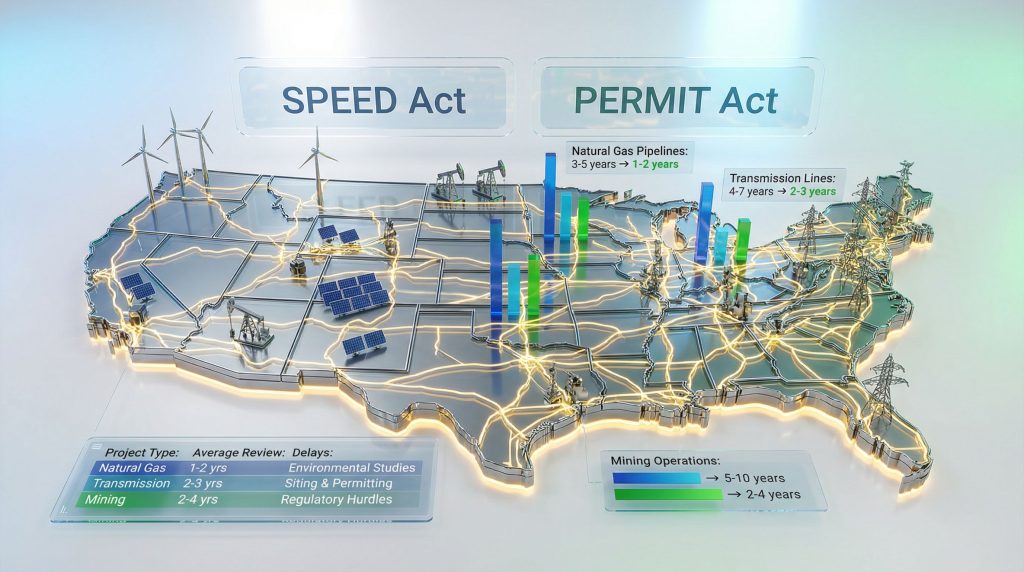
Current federal permitting timelines extend far beyond what most lay observers expect. Complexity multiplies with cross-jurisdictional projects, particularly those involving federal lands, navigable waters, or protected habitats.
| Project Type | Average Review Period | Primary Delay Factors | Litigation Risk Level |
|---|---|---|---|
| Natural Gas Pipelines | 3–5 years | NEPA compliance, water crossings | High |
| Renewable Energy Projects | 2–4 years | Environmental reviews, grid connection | Medium |
| Transmission Lines | 4–7 years | Multi-jurisdictional sign-offs | Very High |
| Mining Operations | 5–10 years | Water/air permits, species protection | High |
Disclaimer: Timelines are industry-wide medians compiled from Federal Energy Regulatory Commission and Government Accountability Office reports, but these figures can vary based on project scope and state-level factors.
Delays typically emerge from:
- Redundant or prolonged environmental assessments
- Fragmented agency approvals that lack defined deadlines
- Heightened court exposure, especially post-NEPA determination
- Permitting processes interrupted by changes in federal administration
Economic and Market Impact of Regulatory Inefficiency
Lengthy timelines create cascading costs:
- Project development costs increase as capital remains tied up longer
- Risk premiums rise as uncertainty for investors or lenders expands, directly impacting financing rates
- Opportunity costs mount as delayed energy supply can mean lost revenue and potential market share to overseas competitors
A Congressional Budget Office study found that each additional year of permitting can add up to $50 million in capitalised interest for a typical interstate pipeline with a $2 billion budget. This directly alters return-on-investment calculations and capital allocation priorities.
Political Realities: Bipartisan Fractures and Legislative Chess
Framework for Early Coalition and Subsequent Fragmentation
Initial drafts of the SPEED Act prioritised "technology neutrality," attracting support across energy sectors and Congressional lines. The expectation of 30–40 Democratic votes fell significantly short, with only 11 crossing over, after amendments excluding offshore wind and solar projects were added to appease conservative factions.
Key factors that built (and then fractured) support:
- Common frustration with project cancellations (e.g., Keystone XL, offshore wind moratoria) created early alignment
- Industry associations for both fossil and clean energy viewed streamlined permitting as critical for market expansion
- Late-stage amendments, influenced by White House directives and conservative demands, explicitly barred expedited reviews for projects previously blocked by the Trump administration since January 20, 2025
This shift led the American Clean Power Association to withdraw support, branding the revision as effectively gutting bipartisan gains. Moreover, the ongoing mining industry evolution continues to shape how these legislative changes are being received across different sectors.
Legislative Path Forward: Senate Dynamics and Probability Modelling
With the bill now in the Senate, overcoming a filibuster requires obtaining at least seven Democratic votes—mandating significant negotiation, particularly around the controversial offshore renewables exclusion. That exclusion, linked to recent construction halts for projects like the 704MW Revolution Wind project off Rhode Island, remains a sticking point for both Democratic senators and clean energy industry lobbyists.
Negotiation avenues might include:
- Reincorporating technology-neutral language for both onshore and offshore projects
- Crafting compromise amendments that grant expedited paths in exchange for enhanced environmental safeguards or stakeholder input
- Sequencing votes to prioritise less contentious sections, with offshore eligibility addressed in future standalone legislation
Disclaimer: Legislative forecasting is inherently speculative. Political alignments and amendment details may shift rapidly as the Senate undertakes review and markup processes.
Sector Implications: What Does Reform Mean for Energy & Mining?
Oil and Gas Pipelines
Expanded certainty provisions substantially reduce the risk of retroactive cancellation—a persistent fear for interstate pipelines and liquefied natural gas facilities. These measures could lower project financing costs as risk premiums shrink and may accelerate timelines for critical infrastructure to reach export and refining hubs.
Renewable Energy Installations
While expedited timelines for onshore wind and solar farms remain, the exclusion of offshore projects from the SPEED Act's streamlined pathways could lead to strategic rebalancing in industry planning. Developers may defer or redirect investments if federal risk exposure remains disproportionately high.
The American Clean Power Association's policy shift underscores the volatility such targeted amendments can introduce for project pipelines, particularly with major assets like Revolution Wind suddenly exposed to renewed federal scrutiny.
Mining and Critical Minerals Extraction
Critical mineral and rare earth ventures—central to energy security ambitions—could benefit from reduced delays, especially for extraction on federal lands. For instance, the Trump critical minerals order has already set the stage for prioritising strategic mineral development, making these permitting reforms particularly relevant.
For mining investors, streamlined water and habitat permitting, and more defined judicial procedures may improve capital allocation by making project returns more predictable.
Technical note: Even with federal reform, state-level permits remain a separate barrier, and coordination gaps may persist unless uniformly addressed.
Regulatory and Institutional Adaptation Challenges
Federal Agency Overhaul Needs
- Rewriting agency handbooks and NEPA guidance
- Implementing new IT systems to monitor compressed timeline compliance
- Enhancing staff training, particularly for complex Environmental Impact Statements
- Scaling interagency task forces to reduce repetitive reviews
Legal and Environmental Law Integration
- Further NEPA regulation revisions to ensure consistency with Clean Water Act and Endangered Species Act rules
- Updated agency coordination protocols to manage overlapping jurisdiction
State, Local, and Tribal Alignment
- Streamlining interfaces between federal approvals and state/local zoning, air/water quality boards
- Ensuring meaningful tribal consultation within new, shorter timeframes
Disclaimer: Reform success is highly dependent on effective agency adaptation and multi-level governance integration. Potential for legal disputes persists if interagency and state-federal processes are not harmonised.
The next major ASX story will hit our subscribers first
Long-Term Policy and Market Implications
Energy Security and Investment Climate
Accelerated permitting is positioned to support US energy and supply chain resilience. By reducing deployment timeline risk for strategic oil, gas, and mineral projects, reforms may encourage greater capital investment, shorten infrastructure delivery, and enhance sectoral independence.
Table: Potential Investment Climate Shifts
| Investment Factor | Status Quo | Post-Reform (Projected) |
|---|---|---|
| Regulatory Uncertainty | High | Lower |
| Project Timeline Clarity | Vague/Variable | Defined/Condensed |
| Infrastructure Valuations | Discounted | Improved |
| Financing Costs | Elevated | Reduced (with certainty) |
Environmental Trade-Offs
Efficiency in permitting will inevitably prompt debate on the adequacy of environmental safeguards. Supporters argue that expediting reviews does not preclude rigorous standards, provided agencies are resourced and oversight mechanisms strong.
Detractors raise concerns that accelerated processes risk missing cumulative or long-term impacts, particularly where administrative continuity overrides environmental litigation.
What Does This Mean for Future Energy Infrastructure?
The US House passes bill to expedite permitting represents more than just procedural reform—it signals a fundamental shift in how America approaches energy infrastructure development. However, the success of these measures depends heavily on implementation and Senate negotiations.
Looking ahead, the intersection of faster permitting with emerging energy technologies could reshape the competitive landscape. Furthermore, the coordination between federal reforms and existing state-level processes will determine whether these changes deliver the promised acceleration.
Conclusion: Navigating Reform and Uncertainty
The passage of the SPEED Act by the US House passes bill to expedite permitting marks a decisive but complex step in the evolution of federal energy permitting.
Critical variables influencing the ultimate outcome:
- Extent of Senate compromise over current amendments, particularly around offshore renewable exclusions
- Institutional capacity of agencies to adapt to new procedures, given resource and expertise constraints
- Harmonisation with state-level and tribal permitting frameworks
- Legal challenges testing the boundaries of permit "certainty" and judicial review limitations
Looking ahead:
Potential next-phase reforms could address residual bottlenecks, particularly in state-federal integration, grid infrastructure, and advanced critical minerals extraction. Consequently, the competitive position of US energy sectors will hinge not only on the speed of permitting but on how regulatory certainty, environmental rigour, and technological neutrality are balanced as this legislative push proceeds.
Disclaimer: The analysis presented above reflects the current state of legislative debate and may evolve pending Senate amendments or subsequent legal review. For further detail, consult resources from the Federal Energy Regulatory Commission and the Council on Environmental Quality for ongoing updates on regulatory protocols and infrastructure permitting guidance.
Further Exploration:
For those wishing to understand more about the evolving landscape of federal permitting, consult references from the Federal Energy Regulatory Commission (FERC) and the Council on Environmental Quality. These offer extensive insights into NEPA procedures, Clean Water Act implementation, and the broader regulatory mechanisms affecting energy and mineral infrastructure in the United States.
Ready to Capitalise on Mining Discoveries Before Major Policy Shifts Impact Markets?
Discovery Alert's proprietary Discovery IQ model delivers real-time alerts on significant ASX mineral discoveries, instantly empowering subscribers to identify actionable opportunities ahead of broader market awareness of regulatory and policy changes. Begin your 30-day free trial today at Discovery Alert and secure your market-leading advantage in an evolving energy landscape.