June 11, 2026
How Fault Convergence Systems Transform Precious Metal Exploration
The convergence of geological fault systems represents one of the most powerful mechanisms for concentrating precious metals in epithermal deposits. When multiple fault networks intersect beneath the earth's surface, they create zones of enhanced permeability that act as conduits for mineralising fluids, resulting in the formation of high-grade precious metal deposits that can fundamentally alter mining economics.
Understanding these structural intersections requires detailed analysis of fault architecture and hydrothermal fluid flow patterns. At the structural intersection at Hycroft mine, recent drilling has demonstrated how fault convergence can produce exceptional mineralisation, with intercepts measuring 53.37 metres at 304.14 grams per tonne silver and 1.33 grams per tonne gold, establishing gold equivalent grades of 4.86 grams per tonne.
Primary Fault Architecture in Epithermal Systems
The geometry of fault systems controls the distribution and intensity of precious metal mineralisation through several key mechanisms. Furthermore, understanding these structural controls is essential for recognising mineral exploration importance in epithermal systems.
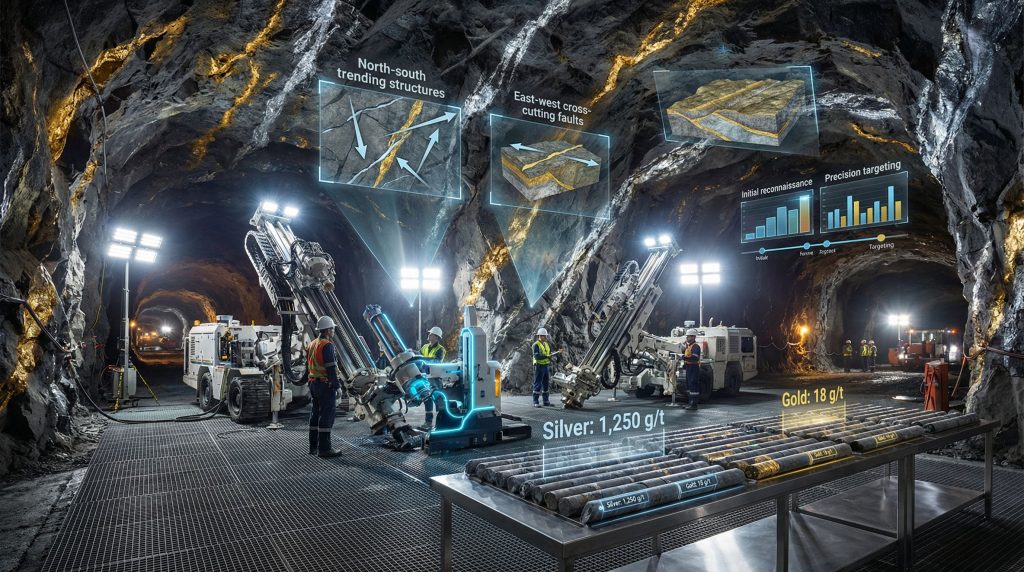
• North-south trending structures establish regional fluid flow corridors
• East-west cross-cutting faults generate localised high-grade concentrations
• Horst-graben configurations form structural traps for ore-bearing fluids
• Breccia zones develop at intersection points with exceptional grade potential
The structural intersection at Hycroft mine exemplifies this architecture, where the Break Fault and Albert Fault converge to create a zone of concentrated mineralisation. Within the broader high-grade interval, a 7.04-metre sub-interval returned 1,241.97 grams per tonne silver and 6.59 grams per tonne gold, demonstrating the nested grade distribution characteristic of fault intersections.
Hydrothermal Fluid Pathway Mechanics
Fault intersections create preferential pathways for mineralising fluids through enhanced fracture connectivity and increased permeability. Consequently, the convergence of multiple fault systems generates complex three-dimensional networks that focus hydrothermal circulation, leading to:
• Enhanced permeability at convergence zones
• Multiple mineralising events in overlapping systems
• Concentrated precious metal deposition in structural traps
• Formation of bonanza-grade zones within broader mineralised intervals
The most concentrated zone at the structural intersection at Hycroft mine measured 0.88 metres and recorded exceptional bonanza-grade mineralisation of 2,890 grams per tonne silver and 33.70 grams per tonne gold, representing 67.26 grams per tonne gold equivalent. This extreme concentration demonstrates the focusing effect of structural intersections on ore-forming processes.
When big ASX news breaks, our subscribers know first
The Critical Role of Extended Core Logging Programs
Modern exploration success increasingly depends on systematic geological analysis conducted over multi-year timeframes. Extended core logging programs provide the detailed structural understanding necessary for precision targeting of fault intersections, transforming exploration from broad reconnaissance to focused discovery drilling.
Methodical Geological Model Development
The refinement of geological models through extended core logging follows a systematic progression that builds understanding incrementally. In addition, 3D geological modelling plays a crucial role in visualising these complex structural relationships. Hycroft's two-year core logging program directly preceded the discovery of exceptional grades at the structural intersection at Hycroft mine, demonstrating the causal relationship between systematic analysis and exploration success.
Core Logging Timeline Benefits:
| Duration | Geological Understanding | Targeting Precision | Discovery Potential |
|---|---|---|---|
| 6 months | Basic structure | Low | Limited |
| 1 year | Refined model | Moderate | Emerging |
| 2+ years | Comprehensive system | High | Exceptional |
Structural Model Evolution Process
The progression from initial exploration to refined targeting follows a predictable sequence that builds geological confidence through systematic data collection:
- Initial reconnaissance establishing broad geological framework
- Core logging integration providing detailed structural analysis
- Model refinement updating geological interpretations
- Precision targeting enabling high-confidence drill programmes
This methodical approach at the structural intersection at Hycroft mine culminated in successful targeting of the Break and Albert Fault convergence, resulting in the discovery of a 48.25-metre interval grading 4.21 grams per tonne silver and 0.50 grams per tonne gold from shallow depths, indicating broad mineralisation distribution beyond the primary structural intersection zone.
Grade Characteristics That Define Exceptional Discoveries
The classification of precious metal grades provides essential benchmarks for evaluating discovery significance and economic potential. However, interpreting drill results requires understanding industry standards and classification systems to properly assess exploration outcomes.
Silver Grade Classifications
Silver mineralisation exhibits wide grade variations across different deposit types and geological settings:
• Commercial grade: 100-300 g/t establishing basic economic thresholds
• High-grade: 500-1,000 g/t exceeding typical commercial standards
• Exceptional grade: 1,000+ g/t representing superior mineralisation
• Bonanza grade: 2,000+ g/t indicating extreme concentration
The structural intersection at Hycroft mine demonstrates all these classifications within a single drill hole. The 53.37-metre primary interval averaging 304.14 grams per tonne silver establishes exceptional-grade mineralisation across substantial width, while the 7.04-metre sub-interval at 1,241.97 grams per tonne silver crosses into bonanza-grade territory.
Gold Grade Classifications
Gold mineralisation follows similar hierarchical classifications, though absolute grade thresholds differ substantially from silver:
• Commercial grade: 1-3 g/t providing basic economic viability
• High-grade: 5-10 g/t exceeding standard commercial thresholds
• Exceptional grade: 15+ g/t representing superior concentration
• Bonanza grade: 30+ g/t indicating extreme enrichment
The 0.88-metre best interval at the structural intersection at Hycroft mine grading 33.70 grams per tonne gold exemplifies bonanza-grade gold mineralisation, while the broader intervals demonstrate commercial to high-grade gold distribution across significant widths.
Mineralisation Continuity Factors
Successful structural intersections demonstrate consistent characteristics that support long-term economic extraction:
• Consistent grade distribution across intersection zones
• Multiple depth horizons with economic mineralisation
• Strike length potential extending beyond initial discovery
• Down-dip continuity supporting sustained extraction
Important Disclaimer: Precious metal exploration involves substantial risks including geological uncertainty, technical challenges, and commodity price volatility. Past exploration results do not guarantee future performance or economic viability of mining operations.
Intermediate Sulfidation Systems and Economic Deposit Formation
Intermediate sulfidation epithermal systems represent a specific class of hydrothermal deposits that form under particular geological and geochemical conditions. These systems frequently host the most economically significant precious metal deposits in volcanic arc environments worldwide.
Geological Environment Characteristics
Intermediate sulfidation systems develop within well-defined geological settings that control both deposit formation and subsequent exploration targeting. Understanding mineral deposit tiers helps classify these systems within broader geological frameworks:
• Volcanic arc environments providing active hydrothermal circulation
• Fault-controlled fluid flow creating focused mineralisation
• Breccia and vein systems hosting precious metal concentrations
• Multiple mineralising events enhancing grade distribution
The Hycroft Mine operates within this geological framework in northern Nevada, where Tertiary volcanic rocks host numerous epithermal precious metal deposits. The structural intersection at Hycroft mine occurs within this established mineralised system, where fault convergence has concentrated ore-forming fluids.
Deposit Formation Mechanisms
The formation of intermediate sulfidation deposits follows predictable geochemical and structural processes:
- Hydrothermal fluid generation from deep magmatic sources
- Structural focusing through fault intersection zones
- Precipitation processes depositing precious metals
- Multiple fluid pulses creating overlapping mineralisation
This process explains the nested grade distribution observed at the structural intersection at Hycroft mine, where multiple mineralising events have created bonanza-grade zones within broader high-grade envelopes.
Operational Advantages of Structural Discoveries
Structural intersections provide significant operational benefits that extend beyond simple grade considerations. The predictable nature of fault-controlled mineralisation enables more efficient mine planning, processing optimisation, and resource development strategies.
Underground Mining Optimisation
Concentrated ore zones at structural intersections offer multiple operational advantages:
• Concentrated ore zones reducing mining costs per ounce
• Predictable mineralisation supporting accurate mine planning
• High-grade continuity improving extraction economics
• Multiple mining horizons extending operational mine life
Processing Considerations for Sulfide Mineralisation
The transition from oxide heap leach operations to sulfide processing represents a critical technical and economic evolution for many epithermal systems:
Processing Method Comparison:
| Method | Oxide Ores | Sulfide Ores | Capital Requirements | Recovery Rates |
|---|---|---|---|---|
| Heap Leach | Excellent | Poor | Low | 60-80% |
| Conventional Milling | Good | Excellent | High | 85-95% |
| Combined Approach | Optimal | Optimal | Moderate | 80-90% |
The structural intersection at Hycroft mine occurs within sulfide-dominated mineralisation zones, requiring processing technology advancement beyond traditional heap leach methods to optimise precious metal recovery from high-grade sulfide ores.
Transition Planning from Oxide to Sulfide Processing
The evolution from heap leach to milling operations requires systematic planning across multiple technical domains:
• Metallurgical testing of sulfide mineralisation characteristics
• Process design optimisation for complex ore types
• Capital investment planning for mill construction
• Operational integration with existing infrastructure
Scaling Exploration Programs for District-Level Discoveries
Successful structural discoveries warrant systematic expansion of exploration programmes to fully evaluate district-scale potential. For instance, drilling programs in exploration require strategic scaling to maximise discovery potential whilst managing operational costs effectively.
Drill Programme Expansion Strategies
Effective expansion of drilling programmes follows systematic approaches designed to optimise both geological understanding and resource definition:
• Additional drilling rigs for accelerated delineation
• Step-out drilling to test strike extensions
• Depth testing to evaluate down-dip potential
• Infill drilling to define grade continuity
Hycroft has announced the deployment of two additional core rigs to accelerate exploration at the structural intersection at Hycroft mine and surrounding targets, demonstrating the systematic approach to discovery expansion.
Resource Definition Methodology
Progressive resource development follows established industry protocols that build geological confidence through systematic drilling:
- Initial discovery with high-grade intersections
- Systematic delineation through grid drilling
- Resource estimation using geological modelling
- Reserve conversion through detailed feasibility studies
Financial Requirements for Sustained Exploration
Large-scale exploration programmes require substantial financial resources and strategic planning:
• Substantial cash reserves for multi-year drilling campaigns
• Debt-free balance sheets providing operational flexibility
• Strategic partnerships for technical expertise
• Market timing for optimal funding conditions
Hycroft's financial position with approximately US$189 million in unrestricted cash and no debt provides the foundation for sustained exploration expansion following the success at the structural intersection at Hycroft mine.
The next major ASX story will hit our subscribers first
Technical Studies Supporting Operational Transitions
Comprehensive technical evaluations provide the foundation for advancing discoveries from exploration through development to production. These studies integrate geological, engineering, metallurgical, and economic analyses to establish project viability.
Feasibility Study Components
Technical evaluations for epithermal systems require integration across multiple disciplines:
• Geological modelling with detailed structural interpretations
• Metallurgical testing for processing optimisation
• Mining engineering for extraction planning
• Environmental assessments for regulatory compliance
Processing Technology Selection
Processing technology decisions depend on ore characteristics and economic considerations:
Key Decision Factors:
• Ore mineralogy and grade distribution patterns
• Capital and operating cost considerations
• Environmental impact assessments and mitigation
• Market timing and long-term commodity price projections
Infrastructure Development Requirements
Transitioning to milling operations necessitates substantial infrastructure development:
• Power supply systems for increased energy demands
• Water management infrastructure for processing operations
• Tailings facilities for environmentally compliant waste storage
• Transportation infrastructure for concentrate delivery
Market Dynamics and Discovery Development
Current precious metals market conditions significantly influence the timing and approach to discovery development. Understanding these dynamics enables more effective strategic planning for advancing structural discoveries through development phases.
Precious Metals Market Dynamics
Several factors currently support development of high-grade precious metal discoveries:
• Gold price stability supporting robust project economics
• Silver industrial demand driving long-term fundamental strength
• Investment sentiment favouring precious metals exposure
• Geopolitical factors enhancing safe-haven metal demand
Investment Timing Considerations
Optimal development windows depend on multiple market and technical factors:
Favourable Development Conditions:
• Strong commodity price environments
• Favourable regulatory and permitting conditions
• Available capital markets for project financing
• Technical team availability and expertise
Risk Management in Discovery Development
Development of structural discoveries involves managing multiple risk categories:
Primary Risk Categories:
• Geological risk: Resource continuity and grade uncertainty
• Technical risk: Processing complexity and metallurgical challenges
• Financial risk: Capital requirement escalation
• Regulatory risk: Permitting delays or regulatory changes
Future Exploration Potential in Established Districts
Mature mining districts often provide exceptional exploration potential through the combination of geological understanding, existing infrastructure, and proven mineralisation systems. The structural intersection at Hycroft mine exemplifies how systematic exploration in established districts can yield exceptional discoveries.
District-Scale Opportunity Assessment
Established mining districts offer continued exploration potential through several key advantages:
• Advanced geological understanding from extensive historical data
• Proven mineralisation systems with documented expansion potential
• Existing infrastructure reducing development costs substantially
• Regulatory familiarity streamlining permitting processes
Technology Applications in Modern Exploration
Advanced exploration techniques enhance discovery potential in mature districts:
Modern Exploration Technologies:
• 3D geological modelling for precise structural interpretation
• Advanced geophysical surveys for subsurface mapping
• Geochemical analysis for alteration zone identification
• Remote sensing technology for regional target generation
Long-Term Development Scenarios
Multiple development pathways exist for advancing structural discoveries:
Potential Development Strategies:
- Incremental expansion of existing operational infrastructure
- New discovery integration with current processing facilities
- District consolidation through strategic acquisitions
- Technology advancement improving extraction economics
The success at the structural intersection at Hycroft mine demonstrates how systematic geological analysis and precision targeting can unlock exceptional value in established mining districts. Furthermore, exceptional drill results like these validate the structural targeting approach and establish the foundation for continued district-scale exploration.
Investment Disclaimer: This article discusses exploration results and geological interpretations that involve inherent uncertainties. Readers should conduct independent research and consult qualified professionals before making investment decisions. Exploration results do not guarantee economic viability or future mining success.
Ready to Discover the Next High-Grade Structural Intersection?
Discovery Alert's proprietary Discovery IQ model provides instant notifications on significant ASX mineral discoveries, empowering subscribers to identify actionable opportunities ahead of the broader market. Understand why major mineral discoveries can lead to substantial returns by exploring Discovery Alert's dedicated discoveries page, showcasing historic examples of exceptional outcomes, and begin your 14-day free trial today to position yourself ahead of the market.