June 10, 2026
The Geological Clock Ticking Inside the World's Nickel Powerhouse
Few commodity markets are as vulnerable to subsurface geology as nickel. Unlike copper or gold, where grade dilution is a gradual, manageable process, nickel laterite deposits carry a structural trap: the richest material sits closest to the surface, and once it is gone, everything beneath it is fundamentally different in chemistry, processing requirements, and economic value. Indonesia built its nickel dominance on the upper saprolite horizon, and Indonesia nickel ore grade decline and quotas are now among the most consequential structural forces shaping global supply. That horizon is, in many places, exhausted.
Understanding what this means for global supply requires moving beyond quota headlines and into the physical reality of what is actually being pulled from the ground.
When big ASX news breaks, our subscribers know first
What the Grade Numbers Are Actually Telling the Market
Beyond Tonnage: Ore Grade as the True Supply Metric
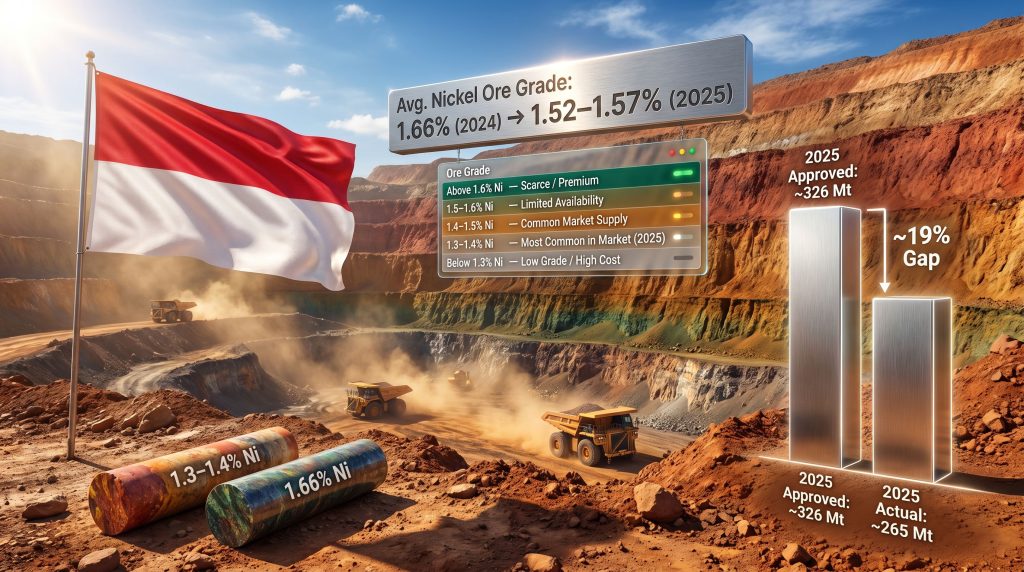
Market commentary on Indonesian nickel tends to fixate on approved production volumes, treating quota announcements as the primary supply signal. This framing misses the more consequential shift happening at the extraction face. Average nickel ore grades in Indonesia have fallen from approximately 1.66% in 2024 to a range of 1.52–1.57% in 2025, representing a contraction of roughly 7–10% within a single year. That is not a rounding error or a statistical artefact. It is a structural signal.
The practical consequence of grade compression is multiplicative across the value chain. Lower ore grades require more material to be mined, crushed, transported, and processed per unit of contained nickel. Each step in that chain carries a cost, and those costs compound. Furthermore, a 10% grade decline does not produce a 10% cost increase; it produces a wider margin squeeze across mining, logistics, and processing simultaneously.
Field-level intelligence from traders and producers active in the Indonesian nickel market trends now points to a striking commercial reality: material trading above 1.4% nickel is increasingly difficult to source in meaningful volumes, with the bulk of actively traded ore sitting in the 1.3–1.4% range. This is not a temporary tightness driven by seasonal factors. It reflects the progressive exhaustion of accessible high-grade saprolite across Sulawesi, Halmahera, and the Maluku region.
The Saprolite-to-Limonite Geological Transition
Indonesia's nickel laterite profile consists of two chemically distinct horizons. The upper saprolite layer carries higher nickel concentrations and has historically been the preferred feedstock for Rotary Kiln Electric Furnace (RKEF) and Nickel Pig Iron (NPI) processing. The lower limonite horizon carries less nickel per tonne but is better suited to High-Pressure Acid Leach (HPAL) processing, which produces battery-grade nickel sulphate.
The industry is now in the early stages of a forced geological migration. As saprolite resources thin out across key producing regions, miners are moving progressively deeper into limonite-dominant material. This transition is not merely a grade issue; it is a processing pathway issue that requires entirely different capital infrastructure, reagent inputs, and water management systems.
The table below illustrates how ore grade availability has stratified in the current Indonesian market:
| Ore Grade Band | Market Availability (2025) | Processing Suitability |
|---|---|---|
| Above 1.6% Ni | Scarce / Commands premium | RKEF / NPI |
| 1.4–1.6% Ni | Limited supply | RKEF (marginal economics) |
| 1.3–1.4% Ni | Most prevalent in market | HPAL / blended feed |
| Below 1.3% Ni | Increasing share | HPAL / limonite circuit |
One of the more striking consequences of this grade compression is that Philippine ore, which was historically dismissed as low-grade material unworthy of serious commercial attention, is now sitting at or above the quality threshold of much Indonesian supply. This shift is directly responsible for the recent uptick in Philippine export volumes, as buyers seek to blend or substitute Indonesian material with ore that was previously considered marginal.
S&P Global has reported that Indonesian processors have themselves begun importing ore from neighbouring countries to compensate for domestic grade shortfalls — an extraordinary reversal for a nation that holds the world's largest nickel resource base. For further context on Indonesia's nickel industry challenges, this reversal represents a pivotal shift in the country's resource narrative.
How Indonesia's Quota System Works and Why the Numbers Are Misleading
Understanding the RKAB Framework
Indonesia manages nickel extraction through a system known as RKAB, or Rencana Kerja dan Anggaran Biaya, which translates broadly as the Annual Work Plan and Budget framework. Under this structure, the Ministry of Energy and Mineral Resources issues annual production ceilings to individual mining operations, setting the maximum volume of ore each site may legally extract and sell within a given year. Benchmark Minerals has reported that Indonesia's 2026 quota announcements are significantly lower than prior years, reinforcing the structural tightening underway.
The critical analytical error made by many market participants is treating approved quota as equivalent to realised production. This is not how the system has functioned in practice:
- Indonesia's 2025 approved quota was approximately 326 million tonnes
- Estimated actual output for the same period was closer to 265 million tonnes
- This represents a utilisation rate of roughly 81%, meaning nearly one-fifth of approved supply never materialised
This gap between approval and execution is a persistent structural feature of the RKAB system, not an anomaly. It arises from a combination of factors including infrastructure constraints, weather disruptions, mine-level compliance issues, and the kind of quota negotiation dynamics visible in the situation involving Weda Bay, which ceased mining operations after exhausting its allocation and faced a multi-million dollar regulatory fine that reportedly needs to be resolved before additional quota becomes available.
What a 250 Million Tonne Ceiling Would Actually Mean
Discussion around Indonesia's 2026 production quota has centred on a figure of approximately 250 million tonnes, representing a meaningful reduction from both the 2025 approved ceiling and actual realised output. On paper, modelling suggests this could remove up to 700,000 tonnes of contained nickel from global supply. However, nickel price momentum analysis suggests that two critical variables must be applied before accepting that number at face value.
- Grade adjustment: If the ore subject to curtailment is already trading at 1.3–1.4% nickel rather than the historical 1.6%+ benchmark, the contained nickel per tonne is proportionally lower, shrinking the real supply impact below the headline figure.
- Utilisation discount: Applying the historical ~81% utilisation rate to a 250 million tonne ceiling suggests effective supply may land closer to 200–205 million tonnes, which changes the supply calculus significantly.
Quota headlines should always be adjusted for both realised utilisation rates and prevailing ore grades before drawing supply conclusions. The convergence of these two discounts means the effective supply tightening may be less dramatic than headline numbers imply, while the grade-driven cost inflation may be more severe.
| Year | Approved Quota (Mt) | Estimated Actual Output (Mt) | Utilisation Rate |
|---|---|---|---|
| 2025 | ~326 | ~265 | ~81% |
| 2026 (proposed) | ~250 | TBD | TBD |
Indonesia's Supply Management Strategy: Price Support Meets Resource Conservation
The Dual Mandate Driving Policy Decisions
Indonesian nickel policy is operating under two intersecting imperatives that are reinforcing each other in the current environment.
The first is price support. Market analysis suggests that Indonesian quota management is implicitly oriented around maintaining nickel prices within an approximate range of $18,000–$21,000 per tonne. This band is high enough to sustain domestic processing margins without incentivising aggressive supply expansion from competing jurisdictions. When prices drift toward the lower boundary of this range, the government has tools to manage the pace of quota allocation without formal intervention.
The second is resource conservation. With grade depletion accelerating, Indonesia's policymakers face an emerging reality: the ore that remains is not the ore that built the country's nickel dominance. Managing extraction pace is increasingly about extending the productive life of what is left, rather than purely maximising near-term revenue.
Cost pressures are also tightening from below. Sulphur, a key processing reagent in nickel refining, has seen incremental price increases that squeeze smelter margins. The economic paradox of the current situation is that while nickel prices are running $4,000–$5,000 per tonne higher than recent lows, much of that value is being absorbed by miners at the ore price level, with the broader processing and refining chain extracting relatively thin margins.
The Sovereign Wealth Routing Mechanism
Indonesia has moved to channel nickel and other commodity transactions through a state-aligned sovereign wealth structure. The primary objective appears to be transaction visibility and tax revenue assurance, particularly targeting offshore-domiciled processing operations, many of which are Chinese-affiliated, where revenue leakage through intercompany transfer pricing has been a concern.
This mechanism is less a tool for direct price control than it is a fiscal monitoring instrument. However, the insertion of any large government intermediary into commercial transaction flows introduces friction, compliance complexity, and potential market distortions. Foreign-owned processing entities with complex offshore structures will face materially increased scrutiny and operating complexity under this framework.
The broader fiscal context matters here. Indonesia has faced periodic currency pressure and sovereign financing constraints, creating a structural incentive to extract maximum value from natural resource sectors. Consequently, when balance of payments pressures emerge, royalty optimisation and revenue transparency become government priorities, not optional policy enhancements. Indonesia's 2026 policy tightening has, in effect, repriced the entire nickel cost map, according to analysts at Crux Investor.
Global Market Responses and the Philippines Buffer
How Nickel Prices Are Absorbing the Grade Signal
Despite significant volatility across the base metals complex, nickel has demonstrated relative resilience, holding near the lower boundary of its established trading range. Notably, NPI and stainless steel intermediate prices have shown greater stability than London Metal Exchange spot prices, suggesting that downstream processors are currently absorbing grade-related cost increases rather than passing them through to end consumers.
The Philippines is providing a seasonal supply buffer, with peak shipping windows typically occurring mid-year when weather conditions permit higher export volumes. As Indonesian ore grades compress toward and below the 1.4% threshold, Philippine ore has moved from marginal status to commercially competitive material. This is a meaningful repositioning, but it carries important limits:
- The Philippines lacks the resource scale to substitute for Indonesian supply over a multi-year horizon
- Philippine export volumes are seasonal and weather-dependent
- The grade profile of Philippine ore, whilst now competitive, is not dramatically superior to the lowest-tier Indonesian material
- Infrastructure and logistics depth in Philippine mining regions is more constrained than in Indonesia
The Philippines should therefore be understood as a complementary supply source providing near-term blending optionality, not a structural replacement for Indonesian volume.
Rising M&A Interest in Non-Indonesian Nickel Assets
What the Deal Activity Signals
The combination of Indonesian grade deterioration, quota uncertainty, and sovereign intervention is redirecting strategic capital toward nickel assets outside Indonesia. Recent M&A activity in the nickel junior and mid-tier space has included a Hong Kong-based group reportedly evaluating an acquisition of an advanced laterite development project, and a separate transaction in Madagascar where a Korean-held stake in a major laterite operation attracted a strategic buyer with Chinese-affiliated interests.
The underlying investment thesis is straightforward: as Indonesian supply becomes less predictable, more costly, and subject to increasing policy friction, high-grade, well-advanced projects in stable jurisdictions carry a scarcity premium that was not present during the period of abundant Indonesian ore availability. In addition, the diversification of global lithium reserves has demonstrated how strategic buyers respond when dominant supply sources face structural constraints — a pattern now repeating itself in nickel.
It is important to advance projects as far as possible toward construction-readiness, since the more capital invested and technical de-risking completed, the more expensive it becomes for strategic acquirers to justify waiting, ultimately forcing a market bid.
Why Non-Indonesian Assets Cannot Replace Indonesian Scale
The M&A activity should not be misread as a structural market rebalancing. Indonesia remains the dominant global nickel resource base by a substantial margin, and laterite deposits in other jurisdictions generally offer:
- Lower average grades than Indonesia's historical saprolite resources
- Smaller resource scales that cannot match Indonesian throughput capacity
- Higher per-unit extraction and processing costs due to less favourable deposit geometries
- Less developed supporting infrastructure
Non-Indonesian nickel M&A is best understood as supply diversification and optionality acquisition. It is not, and cannot be in the foreseeable future, a structural offset to Indonesian supply dynamics at scale. Indonesia remains, in geological terms, the Saudi Arabia of nickel resources.
The Scenario Where Indonesian Grades Fall Below 1.3%
If the downward grade trend continues at its current trajectory, average traded ore could approach the 1.2–1.3% range within two to three years. The consequences of crossing that threshold would cascade through the supply chain:
- RKEF and NPI economics deteriorate to the point where capacity rationalisation becomes likely
- HPAL becomes the dominant processing pathway, requiring substantial new capital investment
- The effective nickel content of each quota tonne falls further, making headline quota figures even less meaningful as supply proxies
- Import demand for Philippine, Papua New Guinean, and potentially New Caledonian ore intensifies significantly
- The cost floor for Indonesian nickel production shifts structurally higher, providing a firmer price support mechanism than any quota policy could deliver
The next major ASX story will hit our subscribers first
Key Questions for Investors and Industry Participants
What Does Grade Decline Mean for Production Costs?
Processing lower-grade ore requires proportionally more energy, reagents, water, and tailings management capacity per unit of finished nickel. A mine producing at 1.3% nickel must handle roughly 24% more ore tonnage to deliver the same contained metal as one operating at 1.66%. That differential flows directly into operating cost per tonne of nickel produced, structurally raising the industry cost floor. Understanding the full scope of nickel uses and importance helps contextualise why this cost escalation carries downstream consequences across stainless steel, batteries, and defence applications.
Why the Quota Utilisation Gap Matters to Forecasting
Analysts anchoring supply models to approved quota figures will systematically overestimate available supply. A 250 million tonne approved ceiling, adjusted for historical utilisation rates of approximately 81%, implies effective output closer to 200 million tonnes. Grade-adjusting that figure further reduces the contained nickel estimate. Both adjustments need to be applied simultaneously to generate credible supply forecasts.
What the Sovereign Wealth Mechanism Means for Foreign Operators
Offshore-domiciled processing operations, particularly those structured to minimise Indonesian tax exposure through intercompany arrangements, face the most significant compliance exposure under the new routing framework. The mechanism is designed specifically to intercept revenue flows that have historically bypassed Indonesian sovereign accounts, and its implementation will increase operational complexity for any entity with non-transparent transaction structures.
Structural Forces Converging on a Tighter Market
The nickel market's medium-term supply picture is shaped by the convergence of two independent forces operating simultaneously. Indonesia nickel ore grade decline and quotas represent, respectively, a geological reality and a policy overlay — one that will continue regardless of what quota policy dictates, and one that amplifies the structural constraint already in motion.
Together, these forces create a dual compression on effective nickel supply that headline tonnage approvals obscure rather than illuminate. Downstream processors, battery manufacturers, and stainless steel producers who model supply based on approved quota volumes alone are building their forecasts on a foundation that does not reflect physical market reality.
The nickel market that emerges through the 2025–2028 horizon is likely to be structurally tighter, higher cost, and more geographically diversified in its sourcing than the market of the preceding decade. Furthermore, Indonesia nickel ore grade decline and quotas will remain the central analytical lens through which credible supply forecasting must operate. Grade-adjusted supply analysis, rather than quota headline tracking, is the framework that will correctly anticipate that transition.
This article contains forward-looking analysis based on current market data, geological assessments, and publicly available production figures. Commodity markets are subject to significant uncertainty, and nothing in this article should be construed as financial or investment advice. Readers should conduct independent research and consult qualified advisers before making investment decisions.
Want To Stay Ahead of the Next Major Nickel Discovery on the ASX?
As Indonesian ore grades compress and global nickel supply tightens, the window to act on significant ASX mineral discoveries is narrowing — Discovery Alert's proprietary Discovery IQ model delivers real-time alerts the moment a major discovery hits the exchange, turning complex geological data into actionable opportunities. Explore how historic mineral discoveries have generated substantial returns on Discovery Alert's dedicated discoveries page, and begin your 14-day free trial today to position yourself ahead of the market.