
June 9, 2026
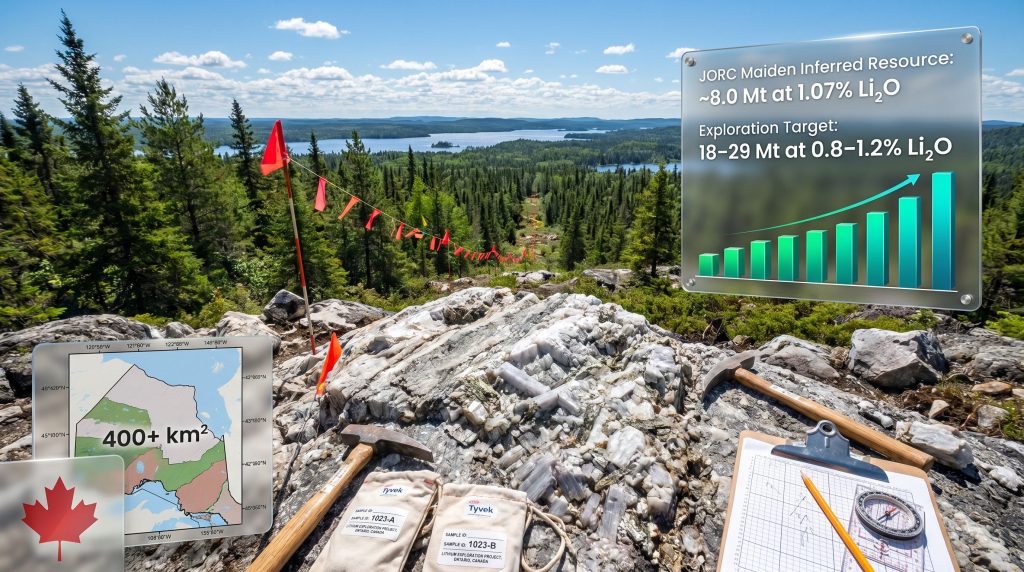
Why Hard-Rock Lithium Geology Is More Complex Than Most Investors Realise
The geology that governs where lithium accumulates in the Earth's crust is rarely discussed in mainstream coverage of battery metals investing. Most attention falls on commodity prices, project timelines, and capital raises. Yet the mineralogical system underlying a lithium deposit determines almost everything that follows: how reliably grades hold across a tenement, whether processing will be straightforward or technically demanding, and whether a project's early resource footprint is likely the beginning of something larger or close to its ceiling.
Hard-rock lithium hosted in LCT pegmatites represents one of the most geologically distinctive deposit types in the critical minerals sector. Understanding how these systems form and behave is not just academic; it directly informs how investors and geologists should interpret exploration results from projects like the Critical Resources Mavis Lake lithium project in northwestern Ontario, Canada.
When big ASX news breaks, our subscribers know first
What Makes LCT Pegmatites a Distinctive Source of Battery-Grade Lithium
The Geology Behind the Grade
Lithium-caesium-tantalum pegmatites form through the crystallisation of highly evolved granitic melts that become progressively enriched in volatile elements and incompatible ions as the magmatic system cools. Because lithium, caesium, and tantalum do not readily fit into the crystal lattices of common rock-forming minerals, they concentrate in the residual melt until they eventually crystallise into coarse-grained, mineralogically complex bodies.
The key lithium-bearing mineral within most economically viable LCT pegmatites is spodumene (LiAlSi₂O₆), a pyroxene-group mineral that can carry lithium oxide concentrations of up to approximately 8% Li₂O in its pure form. Understanding spodumene extraction basics is therefore essential context when evaluating grade ranges commonly reported in project resource estimates.
What distinguishes hard-rock spodumene deposits from lithium brine systems is the nature of grade distribution. As lithium brines explained in detail elsewhere, brine deposits rely on lithium dissolved in saline groundwater, with grades typically expressed in mg/L or parts per million and subject to significant variability based on aquifer behaviour. By contrast:
- Pegmatite-hosted deposits present lithium in solid mineral form, which generally produces more consistent grade profiles across drill intersections once the pegmatite body itself is well-characterised.
- Processing pathways also differ substantially. Brine operations typically require evaporation pond infrastructure and chemical precipitation, while hard-rock deposits require crushing, flotation, and dense media separation to produce a spodumene concentrate, which is then typically converted to lithium hydroxide or lithium carbonate through downstream refining.
- Furthermore, newer approaches such as direct lithium extraction are beginning to reshape how the industry thinks about processing efficiency across both deposit types.
Ontario's geological terranes, particularly the Archean-age greenstone belts and granitic domains of the Superior Province, have a well-established history of hosting pegmatite-style mineralisation. The geological conditions that favour LCT pegmatite formation are present across significant portions of northwestern Ontario.
Mavis Lake by the Numbers: Project Metrics at a Glance
| Metric | Detail |
|---|---|
| Location | Northwestern Ontario, Canada |
| JORC Resource (Maiden Inferred) | ~8.0 Mt at 1.07% Li₂O |
| Exploration Target (Conceptual) | 18-29 Mt at 0.8-1.2% Li₂O |
| Total Landholding | 400+ km² (expanded 25% in 2024) |
| Known LCT Pegmatite Occurrences | 31+ identified (as of 2024) |
| Pegmatite Targets (Northern Corridor) | 14 confirmed (June 2026 program) |
| Distance from Existing Resource | ~4 km north (Corona/northern corridor) |
A maiden inferred resource of 8.0 million tonnes at 1.07% Li₂O places Mavis Lake within a competitive range for early-stage hard-rock lithium development globally. The conceptual exploration target of 18-29 million tonnes at 0.8-1.2% Li₂O is not a JORC-compliant resource estimate and requires substantial additional drilling and technical work before it can be formalised. Readers should treat this figure as an indication of the geological team's assessment of district potential rather than a confirmed resource inventory.
Key Investor Note: Conceptual exploration targets and inferred mineral resources are categorically different under the JORC Code. Inferred resources carry sufficient geological confidence to be reported publicly, but are not reliable enough to support mine planning. Conceptual targets carry even less certainty and exist to direct future exploration programs rather than support economic assessments. Investors should weight these figures accordingly when evaluating project risk.
What the 2026 Northern Corridor Exploration Program Actually Involved
Field Methodology at the Corona Pegmatite Field
The recently completed 10-day surface exploration program focused on the Corona pegmatite field and adjacent northern target areas, covering ground located approximately 4 kilometres north of the existing 8.0 Mt mineral resource boundary. Prior to this campaign, this portion of the northern Mavis Lake corridor had not been subjected to systematic prospecting, meaning the geological understanding of this area was based primarily on regional datasets rather than direct field characterisation.
The program employed a multi-technique field methodology rather than relying on a single data-collection approach:
- Systematic prospecting across previously unsurveyed ground to identify surface expressions of pegmatite mineralisation.
- Geological mapping of individual outcrops, producing 161 separate outcrop maps that document the spatial distribution, dimensions, and mineralogical characteristics of exposed rock.
- Structural data collection capturing 74 structural measurements, which record the orientation, dip, and strike of pegmatite bodies and host-rock fabrics. This information is critical for building three-dimensional geological models and designing drill holes at optimal angles.
- Rock sampling involving the collection of 106 rock samples dispatched for laboratory assay analysis to determine lithium oxide concentrations and characterise the geochemical signature of each target.
Technical Perspective: The reliance on direct field observation, structural measurement, and geochemical sampling in this program reflects an important methodological principle in pegmatite exploration: remote sensing and geophysical surveys can identify anomalies, but they cannot reliably distinguish lithium-bearing pegmatites from barren equivalents without direct geological investigation. A boots-on-ground approach builds the high-confidence targeting foundation needed to allocate drill rig time efficiently.
Six New Pegmatite Bodies Identified in Under-Explored Ground
The program confirmed 14 pegmatite targets across the northern Mavis Lake corridor, with 6 of those targets representing newly identified bodies not previously recorded in the project's geological database. The discovery of six new occurrences within a single 10-day program across previously unsurveyed ground is operationally significant because it demonstrates that the LCT pegmatite system at Mavis Lake extends materially beyond what had been documented prior to systematic prospecting of this area.
Key outputs from the program include:
- Total northern corridor pegmatite targets: 14 confirmed
- Newly identified bodies within this program: 6 previously unrecognised occurrences
- Rock samples dispatched for assay: 106 samples
- Assay results expected: within 3-4 weeks of program completion
- Integration pathway: geochemical data to be merged with existing geological, geochemical, and geophysical datasets for target ranking
Importantly, assay results will be the first geochemical test of several of these targets, meaning the lithium oxide grade potential of the six new bodies remains unconfirmed at this stage. The structural and mapping data collected during the program provides the geometric framework, but grade confirmation from assay results is the critical next data point.
Why the Northern Corridor Matters for District-Scale Resource Growth
Spatial Context: Four Kilometres of Unexplored Strike
The significance of the northern corridor's location, approximately 4 km from the boundary of the existing 8 Mt inferred resource, is best understood through the lens of pegmatite field architecture. LCT pegmatite districts typically form through the emplacement of multiple discrete bodies along structurally controlled corridors, often over kilometres of strike length.
Individual pegmatite bodies within the same system can be separated by hundreds of metres to several kilometres of relatively unmineralised country rock, yet remain part of a coherent geological and metallogenic province. The fact that six new pegmatite bodies were identified in a single 10-day program across ground that had not previously been systematically prospected suggests the system remains open in the northern direction.
Building a Multi-Deposit District Rather Than a Single Mine
The distinction between a single-deposit mining operation and a multi-deposit lithium district carries substantial implications for long-term project value:
| Characteristic | Single-Deposit Model | Multi-Deposit District Model |
|---|---|---|
| Resource base | Fixed at one location | Additive across multiple bodies |
| Exploration upside | Limited post-discovery | Ongoing across district tenure |
| Production optionality | One processing stream | Potential for blended feed or staged development |
| Capital efficiency | Concentrated risk | Risk distributed across multiple targets |
| Mine life potential | Determined by one resource | Extendable through new discoveries |
Critical Resources has articulated a deliberate multi-deposit strategy at Mavis Lake, with the Gullwing prospect identified as the primary resource definition target within the 2026 Northern Prospects campaign. The northern expansion program feeds directly into this objective by generating a ranked target inventory that will guide drill program scheduling toward the most geochemically and structurally prospective locations.
From Surface Discovery to Drill-Ready Target: The Ranking Process
The pathway from surface prospecting to drill program involves a structured analytical sequence:
- Assay results received from 106 rock samples (expected 3-4 weeks post-program completion).
- Geochemical data integration with existing geological mapping, prior geochemical datasets, and geophysical survey results.
- Target ranking based on combined dataset analysis, scoring each of the 14 targets against criteria including lithium oxide grade, structural continuity, depth penetration potential, and accessibility.
- Drill location confirmation for highest-priority targets based on ranked assessment.
- Gullwing resource definition drilling advances toward a formal resource update incorporating new data.
How Mavis Lake Fits Into a Vertically Integrated Lithium Strategy
Mine-to-Market Positioning: What Vertical Integration Means in Practice
The Critical Resources Mavis Lake lithium project is framed not as a standalone exploration asset but as the upstream foundation of a broader end-to-end lithium value chain. The company's stated strategic vision connects the in-ground resource at Mavis Lake directly to solid-state lithium-ion battery technology development activities underway in the United States, creating a value chain architecture that spans from raw mineral extraction through to advanced battery technology.
For investors evaluating this positioning, it is essential to assess each stage of the proposed value chain independently. The key stages and their respective risk profiles are materially different:
- Exploration and resource development at Mavis Lake represents a conventional junior mining investment with geological, funding, and commodity price risks.
- Solid-state battery technology development in the United States is a capital-intensive, technology-driven venture with its own distinct commercialisation timeline, intellectual property risks, and competitive dynamics.
- The integration of both into a single corporate strategy creates potential synergies but also complexity. Each pillar requires its own execution capacity, funding pathway, and stakeholder engagement.
Strategic Framing: For a company with a market capitalisation of approximately A$25.55 million, the articulation of a vertically integrated mine-to-battery strategy is an ambitious positioning that differentiates Critical Resources from pure-play exploration companies. However, the gap between strategic vision and execution capacity is substantial at this market cap level. Investors should evaluate the company's ability to fund and advance both pillars simultaneously, particularly given the broader lithium market downturn that has created significant price compression since the 2022-2023 peak.
Why Ontario Jurisdiction Strengthens the Investment Case
Northwestern Ontario carries several structural advantages as a lithium project location that are worth understanding in detail:
- Tier 1 jurisdiction: Canada and Ontario specifically rank consistently among the world's most stable and investment-friendly mining environments, reflecting strong property rights, transparent regulatory processes, and established mining law.
- Infrastructure access: Northwestern Ontario benefits from established road, rail, and power infrastructure developed over decades of base metal and gold mining activity, reducing the capital intensity of bringing a new project to development stage.
- Proximity to North American battery manufacturing: The geographic logic of developing North American lithium supply is reinforced by the expansion of electric vehicle battery manufacturing capacity across the United States and Canada, creating a natural regional demand pull for domestically sourced lithium feedstock.
- Skilled workforce and service sector: Ontario's established mining services ecosystem, including drilling contractors, assay laboratories, and geological consultants, provides operational support infrastructure that reduces execution risk during exploration programs.
Development Stage Snapshot
| Development Stage | Status |
|---|---|
| Mineral Resource Estimate | Maiden inferred resource established (8 Mt at 1.07% Li₂O) |
| Exploration Expansion | Active: 2026 Northern Prospects campaign underway |
| Environmental and Baseline Studies | In progress |
| Permitting | Advancing |
| Scoping Study and Preliminary DFS | In progress |
| Production Decision | Pre-decisional, dependent on study outcomes |
Key Technical Risks and Uncertainties Investors Should Understand
The Critical Difference Between Exploration Targets and Formal Resources
One of the most frequently misunderstood concepts in junior mining investment is the distinction between a JORC-compliant mineral resource and a conceptual exploration target. These are not interchangeable terms, and treating them as equivalent materially overstates a project's confirmed inventory.
The Mavis Lake conceptual exploration target of 18-29 million tonnes at 0.8-1.2% Li₂O requires significant additional drilling, geological modelling, and technical validation before any portion can be elevated to inferred resource status. The current 8.0 Mt inferred resource reflects what has been systematically drilled, sampled, and modelled to the geological confidence level required under the JORC Code. Furthermore, interpreting drill results correctly is a skill that investors should develop early when following projects at this stage.
Factors that will determine whether the 14 newly identified northern corridor targets advance toward drilling include:
- Lithium oxide grade confirmation from assay results on the 106 collected rock samples.
- Structural continuity of pegmatite bodies at depth, assessed through orientation data and comparison with known pegmatite geometries elsewhere in the system.
- Accessibility and drill-hole orientation feasibility at each target location, affecting program logistics and cost.
- Target ranking outcomes from the integrated dataset analysis combining new field data with existing geological and geophysical information.
Lithium Market Context and Junior Explorer Funding Dynamics
The lithium price environment is a material consideration for any junior explorer at this development stage. Lithium carbonate and lithium hydroxide prices experienced a dramatic rise through 2021-2022, reaching historic peaks before undergoing substantial correction through 2023 and into 2024-2025. This pricing cycle has created a more challenging capital-raising environment for junior lithium explorers, as institutional investors and retail market participants recalibrate their risk appetite against lower near-term commodity price expectations.
For a company with a market capitalisation of approximately A$25.55 million, the practical funding implications are significant:
- Exploration programs are typically funded through equity raises, which at this market cap level may be dilutive to existing shareholders.
- Positive assay results from the 106 rock samples have the potential to serve as a catalyst for improved market sentiment, but the magnitude of any share price response will depend on the broader lithium market backdrop at the time of release.
- The advancement of a scoping study and preliminary definitive feasibility study alongside active exploration represents a capital demand profile that requires careful management of available cash resources.
Disclaimer: The financial observations in this section are provided for informational and analytical purposes only and do not constitute financial advice. Investors should conduct independent research and consult with a licensed financial advisor before making any investment decisions. Junior mining companies carry elevated risk relative to producing peers, and past exploration results are not indicative of future resource outcomes.
The next major ASX story will hit our subscribers first
Frequently Asked Questions: Critical Resources Mavis Lake Lithium Project
What is the current mineral resource at the Critical Resources Mavis Lake lithium project?
The project holds a JORC-compliant maiden inferred resource of approximately 8 million tonnes at 1.07% lithium oxide (Li₂O), established through prior systematic drilling programs across the main resource area.
What is an LCT pegmatite and why does it matter for lithium exploration?
LCT stands for lithium-caesium-tantalum. These are coarse-grained igneous rocks that form from highly evolved granitic melts and concentrate lithium in the mineral spodumene. They represent one of the primary hard-rock sources of battery-grade lithium globally, alongside continental lithium brines, and are the geological host type at Mavis Lake.
How many pegmatite targets has the 2026 program confirmed at Mavis Lake?
The completed surface exploration program at the Corona pegmatite field confirmed 14 pegmatite targets across the northern Mavis Lake corridor, including 6 newly identified bodies not previously recorded in the project's geological database.
What does the field program data actually tell us at this stage?
The 161 outcrop maps and 74 structural measurements establish the geometry, spatial distribution, and orientation of pegmatite bodies across the northern corridor. The 106 rock samples will provide geochemical data on grade and mineralogy. Until assay results are received, the lithium oxide content of several newly identified bodies remains unconfirmed.
What are the next milestones after the field program?
Assay results from rock samples are expected within 3-4 weeks of program completion. These results will be integrated with existing datasets to rank and confirm the highest-priority drill targets for the 2026 Northern Prospects campaign, with Gullwing advancing toward formal resource definition drilling.
What is the broader strategic vision for Mavis Lake?
The project is positioned as the upstream foundation of a fully integrated lithium value chain that extends to solid-state lithium-ion battery technology development in the United States. The company's objective is to grow Mavis Lake into a multi-deposit lithium district anchoring this end-to-end strategy. Further details on the company's investment case outline how this vision is being pursued across multiple workstreams.
Where is Mavis Lake located and why does jurisdiction matter?
Mavis Lake is situated in northwestern Ontario, Canada, a consistently top-ranked global mining jurisdiction with established infrastructure, a transparent regulatory environment, and proximity to North American electric vehicle battery manufacturing supply chains.
What 14 Pegmatite Targets Mean for Mavis Lake's Growth Trajectory
Reading the Results in Geological Context
The identification of six previously unrecognised pegmatite bodies during a single 10-day program across ground that had not been systematically prospected is a meaningful exploration result. It does not confirm economic mineralisation in those bodies, but it materially expands the target inventory available for geochemical evaluation and prioritised drilling.
In district-scale exploration terms, the density of pegmatite occurrences per unit of surveyed area is one indicator of a system's overall endowment potential, and the northern Mavis Lake corridor has now demonstrated it hosts multiple previously undocumented targets. The integration of new field data with existing geological, geochemical, and geophysical datasets will be the analytical step that converts these targets from mapped occurrences to ranked drill candidates.
Key Milestones to Monitor
The following milestones represent the critical near-term data events for the Critical Resources Mavis Lake lithium project:
- Assay results from 106 rock samples expected within 3-4 weeks of June 2026 program completion.
- Geochemical ranking of all 14 pegmatite targets published following data integration.
- Highest-priority drill locations confirmed for the 2026 Northern Prospects campaign.
- Gullwing prospect resource definition drilling commences.
- Updated mineral resource estimate incorporating new drilling data released.
- Scoping study and preliminary definitive feasibility study progress updates issued.
Each of these milestones represents a potential inflection point in the project's geological understanding and its capacity to attract the market attention and funding needed to advance through the development curve. Whether the current lithium price environment supports the capital-raising required to execute this program at pace remains the central variable beyond the company's direct control.
Further Reading: Readers seeking ongoing coverage of the Critical Resources Mavis Lake lithium project and broader ASX materials sector activity can visit The Market Online at themarketonline.com.au, which provides regular reporting on ASX-listed exploration companies and project developments.
Want to Be First When the Next Major Lithium Discovery Hits the ASX?
Discovery Alert's proprietary Discovery IQ model scans ASX announcements in real time, instantly identifying significant mineral discoveries — including lithium — and delivering actionable alerts directly to subscribers before the broader market has time to react. Explore historic examples of major mineral discoveries and their market returns, then start your 14-day free trial at Discovery Alert to position yourself ahead of the next significant find.