July 27, 2026
The Industrial Backbone Nobody Talks About: Why Tungsten Supply Is Broken
Geopolitical stress tests rarely announce themselves in advance. They emerge gradually, through the quiet accumulation of dependencies that seemed manageable until they suddenly were not. Western industrial policy is currently confronting one of these slow-moving vulnerabilities in a metal that rarely makes headlines despite underpinning modern warfare, precision manufacturing, and semiconductor fabrication at a foundational level.
Tungsten is not glamorous in the way lithium or cobalt can be. There are no electric vehicle narratives attached to it, no consumer-facing applications that drive mainstream coverage. What tungsten does, it does invisibly: it cuts harder metals, penetrates armored vehicles, and holds structural integrity at temperatures that would reduce most engineering materials to liquid. These are not optional capabilities for advanced economies. They are prerequisites.
The Red Mountain Pioneer Tungsten Project in Montana sits within this context as a genuinely differentiated exploration opportunity, combining outcropping surface mineralisation, historical drill validation, a defined neighbouring resource benchmark, and a district-scale production history that collectively reduce the early-stage uncertainty that characterises most greenfield tungsten exploration. Understanding why requires working through the geology, the supply chain logic, and the exploration mechanics simultaneously.
When big ASX news breaks, our subscribers know first
What Makes Tungsten Irreplaceable in 2026?
Physical Properties That Eliminate Substitution
At 3,422°C, tungsten's melting point is the highest of any pure metal, a property that stems from exceptionally strong metallic bonding at the atomic level. This is not merely a laboratory curiosity. In practice, it means tungsten retains structural integrity under conditions that destroy alternatives, making it the only viable material for kinetic energy penetrators in armour-piercing munitions, where frictional heat during penetration would compromise any other metallic projectile.
Its density of 19.25 g/cm³ places it in the same weight class as uranium (19.05 g/cm³) and well above lead (11.34 g/cm³), which is why tungsten heavy alloy has progressively replaced depleted uranium in non-nuclear defence applications where environmental and handling concerns create operational complications. Furthermore, the critical military metals conversation increasingly centres on tungsten precisely because of this irreplaceable role.
In cemented carbide tooling, which accounts for approximately 60-65% of global tungsten consumption, the production process involves combining tungsten carbide (WC) powder with a cobalt binder, sintering at temperatures between 1,300°C and 1,500°C, and producing a composite material with hardness values of 1,200-1,800 HV compared to 200-300 HV for hardened steel. No commercially viable substitute for this application exists at scale.
Semiconductor manufacturing represents a rapidly growing demand segment. Tungsten is deposited as a thin diffusion barrier layer in advanced chip interconnects using chemical vapour deposition with tungsten hexafluoride (WF₆) as the precursor, preventing copper atoms from migrating into silicon substrates and causing electrical failure. As node geometries shrink below 7nm, the precision requirements for this application increase substantially.
The Supply Chain Problem in Numbers
China controls approximately 80% of global tungsten mine production and an estimated 85% of intermediate processing capacity for ammonium paratungstate (APT), the primary tungsten intermediate compound used to manufacture downstream products. This dual dominance in both raw material and processing is more strategically problematic than mine-level concentration alone, because it means that even nations with domestic tungsten deposits currently lack the industrial infrastructure to convert ore to finished products without Chinese processing involvement.
The United States has no operating primary tungsten mine. All domestic tungsten requirements are met through imports, predominantly from China, with secondary contributions from Vietnam, Bolivia, and Russia. The USGS has maintained tungsten on its Critical Minerals List since the list's initial formalisation, reflecting longstanding recognition of this vulnerability. Consequently, the surge in critical minerals demand has placed tungsten at the forefront of Western supply chain discussions.
The strategic risk is not merely that supply could be disrupted. It is that the downstream processing chain capable of converting domestic ore to usable tungsten intermediates has been largely offshored, meaning that developing a mine without simultaneously developing processing capacity would address only part of the vulnerability.
The critical minerals executive order targeting domestic critical mineral development — including those directing federal agencies to accelerate permitting processes and identify federal lands prospective for critical mineral extraction — reflects the policy urgency this supply gap has generated. Tungsten features prominently in these frameworks given its defence application significance. It bears noting that these are broad regulatory policy frameworks, and their application to any specific exploration project would require project-specific engagement with relevant agencies.
Why Skarn-Hosted Tungsten Deposits Matter Geologically
Not all tungsten deposits are created equal. Skarn systems, formed through metasomatic replacement of carbonate rocks by silicate minerals driven by heat and fluid from an intrusive magma body, consistently produce higher-grade tungsten mineralisation than competing deposit styles including veins, greisens, and disseminated porphyry systems.
The primary tungsten mineral in skarn environments is scheelite, calcium tungstate (CaWO₄). One of its most practically useful properties for exploration geologists is its fluorescence under shortwave ultraviolet light, appearing as a distinctive blue-white glow against the dark background of surrounding skarn assemblages. This means skilled field geologists can visually identify scheelite-bearing zones in outcrops without waiting for laboratory assay results, accelerating the pace of surface reconnaissance significantly.
Garnet skarn systems associated with granodiorite intrusions have historically produced some of the world's most economically significant tungsten mines. The Sangdong mine in South Korea, currently operated as a modern operation by Almonty Industries, and the Mittersill mine in Austria both occur in comparable geological settings. The Almonty tungsten partnership framework demonstrates precisely how strategic this geological setting has become in the current supply chain environment. This is directly relevant to the Red Mountain Pioneer Tungsten Project in Montana's geological context, where the same structural combination of granodiorite intrusion and limestone host rock is present along the eastern margin of the Mount Torrey Batholith.
The Pioneer Project: Geological Setting and District Context
Location, Infrastructure, and Land Package
The Pioneer Tungsten Project covers 209 hectares in the Pioneer Mountains of southwest Montana, one of the most geologically documented tungsten-bearing regions in the continental United States. Southwest Montana benefits from established hard rock mining infrastructure, road access networks, regional power connections, and a skilled mining services sector developed over more than a century of regional mineral extraction activity.
The project's structural position along the eastern margin of the Mount Torrey Batholith is its defining geological attribute. The Mount Torrey Batholith is interpreted as the magmatic heat source that drove the metasomatic processes creating skarn mineralisation across the district. Its eastern margin represents the contact zone where intruding granodiorite intersected carbonate-bearing sedimentary sequences — the ideal physical setting for repeated skarn-forming events at multiple locations along the same structural trend.
The Three Claim Groups
| Claim Area | Key Geological Feature | Current Exploration Status |
|---|---|---|
| Greenstone | Outcropping garnet skarn confirmed; subsurface magnetic anomaly identified; historical drill data available | 24 rock chip samples submitted; drill targeting in progress |
| Mammoth | Outcropping garnet skarn confirmed; subsurface magnetic body interpreted | 24 rock chip samples submitted; reconnaissance mapping planned |
| Lost Creek | Part of broader Pioneer claim package on eastern batholith margin | Reconnaissance mapping planned for June 2026 |
The confirmation of outcropping garnet skarn at both Greenstone and Mammoth is technically significant beyond its headline appeal. Surface-exposed mineralisation removes one of the highest-risk elements in early-stage exploration, which is the requirement to drill blind into geophysically interpreted targets that may or may not contain economic mineralisation at the surface. When a field team can physically sample the mineralised rock face, the confidence interval around early assay data is materially higher than for covered targets.
Arrow Geosciences Magnetic Modelling: What It Reveals
Magnetic surveys are a cost-effective first-pass geophysical tool in skarn exploration because granodiorite intrusions and magnetite-bearing skarn assemblages produce measurable magnetic contrasts against surrounding limestone sequences. Arrow Geosciences' modelling study identified subsurface magnetic bodies beneath both the Greenstone and Mammoth claim areas, interpreted as shallow extensions of the granodiorite intrusion responsible for skarn formation.
The practical implication is that the exposed quartzite horizon currently overlying the skarns may represent a stratigraphic cap rather than the base of the mineralised system. If skarn mineralisation continues at depth below this horizon, the total mineralised volume could substantially exceed what surface sampling alone could indicate. This is precisely the hypothesis that planned drill testing is designed to evaluate.
Historical Data and Current Sampling: What the Numbers Show
Reading Historical Drill Results Carefully
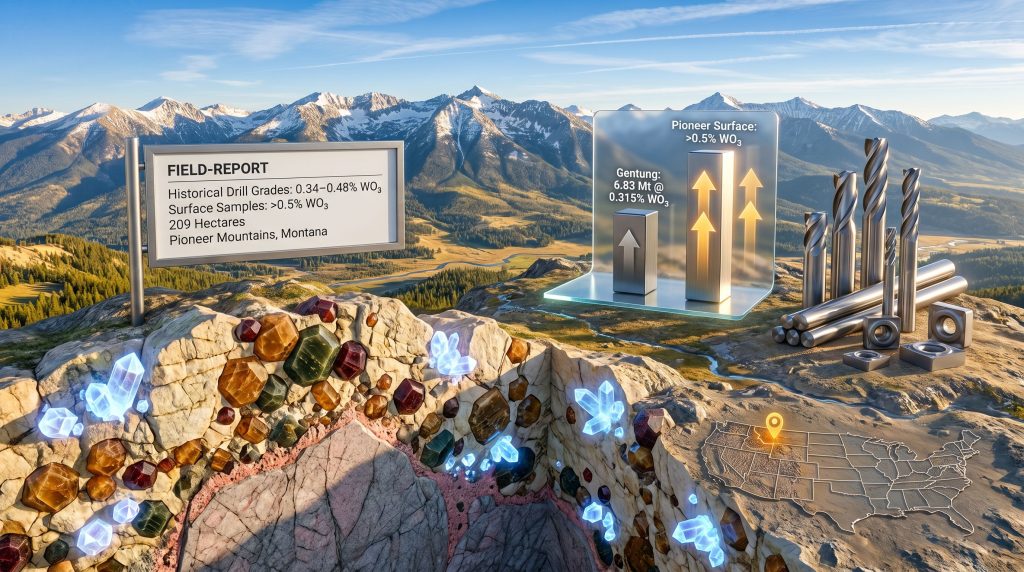
Previous drill programmes at the Greenstone prospect intersected tungsten mineralisation across full drill-hole lengths, with reported historical average grades ranging from 0.34% to 0.48% WO₃ over downhole intervals of 5.8 metres to 10.7 metres. Surface rock chip samples from the area have locally exceeded 0.5% WO₃, placing Pioneer in the upper tier of active tungsten exploration projects globally on a grade basis.
Context for these numbers is essential. For reference, the Gentung Tungsten Deposit immediately adjacent to Pioneer, held by Almonty Industries, carries a formally stated mineral resource of 6.83 million tonnes at 0.315% WO₃. Pioneer's historical surface assay results above 0.5% WO₃ suggest the potential for higher-grade zones within the broader mineralised system, though direct numerical comparisons between surface samples and formal resource estimates involve different sampling methodologies and statistical frameworks.
Historical drill results and surface assay data must be interpreted with appropriate caution. Data collected under operational conditions in the 1950s and 1970s may not meet current JORC 2012 or NI 43-101 reporting standards, and independent verification through systematic modern drilling programmes is necessary before any resource classification can be made.
The 24 rock chip samples collected during late May 2026 fieldwork are submitted for multi-element analysis covering tungsten (WO₃) alongside molybdenum, copper, bismuth, and gold as co-pathfinder elements. Multi-element analysis in skarn exploration serves a dual purpose: it quantifies tungsten grades at sampled points, and it maps the geochemical footprint of the hydrothermal system, which often extends beyond the visually identifiable mineralised zone and can guide subsequent drill targeting.
District-Scale Production History: Why It Matters
The Mount Torrey Batholith district has a documented production history that provides context no amount of surface sampling can fully replicate. The Ivanhoe and Lost Creek historical mines are estimated to have collectively produced approximately 680,000 tonnes of tungsten ore during their peak operational periods in the 1950s and 1970s.
For investors and geologists alike, historical production is one of the most meaningful indicators available at an early exploration stage. It confirms that the mineralising system produced economically extractable grades at surface-accessible depths within a real operational context, not just in laboratory assay conditions. A district that has previously supported commercial extraction carries fundamentally different geological credibility than a purely theoretical skarn target. Indeed, Red Mountain Mining's acquisition of the Pioneer Tungsten Project was partly motivated by this proven district history.
| Asset | Operator | Resource or Production | Grade (WO₃) | Current Status |
|---|---|---|---|---|
| Gentung Tungsten Deposit | Almonty Industries | 6.83 Mt stated resource | 0.315% | Defined resource, eastern batholith margin |
| Ivanhoe Mine (historical) | N/A | Part of ~680,000t combined | Not publicly restated | Past producer, same district |
| Lost Creek Mine (historical) | N/A | Part of ~680,000t combined | Not publicly restated | Past producer, same district |
| Pioneer Greenstone (historical drill) | Red Mountain Mining | Multiple intersections | 0.34-0.48% WO₃ | Exploration stage, verification required |
| Pioneer Surface Samples | Red Mountain Mining | 24 samples submitted | Locally >0.5% WO₃ | Results pending, pre-June 2026 |
Exploration Roadmap: What Comes Next
Sequenced Methodology
Red Mountain Mining's exploration pathway at the Red Mountain Pioneer Tungsten Project in Montana follows a logical, risk-staged sequence designed to build evidentiary confidence before committing to higher-cost drilling:
- Geochemical results from 24 rock chip samples (expected before end of June 2026): multi-element analysis quantifying WO₃ grades and mapping the hydrothermal geochemical footprint across Greenstone and Mammoth
- Reconnaissance mapping and surface sampling across all three claim areas throughout June 2026: systematic coverage of Lost Creek and additional infill sampling at Greenstone and Mammoth
- Drilling approvals process: already initiated concurrently with surface sampling, compressing the timeline between analytical results and drill mobilisation
- Drill testing of downdip skarn extensions: targeting the subsurface magnetic bodies identified by Arrow Geosciences, subject to positive analytical results
The decision to initiate drilling approvals before receiving geochemical results is strategically intelligent. Montana's regulatory framework for exploration drilling typically involves requirements under state hard rock mining legislation, with approval timelines that can run 60 to 120 days depending on land tenure category and the scope of environmental review required. By running permitting concurrently with surface work rather than sequentially, the project can potentially mobilise a drill programme weeks or months earlier than if approvals were only sought after results confirmed the case for drilling.
What Drill Testing Could Reveal
The phrase "downdip skarn extensions" describes mineralisation that continues at depth below the surface-exposed or shallow-drilled zone, potentially extending the mineralised system vertically and increasing total contained metal. In skarn geology, the relationship between surface exposure and depth continuity depends heavily on the geometry of the original carbonate horizon that hosted skarn replacement, and the angle at which this horizon dips relative to the land surface.
At Pioneer, the quartzite horizon overlying the skarns creates a specific geological question: does it represent the base of a completed mineralised sequence, or a stratigraphic cap beneath which additional skarn-forming replacement occurred in deeper carbonate units? The magnetic anomaly data provides indirect evidence for the latter interpretation, but only drilling can resolve this question definitively.
Risk Factors Every Investor Should Understand
Where Uncertainty Remains High
- Grade continuity in skarn systems: skarn deposits are geometrically irregular by nature, with high-grade pods that can terminate laterally or at depth without predictable patterns. Historical drill data at single points does not guarantee continuity between holes
- Historical data standards gap: assay results and drill logs from 1950s and 1970s operations were compiled under technical standards that predate modern resource estimation requirements. Independent re-sampling and re-logging of historical drill core, where accessible, may produce different results
- Magnetic anomaly interpretation uncertainty: geophysical modelling provides probabilistic, not deterministic, information about subsurface geology. Magnetic bodies interpreted as granodiorite extensions could represent other magnetically susceptible lithologies
- Permitting timeline variability: exploration drilling timelines in Montana can be extended by environmental review processes, particularly where operations occur on or near federal land categories with additional oversight requirements
What Reduces Risk at Pioneer Relative to Comparable Projects
- Surface outcrop of garnet skarn at two separate prospect areas eliminates blind-target drilling risk at the initial phase
- The Gentung Deposit's 6.83 Mt resource on the same structural trend as Pioneer provides an independently established geological benchmark demonstrating that the district's mineralising system has produced resources of meaningful scale at depth
- Historical production from the Ivanhoe and Lost Creek mines confirms that economic-grade tungsten mineralisation has been commercially extracted from this district previously
- Arrow Geosciences' magnetic modelling provides a geophysically constrained drill target framework rather than requiring collar placement based solely on surface observations
The next major ASX story will hit our subscribers first
The Broader Supply Chain Argument for U.S. Tungsten Development
Why Domestic Production Has Structural Economic Logic
The absence of any operating primary tungsten mine in the United States is not primarily a function of geological scarcity. Several prospective tungsten districts exist within U.S. borders, including the Mount Torrey Batholith area in Montana. The absence of production reflects decades of economic decisions made when Chinese tungsten was available at prices that made domestic development uncompetitive — a calculus that has materially changed as supply chain security concerns have been priced into strategic decision-making at both government and corporate levels.
The downstream economics of domestic tungsten processing add further dimension to this argument. Scheelite concentrate from a domestic mine could potentially supply ammonium paratungstate (APT) production facilities within the United States, enabling tungsten carbide and specialty alloy manufacturing without Chinese processing involvement at any stage of the value chain. This vertical integration opportunity is one reason tungsten strategic importance is considered among the most significant factors driving domestic supply chain development. Furthermore, securing 100% ownership of Pioneer positions Red Mountain Mining to capture the full value of this strategic opportunity.
The economic case for near-mine processing is compelling but should be understood as a long-term strategic aspiration rather than an immediate project-level certainty. Pioneer is currently at the exploration stage. Resource definition, feasibility assessment, and infrastructure planning would all precede any processing investment decision.
Montana's established mining regulatory environment, the state's existing hard rock mining services infrastructure, and the district's proven production history collectively position Pioneer within one of the more practically viable jurisdictions for tungsten development in the continental United States. These are structural advantages that exploration-stage projects in less-established jurisdictions do not share.
Key Metrics and Project Status at a Glance
| Parameter | Detail |
|---|---|
| Project Name | Pioneer Tungsten Project |
| Location | Pioneer Mountains, southwest Montana, USA |
| Total Land Package | 209 hectares |
| Claim Groups | Greenstone, Mammoth, Lost Creek |
| Geological Setting | Eastern margin, Mount Torrey Batholith |
| Mineralisation Style | Limestone-hosted garnet skarn (scheelite, CaWO₄) |
| Historical Drill Grades | 0.34-0.48% WO₃ over 5.8-10.7 metre intervals |
| Local Surface Sample Grades | Locally exceeding 0.5% WO₃ |
| Current Samples Submitted | 24 rock chips, multi-element analysis |
| Results Expected | Before end of June 2026 |
| Geophysical Work Completed | Arrow Geosciences magnetic modelling, subsurface bodies identified |
| Adjacent Resource (Gentung) | 6.83 Mt at 0.315% WO₃ (Almonty Industries) |
| District Production History | Approximately 680,000t tungsten ore (Ivanhoe and Lost Creek combined) |
| Operator | Red Mountain Mining (100% ownership) |
| Immediate Next Milestone | Geochemical results, followed by drill permit approval and drill testing |
This article contains forward-looking statements and exploration-stage information. Historical drill data referenced has not been independently verified under current JORC 2012 or NI 43-101 reporting standards and should not be relied upon as the basis for investment decisions. Readers are encouraged to review all publicly available company announcements and seek independent financial advice before making investment decisions related to exploration-stage mineral projects.
Want To Be First When the Next Major Mineral Discovery Hits the ASX?
Discovery Alert's proprietary Discovery IQ model delivers real-time notifications on significant ASX mineral discoveries — turning complex geological data into actionable investment insights the moment announcements land, just as it has for transformative discoveries like De Grey Mining and WA1 Resources. Explore Discovery Alert's dedicated discoveries page to understand how historic mineral discoveries have generated substantial returns, and begin your 14-day free trial to position yourself ahead of the broader market.