
July 25, 2026
Why Tailings Management Fails Before It Begins
Every significant tailings-related failure in modern mining history carries a recognisable signature. It is rarely a single catastrophic miscalculation. More often, it is the accumulation of individually defensible decisions, made by people who had no visibility into what others in the same organisation were deciding at the same time. A processing engineer optimises grind size for recovery without modelling the downstream geotechnical implications. A water management plan is updated without triggering a review of the closure design. A new site manager inherits a facility without inheriting the institutional knowledge embedded in its construction history.
This is the central challenge of connecting the dots in tailings management: not finding better engineers or better technologies in isolation, but building the connective tissue between them. The industry has made meaningful progress over the past decade, driven in part by catastrophic reminders of what disconnection costs. Yet the structural conditions that enable failures persist at many operations, particularly where technical disciplines operate in silos and governance frameworks treat tailings as an engineering sub-function rather than an enterprise-wide risk.
Understanding why this happens, and what a genuinely integrated approach looks like, requires moving beyond checklists and compliance frameworks to examine the architecture of risk itself.
When big ASX news breaks, our subscribers know first
Tailings as a System, Not a Structure
The Whole-of-Lifecycle Principle
A tailings storage facility is not a destination. It is a dynamic system that receives inputs from processing, responds to weather and seismicity, interacts with groundwater, and must eventually be handed off to a post-closure world that may look very different from the one in which it was designed. Managing it well requires treating every decision made across the mine's lifecycle as a potential input into that system's behaviour.
This whole-of-lifecycle framing is not simply good practice. It is increasingly embedded in leading governance frameworks, including the Global Industry Standard on Tailings Management (GISTM), which was developed following the catastrophic failures at Mount Polley in Canada in 2014 and Brumadinho in Brazil in 2019. The Brumadinho disaster alone resulted in 270 deaths and triggered a fundamental reassessment of how the global industry approaches tailings governance at the board level.
How Upstream Decisions Shape Downstream Outcomes
One of the least discussed but most consequential connections in tailings management runs between the processing plant and the storage facility. The physical and chemical characteristics of tailings material are determined largely by decisions made during mineral processing: grind size, reagent selection, and the method of solid-liquid separation chosen to produce the tailings stream.
Finer grind sizes, while often beneficial for metallurgical recovery, produce tailings with lower permeability and higher liquefaction potential under undrained loading. Certain flotation reagents introduce chemical compounds into the tailings porewater that complicate closure chemistry for decades. These are not edge cases. They are routine processing decisions with long-tail consequences that are rarely modelled at the time they are made.
Processing decisions made to maximise short-term recovery can inadvertently create geotechnical and geochemical conditions in tailings that persist and evolve for generations after mine closure. The processing-tailings interface is one of the most underexamined risk junctions in the industry.
The Lifecycle Architecture of a Tailings Management System
Connecting the dots in tailings management requires understanding where the critical decision points sit across the mine lifecycle and what is at stake if those decisions are made in isolation.
| Lifecycle Stage | Key Decisions Made | Risk if Disconnected |
|---|---|---|
| Project Conception | Tailings volume estimates, storage method selection | Undersized or mismatched facilities |
| Design and Construction | Geotechnical parameters, water balance, liner systems | Structural vulnerabilities baked into design |
| Active Operations | Deposition sequencing, monitoring protocols | Gradual condition drift undetected |
| Closure and Post-Closure | Final landform, long-term water management | Legacy liability and community risk |
The table above illustrates a fundamental principle: risk compounds when decisions made in one stage are not visible to those working in the next. A storage method selected at feasibility because it appeared cost-effective may create operational constraints that are not apparent until construction is underway. A liner system specified during design may prove inadequate once actual ore chemistry diverges from the feasibility-stage model.
Starting at the Beginning: Why Feasibility Is the Highest-Leverage Stage
Tailings planning that begins at project conception, rather than when material begins flowing to a storage facility, offers the highest return on risk reduction investment. A definitive feasibility study is when the fundamental architecture of the system is set: the storage method, the approximate volume, the relationship between the facility and the local hydrology, and the preliminary closure concept.
Industry data consistently shows that retrofitting a tailings facility design after construction begins costs between three and ten times more than addressing the same issues at feasibility. More critically, some structural vulnerabilities introduced at design stage cannot be remediated at any cost once operations commence.
The GISTM: Governance as the Structural Foundation
What the Standard Actually Requires
The Global Industry Standard on Tailings Management, published in 2020 and developed through a collaboration involving the International Council on Mining and Metals (ICMM), the United Nations Environment Programme (UNEP), and the Principles for Responsible Investment (PRI), represents the most comprehensive attempt to date to establish a governance architecture for tailings management at the international level.
The standard is built around six governance pillars that together define the accountability structure within which all technical activity must operate:
- Accountability – Board-level designation of an Accountable Executive with defined authority over tailings risk
- Competency – Formal requirements for the qualifications and experience of those responsible for tailings facilities
- Risk Management – Systematic identification, assessment, and treatment of tailings-related risks across the lifecycle
- Change Management – Documented protocols triggered whenever design, operational, or organisational changes occur
- Emergency Preparedness – Response planning that extends beyond the site boundary to include downstream communities
- Independent Assurance – Mandatory review at defined intervals by qualified independent engineers with public reporting
Compliance vs. Integration: A Critical Distinction
One of the most important distinctions in contemporary tailings governance is between meeting the GISTM and genuinely integrating its intent into operational culture. Many operations can document conformance with the standard's requirements while still operating with the siloed decision-making that the standard was designed to address.
| Governance Element | Pre-GISTM Norm | GISTM Expectation |
|---|---|---|
| Accountability | Site-level engineers | Board-level Accountable Executive |
| Risk Review | Periodic, reactive | Continuous, documented |
| Community Engagement | Notification-based | Participatory, rights-based |
| Emergency Response | Internal plans only | External stakeholder integration |
| Independent Review | Optional | Mandatory at defined intervals |
The distinction between compliance and integration is not semantic. Operations that treat the GISTM as a documentation exercise will produce the paperwork of integrated risk management without the substance of it.
Water Stewardship: The Most Hazardous Variable in the System
Why Water Balance Defines Facility Stability
Water is simultaneously the most operationally necessary and the most geotechnically dangerous element in a tailings storage facility. The relationship between pore water pressure and effective stress in a tailings mass is foundational to understanding how a facility behaves under loading. Elevated pore pressures reduce the shear strength of the tailings material, increasing the risk of static liquefaction and slope instability.
Managing water balance requires real-time coordination between the processing plant, the geotechnical team, and the environmental function. In practice, these three functions often report through different organisational hierarchies and meet infrequently, creating exactly the kind of disconnection that allows water-related risk to accumulate undetected. Furthermore, effective mining waste management across these functions is essential to maintaining overall facility integrity.
Filtered and Dry-Stack Tailings: Conditions for Applicability
Filtered tailings and dry-stack storage have attracted significant industry attention as a means of reducing free water in the facility and improving long-term geotechnical stability. However, these technologies are not universally applicable. Their suitability depends on:
- Tailings throughput – filtration systems become increasingly energy-intensive at high tonnages
- Climate conditions – dry stacking requires sufficient evaporative capacity to manage residual moisture
- Seismicity – filtered tailings generally perform better under seismic loading than conventional slurry facilities
- Closure context – the long-term water management obligations differ substantially between filtered and slurry storage methods
Dry stacking is not inherently safer than conventional tailings storage in all contexts. Its appropriateness must be evaluated against site-specific conditions rather than adopted as a general risk-reduction strategy.
Building the Human Architecture of Tailings Risk
Governance Structure as a Risk Control
The Accountable Executive role created by the GISTM represents a structural change in how tailings risk is positioned within mining organisations. By requiring board-level accountability, the standard creates a direct reporting line between site-level tailings conditions and the organisation's most senior decision-makers, bypassing the multiple organisational layers that historically allowed risk information to be filtered, delayed, or lost.
Building an effective tailings governance structure requires more than designating a title. It demands a cross-functional architecture:
- Designate a Board-level Accountable Executive with defined authority and unambiguous reporting lines
- Establish a cross-functional Tailings Review Board spanning geotechnical engineering, environmental science, legal, operations, and community relations
- Implement a formal change management protocol activated by any modification to design, operations, water balance, or personnel in key roles
- Conduct annual independent technical reviews with findings escalated directly to Board level
- Integrate tailings risk into the enterprise risk register alongside financial, legal, and reputational exposures
Personnel Transitions as a Hidden Risk Factor
One of the least-discussed risk factors in tailings governance is the transition of key personnel. When an experienced tailings engineer leaves a site, they take with them decades of tacit knowledge about how the facility behaves seasonally, what anomalies are normal, and what was never formally documented. Governance frameworks that treat personnel transitions as an administrative matter rather than a change management trigger create a structural vulnerability that is difficult to quantify but easy to recognise in retrospect.
The next major ASX story will hit our subscribers first
Artificial Intelligence and the Future of Condition Monitoring
From Periodic Inspection to Continuous Intelligence
The shift from periodic physical inspection to continuous sensor-based monitoring represents one of the most significant operational changes in tailings management over the past decade. Modern facilities increasingly deploy networks of piezometers, inclinometers, settlement plates, and surface displacement sensors that generate continuous data streams on facility behaviour.
AI in mining and machine learning models are now being applied to this sensor data to identify patterns that would be invisible to human reviewers examining periodic reports. Specifically, machine learning systems trained on historical deformation data can detect subtle, progressive changes in dam wall behaviour that precede visible instability by weeks or months.
The challenge with AI-driven monitoring is not the detection capability itself. It is ensuring that alerts generated by automated systems are connected to people with both the authority to act and the contextual knowledge to interpret what they are seeing.
Digital Twins and Decision-Making Integration
Several leading operations are now deploying digital twin models of their tailings facilities, which integrate real-time sensor data with three-dimensional geotechnical models to simulate facility behaviour under various loading scenarios. These tools have the potential to transform scenario planning and change management, allowing engineers to model the consequences of proposed operational changes before implementing them.
The data governance challenges associated with these systems are substantial. Monitoring data must be accessible across organisational functions, archived in auditable formats, and connected to decision-making processes in ways that create accountability rather than simply generating information volume.
Community Engagement as a Structural Risk Control
Beyond Notification: What Participatory Engagement Actually Requires
The GISTM's requirements around community engagement represent a substantive departure from the historical norm of notification-based communication. The standard requires that communities located downstream or adjacent to tailings facilities be active participants in emergency response planning, with access to comprehensible information about the nature of the hazard they face.
This distinction matters operationally. A community that has been genuinely engaged in emergency response planning, that understands evacuation routes, that has participated in drills, and that has a functioning communication channel with the operation, will respond more effectively in an emergency than one that received a notification letter it may not have fully understood.
The social risk dimension of tailings management also extends to disclosure and transparency. Operations that publish regular, accessible reports on the condition of their tailings facilities build a reservoir of community trust that can absorb the communication shocks that accompany operational upsets. Operations that do not publish such information may face a far more hostile environment when something goes wrong.
Waste Valorisation: Reducing the Problem at Its Source
The Circular Economy Case for Tailings Reprocessing
One of the most structurally important shifts in contemporary tailings management thinking is the recognition that tailings are not simply a waste problem to be managed but a potential resource inventory to be evaluated. Historic tailings deposits from gold, copper, and iron ore operations frequently contain economically significant concentrations of critical minerals that were uneconomical or technically unrecoverable at the time of original processing.
| Valorisation Pathway | Applicable Tailings Type | Value Potential | Maturity Level |
|---|---|---|---|
| Critical mineral reprocessing | Historic gold, copper tailings | High | Emerging-commercial |
| Construction material extraction | Silica-rich tailings | Moderate | Established |
| Rare earth recovery | Iron ore, phosphate tailings | High | Early-stage |
| Paste backfill for underground mines | Fine-grained tailings | Moderate | Established |
The economics of tailings reprocessing are improving as critical mineral prices strengthen and reprocessing technologies mature. More importantly from a risk management perspective, reprocessing reduces the volume of material requiring long-term storage, directly reducing the scale of the liability that must be managed through mine closure and reclamation and into perpetuity.
Upstream Volume Reduction Through Ore Sorting and Pre-Concentration
The most effective way to reduce the tailings management challenge is to produce less tailings in the first place. Ore sorting technology, which uses sensors to separate ore from waste rock before it enters the processing plant, can reduce the volume of material processed by between 20 and 40 percent at some operations, with proportional reductions in tailings production. Pre-concentration techniques including dense media separation and sensor-based sorting are increasingly viable at the throughputs typical of mid-tier mining operations.
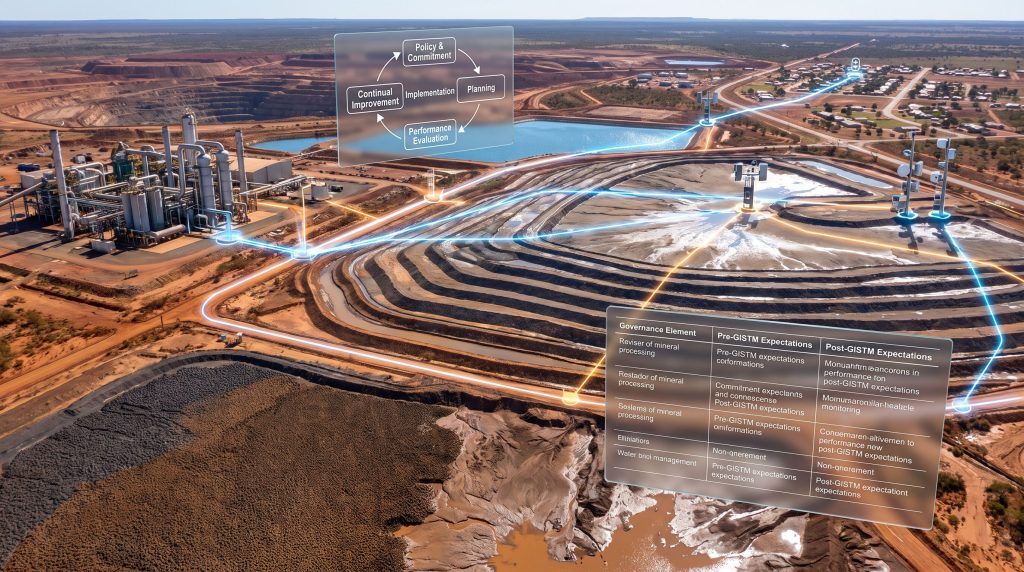
The Five-Element Management System Cycle
A formal tailings management system provides the repeating framework within which all of the connections described above are maintained over time. The five-element cycle, adapted from ISO 14001 and applied specifically to tailings, creates the structural conditions for continual improvement rather than episodic review:
- Policy and Commitment
- Planning (Risk Assessment, Design Standards, Water Balance)
- Implementation (Operational Controls, Monitoring, Training)
- Performance Evaluation (Audits, Reviews, KPI Tracking)
- Continual Improvement (Corrective Actions, Innovation Adoption) — feeding back into Policy and Commitment
The critical insight embedded in this cycle is the feedback loop at the bottom. Performance evaluation findings must flow back into planning and policy in a documented, auditable way. Operations that conduct audits without implementing corrective actions, or that identify KPI shortfalls without investigating root causes, are running the cycle without closing the loop.
Frequently Asked Questions
What is a tailings management system and why does it matter?
A tailings management system is a documented framework that integrates all decisions, controls, monitoring activities, and governance structures related to a mine's tailings facilities into a coherent whole. It matters because tailings represent one of the largest long-term liabilities in mining, and unmanaged risk in this area has produced some of the industry's most serious environmental and human catastrophes.
When should tailings planning begin in a mining project?
Tailings planning should begin at the project conception and feasibility stage, when fundamental decisions about storage method, facility location, and closure concept are being made. Beginning planning after construction has commenced significantly limits the options available and increases the cost of addressing design deficiencies.
What is the GISTM and who does it apply to?
The Global Industry Standard on Tailings Management is an international governance framework developed in 2020. It applies to all tailings facilities operated by companies that are members of the ICMM, as well as those that have voluntarily committed to the standard. Its requirements span the full lifecycle of a facility, from design through to post-closure.
How does dry stacking differ from conventional tailings storage?
Conventional tailings storage involves pumping a slurry of finely ground rock and water into an impoundment retained by a dam structure. Dry stacking involves filtering the tailings to remove most of the water before placement, producing a stackable, compacted material with significantly lower free water content and generally better geotechnical stability.
What role does AI play in modern tailings monitoring?
AI and machine learning are being applied to continuous sensor data from tailings facilities to detect subtle deformation patterns and anomalies that would be difficult to identify through periodic manual inspection. These systems provide earlier warning of developing instability when integrated with empowered decision-making structures.
How can mining companies reduce the volume of tailings they produce?
Volume reduction strategies include ore sorting and pre-concentration before processing, optimising grind size to avoid unnecessary over-grinding, selecting processing reagents that support simpler solid-liquid separation, and reprocessing legacy tailings to extract recoverable value while reducing stored volumes.
What is the role of communities in tailings emergency response planning?
Under the GISTM and leading practice frameworks, downstream and adjacent communities are participants in emergency response planning, not simply recipients of notification. This includes access to meaningful information about facility hazards, involvement in drill exercises, and functioning communication channels with the operating company.
How does closure planning connect to tailings design decisions?
Closure planning must inform design from the outset because many design decisions, including facility geometry, liner systems, and water management infrastructure, directly determine the long-term obligations and costs of closure. Facilities designed without a credible closure concept frequently require expensive retrofitting or carry unresolved long-term liabilities.
Key Takeaways
- Tailings management is a whole-of-lifecycle, cross-functional risk system, not an isolated engineering discipline
- Planning must begin at project conception, not at the point where material reaches a storage facility
- The GISTM establishes governance as the structural foundation within which all technical activities must operate
- Water balance, filtration technology, and processing decisions are directly linked to long-term tailings stability
- AI and digital monitoring are transforming condition assessment, but only when connected to empowered decision-makers
- Community engagement is a structural risk management requirement, not a communications exercise
- Waste valorisation and circular economy strategies offer a genuine pathway to reducing tailings volumes at their source
- Continual improvement requires formal feedback loops between monitoring data, operational decisions, and governance review
Readers interested in deepening their understanding of integrated tailings management practice can explore related professional content available through The Intelligent Miner at theintelligentminer.com, which publishes practitioner-focused analysis across technology, environment, and governance topics in the mining sector.
Want to Stay Ahead of Significant ASX Mineral Discoveries Before the Broader Market Reacts?
Discovery Alert's proprietary Discovery IQ model scans ASX announcements in real time, instantly translating complex mineral data across 30-plus commodities into clear, actionable insights for both short-term traders and long-term investors — explore the historic returns major discoveries have delivered and begin your 14-day free trial at Discovery Alert to secure your market-leading edge.