June 12, 2026
Federal Energy Infrastructure Faces a Transformation Through Regulatory Reform
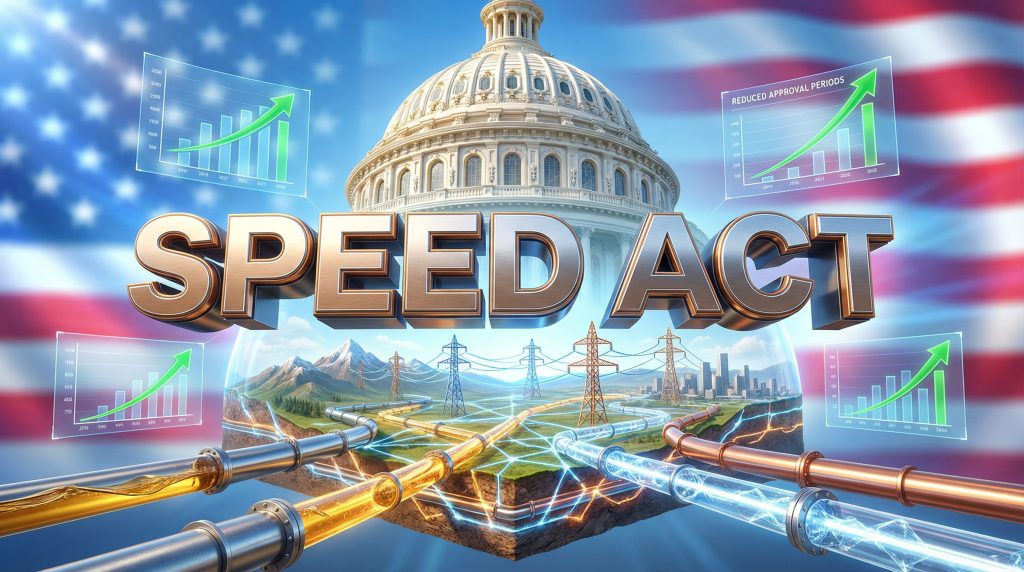
American energy infrastructure development operates within a complex web of federal oversight that has evolved significantly since environmental protection laws first emerged in the 1970s. The U.S. SPEED Act federal permitting reform represents a pivotal legislative effort to modernise these processes and accelerate critical infrastructure development. Multiple agencies coordinate reviews across jurisdictional boundaries, creating layered approval processes that extend project timelines and increase capital requirements for developers.
The intersection of environmental protection, energy security minerals, and economic competitiveness has reached a critical inflection point where traditional regulatory frameworks struggle to accommodate modern infrastructure demands.
Current federal permitting systems require extensive coordination between agencies including the Federal Energy Regulatory Commission, Environmental Protection Agency, Army Corps of Engineers, and various Department of Interior bureaus. This multi-agency approach, while designed to ensure comprehensive project evaluation, has generated approval timelines that industry representatives characterise as incompatible with national energy security requirements.
When big ASX news breaks, our subscribers know first
Understanding the SPEED Act Legislative Framework
The Standardising Permitting and Expediting Economic Development Act, designated as H.R. 4776, represents a comprehensive approach to modernising federal environmental review processes. House passes permit reform legislation on December 18, 2025, with bipartisan support, targeting three primary operational areas that have created bottlenecks in energy infrastructure development.
House Natural Resources Committee Chairman Bruce Westerman introduced the legislation as a response to decades of accumulated regulatory complexity that has extended project approval timelines beyond economically viable parameters. The bill's scope encompasses pipeline infrastructure, electric transmission systems, critical mineral extraction operations, and cross-border energy facilities.
Strategic Importance for National Infrastructure
Energy infrastructure development delays have cascaded through multiple economic sectors, creating supply chain constraints and limiting grid modernisation capabilities. The legislation addresses these challenges through targeted reforms to the National Environmental Policy Act (NEPA) process, which serves as the primary federal environmental review mechanism for major infrastructure projects.
Industry coalitions have identified federal permitting delays as a primary constraint on capital deployment in energy infrastructure. The Energy Workforce & Technology Council, American Petroleum Institute, and Independent Petroleum Association of America have collectively characterised extended approval timelines as a national security vulnerability requiring immediate legislative intervention.
Furthermore, understanding mining permitting basics provides valuable context for how these reforms could impact critical mineral extraction projects essential for renewable energy technologies and defence applications.
Current Federal Permitting System Creates Multi-Year Project Delays
The National Environmental Policy Act, enacted in 1970, established comprehensive environmental review requirements for federal projects and private projects requiring federal permits. While designed to ensure thorough environmental protection, the system has evolved into a complex process involving multiple agencies with overlapping jurisdictions and varying approval timelines.
Environmental Review Process Complexity
NEPA reviews typically involve several sequential and parallel processes:
• Environmental Assessment (EA) – Initial evaluation determining whether full environmental impact statements are required
• Environmental Impact Statement (EIS) – Comprehensive analysis of project environmental consequences across multiple impact categories
• Public Comment Periods – Mandated stakeholder input phases with specific duration requirements
• Inter-agency Consultation – Coordination between federal departments with overlapping regulatory authority
• Permit Issuance – Final approval determinations from individual agencies
Each phase involves distinct timeline requirements and procedural standards that vary across agencies and project types. The cumulative effect creates approval processes that industry representatives characterise as incompatible with modern infrastructure development requirements.
Agency Coordination Challenges
Federal energy infrastructure projects typically require approvals from multiple agencies with distinct jurisdictional authorities:
| Agency | Primary Authority | Typical Project Types |
|---|---|---|
| Federal Energy Regulatory Commission (FERC) | Interstate natural gas pipelines | Pipeline infrastructure |
| Army Corps of Engineers | Waterway crossings and wetlands | All infrastructure crossing water bodies |
| Environmental Protection Agency (EPA) | Water quality certifications | Projects affecting water resources |
| Bureau of Land Management (BLM) | Public lands access | Projects on federal lands |
| Forest Service | National Forest access | Projects crossing forest lands |
These overlapping jurisdictions create coordination challenges where project approvals require sequential or simultaneous reviews from multiple agencies, each operating under distinct procedural requirements and timeline parameters.
Litigation Risk and Legal Challenge Duration
Environmental and community groups frequently challenge federal project approvals through the federal court system, creating additional timeline extensions that can span multiple years. Legal challenges typically focus on NEPA process adequacy, endangered species consultation requirements, and water quality certification procedures.
Court proceedings often involve complex technical evidence regarding environmental impact assessments, requiring expert testimony and extensive discovery processes. Appeals to federal circuit courts create additional delay layers that can extend final project approval determinations by several years beyond initial permitting timelines.
SPEED Act Implementation Strategy and Reform Mechanisms
The legislation establishes a three-pronged approach to U.S. SPEED Act federal permitting reform, targeting the most significant sources of delay and regulatory uncertainty in current approval processes. Each reform mechanism addresses specific operational challenges that have created multi-year project timelines.
NEPA Process Modernisation
The SPEED Act introduces statutory deadline requirements for environmental review completion, fundamentally altering the open-ended timeline structure that has characterised NEPA processes since the law's enactment. These deadlines create accountability mechanisms for federal agencies while establishing predictable approval timelines for project developers.
Scope limitation provisions address the expansive environmental assessment requirements that have evolved through decades of regulatory interpretation and court decisions. By defining specific boundaries for environmental review scope, the legislation aims to prevent unlimited expansion of assessment requirements that can encompass indirect and cumulative impacts spanning multiple geographic regions and extended time horizons.
Documentation streamlining provisions modernise the extensive reporting requirements that have accumulated over decades of regulatory evolution. Environmental impact statements frequently exceed hundreds of pages and require analysis of numerous impact categories, creating document preparation timelines that can span multiple years for complex projects.
The legislation establishes clear temporal parameters for federal agencies to complete environmental and technical reviews, reduces duplicative assessments between departments, and creates accountability mechanisms for meeting statutory deadlines.
Federal Agency Coordination Enhancement
Inter-agency coordination reforms address the duplicative review processes that occur when multiple federal agencies evaluate similar environmental and technical aspects of individual projects. The legislation establishes mechanisms for reducing redundant assessments while maintaining environmental protection standards.
Accountability mechanisms create specific consequences for agencies that fail to meet established review timelines, fundamentally altering the incentive structure that has allowed indefinite review extensions. These provisions aim to restore predictability to federal permitting while ensuring adequate environmental protection.
Legal Challenge Timeline Management
The legislation modifies court proceeding parameters for environmental challenges to federal project approvals, establishing duration limits that prevent indefinite legal proceedings. These provisions address the multi-year court cases that have characterised many major infrastructure project challenges.
Standing requirement modifications aim to ensure that legal challenges originate from parties with direct legal interests in project outcomes, potentially reducing frivolous litigation that creates additional project delays without substantive environmental protection benefits.
Energy Sector Impact Analysis and Development Acceleration
Different energy infrastructure sectors face varying federal permitting challenges based on their specific regulatory requirements and environmental impact profiles. The SPEED Act's reforms are expected to generate sector-specific benefits that could accelerate development timelines across multiple infrastructure categories.
Pipeline Infrastructure Development Acceleration
Interstate natural gas pipeline projects require Federal Energy Regulatory Commission certificates of public convenience and necessity, which involve comprehensive environmental assessments under NEPA. These projects also require numerous additional permits for waterway crossings, wetland impacts, and federal land access, creating complex multi-agency approval processes.
Oil transportation infrastructure faces similar multi-agency coordination requirements, particularly for projects crossing state boundaries or federal lands. The streamlined approval processes established by the SPEED Act could significantly reduce the multi-year timelines that have characterised major pipeline projects in recent decades.
Cross-border energy infrastructure projects involve additional complexity from international coordination requirements and national security considerations. Expedited federal permitting could enhance North American energy integration by reducing approval uncertainties that have constrained international infrastructure development.
Electric Grid Infrastructure Modernisation
Electric transmission line projects face unique permitting challenges due to their linear infrastructure characteristics, which often require approvals from multiple agencies for rights-of-way crossing various federal jurisdictions. Grid interconnection projects require coordination between federal and state regulatory authorities, creating dual approval processes that can extend project timelines significantly.
Renewable energy integration infrastructure, including transmission lines connecting wind and solar facilities to existing grid systems, has become increasingly important for meeting state renewable energy mandates and federal clean energy objectives. Streamlined federal permitting could accelerate the transmission infrastructure development necessary for renewable energy expansion.
Critical Minerals Extraction Operations
Mining operations on federal lands require extensive environmental assessments due to their potential for long-term environmental impacts and complex reclamation requirements. Critical mineral projects have gained strategic importance for national security applications, including defence technologies and renewable energy systems.
| Infrastructure Type | Primary Permitting Challenges | Expected Reform Benefits |
|---|---|---|
| Natural Gas Pipelines | Multi-state coordination, waterway crossings | Reduced FERC timeline uncertainty |
| Electric Transmission | Federal land rights-of-way, environmental assessments | Accelerated grid modernisation |
| Critical Minerals Mining | Long-term environmental impacts, federal lands access | Strategic resource development |
| Oil Transportation | State boundary coordination, environmental reviews | Enhanced supply chain infrastructure |
Economic Implications and Investment Capital Mobilisation
Federal permitting delays have created significant economic impacts across energy infrastructure development, constraining capital deployment and increasing project financing costs through extended development timelines and regulatory uncertainty. The U.S. SPEED Act federal permitting reform could generate substantial economic benefits through improved investment predictability and reduced project risk premiums.
Capital Deployment and Investment Risk Reduction
Extended permitting timelines increase project carrying costs through prolonged development phases that require ongoing expenditures without revenue generation. Project developers must maintain regulatory compliance, engineering teams, and stakeholder engagement capabilities throughout multi-year approval processes, creating substantial pre-construction expenditures.
Regulatory uncertainty generates investment risk premiums that increase project financing costs and reduce capital availability for infrastructure development. Financial institutions and investors require higher returns to compensate for the unpredictable approval timelines and potential legal challenges that characterise current federal permitting processes.
In addition, implementing effective investment risk reduction strategies becomes crucial when navigating these regulatory environments and capital allocation decisions.
Regional Economic Development Acceleration
Energy infrastructure projects generate significant local economic benefits through construction employment, ongoing operational jobs, and increased tax revenues for local governments. Accelerated project approvals could enhance regional economic development by reducing the uncertainty that constrains infrastructure investment in rural and economically disadvantaged communities.
Supply chain effects from energy infrastructure development extend beyond direct project employment to supporting industries including steel manufacturing, equipment fabrication, and professional services. Predictable permitting timelines could enhance supply chain planning and increase domestic manufacturing capacity for energy infrastructure components.
Energy Market Competition and Consumer Benefits
Infrastructure bottlenecks created by permitting delays can constrain energy market competition by limiting pipeline capacity, transmission access, and production capabilities. Enhanced infrastructure development could increase market competition and potentially reduce consumer energy costs through improved supply chain efficiency.
Grid reliability improvements through accelerated transmission infrastructure development could reduce electricity supply disruptions and enhance overall system resilience. These benefits extend beyond direct cost savings to include economic productivity improvements from more reliable energy supplies.
The next major ASX story will hit our subscribers first
Industry Stakeholder Perspectives and Political Dynamics
The SPEED Act has generated strong support from energy industry associations, which have characterised federal permitting delays as a primary constraint on infrastructure development and national energy security. Industry groups have emphasised the legislation's potential to restore predictability to federal approval processes while maintaining environmental protection standards.
Energy Industry Coalition Support
Tim Tarpley, President of the Energy Workforce & Technology Council, has characterised extended permitting timelines as a national security vulnerability that requires immediate legislative intervention. The organisation represents energy service companies and contractors who face project uncertainty due to unpredictable federal approval processes.
Mike Sommers, President and CEO of the American Petroleum Institute, has described the SPEED Act as a practical reform measure that would restore predictability to federal permitting through reduced litigation risk and elimination of overlapping regulatory reviews. API represents upstream oil and natural gas companies that face multi-year approval processes for major infrastructure projects.
Edith Naegele, President and CEO of the Independent Petroleum Association of America, has emphasised that NEPA reforms would provide increased certainty for oil and natural gas sector development while expediting energy infrastructure approvals. IPAA represents independent producers who often lack the resources to navigate extended permitting processes.
Environmental Group Concerns and Opposition
Environmental organisations have expressed concerns that accelerated permitting timelines could compromise thorough environmental impact assessments and reduce community input opportunities. These groups argue that NEPA serves as a crucial safeguard for environmental protection and public participation in federal project decisions.
Environmental advocates contend that litigation challenges serve an important oversight function by ensuring federal agencies comply with environmental protection requirements and consider all relevant impacts before approving major infrastructure projects. They argue that timeline restrictions could undermine this oversight mechanism.
Congressional Political Alignment
The legislation's bipartisan House passage indicates significant political support for federal permitting reform across party lines. Republican members have generally supported the reforms as necessary for economic competitiveness and energy security, while some Democratic members have expressed concerns about environmental protection and community input preservation.
Senate consideration will likely involve additional scrutiny of specific provisions and potential modifications to address environmental group concerns while maintaining industry support. The legislative process could result in compromise provisions that balance reform objectives with environmental protection requirements.
Senate Legislative Process and Implementation Timeline
The SPEED Act faces several procedural hurdles in the Senate, where different political dynamics and committee jurisdictions could influence the legislation's final form. Understanding these challenges provides insight into potential timeline scenarios and implementation possibilities.
Committee Jurisdiction and Review Process
Senate committee consideration will likely involve multiple committees with overlapping jurisdiction over energy, environment, and public lands issues. The Energy and Natural Resources Committee typically handles major energy legislation, while the Environment and Public Works Committee oversees environmental protection laws including NEPA.
Committee markup processes could result in amendments that modify specific provisions to address stakeholder concerns or improve implementation mechanisms. These modifications might include adjustments to statutory deadlines, environmental protection safeguards, or agency coordination requirements.
Legislative Timeline Scenarios
Several factors could influence the Senate's legislative timeline:
• Early 2026 consideration – Industry groups have urged rapid Senate action to enable presidential signature in early 2026
• Committee modification process – Amendments during committee markup could extend consideration timelines
• Floor debate and voting – Senate floor procedures could involve additional amendments and procedural votes
• Conference committee process – Differences between House and Senate versions might require conference committee resolution
Presidential Signature and Implementation
Following congressional passage, the legislation would require presidential signature to become law. Implementation would involve federal agency rulemaking to establish specific procedures and timelines consistent with the statutory requirements.
Agency implementation could involve transition periods to accommodate existing project reviews and establish new procedural requirements. Training programmes for federal employees and coordination mechanisms between agencies would be necessary to ensure effective implementation.
However, recent executive permit orders suggest administrative support for accelerated permitting processes, which could facilitate rapid implementation of congressional reforms.
Regional Infrastructure Development and Geographic Impacts
The U.S. SPEED Act federal permitting reform could generate varying impacts across different geographic regions based on their specific energy infrastructure needs and federal land ownership patterns. Understanding these regional variations provides insight into potential economic development distributions and implementation challenges.
Western Regional Transmission Expansion
Western states face significant transmission infrastructure needs due to renewable energy resource development and population growth in major metropolitan areas. Federal land ownership patterns in western states create additional permitting complexity for transmission projects that cross multiple federal jurisdictions.
The Bureau of Land Management and Forest Service manage extensive federal lands in western states, creating multi-agency approval requirements for transmission infrastructure. Streamlined federal permitting could particularly benefit western transmission projects that face complex federal land rights-of-way requirements.
Gulf Coast Energy Infrastructure Development
Gulf Coast states host significant petrochemical facilities, liquefied natural gas export terminals, and pipeline infrastructure that requires federal approvals for waterway crossings and coastal zone impacts. The region's energy infrastructure development could benefit from reduced permitting uncertainty and accelerated approval timelines.
Cross-border infrastructure connecting Gulf Coast facilities with Mexican energy systems could particularly benefit from streamlined federal approvals that reduce international project development risks.
Appalachian Pipeline Infrastructure
Appalachian natural gas production has generated significant demand for pipeline infrastructure to transport gas to consuming markets and export facilities. Pipeline projects in the region face complex federal permitting requirements for waterway crossings, forest lands access, and interstate coordination.
Federal permitting reforms could accelerate pipeline infrastructure development that connects Appalachian production with market demand centres, potentially enhancing regional economic development and natural gas supply reliability.
Long-Term Strategic Implications for American Energy Policy
The SPEED Act represents a fundamental shift in federal energy policy that could generate long-term strategic consequences extending beyond immediate infrastructure development acceleration. These implications encompass energy security, international competitiveness, and technology innovation facilitation.
Domestic Energy Security Enhancement
Accelerated infrastructure development could enhance domestic energy production capacity and supply chain resilience through reduced regulatory constraints on strategic projects. This capability becomes particularly important during international supply disruptions or geopolitical tensions that constrain energy imports.
Strategic petroleum reserve and natural gas storage facility development could benefit from streamlined federal approvals, enhancing national energy security infrastructure. Critical mineral extraction projects could reduce dependence on international supply chains for defence and renewable energy applications.
Furthermore, developing a comprehensive critical minerals strategy becomes essential for maintaining strategic autonomy in key technological sectors.
International Energy Market Competitiveness
Streamlined permitting could position the United States to compete more effectively with countries that have faster infrastructure approval processes, potentially attracting international energy investment and enhancing export capabilities.
Liquefied natural gas export facility development could benefit from predictable federal approval timelines, enhancing American competitiveness in international energy markets. Reduced permitting uncertainty could attract foreign investment in American energy infrastructure projects.
Technology Innovation and Deployment Acceleration
Emerging energy technologies often require federal approvals for demonstration and commercial deployment projects. Streamlined permitting could accelerate the development of innovative energy systems including advanced nuclear reactors, carbon capture facilities, and hydrogen production infrastructure.
Research and development projects involving federal lands or facilities could benefit from reduced approval timelines, enhancing the pace of energy technology innovation. Clean energy transition infrastructure, including renewable energy projects and supporting transmission systems, could achieve faster deployment through reformed federal processes.
Implementation Considerations and Potential Challenges
Successful SPEED Act implementation will require careful attention to several operational challenges that could affect reform effectiveness. Understanding these potential issues provides insight into factors that could influence the legislation's ultimate success.
Federal Agency Capacity and Resource Requirements
Accelerated permitting timelines will require federal agencies to process applications more efficiently while maintaining environmental protection standards. This requirement could necessitate additional staffing, training programmes, and technology systems to manage increased workload demands.
Inter-agency coordination improvements will require new communication protocols, shared databases, and standardised procedures across multiple federal departments. These changes could require significant administrative resources and change management efforts.
Environmental Protection Balance
The legislation aims to maintain environmental protection standards while accelerating approval timelines. Achieving this balance will require careful implementation that ensures adequate environmental assessment while preventing unnecessary delays.
Community input preservation mechanisms will need to accommodate faster approval timelines while maintaining meaningful public participation opportunities. This balance could require innovative approaches to stakeholder engagement and environmental review processes.
Legal Challenge and Litigation Management
Modified legal challenge procedures could face constitutional scrutiny regarding access to judicial review and due process protections. Courts may need to develop new procedures for managing environmental litigation under restricted timelines.
Standing requirement changes could generate legal challenges from environmental groups concerned about reduced access to judicial oversight of federal project approvals. These challenges could create implementation delays while legal precedents develop.
Economic Risk Assessment and Investment Implications
While the SPEED Act offers significant potential benefits for energy infrastructure development, several risk factors could influence its ultimate economic impact. Investors and project developers should consider these variables when evaluating infrastructure investment opportunities.
Implementation Timeline Uncertainty
The legislation's effectiveness will depend on successful federal agency implementation, which could require several years to achieve full operational capacity. Early implementation phases might not immediately generate the full timeline reductions anticipated by supporters.
Legal Challenge Transition Period
Modified litigation procedures could face court challenges that create temporary uncertainty while new legal precedents develop. This transition period might not immediately provide the litigation risk reduction sought by project developers.
State and Local Permitting Coordination
Energy infrastructure projects typically require both federal and state approvals, creating dual permitting processes that could limit overall timeline improvements if state-level reforms do not accompany federal changes. State environmental review processes might become the constraining factor for project approvals.
Market Demand and Economic Conditions
Infrastructure development acceleration will ultimately depend on market demand for energy projects and favourable economic conditions that support capital investment. Permitting reform alone cannot guarantee increased infrastructure development without underlying market drivers.
What Could Be the Timeline for Implementation?
Establishing metrics for measuring SPEED Act effectiveness will be crucial for evaluating reform success and identifying areas requiring additional attention. These measurement frameworks could guide future legislative adjustments and implementation improvements.
Timeline Reduction Measurement
Tracking average approval timelines for different project types before and after implementation will provide quantitative evidence of reform effectiveness. These measurements should account for project complexity variations and seasonal factors that could influence approval timelines.
Investment Capital Flow Analysis
Monitoring infrastructure investment levels and project financing terms could indicate whether reforms successfully reduce regulatory risk premiums and attract additional capital to energy infrastructure development.
Environmental Protection Outcomes
Assessing environmental protection effectiveness under reformed procedures will be essential for evaluating whether accelerated timelines compromise environmental safeguards. These assessments should include monitoring of environmental compliance and impact mitigation effectiveness.
The SPEED Act represents a significant transformation in federal energy infrastructure policy that could reshape American energy development patterns for decades. Success will depend on effective implementation that achieves the delicate balance between development acceleration and environmental protection, while maintaining the comprehensive oversight that ensures responsible infrastructure development. The legislation's ultimate impact will emerge through the complex interaction of regulatory reform, market forces, and technological innovation that characterises modern energy infrastructure development.
This analysis is based on publicly available information and industry statements as of December 18, 2025. Legislative and regulatory developments are subject to change, and readers should consult current sources for the most recent information regarding federal permitting reform implementation.
Looking to Capitalise on Energy Infrastructure Investment Opportunities?
Discovery Alert's proprietary Discovery IQ model delivers real-time alerts on significant ASX mineral discoveries, including critical minerals essential for America's energy infrastructure transformation. With streamlined federal permitting potentially accelerating mining projects, subscribers gain instant access to actionable investment opportunities in the resources sector that could benefit from regulatory reform. Begin your 30-day free trial today to position yourself ahead of the market as energy security becomes increasingly vital.