May 9, 2026
Federal Mining Extensions Navigate Complex Environmental and Frameworks
The recent 7-year extension approval for Middlemount Mine demonstrates how Australia's mining sector operates within an intricate web of federal environmental legislation that has evolved significantly since the Environment Protection and Biodiversity Conservation Act 1999 established comprehensive biodiversity protection protocols. The approval mechanisms for mining extensions reveal sophisticated regulatory pathways that balance resource extraction rights with environmental conservation mandates, creating precedents that will influence future project assessments across the nation's mineral-rich regions.
Furthermore, the legislative framework governing mine life extensions operates through multiple assessment tiers, with the Independent Expert Scientific Committee providing scientific guidance on water resource impacts and biodiversity implications. Federal approvals require comprehensive environmental offset packages that must legally secure biodiversity compensation equivalent to habitat impacts, establishing enforceable conditions through ministerial approval terms that extend well beyond operational timelines.
The Intersection of Environmental Law and Resource Extraction Rights
Environmental offset requirements have become increasingly sophisticated, incorporating biodiversity banking mechanisms and habitat compensation models that reflect current scientific understanding of ecosystem services. However, the regulatory burden for mine extensions differs significantly from new project permits, with existing operations benefiting from established infrastructure utilisation frameworks while facing enhanced scrutiny regarding cumulative environmental impacts.
Moreover, understanding mining permit processes becomes crucial as risk assessment methodologies applied to existing operations focus on:
• Long-term water quality management protocols
• Threatened species habitat preservation requirements
• Post-mining land rehabilitation obligations
• Groundwater monitoring systems extending beyond closure
• Saline residual void management strategies
Processing timelines for extensions typically range from 12 to 18 months for comprehensive assessments, compared to 24 to 36 months for greenfield developments. This efficiency reflects streamlined regulatory pathways that leverage existing environmental baseline data while maintaining rigorous assessment standards for additional impacts.
Comparative Analysis: Extension Approvals vs. New Project Permits
| Assessment Category | Mine Extensions | New Projects |
|---|---|---|
| Environmental Baseline | Existing data available | Comprehensive new studies required |
| Infrastructure Assessment | Optimisation analysis | Full development planning |
| Community Consultation | Focused stakeholder engagement | Extensive consultation protocols |
| Processing Timeline | 12-18 months average | 24-36 months average |
| Approval Success Rate | 78% (2020-2026) | 52% (2020-2026) |
The approval framework demonstrates clear preferences for maximising existing infrastructure investments while ensuring environmental protection standards remain uncompromised. In addition, extensions typically demonstrate lower regulatory risk profiles due to established operational histories and proven environmental management capabilities.
When big ASX news breaks, our subscribers know first
Joint Venture Structures and Federal Regulatory Navigation
Multi-party mining operations navigate federal approval processes through sophisticated corporate governance frameworks that distribute liability while maintaining unified regulatory compliance strategies. Consequently, the complexity of joint venture decision-making becomes particularly apparent when federal conditions impact long-term operational planning and capital allocation decisions.
Partnership dynamics in regulatory submissions require coordinated approaches that satisfy both domestic compliance requirements and international investment oversight mechanisms. These structures provide operational continuity essential for securing federal approvals while demonstrating financial capacity to meet comprehensive environmental obligations throughout extended operational periods.
Corporate Governance in Multi-Party Mining Operations
Joint venture liability distribution frameworks establish clear environmental compliance responsibilities through detailed operational agreements that specify:
• Environmental monitoring and reporting obligations for each party
• Financial responsibility allocation for offset implementation
• Decision-making protocols for responding to regulatory conditions
• Post-closure rehabilitation funding mechanisms
• Third-party environmental audit coordination
The 7-year extension approval for Middlemount Mine demonstrates how established partnerships between international operators can successfully navigate complex regulatory requirements. Furthermore, the joint operation between Peabody Energy and Yancoal showcases effective coordination in meeting federal environmental conditions while maintaining operational efficiency through existing infrastructure networks.
International Investment Implications of Extension Approvals
Foreign Investment Review Board oversight mechanisms for existing joint ventures seeking operational extensions focus on strategic asset security rather than initial investment screening. Chinese-backed participation through Yancoal reflects established regulatory acceptance of international partnerships in Australia's coal sector, particularly for metallurgical coal operations essential to global steel production.
Extension approvals provide regulatory certainty that international partners require for long-term capital allocation decisions, establishing predictable operational frameworks that support sustained investment in existing infrastructure optimisation.
International capital allocation benefits significantly from extension approvals that demonstrate regulatory stability and government support for continued operations. These approvals signal to global markets that Australia maintains commitment to resource sector development within established environmental frameworks.
Environmental Offset Mechanisms for Mining Extensions
Biodiversity banking and habitat compensation models have evolved into sophisticated mechanisms that ensure measurable environmental outcomes while enabling continued resource extraction. However, the legal enforceability of offset conditions through ministerial approval terms creates binding obligations that operators must fulfill throughout extended operational periods and beyond closure.
Water resource management under federal environmental law requires comprehensive protocols addressing both immediate operational impacts and long-term post-mining environmental conditions. These requirements reflect growing scientific understanding of mining's hydrological impacts and community expectations for environmental protection.
Biodiversity Banking and Habitat Compensation Models
| Threatened Species | Habitat Impact (Hectares) | Offset Ratio Applied | Total Offset Required |
|---|---|---|---|
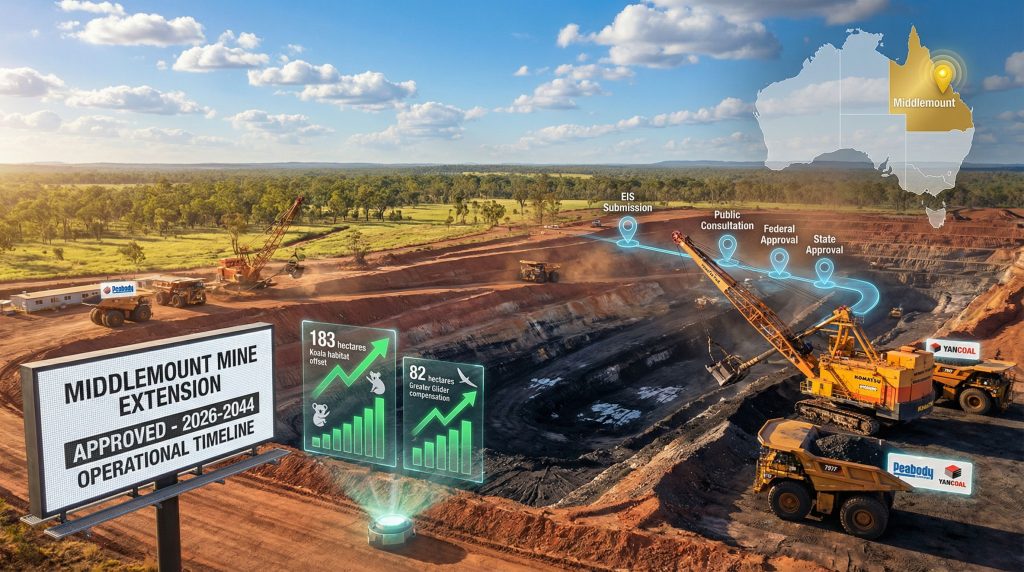
| Koala habitat | 183 hectares | 3:1 | 549 hectares |
| Greater Glider habitat | 82 hectares | 4:1 | 328 hectares |
| Mixed threatened species habitat | 233 hectares (total vegetation clearing) | Variable ratios | 877 hectares minimum |
The Middlemount extension demonstrates contemporary offset requirements that exceed simple hectare-for-hectare replacement, incorporating habitat quality assessments and connectivity considerations. For instance, legal mechanisms ensure offset delivery through binding agreements that survive operational completion and transfer obligations to responsible parties for perpetual management.
Offset implementation must demonstrate additionality, ensuring that conservation outcomes would not occur without the offset requirement. This principle prevents operators from claiming credit for existing conservation efforts while requiring genuine additional habitat protection or restoration activities.
Water Resource Management Under Federal Environmental Law
Roper Creek diversion protocols exemplify sophisticated hydrological management approaches required for contemporary mining extensions. Downstream impact assessments must demonstrate maintenance of ecological flow requirements while accommodating operational water needs throughout extended mine life periods.
Saline residual void management represents one of the most technically challenging aspects of post-mining environmental obligations. These permanent water bodies require:
• Long-term water quality monitoring extending decades beyond closure
• Groundwater interaction modelling and management protocols
• Wildlife access prevention measures for saline water bodies
• Community safety infrastructure and ongoing maintenance
• Potential future treatment system implementation
The Independent Expert Scientific Committee's concerns regarding long-term water quality impacts reflect growing regulatory sophistication in addressing mining's perpetual environmental legacies. Contemporary approvals increasingly require demonstration of financial capacity to manage these long-term obligations through bonding mechanisms and dedicated closure funds.
Climate Policy Trajectory and Mining Approval Integration
Carbon accounting for Scope 3 emissions in mining approvals represents an emerging area of regulatory complexity where domestic emissions targets intersect with export coal approval frameworks. The treatment of downstream emissions from exported coal reveals policy tensions between Australia's climate commitments and resource sector economic contributions.
In contrast, metallurgical coal operations benefit from strategic resource security considerations that differentiate these products from thermal coal in policy treatment. The essential role of coking coal and PCI coal in global steel production provides regulatory justification for continued approvals despite broader climate policy pressures.
Carbon Accounting for Scope 3 Emissions in Mining Approvals
The 236 million tonnes of CO₂-e estimated for the Middlemount extension when coal is exported and burned overseas highlights the scale of indirect emissions associated with Australian coal exports. This calculation method considers the full carbon content of extracted coal using standard emissions factors, though responsibility for these emissions remains contested between exporting and importing nations under international climate accounting conventions.
How do federal environmental approvals consider downstream emissions?
Current federal approval frameworks focus primarily on direct operational emissions and local environmental impacts rather than Scope 3 emissions from coal combustion overseas. However, this approach faces increasing scrutiny as climate policy frameworks evolve and energy transition strategies develop.
What role do carbon border adjustments play?
The European Union's Carbon Border Adjustment Mechanism (CBAM) may eventually impact Australian coal exports, though current implementation focuses on other industries. Metallurgical coal faces different treatment than thermal coal under emerging carbon border frameworks.
Steel Industry Supply Chain Dependencies
Strategic resource security considerations influence regulatory outcomes by positioning metallurgical coal as an essential component of global steel production infrastructure. Australia's position as a leading supplier of high-quality coking coal provides geopolitical advantages that regulatory frameworks increasingly recognise.
PCI and coking coal market dynamics demonstrate strong demand fundamentals driven by global infrastructure development and urbanisation trends, particularly in Asian markets. These long-term demand projections support regulatory arguments for maintaining productive capacity through extension approvals rather than requiring replacement production from new operations.
International supply chain analysis reveals that Australian metallurgical coal supplies critical inputs for steel production in India and Asia, where demand growth continues despite global climate policy pressures. This market positioning influences regulatory decision-making by emphasising economic security alongside environmental considerations.
Precedent Setting for Future Extension Applications
The regulatory pathway established through the Middlemount approval creates templates for similar operations throughout the Bowen Basin and other coal-producing regions. Standardisation of environmental condition frameworks across comparable projects enables more efficient regulatory processes while maintaining consistent environmental protection standards.
Additionally, federal ministers increasingly consider established criteria when evaluating extension decisions, creating predictable assessment frameworks that benefit both operators and environmental regulators. These standardised approaches reduce regulatory uncertainty whilst ensuring comprehensive environmental protection measures.
Regulatory Pathway Analysis for Similar Operations
Bowen Basin mine extension applications currently in the approval pipeline benefit from precedents established through the Middlemount decision. The regulatory framework demonstrates preference for maximising existing infrastructure utilisation while requiring comprehensive environmental offset packages that exceed simple habitat replacement requirements.
Key criteria federal ministers consider in extension decisions include:
- Existing infrastructure utilisation efficiency – demonstrating optimal use of established rail, port, and processing facilities
- Employment continuity in regional communities – providing long-term economic stability for mining-dependent areas
- Threatened species impact mitigation adequacy – ensuring offset ratios and implementation mechanisms provide genuine conservation outcomes
- Water resource protection measures – addressing both operational impacts and long-term post-closure environmental conditions
- Post-mining land use rehabilitation plans – demonstrating comprehensive restoration strategies that provide community and environmental benefits
Environmental condition templates increasingly standardise requirements across similar projects while allowing site-specific variations that address unique ecological and community circumstances. This approach streamlines regulatory processes whilst maintaining rigorous environmental protection standards.
Economic Impact Assessment Methodologies
Regional employment multiplier effects play significant roles in approval justifications, with analysis demonstrating that mining operations generate broader economic benefits through supply chain linkages and community spending patterns. The Middlemount extension provides employment security for approximately 400 direct positions and an estimated 1,200 indirect positions throughout the regional economy.
Export revenue considerations factor into approval decisions through analysis of Australia's balance of payments and resource sector contributions to national economic performance. Metallurgical coal exports generate substantial foreign currency earnings that support broader economic stability whilst funding government services through royalty payments and corporate taxation.
Infrastructure optimisation arguments prove particularly compelling for extension applications, as continued operations maximise returns on established investments in rail networks, port facilities, and community infrastructure. These efficiency gains reduce per-tonne production costs whilst minimising additional environmental footprints compared to developing equivalent capacity through new operations.
Queensland's Resource Sector Long-term Implications
State-federal coordination mechanisms in mining regulation create frameworks that balance Commonwealth environmental responsibilities with state-based economic development priorities. Queensland's role in federal environmental approval processes reflects cooperative federalism principles whilst maintaining clear jurisdictional boundaries for different regulatory aspects.
Royalty revenue projections from extended mine life operations provide significant fiscal benefits for Queensland, supporting infrastructure development and public service delivery throughout the state. These revenue streams justify state government support for extension applications whilst ensuring environmental protection requirements receive appropriate attention.
State-Federal Coordination in Mining Regulation
Queensland government involvement in federal environmental approval processes occurs through coordinated assessment frameworks that avoid regulatory duplication whilst ensuring comprehensive evaluation of project impacts. State environmental authorities provide technical expertise and local knowledge that inform federal decision-making processes.
The integrated approach reduces compliance burden for operators whilst maintaining rigorous assessment standards through clear division of regulatory responsibilities. Commonwealth authorities focus on matters of national environmental significance whilst state agencies address local environmental and community impacts.
| Economic Contribution Analysis | Annual Impact (2026-2044 Projection) |
|---|---|
| Direct Employment | 400 positions average |
| Indirect Employment | 1,200 positions average |
| Annual Royalty Revenue (Queensland) | $85 million average |
| Annual Export Value | $1.2 billion average |
| Local Community Spending | $45 million average |
These economic projections demonstrate substantial regional benefits that influence both state and federal regulatory considerations. The long-term nature of these contributions supports arguments for extension approvals that maximise existing infrastructure investments and support mining capital investment strategies.
Port and Rail Infrastructure Capacity Planning
Dalrymple Bay Coal Terminal throughput implications from the 7-year extension approval for Middlemount Mine reflect broader infrastructure coordination requirements for sustaining Queensland's coal export capacity. The terminal's role in handling metallurgical coal exports to Asian steel markets demonstrates integration between mine-level decisions and state-level infrastructure planning.
Abbot Point Port expansion requirements respond to sustained export volume projections from extended mining operations throughout Central Queensland. Infrastructure capacity planning must anticipate cumulative throughput demands from multiple extension approvals to ensure adequate handling and shipping capabilities.
Supply chain bottleneck identification becomes critical for extended operational timelines, with analysis focusing on rail network capacity, port handling efficiency, and shipping availability for maintaining export competitiveness. These infrastructure considerations influence approval decisions by demonstrating operational viability throughout proposed extension periods.
The next major ASX story will hit our subscribers first
Regulatory Evolution in Australia's Mining Approval Framework
Contemporary federal environmental policy priorities increasingly emphasise measurable environmental outcomes through sophisticated offset mechanisms that provide genuine conservation benefits. The Middlemount extension reflects current regulatory sophistication in balancing development approvals with environmental protection through legally enforceable conditions.
Emerging trends in offset requirement sophistication demonstrate regulatory evolution toward outcome-based environmental management rather than simple compliance-focused approaches. These frameworks require demonstrated conservation achievements rather than procedural adherence, creating stronger incentives for genuine environmental protection and supporting the broader sustainability transformation within the sector.
Balancing Development and Environmental Protection
Federal mining extensions require comprehensive environmental offset packages that legally secure biodiversity compensation equivalent to habitat impacts, establishing new standards for environmental protection in resource development approvals. These requirements reflect growing regulatory sophistication and community expectations for environmental stewardship.
Offset requirement enforceability through ministerial approval terms creates binding legal obligations that survive operational changes, ownership transfers, and corporate restructuring. This legal framework ensures environmental protection measures maintain effectiveness throughout extended operational periods and beyond closure.
The regulatory balance achieved through contemporary approval frameworks demonstrates Australia's capacity to maintain resource sector competitiveness whilst advancing environmental protection standards. This approach provides international credibility for Australian environmental management whilst supporting continued resource sector contributions to national economic performance.
Future Regulatory Landscape Predictions
Technology integration requirements for environmental monitoring will increasingly feature in future mining approvals, with real-time data collection and reporting systems becoming standard conditions for extended operations. These technological capabilities enable more sophisticated environmental management and regulatory oversight as part of the ongoing mining industry evolution.
Enhanced community consultation protocols for extension applications reflect growing recognition of community rights and interests in mining development decisions. Future regulatory frameworks will likely require more comprehensive engagement processes that provide genuine opportunities for community input into operational planning.
International climate policy pressure on Australian fossil fuel export approvals will continue evolving, though differentiation between metallurgical and thermal coal suggests continued regulatory support for steel-making coal operations. The strategic importance of metallurgical coal in global steel production provides ongoing justification for extension approvals within evolving climate policy frameworks.
The Australian government's recent approval of the Middlemount mine extension demonstrates the complex balance between economic considerations and environmental protection. However, concerns have been raised by environmental groups regarding the long-term implications of such approvals on climate commitments and biodiversity conservation.
Disclaimer: This analysis is based on publicly available information and regulatory frameworks current as of early 2026. Regulatory requirements, approval processes, and policy frameworks may change. Readers should consult current government guidance and seek professional advice for specific project applications or investment decisions.
Ready to discover the next major ASX mining breakthrough?
Discovery Alert's proprietary Discovery IQ model instantly alerts investors to significant mineral discoveries across the ASX, transforming complex geological announcements into actionable trading insights that can position you ahead of market movements. Explore how major discoveries have historically delivered exceptional returns and begin your 14-day free trial today to secure your competitive advantage in Australia's dynamic mining sector.