
June 13, 2026
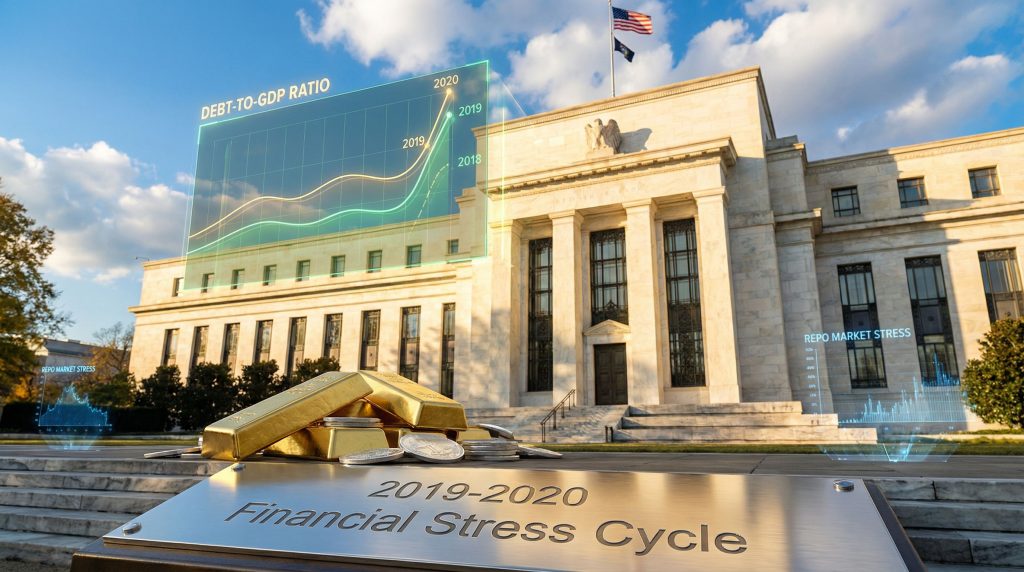
The modern financial system operates under a delicate balance of debt, liquidity, and monetary intervention that has become increasingly fragile over the past two decades. Understanding how central banks navigate policy transitions requires recognising that massive debt accumulation across government, corporate, and household sectors fundamentally constrains policy options. When debt-to-GDP ratios reach critical thresholds, traditional monetary tightening becomes economically destructive, forcing policymakers into recurring cycles of accommodation regardless of inflation objectives. Furthermore, the signs the Fed is quietly pivoting toward renewed accommodation are becoming increasingly apparent through operational data and funding market conditions.
Understanding the Federal Reserve's Communication Strategy During Policy Transitions
Why Central Banks Avoid Announcing Major Pivots Publicly
Central bank communication operates on multiple layers, with official statements representing only the surface level of actual policy implementation. Federal Reserve officials deliberately employ careful language construction to avoid explicit acknowledgment of major policy reversals, particularly when those reversals contradict previously stated objectives. This communication strategy reflects the political and market sensitivity around admitting that tightening policies have failed or that economic conditions require immediate accommodation.
The gap between official guidance and market reality creates opportunities for institutional investors who can decode the subtle signals embedded in Federal Reserve operations. When policymakers face genuine constraints due to debt dynamics or funding market stress, their public communications often lag behind actual policy adjustments by several weeks or months.
The Difference Between Official Guidance and Actual Implementation
Professional market participants focus on Federal Reserve balance sheet changes, facility usage patterns, and operational adjustments rather than relying solely on press releases or FOMC statements. The Standing Overnight Repo Facility usage, Treasury purchase patterns, and reserve management operations provide more accurate signals about policy direction than forward guidance language.
Historical analysis reveals consistent patterns where Federal Reserve officials maintain hawkish rhetoric while simultaneously implementing accommodative measures through technical adjustments. This approach allows policymakers to address immediate funding stress without explicitly abandoning inflation-fighting credibility.
How Market Participants Decode Fed Signals Beyond Press Releases
Sophisticated investors monitor overnight funding rates, repo market conditions, and Federal Reserve facility usage data to identify policy shifts before they appear in official communications. The Federal Reserve's own operational data, published with short delays, provides concrete evidence of balance sheet expansion or contraction that often contradicts stated policy intentions.
Quarter-end and year-end funding market dynamics create predictable spikes in repo facility usage, but sustained elevated usage beyond these periods indicates underlying systemic stress rather than routine balance sheet management. When private markets require Federal Reserve backstopping for routine short-term funding, this signals liquidity scarcity or prohibitively expensive private funding conditions.
When big ASX news breaks, our subscribers know first
How Do Precious Metals Markets Reveal Underlying Monetary Stress?
Gold Price Volatility as a Leading Economic Indicator
Precious metals markets respond to underlying monetary conditions before traditional economic indicators reflect policy stress. Gold and silver price movements often anticipate Federal Reserve policy reversals by several months, as these markets price in the long-term implications of debt dynamics and currency debasement policies.
The 2019 financial stress period demonstrated how quickly precious metals markets can identify systemic fragility. During that cycle, gold prices began advancing in early 2019 while equity markets continued reaching new highs, correctly anticipating that Federal Reserve tightening would prove unsustainable given underlying debt conditions.
Gold Performance During Fed Policy Reversals
| Period | Gold Price Change | Policy Reversal Timeline | Duration |
|---|---|---|---|
| 2019 Repo Crisis | +18.9% | September – October 2019 | 6 weeks |
| 2008 Financial Crisis | +25.1% | October – December 2008 | 8 weeks |
| 2020 Pandemic Response | +27.5% | March – April 2020 | 4 weeks |
| 1970s Stagflation | +2,200% | 1971 – 1980 | 9 years |
Why Predictions in Precious Metals Often Miss the Mark
Conventional financial analysis frequently mischaracterises precious metals price appreciation as speculative excess rather than recognition of underlying monetary fundamentals. These "bubble" predictions typically fail because they focus on sentiment metrics and relative valuation measures rather than the structural forces driving long-term demand for monetary alternatives.
Precious metals function as early warning systems for currency debasement policies and debt sustainability concerns. When central banks face genuine constraints between maintaining price stability and preserving financial system stability, precious metals markets anticipate the inevitable choice in favour of accommodation and liquidity provision.
The Relationship Between Currency Debasement and Safe Haven Demand
Physical precious metals demand increases during periods when currency regimes demonstrate unsustainable debt trajectories and recurring intervention requirements. Unlike paper assets, gold and silver cannot be created through monetary policy and maintain purchasing power across extended periods of currency debasement.
The modern monetary system's dependence on continuous intervention and balance sheet expansion creates structural demand for assets that exist outside the debt-based financial framework. Central bank gold accumulation by emerging market nations reflects growing recognition that dollar-denominated reserves carry counterparty risk through Federal Reserve policy decisions. This trend supports the historic gold surge that many analysts are tracking.
What Does Austrian Business Cycle Theory Predict About Current Market Conditions?
The Structural Problems with Credit-Driven Economic Expansion
Austrian Business Cycle Theory provides a framework for understanding how artificially suppressed interest rates distort economic calculation and resource allocation. When central banks maintain rates below market-clearing levels, this encourages borrowing and investment in projects that appear profitable under subsidised capital costs but cannot sustain profitability when rates normalise.
The modern economy operates under conditions where credit expansion consistently exceeds real productive capacity growth, creating systematic malinvestment that must eventually be liquidated through recession or currency debasement.
The credit expansion mechanism operates predictably: artificially low rates → increased borrowing → boom conditions → normalisation attempts → bust emergence. This cycle reflects the structural impossibility of maintaining subsidised capital costs indefinitely without encountering real resource constraints.
Why Easy Money Creates Unsustainable Investment Patterns
Credit expansion distorts the capital structure by making long-duration investments appear more attractive relative to short-duration projects. This leads to overconsumption in capital goods sectors and insufficient investment in consumer goods production, creating bottlenecks and inflationary pressure when the expansion reaches physical limits.
The pattern repeats because policymakers focus on financial metrics rather than real economic foundations. Expanding money and credit can increase nominal activity temporarily, but it cannot create additional productive resources or overcome physical constraints on output growth.
Real Resource Constraints vs. Financial Engineering Solutions
The fundamental limitation of monetary expansion becomes apparent when economies encounter supply-side constraints. Labour markets, commodity supplies, and productive capacity represent real limits that cannot be overcome through financial engineering or additional credit creation.
When credit expansion pushes economic activity beyond sustainable levels, the system hits what can be characterised as a "brick wall" of real constraints. Projects initiated under easy money conditions stall, malinvestments become apparent, and the boom loses foundation regardless of continued monetary accommodation.
How Does Excessive Debt Accumulation Force Central Bank Policy Reversals?
The Debt Sensitivity Problem in Modern Financial Systems
Contemporary debt levels across government, corporate, and household sectors create unprecedented interest rate sensitivity throughout the economic system. Federal government debt exceeding $33 trillion means each percentage point increase in average borrowing costs adds hundreds of billions in annual interest expense, creating fiscal pressure for rate reductions.
This situation closely mirrors the conditions examined in our analysis of US inflation & debt, where debt dynamics fundamentally constrain policy options.
Current U.S. Debt Metrics (Q4 2025)
| Debt Category | Total Amount | % of GDP | Interest Sensitivity |
|---|---|---|---|
| Federal Government | $33.2 trillion | 125% | High |
| Corporate Non-Financial | $12.1 trillion | 46% | Very High |
| Household | $17.8 trillion | 68% | Moderate |
| Financial Sector | $19.3 trillion | 73% | Extreme |
Why Higher Interest Rates Become Economically Destructive
Years of easy money policies reward leverage accumulation, making the entire economy dependent on continued access to cheap credit. When rates rise, debt service costs increase simultaneously across all economic sectors, creating synchronised pressure that overwhelms the benefits of monetary tightening.
Corporate debt structures developed under low-rate environments cannot sustain profitability when refinancing costs increase substantially. Household debt payments consume rising portions of disposable income, reducing consumption and economic growth. Government interest expense crowds out other spending priorities or forces deficit expansion.
Government, Corporate, and Household Leverage Metrics to Watch
Federal government interest expense as a percentage of total revenues provides a critical threshold metric. When interest costs exceed 15-20% of government revenues, political pressure for rate reduction becomes overwhelming regardless of inflation conditions. Current projections suggest this threshold could be reached with sustained rates above 4.5-5%.
Corporate debt-to-EBITDA ratios across non-financial sectors indicate refinancing stress potential. Historical analysis suggests widespread corporate distress emerges when average borrowing costs exceed 6-7% for investment-grade issuers and 9-10% for high-yield borrowers, levels that become problematic with Federal Reserve target rates above 4%.
What Do Repo Market Stress Signals Tell Us About System Liquidity?
Understanding the Federal Reserve's Standing Overnight Repo Facility
The repo market functions as the plumbing system for short-term liquidity across financial institutions. Repo transactions involve short-term borrowing backed by collateral such as Treasury securities and mortgage-backed securities, allowing banks and dealers to manage daily funding needs and regulatory balance sheet requirements.
Step-by-Step Repo Market Mechanics:
- Financial institution needs overnight funding to meet regulatory requirements
- Institution pledges high-quality collateral (typically Treasury securities) to counterparty
- Counterparty provides cash in exchange for collateral with agreement to reverse transaction next day
- Interest rate charged reflects supply and demand for overnight funds
- Federal Reserve Standing Overnight Repo Facility serves as backstop when private market rates spike
Normal vs. Abnormal Patterns in Short-Term Funding Markets
Repo facility usage typically spikes at quarter-end and year-end due to balance sheet accounting requirements and regulatory capital calculations. Financial institutions temporarily reduce lending to improve their reported leverage ratios and liquidity metrics, creating predictable funding stress that resolves within days.
However, sustained elevated usage beyond these mechanical periods indicates genuine liquidity scarcity or prohibitively expensive private funding conditions. When markets consistently require Federal Reserve intervention for routine short-term cash needs, this signals underlying system stress rather than temporary accounting adjustments.
Why Quarter-End Spikes Matter More Than Routine Fluctuations
The magnitude and duration of repo facility usage provides critical information about system health. Normal quarter-end spikes might reach $100-200 billion for 2-3 days before declining rapidly. Sustained usage above $300 billion or persistence beyond one week suggests structural funding problems rather than routine balance sheet management.
Recent patterns showing elevated repo facility usage extending into early January 2026, well beyond normal year-end adjustments, indicates private liquidity markets cannot provide adequate funding at reasonable rates. This mirrors conditions from September 2019 when repo rates spiked to 10% overnight before Federal Reserve intervention.
Is the Federal Reserve Already Implementing Quantitative Easing Without Calling It QE?
Balance Sheet Expansion Through Technical Adjustments
Federal Reserve officials can implement substantial liquidity provision while avoiding the politically sensitive quantitative easing terminology through various operational mechanisms. Treasury purchase operations, reverse repo facility management, and standing facility provisions can effectively expand the money supply without explicitly announcing QE programs.
The distinction between "liquidity operations" and "quantitative easing" becomes semantic when the net effect involves substantial balance sheet expansion and increased system liquidity. Market participants focus on the operational reality of Federal Reserve asset purchases and facility usage rather than the descriptive language used in policy statements.
According to recent analysis, signs the Fed is quietly pivoting are becoming increasingly apparent through these technical adjustments and operational changes.
The Political Economics of Avoiding QE Terminology
Public and political opposition to explicit QE programs creates incentives for Federal Reserve officials to implement accommodation through less visible operational channels. Emergency lending facilities, temporary purchase programs, and "technical" balance sheet adjustments can achieve similar monetary expansion without triggering the political backlash associated with announced QE.
This approach allows policymakers to address immediate funding stress while maintaining the appearance of policy consistency. However, the economic effects remain identical regardless of the terminology employed, as markets respond to actual liquidity conditions rather than official program descriptions.
How Reserve Management Purchases Affect Market Liquidity
Federal Reserve asset purchases under any operational framework increase bank reserves and system liquidity. Whether conducted as "quantitative easing," "operation twist," or "reserve management," these purchases inject money into the financial system and support asset prices across multiple markets.
The 2019 precedent demonstrates how rapidly "technical" operations can expand into substantial accommodation. What began as emergency repo market intervention evolved into sustained balance sheet growth exceeding $400 billion within months, effectively implementing QE without formal announcement.
The next major ASX story will hit our subscribers first
Why Did the 2019-2020 Financial Stress Cycle Never Fully Resolve?
The Pandemic as a Policy Reset Rather Than Economic Solution
The COVID-19 pandemic provided political cover for massive monetary and fiscal intervention that prevented the normal liquidation process required to clear malinvestments and reduce system leverage. Rather than allowing recession to restore sustainable debt levels and clear unproductive investments, policymakers implemented unprecedented stimulus that amplified existing imbalances.
This intervention delayed rather than resolved the underlying structural problems identified in 2019. Corporate debt levels increased rather than decreased, government deficits expanded dramatically, and asset bubbles grew larger through continued monetary accommodation. The pandemic response addressed symptoms while exacerbating root causes.
How Emergency Measures Became Permanent Market Features
Temporary emergency facilities and extraordinary monetary policies implemented during 2020 established new baseline expectations for Federal Reserve intervention. Markets now assume continuous liquidity provision and crisis-level accommodation as normal operating conditions rather than exceptional responses to genuine emergencies.
The Standing Overnight Repo Facility, expanded asset purchase programs, and enhanced lending facilities created permanent intervention infrastructure that market participants depend upon for normal functioning. Removing these supports would expose the underlying fragility that was temporarily masked rather than resolved.
Delayed Reckoning vs. Genuine Economic Recovery
The fundamental debt dynamics and structural imbalances that created 2019 stress conditions remain in place but at amplified levels. Total system debt increased by approximately $15 trillion during the pandemic period, making the economy even more sensitive to interest rate normalisation than it was before the crisis.
Rather than genuine recovery, the 2021-2023 period represented continued expansion of the same unsustainable patterns that created previous stress. Asset prices reached new extremes, corporate leverage increased, and government debt accelerated, setting the stage for an even more severe adjustment when accommodation becomes politically or economically impossible to maintain.
What Economic Scenarios Force Central Banks Into Policy Traps?
The Inflation vs. Financial Stability Dilemma
Central banks face an impossible choice when debt levels reach critical thresholds: maintain price stability through restrictive policy and risk financial system collapse, or preserve system stability through accommodation and accept accelerating inflation. This dilemma becomes acute when both inflation and financial instability rise simultaneously.
The modern economy cannot sustain both price stability and financial stability under current debt conditions. Attempting to control inflation through monetary tightening triggers debt service crises across multiple sectors, while maintaining low rates to support debt service undermines currency purchasing power and creates inflationary pressure.
Why Tightening Monetary Policy Risks System-Wide Failures
Interconnected debt relationships mean that corporate defaults, household bankruptcies, or government fiscal crises can rapidly cascade through the financial system. When total debt reaches 2-3 times GDP, relatively modest interest rate increases can trigger widespread insolvency across borrowers who assumed permanent access to cheap credit.
The 2008 financial crisis demonstrated how quickly localised stress can become systemic when debt levels are excessive. Current debt ratios exceed 2008 levels across most categories, suggesting even greater fragility to interest rate normalisation despite improved regulatory capital requirements.
The Political Pressure for Continuous Market Support
Electoral considerations create powerful incentives for policymakers to maintain asset prices and economic growth through monetary accommodation. Recession, market declines, or unemployment increases generate immediate political consequences, while currency debasement and inflation impose costs that are less visible and emerge more gradually.
Democratic political systems struggle to impose short-term pain for long-term stability when debt levels create dependency on continuous intervention. The path of least resistance involves maintaining accommodation until external constraints force adjustment through currency crisis or inflation acceleration beyond manageable levels.
How Should Investors Position for Recurring Monetary Intervention Cycles?
Real Assets as Protection Against Currency Debasement
Physical assets that cannot be created through monetary policy provide protection against recurring debasement cycles that have become structural features of modern monetary systems. Real estate, commodities, and precious metals maintain purchasing power across extended periods of currency depreciation while financial assets face counterparty risk through policy decisions.
The key insight involves recognising that monetary intervention cycles are not temporary emergencies but permanent features of debt-constrained systems. Investment allocation should reflect the reality that central banks will choose accommodation over stability whenever forced to make that choice.
The Strategic Case for Physical Precious Metals Allocation
Gold and silver serve unique functions as monetary assets that exist outside the debt-based financial system. Unlike stocks, bonds, or bank deposits, physical precious metals carry no counterparty risk and cannot be devalued through policy decisions or institutional failures.
Understanding current gold price forecast trends becomes crucial for positioning, whilst comprehensive investment strategy insights can guide broader portfolio allocation decisions.
Historical Performance During Monetary Policy Reversals
| Asset Class | 2019 Average Return | 2008 Crisis Return | 2020 Pandemic Return |
|---|---|---|---|
| Physical Gold | +18.9% | +25.1% | +27.5% |
| Physical Silver | +15.2% | +23.8% | +47.9% |
| S&P 500 | +31.5% | -37.0% | +18.4% |
| 10-Year Treasury | +9.7% | +20.1% | +11.3% |
| Real Estate | +5.8% | -19.7% | +13.9% |
Pre-1965 Silver Coins as Practical Inflation Hedges
Junk silver coins minted before 1965 contain 90% silver content and provide divisible, recognisable forms of precious metals ownership. These coins offer practical advantages over bullion for smaller transactions while providing the same protection against currency debasement as larger silver investments.
Pre-1965 dimes, quarters, and half dollars carry numismatic premium above silver content while remaining accessible to average investors. Their historical use as circulating currency provides familiar recognition that could prove valuable if confidence in fiat currency systems deteriorates significantly.
What Are the Long-Term Implications of Perpetual Easy Money Policies?
Purchasing Power Erosion as Deliberate Policy Outcome
Modern central banking operates on the assumption that moderate inflation represents successful policy rather than failure. The explicit 2% inflation target means currency purchasing power declines by approximately 22% per decade, transferring wealth from savers to borrowers and reducing real debt burdens across the economy.
This purchasing power erosion is not an accidental side effect but a deliberate policy tool for managing excessive debt levels. Currency debasement provides a politically acceptable method for reducing real debt burdens without explicit default or restructuring that would trigger immediate financial crisis.
The Impossibility of Returning to Normal Interest Rate Environments
Debt levels across government, corporate, and household sectors make return to historical interest rate norms economically impossible without triggering widespread insolvency. The "new normal" involves permanently suppressed rates and recurring intervention to maintain system stability.
Mathematical analysis of current debt service requirements suggests that sustained rates above 4-5% would consume unsustainable portions of income across multiple economic sectors. This creates a structural ceiling on interest rates regardless of inflation conditions, trapping central banks into accommodation policies.
Additionally, implementing effective diversification strategies becomes essential in this environment where traditional risk metrics may no longer provide adequate protection.
How Debt Dynamics Drive Future Policy Decisions
Future Federal Reserve policy decisions will be determined more by debt sustainability concerns than traditional inflation or employment mandates. When debt service costs threaten financial stability, policymakers will choose accommodation regardless of price stability objectives.
This dynamic ensures recurring cycles of attempted normalisation followed by rapid reversals when stress emerges. Each cycle increases total debt levels and amplifies sensitivity to rate changes, making future normalisation attempts even more difficult to sustain.
Furthermore, analysis from TalkMarkets suggests that market participants are increasingly focused on these structural debt constraints when making investment decisions.
Frequently Asked Questions
How can investors identify early signs of Fed policy shifts?
Monitor repo market facility usage, overnight funding rates, and Federal Reserve balance sheet changes rather than relying on official communications. Sustained repo facility usage above $200 billion outside quarter-end periods typically indicates policy accommodation regardless of official statements.
What makes repo market stress different from other financial indicators?
Repo markets represent the foundational plumbing for short-term funding across the financial system. Stress in repo markets indicates that basic liquidity provision is failing, which affects all other financial markets and typically forces immediate central bank intervention.
Why do precious metals respond to monetary policy changes before other assets?
Gold and silver markets price in the long-term implications of currency debasement policies while other markets focus on short-term growth effects. Precious metals anticipate the inevitable choice between financial stability and price stability when central banks face genuine policy constraints.
What historical precedents exist for the current debt-to-GDP situation?
Current U.S. total debt-to-GDP ratios exceed 350%, surpassing levels that triggered currency crises in emerging markets during the 1990s and 2000s. The only historical precedents in developed nations occurred during major wars, typically resolved through default, inflation, or financial repression.
Preparing for the Next Phase of Monetary Expansion
Why the Current Setup Resembles Previous Crisis Periods
The combination of excessive debt levels, repo market stress, and Federal Reserve facility dependence closely parallels conditions from 2019 before the pandemic intervention reset policy expectations. Current stress signals suggest the underlying problems that emerged in 2019 have returned with greater intensity due to increased debt loads.
The Urgency of Portfolio Positioning Before Policy Announcements
Investment positioning becomes most effective before central bank policy shifts receive official acknowledgment. Once accommodation policies are formally announced, asset prices typically adjust rapidly, reducing the opportunity for defensive positioning at reasonable valuations.
The signs the Fed is quietly pivoting toward renewed accommodation are already visible through operational data and funding market conditions. Waiting for official policy announcements means accepting higher costs for protective assets and reduced opportunity to benefit from early trend recognition.
Building Financial Resilience in an Era of Monetary Instability
Long-term financial resilience requires recognising that monetary intervention cycles have become permanent features rather than temporary emergency responses. Portfolio construction should assume recurring debasement policies and plan for purchasing power preservation rather than nominal return maximisation.
Physical precious metals allocation provides insurance against policy mistakes and currency regime instability. While gold and silver prices fluctuate in the short term, their long-term trajectory reflects the mathematical impossibility of returning to sound money principles under current debt conditions.
Disclaimer: This analysis contains forward-looking statements and speculative conclusions based on current economic conditions and debt dynamics. Past performance of precious metals and other assets does not guarantee future results. Investment decisions should consider individual financial circumstances and risk tolerance. Economic forecasts and policy predictions involve substantial uncertainty and may not materialise as expected.
Looking to Position Ahead of Central Bank Policy Shifts?
Discovery Alert's proprietary Discovery IQ model delivers real-time alerts on significant ASX mineral discoveries, instantly empowering subscribers to identify actionable opportunities whilst central banks navigate unprecedented monetary challenges. With precious metals markets often anticipating policy reversals months in advance, begin your 30-day free trial today to secure your market-leading advantage during these periods of monetary instability.