May 21, 2026
Understanding Federal and State Regulatory Mechanisms
Water quality governance in coal mining operations operates through a complex network of federal oversight and state-level implementation. The foundation rests on federal environmental protection standards, particularly the Clean Water Act's National Pollutant Discharge Elimination System (NPDES), which requires mining operations to obtain permits before discharging into waterways. These permits establish numerical limitations for pollutant concentrations and monitoring requirements that mining companies must follow.
Transparency in coal mine water releases begins with understanding the regulatory framework. Under the EPA Coal Mining Effluent Guidelines (40 CFR Part 434), mining operations face specific compliance protocols that govern discharge rates and chemical composition standards. However, the implementation of these federal guidelines varies significantly across different jurisdictions, creating a patchwork of transparency requirements that can leave information gaps for public oversight.
Furthermore, mining permitting basics continue to evolve as environmental concerns intensify across different jurisdictions.
Queensland's Environmental Authority Framework
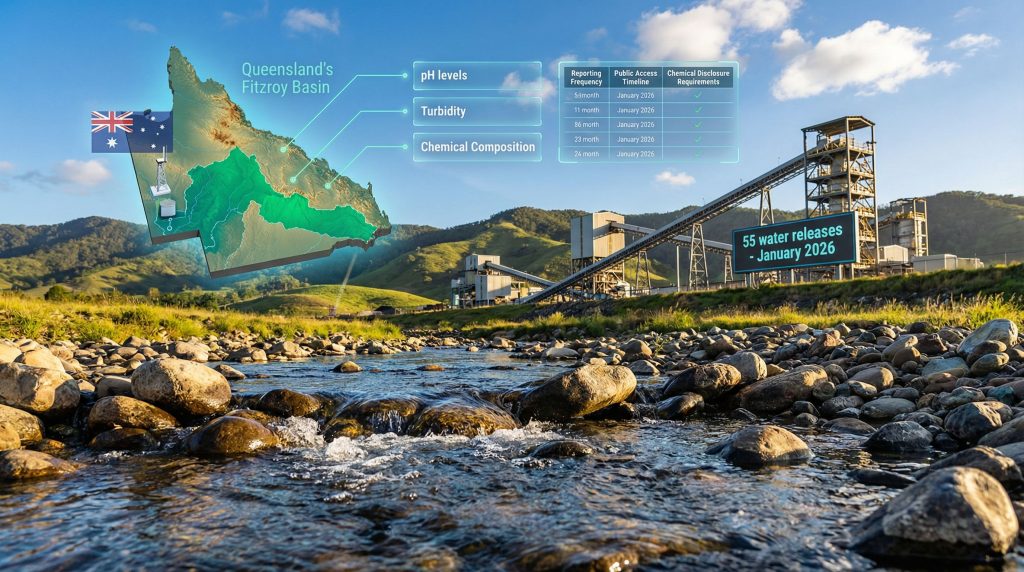
Queensland's regulatory system demonstrates how state-level frameworks translate federal requirements into operational practice. The Department of Environment, Tourism, Science and Innovation (DETSI) oversees a network of 52 coal mines within the Fitzroy Basin, each operating under specific environmental authorities that permit controlled water releases.
The Queensland system features real-time monitoring capabilities through an online portal that provides daily updates on which mines are actively releasing water. During January 2026, this system tracked 55 separate water release events across the basin, demonstrating both the frequency of discharge activities and the challenge of comprehensive oversight.
However, the system reveals significant transparency gaps. While real-time data identifies which mines are releasing water and their locations, detailed information about chemical composition and cumulative volumes requires accessing 28-day compiled reports through a separate public register portal. In addition, this fragmented approach creates accessibility challenges for stakeholders seeking comprehensive impact assessments.
Comparative State Approaches to Disclosure
Different mining jurisdictions have developed varying approaches to transparency in coal mine water releases. The following table illustrates key differences in regulatory compliance frameworks:
| Jurisdiction | Reporting Frequency | Public Access Timeline | Chemical Disclosure Requirements |
|---|---|---|---|
| Queensland | Real-time updates | Immediate online portal | Limited in real-time data |
| Wyoming | Annual comprehensive | 60-day response standard | Comprehensive baseline profiles |
| Colorado | Quarterly assessments | 30-day standard timeline | Full pollutant characterization |
Consequently, these varying approaches create inconsistent public access to critical environmental information across mining jurisdictions.
When big ASX news breaks, our subscribers know first
Examining Current Monitoring Infrastructure and Public Access Challenges
The digital infrastructure supporting coal mine water discharge transparency reveals significant limitations in public information access. While technological capabilities exist for comprehensive monitoring, the current system architecture creates barriers to meaningful public oversight and cumulative impact assessment.
Moreover, data-driven mining tech offers potential solutions to address these transparency challenges through advanced monitoring systems.
Real-Time Data Capabilities and Limitations
Queensland's DETSI portal provides immediate notification when mines begin water releases, including mine identification and release site coordinates. During the January 2026 flood period, the system tracked a peak discharge day when 19 mines released water from 26 separate sites at a combined rate exceeding 123,000 litres per second.
Despite this real-time capability, the system lacks integrated aggregation functions that would allow public users to understand cumulative impacts. Environmental researchers must manually compile data across multiple mine records to calculate basin-wide discharge totals, creating an information asymmetry between regulatory agencies with access to compiled data and public stakeholders seeking comprehensive oversight.
The technical architecture demonstrates this limitation clearly:
- Available in real-time: Mine identification, release location coordinates, discharge initiation notifications
- Missing from real-time portal: Chemical composition details, discharge volumes, cumulative basin totals
- Delayed access requirements: Comprehensive data through 28-day reports with up to 60-day response times
Stakeholder Information Access Barriers
The fragmented data structure creates distinct challenges for different stakeholder groups seeking transparency in coal mine water releases. Environmental advocacy organisations must invest significant resources in manual data compilation to understand cumulative impacts across the 140,000+ square kilometre Fitzroy Basin catchment.
Agricultural and municipal water users downstream face particular information challenges. While individual mine releases may represent small percentages of total basin flow (January 30, 2026 releases accounted for approximately 0.006% of total basin water flow), the cumulative effect of multiple simultaneous releases lacks comprehensive public documentation.
Community access to technical interpretation resources remains limited. The current system provides raw discharge data but offers minimal context for understanding environmental significance or potential health implications for downstream water users.
For instance, advanced waste management solutions could improve both operational efficiency and transparency outcomes.
The current monitoring infrastructure demonstrates technological capability but fails to provide accessible, aggregated information that enables meaningful public oversight of cumulative environmental impacts.
Environmental and Economic Implications of Current Disclosure Standards
The environmental stakes surrounding coal mine water discharge transparency extend far beyond regulatory compliance, encompassing the health of Australia's largest reef catchment and the economic interests of multiple downstream sectors. The Fitzroy Basin's 20,000 kilometres of connected waterways carry potential contaminants directly to the Great Barrier Reef, making transparency a critical factor in marine ecosystem protection.
Great Barrier Reef Catchment Vulnerability Assessment
Satellite imagery from recent discharge events reveals visible contamination plumes extending from mining sites toward coastal waters. These pollutant ribbons demonstrate the direct pathway between mining operations and reef ecosystems, highlighting the importance of comprehensive monitoring and public disclosure.
The scale of potential impact becomes clear when considering the basin's geographic scope. With 52 coal mines permitted to discharge within this reef catchment, the cumulative effect of simultaneous releases during flood periods represents a significant environmental management challenge. Current transparency mechanisms provide insufficient data for comprehensive cumulative impact assessment.
Environmental advocates have identified specific concerns about multiple mines releasing water simultaneously without adequate public documentation of combined pollutant loads. This represents a critical gap in ecosystem protection planning and public health safeguarding.
Agricultural and Municipal Water Supply Considerations
Downstream water users across the Fitzroy Basin depend on maintained water quality for essential operations. Agricultural irrigation systems, livestock watering, and municipal drinking water treatment facilities all face potential impacts from mining discharge events.
The economic implications of inadequate transparency extend throughout these sectors:
- Municipal water treatment: Enhanced treatment costs during contamination events
- Agricultural irrigation: Crop damage risk from contaminated water sources
- Livestock operations: Stock health impacts from polluted watering sources
- Property values: Long-term degradation affecting rural land valuations
Current disclosure practices provide insufficient advance warning for downstream users to implement protective measures during major discharge events. The 28-day reporting delay means agricultural and municipal operators lack real-time access to chemical composition data needed for operational decision-making.
Industry Compliance Cost Structures and Competitive Implications
Enhanced transparency requirements represent both compliance costs and competitive considerations for mining operations. Companies investing in advanced monitoring technologies and comprehensive reporting systems may face higher operational costs compared to those meeting only minimum disclosure requirements.
However, transparency standardisation could level competitive playing fields while improving overall environmental accountability. Mining operations demonstrating superior environmental stewardship through comprehensive disclosure might gain competitive advantages through improved community relations and regulatory predictability.
The current regulatory framework's inconsistent transparency requirements across jurisdictions create compliance complexity for companies operating in multiple locations. Standardised disclosure protocols could reduce administrative burden while improving public oversight capabilities.
International Best Practices for Mining Water Discharge Transparency
Global mining jurisdictions have developed innovative approaches to water discharge transparency that could enhance Australian regulatory frameworks. These international models demonstrate how technological capabilities and regulatory innovation can improve public oversight while maintaining operational flexibility for mining companies.
United States EPA Coordination Models
The U.S. Environmental Protection Agency has implemented comprehensive tracking systems in major coal mining regions, particularly through the Appalachian Surface Coal Mining Enhanced Coordination Procedure. This framework provides integrated public access to permit information, real-time discharge monitoring, and cumulative impact assessments across multiple mining operations.
Key features of the U.S. approach include:
- Integrated permit tracking: Single online portal consolidating information across multiple mines
- Automated notification systems: Real-time alerts for threshold exceedances
- Cumulative impact modelling: Public access to watershed-level pollution load calculations
- Enhanced enforcement transparency: Public documentation of violations and remedial actions
The Stream Protection Rule implementation, while facing political challenges, demonstrated advanced approaches to watershed protection that prioritise cumulative impact assessment over individual site evaluation.
European Union Water Framework Directive Applications
European mining jurisdictions operating under the Water Framework Directive have developed sophisticated multi-stakeholder consultation protocols that could inform Australian transparency enhancement. These systems emphasise precautionary principles in discharge permitting and comprehensive public participation in environmental decision-making.
Notable elements include:
- Integrated catchment management: Watershed-level planning that considers cumulative impacts
- Multi-stakeholder governance: Formal roles for community representatives in oversight processes
- Adaptive management protocols: Regular review and adjustment of discharge standards based on environmental monitoring
- Public participation requirements: Mandatory consultation periods for significant discharge permit modifications
Policy Reform Pathways for Enhanced Environmental Accountability
Effective policy reform must balance legitimate industry operational needs with comprehensive environmental protection and public transparency requirements. The challenge lies in developing adaptive frameworks that can respond to changing environmental conditions while maintaining consistent public oversight capabilities.
Furthermore, recent regulatory permit reforms have highlighted the need for balanced approaches to environmental protection and industry operations.
Adaptive Management Framework Development
Climate change intensifies the complexity of water discharge management as extreme weather events become more frequent and severe. Regulatory frameworks must evolve to address emergency discharge scenarios while maintaining environmental protection standards and transparency in coal mine water releases requirements.
Advanced adaptive management approaches could include:
- Seasonal discharge optimisation: Variable standards reflecting natural flow patterns and ecosystem vulnerability cycles
- Climate resilience planning: Long-term strategies for managing discharge during extreme weather events
- Technology integration: Automated monitoring systems providing real-time data for adaptive decision-making
- Predictive modelling capabilities: Early warning systems for potential environmental threshold exceedances
Multi-Stakeholder Governance Enhancement
Transparent governance requires meaningful participation from diverse stakeholder groups including environmental organisations, agricultural water users, municipal authorities, and affected communities. Current regulatory processes often limit public input to formal comment periods that may not address ongoing operational concerns.
Enhanced governance mechanisms could establish:
- Community advisory panels: Regular oversight groups with access to comprehensive discharge data
- Independent scientific review: External expertise for evaluating cumulative impact assessments
- Conflict resolution procedures: Structured processes for addressing transparency disputes between stakeholders
- Performance-based incentive systems: Recognition and benefits for companies exceeding minimum transparency standards
Economic Incentive Alignment Strategies
Policy reforms can align economic incentives with environmental accountability through innovative fee structures and compliance recognition programmes. These approaches reward superior environmental stewardship while ensuring adequate funding for regulatory oversight capabilities.
Potential incentive mechanisms include:
| Incentive Type | Implementation Method | Environmental Benefit | Economic Impact |
|---|---|---|---|
| Performance-based fees | Reduced permitting costs for enhanced disclosure | Improved public oversight | Lower compliance costs for industry leaders |
| Transparency recognition | Public certification programmes | Community trust building | Competitive market advantages |
| Insurance adjustments | Premium reductions for comprehensive monitoring | Risk reduction incentives | Lower operational insurance costs |
The Role of Environmental Advocacy in Transparency Enhancement
Environmental advocacy organisations serve essential watchdog functions in mining transparency, but their effectiveness depends on access to comprehensive, timely information. Current disclosure limitations restrict advocacy groups' ability to provide meaningful oversight and public education about cumulative environmental impacts.
Watchdog Function Optimisation Through Better Data Access
Environmental advocacy organisations invest considerable resources in manual data compilation to understand coal mine water discharge patterns. During January 2026, advocacy researchers manually tracked daily website updates to identify that 19 mines released water simultaneously at rates exceeding 123,000 litres per second.
This resource-intensive approach highlights systemic inefficiencies in current transparency frameworks. Enhanced data accessibility could enable advocacy organisations to focus resources on analysis and public education rather than basic information gathering.
Optimised watchdog capabilities would include:
- Automated data aggregation: Real-time compilation of basin-wide discharge information
- Threshold alert systems: Notifications when cumulative releases approach environmental concern levels
- Historical trend analysis: Long-term pattern recognition for identifying systematic issues
- Chemical composition tracking: Public access to detailed contamination data for health risk assessment
Collaborative Monitoring Partnership Models
International examples demonstrate successful partnerships between environmental organisations, academic researchers, and industry stakeholders in comprehensive water quality monitoring. These collaborative approaches can enhance data quality while reducing regulatory burden and improving public trust.
Effective partnership models incorporate:
- Industry-NGO data sharing: Joint monitoring protocols with independent verification
- University research integration: Academic expertise for long-term environmental impact studies
- Indigenous knowledge systems: Traditional ecological knowledge contributing to watershed health assessment
- Citizen science programmes: Community-based monitoring expanding geographic coverage
The following table illustrates different advocacy tools and their effectiveness in promoting transparency:
| Advocacy Tool | Implementation Cost | Effectiveness Rating | Regulatory Integration Potential |
|---|---|---|---|
| Real-time monitoring applications | Low | High | Moderate |
| Legal information requests | Medium | Moderate | High |
| Independent scientific studies | High | Very High | Low |
| Community education programmes | Medium | High | Moderate |
The next major ASX story will hit our subscribers first
Future Technologies Transforming Water Discharge Transparency
Emerging technologies offer unprecedented opportunities to enhance coal mine water discharge transparency while reducing compliance costs and improving environmental protection. The integration of automated monitoring systems, blockchain verification, and artificial intelligence could fundamentally transform how stakeholders access and understand discharge information.
Additionally, industry innovation trends suggest that technological advancement will continue to reshape environmental monitoring capabilities.
Automated Monitoring and Immutable Record Systems
Internet of Things (IoT) sensor networks enable continuous, automated monitoring of water discharge quality and quantity with minimal human intervention. These systems can provide real-time chemical composition analysis, flow rate measurement, and automated reporting to regulatory databases.
Blockchain technology offers the potential for immutable discharge records that prevent data manipulation while enabling public verification of monitoring accuracy. This technology could address current concerns about data reliability and regulatory enforcement consistency.
Advanced artificial intelligence systems can provide pattern recognition capabilities for anomaly detection, identifying unusual discharge patterns that may indicate equipment failures or regulatory violations. These systems could enable predictive maintenance and early warning capabilities that prevent environmental incidents.
Public Access Platform Innovation
Next-generation public information platforms could transform stakeholder access to coal mine water discharge data through mobile applications, geographic information system integration, and predictive modelling capabilities.
Key technological enhancements include:
- Mobile alert systems: Real-time notifications for nearby discharge events
- Interactive mapping platforms: Geographic visualisation of discharge locations and contamination plumes
- Predictive impact modelling: Forecasting downstream water quality effects based on current discharge patterns
- Multi-language accessibility: Breaking down language barriers for diverse community stakeholders
Climate Change Adaptation in Regulatory Frameworks
Climate change will likely increase the frequency and intensity of extreme weather events requiring emergency water releases from mining operations. Regulatory frameworks must evolve to accommodate these changing conditions while maintaining environmental protection standards and transparency in coal mine water releases requirements.
Extreme Weather Event Response Protocols
Traditional regulatory approaches assume relatively predictable seasonal patterns for water discharge management. However, intensifying weather volatility requires more flexible, adaptive regulatory responses that can maintain environmental protection during emergency conditions.
Enhanced emergency response protocols should address:
- Rapid authorisation procedures: Streamlined approval processes for emergency releases during flood events
- Real-time environmental monitoring: Continuous assessment during and after extreme weather events
- Public notification systems: Immediate community alerts during emergency discharge scenarios
- Post-event recovery planning: Systematic assessment and remediation following extreme weather releases
Long-Term Ecosystem Resilience Planning
Climate adaptation requires regulatory frameworks that consider long-term ecosystem resilience rather than focusing solely on immediate compliance metrics. This approach necessitates comprehensive watershed planning that integrates mining operations with broader ecosystem health objectives.
Resilience planning elements include:
- Cumulative impact thresholds: Science-based limits on total pollution loads across multiple mining operations
- Ecosystem recovery protocols: Systematic approaches for restoring watershed health following major discharge events
- Adaptive capacity building: Regulatory flexibility mechanisms that can respond to unprecedented environmental conditions
- International cooperation frameworks: Coordination with neighbouring jurisdictions for transboundary watershed management
Future regulatory frameworks must balance operational flexibility with environmental protection, ensuring that transparency requirements evolve alongside changing climate conditions and technological capabilities.
The evolution of coal mine water discharge transparency represents a critical intersection of environmental protection, public health, and economic development. As extreme weather events increase in frequency and technological capabilities expand, regulatory frameworks must adapt to provide comprehensive public oversight while supporting sustainable mining operations. Enhanced transparency serves not only environmental protection goals but also builds the community trust necessary for long-term industry sustainability and effective watershed management in an era of climate uncertainty.
Moreover, comprehensive water contamination research continues to demonstrate the urgent need for improved transparency in coal mine water releases across Australian mining operations.
Looking to Navigate Mining Investment Opportunities?
Discovery Alert's proprietary Discovery IQ model delivers instant notifications on significant ASX mineral discoveries, empowering subscribers to identify actionable opportunities ahead of the broader market. Explore the potential returns from historic discoveries by visiting Discovery Alert's dedicated discoveries page and begin your 14-day free trial today to secure your competitive advantage.