August 5, 2026
The Structural Flaw at the Heart of Modern Money
Every financial system in history has carried within it the seeds of its own undoing. The end of fiat currency and gold standard reset is not merely a fringe theory but a recurring historical pattern playing out across centuries. When governments discovered they could issue money without constraint, the temptation to spend beyond their means became irresistible, and the consequences of that decision have been accumulating for more than half a century.
How Fiat Currency Became an Unlimited Government Credit Card
The fundamental problem with fiat money is architectural. Without a hard anchor, currency issuance becomes a political tool rather than an economic one. Governments facing electoral pressure, war financing, or social obligations can simply expand the money supply rather than confront the difficult trade-offs that sound money would force upon them.
The result is a system that functions like a credit card with no spending limit and no minimum payment requirement, at least not in the short term. Over decades, however, the compounding effect of this arrangement becomes impossible to ignore. Interest payments on accumulated debt begin consuming an ever-larger share of government revenue, deficits widen further, and the currency's purchasing power erodes steadily.
The 1971 Nixon Shock: When the Last Gold Anchor Was Cut
The definitive turning point arrived in August 1971, when U.S. President Richard Nixon suspended the dollar's convertibility into gold. The Nixon shock effectively ended the Bretton Woods system that had governed international monetary relations since 1944, removing the last external constraint on dollar creation and setting the template for a globally unanchored fiat monetary order.
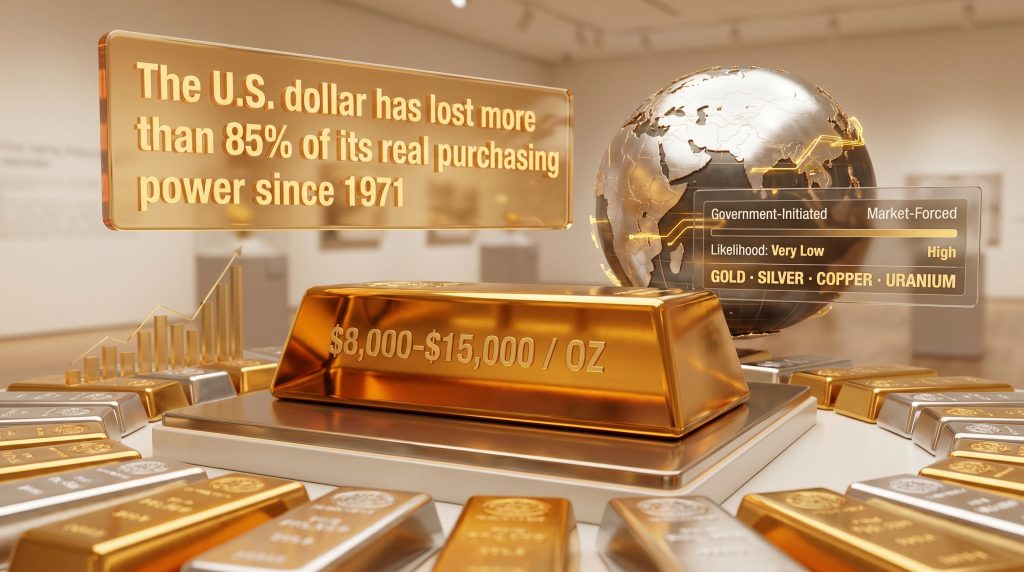
The consequences have been measurable and continuous. Since that pivotal moment, the U.S. dollar has lost more than 85% of its real purchasing power, a trajectory that is not a future prediction but an observable historical fact. A long-term chart of dollar purchasing power reveals a line that has moved in one consistent direction: downward.
Why Every Fiat System in History Has Eventually Been Repriced by Reality
No purely fiat monetary system has survived indefinitely in its original form. From ancient Rome's debasement of silver coinage to the Weimar hyperinflation of the 1920s and modern Argentina's recurring currency crises, the pattern repeats with remarkable consistency. The mechanism may differ, but the underlying cause is always the same: the removal of monetary discipline eventually allows imbalances to compound beyond the capacity of the system to absorb them.
The collapse of fiat purchasing power is not a future prediction. It is an ongoing process. Since 1971, the U.S. dollar has lost more than 85% of its real purchasing power, a trajectory that accelerates with each successive debt cycle.
When big ASX news breaks, our subscribers know first
What Does a Monetary Reset Actually Mean?
The term monetary reset is frequently invoked but rarely defined with precision. It does not mean the elimination of money as a concept. Money, as a communication medium for expressing value and a mechanism for exchange and storage, is a permanent feature of organised society. What is at stake is not money itself but the form that money takes, and whether that form continues to be one untethered from any real-world constraint.
Defining the Reset: A Process vs. a Single Event
A monetary reset is best understood as a transition rather than a moment. The purchasing power deterioration already underway constitutes the early phase of that transition. The question is not whether a reset will occur but what the catalyst for its acceleration will be, and whether the final repricing will be managed or disorderly.
Will Governments Choose a Reset, or Will Markets Force One?
History suggests that voluntary, government-initiated monetary reforms are rare. Governments tend to exhaust every available tool before conceding that the existing system is no longer viable. The more realistic scenario is one in which market forces, specifically a collapse in confidence, drive the transition.
| Reset Trigger | Government-Initiated | Market-Forced |
|---|---|---|
| Likelihood | Very Low | High |
| Mechanism | Planned devaluation + revaluation | Confidence collapse + capital flight |
| Historical Precedent | Rare | Weimar Germany, Argentina, Zimbabwe |
| Gold's Role | Anchor asset | Emergency settlement infrastructure |
| Timeline | Controlled (years) | Disorderly (months) |
How Would a Gold Standard Reset Actually Work?
A common misconception is that returning to a gold standard would require abandoning paper currency entirely. In practical terms, that is not how such a system would function. Furthermore, under a gold-backed monetary arrangement, physical currency remains in circulation, wages are still paid in that currency, and everyday transactions proceed as before. The critical difference is that the currency unit is defined in terms of a fixed weight of gold, creating a hard constraint on its issuance.
The Mechanics of Daily Life Under a Gold-Backed Monetary System
For the average person, the experience of transacting in a gold-backed currency would feel largely similar to today. The currency remains in wallets, bank accounts, and payroll systems. What changes is the underlying guarantee: instead of a promise backed by nothing more than government credibility, the currency represents a defined claim on a real asset.
The deeper transformation is institutional. Central banks lose the ability to create money at will. Governments face genuine fiscal discipline. Deficit spending requires either raising taxes or reducing expenditures, rather than simply expanding the money supply.
Why the Transition Period Is More Dangerous Than the Destination
Critical Warning: The transition from fiat to a gold-backed system is not painless. Those holding currency-denominated assets, including government bond funds, bank deposits, and fixed-income instruments, face systematic wealth erosion during any devaluation phase. Those holding physical gold and hard commodities are structurally advantaged.
The transition requires devaluing the existing currency before linking it to gold, which systematically transfers wealth from currency holders to hard asset holders. This dynamic creates significant potential for social and political instability, which is precisely why governments resist initiating such transitions voluntarily. Yet that same instability may ultimately make a gold standard the least painful option available, compared to hyperinflation or a 1930s-style deflationary collapse.
Winners and Losers in a Monetary Reset: A Structural Breakdown
| Asset Class | Reset Impact | Why |
|---|---|---|
| Physical Gold | Strongly Positive | Revalued as settlement infrastructure |
| Physical Silver | Strongly Positive | Industrial + monetary dual demand |
| Government Bonds | Strongly Negative | Currency devaluation erodes real value |
| Bank Deposits (Fiat) | Negative | Purchasing power destruction |
| Real Estate (Paid Off) | Neutral to Positive | Utility value + inflation hedge |
| Bank Stocks | Highly Negative | Dollar-denominated asset exposure |
| Commodities (Broad) | Positive (post-correction) | Real asset capital rotation |
What Would a Gold Revaluation Actually Look Like?
One of the most striking implications of a genuine monetary reset is the price level at which gold would need to be set in order to credibly back the existing money supply. This is not a speculative number plucked from optimism but a mathematical exercise based on the relationship between the Federal Reserve's reported gold holdings and the current broad money supply.
Featured Snippet: What price would gold need to reach in a monetary reset? Independent monetary analysts estimate gold would need to be revalued to between $8,000 and $15,000 per ounce to credibly back the current U.S. money supply against existing Federal Reserve gold reserves, representing a revaluation of between 2x and 4x current market prices.
How Central Bank Accumulation Is Quietly Positioning the System for Transition
Perhaps the most revealing signal in the contemporary monetary landscape is not what central banks are saying but what they are doing. Central bank gold reserves shifted dramatically after decades of net selling, with institutions globally becoming consistent net buyers and accumulating substantial tonnage over multiple years.
This behaviour is not price-sensitive in the conventional sense. Furthermore, central bank gold buying appears driven by target tonnage levels, suggesting the motivation is strategic positioning rather than short-term return optimisation. The three most plausible strategic rationales are:
- Currency crisis insurance: The ability to defend or stabilise a national currency during a global confidence collapse.
- De-dollarisation positioning: Reducing dependence on U.S. dollar-denominated reserves as geopolitical relationships shift.
- Gold standard optionality: Maintaining the technical infrastructure to back a national currency with gold if and when political conditions make such a move feasible.
The BRICS Gold-Backed Trading Currency: A Blueprint Already in Motion
While a formal global gold standard remains what might be described as a quasi-secret in monetary policy circles, a more limited version of the concept is already taking shape. The BRICS bloc has advanced discussions around a trading currency backed by gold, designed to facilitate commerce among member nations outside the dollar system. This falls short of a comprehensive gold standard but represents a meaningful test of the concept in a real-world multilateral context.
Consequently, the role of gold in the monetary system is evolving rapidly, with geopolitical forces accelerating what market dynamics alone might have taken decades to produce.
What Signals Would Precede a Currency Crisis?
A fiat confidence collapse does not arrive without warning. Specific, observable dynamics tend to precede the terminal phase of a currency's credibility crisis. Investors who understand these signals are better positioned to act before the most severe consequences materialise.
The Five Early Warning Indicators of a Fiat Confidence Collapse
- Accelerating inflation that persists despite monetary tightening, indicating that rate increases alone cannot restore confidence.
- Capital flight from sovereign bond markets, where rising yields reflect declining willingness to hold government debt at any price.
- Central bank gold accumulation reaching critical mass, signalling institutional preparation for a post-dollar monetary architecture.
- Loss of reserve currency status in bilateral trade agreements, reducing the structural demand that has historically supported the dollar.
- Crackup boom dynamics, in which individuals and institutions convert currency into real assets immediately upon receiving it, rather than storing it as a medium of deferred value.
The Austrian Crackup Boom Explained
The crackup boom is a concept drawn from Austrian school monetary theory describing the terminal phase of a fiat currency's decline. In this scenario, the public loses confidence in the currency's ability to hold purchasing power and begins converting it into physical goods and real assets as rapidly as possible. The resulting surge in demand for real assets drives prices higher, which in turn accelerates the currency's devaluation, creating a self-reinforcing spiral.
In a contemporary context, this dynamic could be triggered by a failed government bailout of a major financial crisis. If the public perceives that authorities have lost the capacity to stabilise the system, the resulting loss of confidence could mark the beginning of a structural repricing rather than a temporary correction.
How an AI Bubble Unwind Could Accelerate the Timeline
The current AI investment cycle draws uncomfortable parallels with the late 1990s dot-com era. Vast sums of capital are flowing into AI infrastructure and model development without clear near-term pathways to profitability. A former Wall Street technology analyst who lived through the dot-com bubble has noted that today's AI investment cycle appears significantly larger in scale than its predecessor, with trillions in capital potentially at risk if profitability timelines prove as elusive as they did for many internet-era companies.
If an AI bubble unwind were to trigger a deep equity bear market and subsequent recession, the critical variable would be the government response. A successful bailout stabilises the system temporarily. A failed bailout, one that does not restore confidence, could be the specific event that initiates a genuine crackup boom dynamic.
Is the Gold Bull Market Over, or Just Correcting?
Gold's run to near $6,000 per ounce before its subsequent correction has prompted the inevitable question: is the cycle complete? The answer depends almost entirely on whether the underlying fundamentals that drove the bull market remain intact. In addition, gold as a safe haven continues to attract fresh institutional interest precisely because those fundamentals have not materially changed.
Why the Underlying Fundamentals Have Not Changed
| Macro Indicator | Current Status | Implication for Gold |
|---|---|---|
| U.S. Deficit as % of GDP | ~6% | Structurally bullish |
| U.S. Debt-to-GDP | ~120% | Death spiral territory |
| Central Bank Gold Buying | Net buyers (multi-year trend) | Major demand floor |
| Real Interest Rates | Volatile but historically elevated | Depends on inflation expectations |
| Boomer Retirement Wave | Peak fiscal pressure phase | Expanding deficit trajectory |
The fiscal dynamics driving gold higher have not been resolved. The United States is running deficits of approximately 6% of GDP against a debt-to-GDP ratio near 120%, a combination that monetary analysts describe as being in death spiral territory. The demographic pressure of the baby boomer retirement wave is only intensifying the structural deficit outlook, as pension and healthcare obligations come due at scale.
The 1970s Parallel: When Gold and Interest Rates Rose Together
Key Insight: In the 1970s, the last major currency crisis before the current cycle, gold and interest rates rose simultaneously because both were responding to the same underlying cause: eroding confidence in the U.S. dollar. That same dynamic may be reasserting itself today.
The conventional wisdom that rising interest rates are negative for gold is not universally true. The relationship depends entirely on why rates are rising. If the driver is inflation concern and diminishing trust in currency, both interest rates and gold can rise together, as they did throughout much of the 1970s. The scenario that would genuinely threaten gold is one in which rising rates trigger a deflationary financial crisis severe enough to overwhelm central bank bailout capacity, a scenario that remains possible but is not the current base case.
The next major ASX story will hit our subscribers first
The Global Margin Call Scenario
One of the more counterintuitive risks for gold investors is the possibility of a sharp, crisis-driven selloff in precious metals during the exact period when the monetary thesis appears to be proving out. This occurs because financial crises force liquidation of whatever assets retain value, and gold, as a high-performing liquid asset, often becomes a source of emergency funds.
Historical Precedents and V-Shaped Recoveries
The pattern has repeated in at least two major episodes within recent memory. During the 2008 global financial crisis and the 2020 pandemic shock, gold and silver sold off sharply alongside equities as institutions liquidated positions to meet margin calls. In both cases, precious metals then recovered decisively, ultimately reaching new highs as central bank responses involving aggressive quantitative easing dramatically expanded the money supply.
The critical insight for long-term gold investors is that if a global margin call scenario were to unfold, the government response would almost certainly involve monetary creation at scales not previously attempted, a dynamic that is structurally positive for gold on the recovery side of the V-shaped correction.
Strategic Framing: A global margin call scenario, where institutions, governments, and individuals simultaneously liquidate gold to cover losses elsewhere, would likely produce a sharp, brief correction followed by an aggressive recovery driven by emergency quantitative easing at historically unprecedented scale. This pattern has repeated in 2008 and 2020.
Stagflation vs. Deflationary Collapse: Which Scenario Is More Likely?
| Scenario | Probability | Gold Response | Commodity Response | Key Risk |
|---|---|---|---|---|
| Stagflation | High | Strongly Positive | Positive | Purchasing power erosion |
| Deflationary Crash | Moderate | Short-term negative, then V-recovery | Sharp correction | Margin calls, forced liquidation |
| Hyperinflationary Collapse | Low (but non-zero) | Extreme positive | Extreme positive | Social instability |
| Managed Gold Standard Reset | Low | Positive (revaluation event) | Neutral to positive | Political resistance |
Stagflation represents the base case for most developed economies given the convergence of structural deficits, aging demographics, and persistent inflation pressures. However, a deflationary interruption, most plausibly triggered by an AI bubble unwind, remains a genuine possibility that investors need to account for in their positioning.
The key insight is that a deflationary correction does not invalidate the long-term inflationary thesis. It would more likely represent a temporary disruption before the inflationary endgame reasserts itself, particularly if government bailout attempts further expand the money supply in response.
The Commodity Investment Case Beyond Gold and Silver
Featured Snippet: Which commodities are most bullish in a monetary reset scenario? Analysts with a hard-money framework consistently identify four commodities with the strongest structural demand cases: gold (monetary reserve asset), silver (industrial and monetary dual role), copper (electrification infrastructure), and uranium (nuclear energy expansion). Each faces a supply deficit relative to the scale of demand growth required over the next decade.
Copper, Uranium, and the Electrification Imperative
Copper's investment case rests on a simple arithmetic problem. The electrification of transportation, residential heating, and industrial processes, combined with the expansion of electricity grids to support these transitions, requires copper at a scale that current production capacity cannot meet. If the electrification agenda advances as planned, the copper supply deficit will become one of the defining commodity stories of the decade.
Uranium faces a structurally similar dynamic. The global nuclear renaissance, driven by the recognition that baseload clean energy cannot be delivered by intermittent renewables alone, is generating new reactor construction and life extension programmes simultaneously. Supply chains that were allowed to atrophy during the post-Fukushima period are now scrambling to catch up with demand that is accelerating faster than new production can be developed.
Rare Earth Elements: The Emerging Frontier
Beyond the four core commodity positions, rare earth elements and other critical minerals represent a frontier where significant expertise gaps exist among the broader investment community. For investors willing to develop genuine specialisation in this space, the potential for outsized returns is substantial precisely because the knowledge barrier filters out most participants. The careers and fortunes generated in this space over the coming decade may dwarf those made in more familiar commodity categories.
Why Lithium's Near-Term Outlook Differs
Not every commodity within the energy transition narrative shares the same near-term outlook. Lithium presents a more complicated picture, with supply additions outpacing demand growth in certain market segments, creating a pricing environment that differs meaningfully from the structural deficits characterising copper and uranium. Selectivity within the commodity space matters as much as the decision to invest in commodities at all.
How Should Investors Position for a Monetary Reset?
The end of fiat currency and gold standard reset scenario demands a structured, disciplined approach rather than reactive decision-making. Consider the following step-by-step positioning framework:
- Establish a core allocation to physical gold and silver as monetary insurance against fiat currency deterioration.
- Add exposure to structural commodity demand stories, particularly copper and uranium, where supply deficits appear likely to persist.
- Maintain a cash reserve for opportunistic deployment during correction events, including potential V-shaped buying opportunities.
- Hold short-duration government instruments as a liquidity buffer, not as a long-term store of value.
- Consider income-generating real estate in high-demand locations as an inflation-resistant store of value with genuine utility beyond its investment function.
- Avoid overconcentration in dollar-denominated financial assets, specifically long-duration bonds and bank stocks, which carry the highest exposure to currency devaluation risk.
- Research emerging commodity themes, including rare earth elements and critical minerals, for asymmetric return potential.
The single most costly mistake an investor can make in a structural commodity bull market is exiting positions while waiting for a correction that may or may not materialise. Losing money in a correction is painful. Being completely right about a generational trend and missing it because entry timing concerns kept you out of the market is, in the words of experienced commodity analysts, the kind of error that costs generational wealth.
Diversification remains essential. Even the highest-conviction thesis carries execution risk. A portfolio that balances core commodity positions with liquidity reserves and diversified real assets is better equipped to absorb the disorderly episodes that are likely to characterise the path toward any monetary transition.
Frequently Asked Questions: Fiat Currency Collapse and the Gold Standard Reset
Will money disappear if fiat currencies collapse?
No. Money as a concept and a functional tool is permanent. What collapses is a specific form of money. The transition from fiat to a commodity-backed system replaces the mechanism of monetary discipline, not money itself. According to Investopedia's analysis of the gold standard, monetary systems have historically demonstrated remarkable adaptability across such transitions.
What is the difference between a gold standard and a gold-backed currency?
A full gold standard links the currency unit to a fixed weight of gold and allows conversion on demand. A gold-backed currency uses gold as a reserve asset to support the currency's credibility without necessarily permitting individual convertibility. The BRICS trading currency concept is closer to the latter.
How would a gold standard reset affect ordinary bank accounts and savings?
During the transition, currency-denominated savings face purchasing power erosion as the existing currency is devalued relative to gold. Those holding gold or hard assets are advantaged; those holding cash or bonds are disadvantaged. After the transition, a gold-backed currency provides greater long-term purchasing power stability.
Could the U.S. dollar survive a global monetary reset?
The dollar could survive in some form but would likely require significant devaluation and restructuring. The dollar's reserve currency status, already being gradually eroded through bilateral trade agreements denominated in other currencies, would be among the most consequential variables in any reset scenario.
Why are central banks buying gold if they are not publicly supporting a gold standard?
Central bank gold accumulation provides multiple strategic options simultaneously: currency crisis insurance, de-dollarisation, and the optionality to back currencies with gold if conditions require. They need not commit publicly to any specific plan in order to benefit from the preparatory position that gold ownership provides.
What is the crackup boom and how would it unfold today?
The crackup boom describes the terminal phase of fiat currency confidence collapse, in which holders convert currency to real assets upon receipt rather than storing it. In a contemporary context, it would likely be triggered by a failed government bailout of a major financial crisis, after which confidence in monetary authorities collapses entirely.
Is gold at current levels still a buying opportunity or has the cycle peaked?
The underlying fundamentals driving the gold bull market, including structurally expanding deficits, central bank accumulation, and deteriorating fiat purchasing power, remain intact. Price corrections along the way are features of any bull market, not evidence that the cycle has concluded. The mathematical case for gold at $8,000 to $15,000 per ounce in a monetary reset scenario has not diminished.
What happens to real estate values during a currency crisis?
Real estate with genuine utility, particularly owner-occupied property free of debt obligations, tends to preserve value relative to purely financial assets during currency crises. Speculative real estate in overpriced markets faces different risks. Income-generating property in high-demand locations represents perhaps the most durable non-commodity inflation hedge available to most investors. Furthermore, understanding why the gold standard was abandoned helps contextualise why real assets have become so central to wealth preservation strategies today.
Key Takeaways: The Monetary Reset Thesis in Summary
- Fiat currencies are structurally flawed because they remove fiscal constraints on government spending, enabling unsustainable debt accumulation over decades.
- A monetary reset is far more likely to be forced by market exhaustion than voluntarily initiated by governments, based on the consistent historical pattern.
- Gold revaluation to $8,000 to $15,000 per ounce is a credible mathematical outcome if gold is used to recapitalise a post-fiat monetary system.
- Central bank gold accumulation is the single most reliable leading indicator that a parallel monetary architecture is being constructed, regardless of official public statements.
- The transition period carries the highest risk for holders of currency-denominated assets and dollar-linked financial institutions, particularly banks.
- Commodity investors should maintain positions through correction cycles rather than attempting to time V-shaped recoveries, where the cost of being out of the market frequently exceeds the cost of enduring the correction.
- Gold, silver, copper, and uranium represent the four highest-conviction structural commodity positions in a monetary reset environment, with rare earth elements representing an emerging frontier for specialised investors.
- The end of fiat currency and gold standard reset remains the defining monetary theme of our era, with implications that extend far beyond investment portfolios into the structure of global trade and geopolitical power.
This article represents an analysis of publicly available information and commentary from financial analysts. It is intended for educational and informational purposes only and does not constitute financial advice. All forecasts, price projections, and scenario analyses are speculative in nature and carry significant uncertainty. Past performance of any asset class is not indicative of future results. Readers should conduct their own due diligence and consult a qualified financial advisor before making any investment decisions.
Want to Know When the Next Major Mineral Discovery Hits the ASX?
Discovery Alert's proprietary Discovery IQ model scans ASX announcements in real time, delivering instant alerts on significant mineral discoveries across gold, copper, uranium, and beyond — the very commodities most structurally positioned to benefit from the monetary reset thesis explored above. Begin your 14-day free trial today and visit Discovery Alert's discoveries page to understand how historic mineral discoveries have generated extraordinary returns for early-positioned investors.