
June 7, 2026
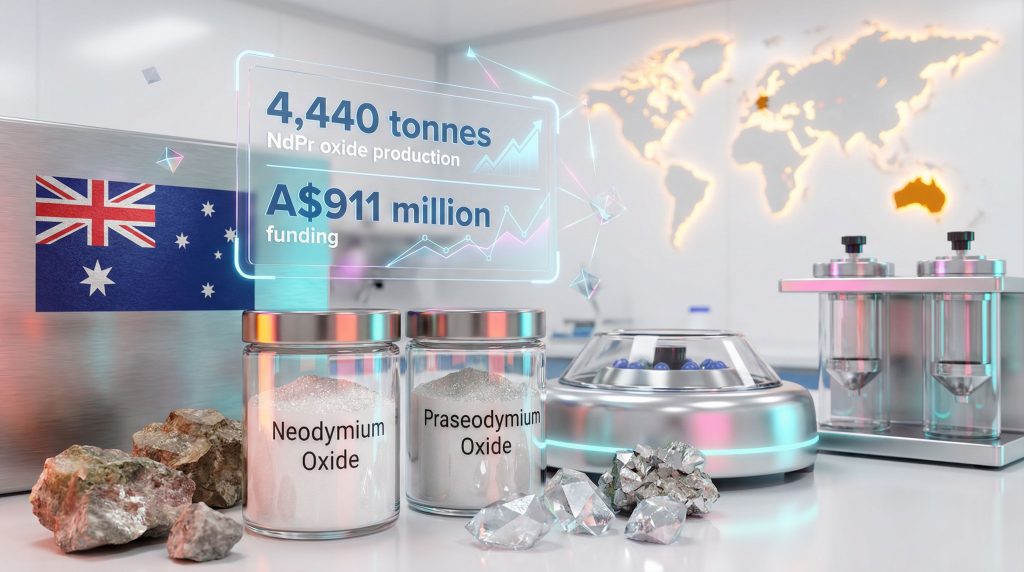
Multi-sovereign coordination frameworks are reshaping how nations approach critical mineral supply chain security. As geopolitical tensions intensify around resource dependencies, allied governments increasingly deploy coordinated financing mechanisms to establish alternative supply pathways. This strategic convergence creates unprecedented opportunities for resource projects that align with multiple national interests, fundamentally altering traditional mining project economics through risk-sharing and strategic validation. Furthermore, financing for Arafura's rare earth project demonstrates how sophisticated capital structures can support complex industrial developments that serve strategic purposes beyond commercial returns.
What Makes Government-Backed Financing Essential for Rare Earth Projects?
Rare earth projects face unique financing challenges that distinguish them from conventional mining operations. The extended development timelines, complex processing requirements, and volatile market dynamics create risk profiles that often exceed private capital appetite. Government-backed financing addresses these structural limitations by providing patient capital with strategic rather than purely commercial return expectations.
Strategic Resource Security vs. Commercial Viability
Private markets systematically undervalue the strategic importance of rare earth projects due to timeline mismatches between commercial financing horizons and resource development cycles. Traditional mining finance typically operates on 5-7 year return expectations, whilst rare earth projects require decades of operational stability to justify massive processing infrastructure investments.
The financing for Arafura's rare earth project demonstrates this strategic approach through its multi-sovereign coordination. Germany's KfW development bank committed A$84 million specifically targeting supply chain integration with offshore wind turbine manufacturing, whilst Australia's Export Finance Australia provided A$146 million to support domestic critical minerals sector development.
This coordination addresses what industry analysts identify as the fundamental disconnect between commercial risk assessment and strategic resource value. Rare earth projects generate returns through long-term supply security rather than short-term commodity price appreciation, requiring financing structures that reflect this extended value creation timeline. Moreover, these projects directly support critical minerals reserve strategies that allied nations increasingly prioritise.
Multi-Sovereign Partnership Models in Critical Minerals
The emergence of coordinated government financing creates new templates for international resource development cooperation. The German-Australian partnership model demonstrates how allied nations can align industrial policy objectives through synchronised capital deployment.
Key coordination mechanisms include:
- Risk-sharing protocols between export credit agencies
- Strategic oversight integration through board representation rights
- Supply chain alignment with downstream industrial requirements
- Technology transfer frameworks for processing expertise
Germany's involvement targets specific industrial applications, particularly permanent magnets for offshore wind turbines manufactured at the Siemens Gamesa facility in Cuxhaven. This end-use specificity transforms commodity financing into strategic industrial infrastructure development, justifying government participation beyond traditional commercial metrics.
Timeline Mismatches Between Commercial Financing and Resource Development
Rare earth projects require patient capital structures that commercial markets struggle to provide. The Nolans project's 38-year mine life and fully integrated processing facility represent capital intensity levels that exceed typical mining industry evolution parameters.
The financing timeline demonstrates this patient capital approach:
- Initial equity placement: A$481 million completed in late 2025
- Convertible bond commitment: A$200 million from National Reconstruction Fund Corporation
- Government equity commitments: A$230 million from KfW and Export Finance Australia
This sequenced approach allows project development to progress through regulatory and technical milestones whilst maintaining financing flexibility. Commercial markets typically demand committed offtake agreements and locked-in pricing before providing capital, whilst government-backed structures can support development through the extended periods required for customer relationship establishment.
When big ASX news breaks, our subscribers know first
How Do Integrated Processing Facilities Change Project Economics?
Vertical integration fundamentally alters rare earth project economics by capturing processing margins traditionally retained by separate refining operations. The Nolans project's design for complete ore-to-oxide production at a single location creates operational advantages that justify the additional technical complexity and capital requirements.
Value Chain Integration Benefits and Challenges
Integrated processing facilities generate multiple economic advantages compared to concentrate-only operations. Traditional rare earth mining produces mineral concentrates that require additional processing stages, typically located in different countries and owned by separate entities. This separation creates margin leakage and supply chain dependency risks.
Economic Benefits of Integration:
- Margin capture across the entire value chain from ore to oxide
- Quality control throughout processing stages
- Customer proximity through direct oxide supply
- Strategic positioning independent of third-party processors
Technical Complexity Challenges:
- Multiple processing technologies required at single location
- Skilled workforce requirements across mining and chemical processing
- Environmental compliance for complex chemical operations
- Capital intensity significantly higher than mine-only operations
The Nolans project targets 4,440 tonnes annual NdPr oxide production, representing approximately 4% of global demand. This scale balances economic efficiency with strategic supply chain impact, avoiding the commodity-scale competition whilst establishing meaningful market presence.
Infrastructure Requirements for Vertical Integration
Integrated rare earth processing requires infrastructure coordination between mining and chemical processing operations. The technical requirements extend beyond conventional mining to include chemical separation facilities, waste management systems, and specialised quality control laboratories.
| Infrastructure Component | Technical Requirement | Capital Intensity |
|---|---|---|
| Ore Processing | Conventional mining equipment | Standard mining capex |
| Chemical Separation | Solvent extraction circuits | High complexity/cost |
| Oxide Production | Calcination and finishing | Specialised equipment |
| Waste Management | Tailings and chemical waste | Environmental compliance |
The integrated approach requires workforce capabilities spanning geological, mining, chemical, and environmental disciplines. This multidisciplinary requirement creates operational complexity but also establishes significant competitive advantages through technical expertise concentration.
Environmental compliance costs increase substantially with chemical processing integration. Rare earth processing generates chemical waste streams requiring specialised treatment and disposal, adding ongoing operational expenses beyond conventional mining operations.
What Financial Instruments Drive Large-Scale Resource Development?
Large-scale resource projects increasingly employ hybrid financing structures that combine multiple instrument types to optimise capital cost and risk allocation. The Nolans project demonstrates sophisticated capital structure design through coordinated deployment of equity, convertible bonds, and government-backed investments. Additionally, understanding effective capital raising strategies becomes crucial for similar projects.
Hybrid Equity-Debt Structures in Mining Finance
Modern critical minerals financing employs layered capital structures that address different risk components through appropriate financial instruments. The complexity arises from balancing commercial return expectations with strategic government objectives and technical project requirements.
Financing Component Breakdown
| Funding Source | Amount (A$ Million) | Instrument Type | Strategic Purpose |
|---|---|---|---|
| KfW (German Fund) | 84 | Equity Investment | Supply chain security |
| Export Finance Australia | 146 | Equity Investment | Domestic industry support |
| National Reconstruction Fund | 200 | Convertible Bonds | Infrastructure development |
| Previous Capital Raise | 481 | Equity Placement | Working capital |
This structure demonstrates risk allocation optimisation across different capital sources. Government equity provides patient capital for long-term development, whilst convertible bonds offer upside participation with downside protection. The sequential timing allows project development milestone achievement before committing additional capital tranches.
The KfW investment includes board representation rights, creating governance integration beyond financial participation. This structure provides strategic oversight capability whilst maintaining commercial project management autonomy.
Export Credit Agency Coordination Mechanisms
Export credit agencies increasingly coordinate across multiple countries to support strategic resource projects. This coordination addresses the scale requirements of modern mining projects whilst distributing political and commercial risks across multiple sovereign entities.
The German-Australian coordination demonstrates practical implementation of allied-nation resource cooperation. Both countries deploy strategic capital through specialised institutions (KfW and Export Finance Australia) whilst targeting complementary objectives:
- German objectives: Secure rare earth supply for renewable energy manufacturing
- Australian objectives: Develop domestic critical minerals processing capability
- Shared objectives: Establish supply chain alternatives to concentrated suppliers
This coordination creates political risk mitigation through multiple sovereign backing whilst establishing shared strategic validation of project importance. The dual-government structure also provides operational flexibility through alternative capital sources if political or economic conditions change.
How Do Rare Earth Projects Navigate Supply Chain Geopolitics?
Rare earth projects operate within complex geopolitical frameworks where supply chain security considerations often outweigh pure commercial factors. The strategic importance of rare earth elements in defence, renewable energy, and advanced technology applications creates government interest in diversifying supply sources beyond traditional dominant producers.
Strategic Mineral Diplomacy and Investment Flows
Government involvement in rare earth project financing reflects broader strategic mineral diplomacy initiatives among allied nations. The coordination between Germany and Australia through the Nolans project demonstrates how industrial policy alignment creates investment opportunities that transcend traditional bilateral trade relationships.
Germany's renewable energy transition strategy requires secure rare earth supplies for permanent magnet manufacturing. The country's offshore wind expansion targets create specific demand for NdPr oxides used in turbine generators. This demand specificity justifies government investment in supply chain security through direct project participation rather than market-based procurement alone. Consequently, green transition strategies increasingly drive government investment decisions.
Australia's critical minerals strategy aims to develop domestic processing capabilities beyond traditional ore exports. The A$5 billion Critical Minerals Facility provides framework for government investment in value-added production, positioning Australia as a supplier of processed materials rather than raw concentrates.
Market Positioning Outside Dominant Supply Sources
Strategic positioning outside established supply concentration creates opportunities for premium pricing and long-term contract structures. Current global rare earth supply chains exhibit significant geographic concentration, creating supply security concerns for importing nations.
The Nolans project's 4% global market share target reflects deliberate positioning to serve specific industrial segments rather than compete for commodity volume. This strategic niche approach enables premium pricing through supply security value rather than lowest-cost production competition.
Competitive Positioning Advantages:
- Supply chain reliability through stable political jurisdictions
- Quality consistency through integrated processing control
- Customer proximity for technical support and relationship management
- Strategic alignment with allied-nation industrial policies
Long-term offtake agreements become strategic partnerships rather than commodity contracts when government backing validates supply security. The German-Australian government coordination provides framework for industrial cooperation extending beyond the immediate project scope. Additionally, recent executive order on minerals policies demonstrate the growing political attention to resource security.
What Risk Mitigation Strategies Support Mega-Project Development?
Large-scale resource projects employ comprehensive risk mitigation frameworks that address technical, financial, political, and market uncertainties. The complexity of integrated rare earth projects requires multiple protection layers to ensure successful development and operation.
Multi-Layer Contingency Planning
"Sophisticated risk management frameworks employ multiple protection tiers including project-level contingencies, lender reserve requirements, cost overrun facilities, and standby liquidity arrangements. This layered approach creates comprehensive downside protection whilst maintaining development flexibility across different risk scenarios."
The Nolans project financing structure demonstrates multi-layered risk mitigation through diversified capital sources and sequential commitment timing. This approach allows risk assessment refinement as project development progresses through technical and regulatory milestones.
Risk Mitigation Framework:
- Technical risk: Government validation through multiple sovereign participation
- Financial risk: Diversified capital sources across different institutions
- Political risk: Allied-nation coordination reducing single-country exposure
- Market risk: Strategic customer alignment through end-use targeting
The convertible bond structure from Australia's National Reconstruction Fund provides additional flexibility by allowing equity conversion if project performance exceeds expectations whilst maintaining debt-level protection if performance disappoints.
Timeline and Execution Risk Management
Resource project development involves extended timelines with multiple regulatory, technical, and commercial milestones. Risk management requires flexible structures that adapt to development progress whilst maintaining financing availability.
The subscription agreements remain subject to regulatory approvals and shareholder consent, demonstrating staged commitment approaches that reduce capital exposure until final conditions satisfaction. This sequential structure allows project refinement and risk assessment updates before final financial commitment.
Execution Risk Controls:
- Regulatory approval sequencing to minimise compliance uncertainty
- Shareholder consent requirements ensuring stakeholder alignment
- Government coordination protocols for multi-sovereign decision-making
- Technical milestone validation before capital deployment tranches
The KfW board representation right creates ongoing oversight capability that allows risk monitoring and strategic guidance throughout project development and operation phases.
How Do Production Targets Align with Global Market Dynamics?
Production planning for strategic mineral projects requires balancing scale economics with market positioning objectives. The Nolans project's production targets reflect strategic market positioning rather than pure volume maximisation, aligning with specific customer requirements and industrial applications.
Annual Output Planning and Market Share Analysis
The 4,440 tonnes annual NdPr oxide production target represents carefully calibrated market positioning that balances economic viability with strategic impact. This volume accounts for approximately 4% of global demand, establishing meaningful supply chain presence without triggering dominant-producer competitive responses.
Production Scale Analysis:
- Market share: 4% of global NdPr oxide demand
- Mine life: 38-year operational period
- Total production: Approximately 168,720 tonnes over project life
- Revenue potential: Substantial based on current rare earth pricing levels
The 38-year mine life provides extended economic visibility that justifies the substantial infrastructure investment required for integrated processing facilities. This timeline exceeds typical commercial investment horizons, supporting the requirement for patient government capital.
Demand Forecasting for Industrial Applications
Rare earth demand growth drivers centre on renewable energy infrastructure, electric vehicle expansion, and advanced technology applications. These sectors exhibit strong growth trajectories that support long-term demand visibility for NdPr oxides.
Primary Demand Sectors:
- Offshore wind turbines: Permanent magnets for generator systems
- Electric vehicles: Motor magnets for propulsion systems
- Industrial automation: Servo motors and robotics applications
- Consumer electronics: Hard drives and speaker magnets
The German industrial connection through wind turbine manufacturing demonstrates specific demand linkage that transcends commodity market dynamics. This application-specific demand provides pricing stability and volume predictability superior to spot market exposure.
Permanent magnet manufacturing requires consistent quality specifications that integrated production facilities can better control compared to multi-stage processing chains. This quality advantage creates competitive positioning opportunities in high-specification industrial applications.
The next major ASX story will hit our subscribers first
What Lessons Does This Financing Model Offer Other Resource Projects?
The Nolans project financing structure establishes precedent for government-backed resource development that other strategic mineral projects can adapt and scale. The coordination mechanisms and risk-sharing frameworks provide templates for similar developments in critical materials sectors.
Replicable Framework Elements
The multi-sovereign financing approach demonstrates scalable coordination mechanisms that other allied nations can employ for strategic resource projects. The framework elements include government partnership structuring, risk allocation protocols, and strategic oversight integration.
Framework Components:
- Strategic resource classification criteria for government involvement
- Multi-country coordination mechanisms for risk and investment sharing
- Industrial policy alignment between resource projects and downstream applications
- Government-private partnership structures balancing strategic and commercial objectives
The KfW and Export Finance Australia coordination provides template for other export credit agencies seeking to support strategic mineral projects. This coordination addresses scale requirements whilst distributing political and financial risks across multiple sovereign entities.
Board representation rights demonstrate governance integration approaches that provide strategic oversight without compromising commercial project management. This balance enables government strategic input whilst maintaining operational efficiency.
Scaling Considerations for Similar Developments
Successful adaptation of this financing model requires consideration of project scale, strategic importance, and government policy alignment. Not all resource projects justify government involvement, requiring assessment frameworks for strategic significance determination.
Scaling Criteria:
- Strategic mineral classification by importing nations
- Supply chain concentration risk in existing sources
- Industrial application criticality for national security or economic objectives
- Capital requirement thresholds exceeding commercial market capacity
The A$911 million combined financing commitment represents substantial capital deployment that requires significant strategic justification. Smaller projects may require alternative coordination mechanisms or different government participation structures.
Technology transfer and knowledge sharing capabilities become increasingly important as projects scale. The integrated processing approach requires specialised expertise that government partnership can facilitate through international cooperation agreements.
How Will This Development Impact Future Critical Mineral Investments?
The success of multi-sovereign financing for the Nolans project creates precedent that will likely influence future critical mineral investment approaches. This development demonstrates practical coordination mechanisms for strategic resource cooperation between allied nations. Furthermore, financing for Arafura's rare earth project serves as a case study for governments seeking to establish strategic resource partnerships.
Precedent Setting for Government-Private Partnerships
The German-Australian coordination establishes template for allied-nation resource cooperation that addresses both supply security and industrial development objectives. This approach balances strategic government interests with commercial project requirements through sophisticated capital structure design.
Future projects will likely adopt similar multi-sovereign approaches when strategic importance justifies government involvement. The risk-sharing and validation mechanisms demonstrated through the Nolans financing provide framework for scaling this approach across different resource sectors and country combinations.
Precedent Implications:
- Investment criteria evolution toward strategic rather than purely commercial assessment
- Due diligence standardisation across sovereign investment funds
- Template creation for government-private partnership structuring
- Technology transfer frameworks for strategic knowledge sharing
The board representation and governance integration approaches establish patterns for government oversight that maintain strategic influence whilst preserving commercial management autonomy.
Market Structure Implications
Increased government involvement in critical mineral financing will likely accelerate supply chain diversification away from concentrated suppliers. This trend creates investment opportunities in alternative jurisdictions whilst potentially disrupting existing market structures.
Investment flow redirection toward allied producers reflects broader geopolitical realignment in strategic resource sectors. Countries seeking supply security will increasingly prioritise political stability and alliance relationships over pure cost optimisation. Additionally, projects demonstrating successful financing for Arafura's rare earth project models will attract increased attention from sovereign funds.
Market Structure Changes:
- Supply chain diversification acceleration through government backing
- Investment criteria expansion beyond commercial return metrics
- Technology transfer emphasis for strategic capability development
- Industrial cooperation integration across allied economies
The success of this financing model may encourage other nations to develop similar critical minerals facilities and coordination mechanisms. This expansion could create competitive dynamics among allied nations seeking to establish strategic resource processing capabilities.
Recent developments confirm the significance of these financing approaches. Taxpayer backing for Arafura Rare Earths has reached $1.2 billion as the Export Finance Australia investment demonstrates government commitment to strategic mineral development. Additionally, Arafura has secured $159 million to further boost the Nolans project development, highlighting ongoing capital mobilisation success.
Investment decisions in critical mineral projects involve substantial risks and require comprehensive due diligence. Government backing does not guarantee commercial success, and investors should evaluate all risk factors before making investment commitments. This analysis is for informational purposes only and does not constitute investment advice.
Interested in the Next Major Mineral Discovery?
Discovery Alert instantly alerts investors to significant ASX mineral discoveries using its proprietary Discovery IQ model, turning complex mineral data into actionable insights. Understand why historic discoveries can generate substantial returns by visiting Discovery Alert's dedicated discoveries page, showcasing exceptional examples of past successes, and begin your 14-day free trial today to position yourself ahead of the market.