
July 24, 2026
The Hidden Cost Variable That Could Reshape the Ionic Rare Earth Investment Landscape
Most investors evaluating rare earth developers focus on grade, resource size, and metallurgical recovery. Far fewer scrutinise the reagent cost structure sitting beneath those headline metrics. In the ionic rare earth element (REE) sector, sulphuric acid is not merely an operational detail. It is the primary consumable that makes clay-hosted rare earth extraction possible, and its availability is now under pressure from a geopolitical disruption that few cost models fully anticipated.
The sulphuric acid supply disruption in the ionic rare earth sector represents one of the most underappreciated cost risk variables in critical mineral development today. Understanding why requires unpacking both the chemistry of ionic REE extraction and the geography of global commodity trade corridors.
When big ASX news breaks, our subscribers know first
Sulphuric Acid: The Consumable That Determines Ionic REE Project Economics
Why Acid Dependency Is Structurally Higher in Clay-Hosted Systems
Ionic REE deposits differ fundamentally from hard-rock rare earth systems in how their mineralisation is hosted and extracted. Rather than being locked within crystalline mineral structures requiring high-temperature cracking, ionic clay deposits hold rare earth ions loosely adsorbed onto clay mineral surfaces. This makes them more amenable to low-energy extraction, but it creates an almost absolute dependency on leaching reagents.
Sulphuric acid is the dominant reagent used in this leaching process. When acid solution contacts the clay matrix, it displaces the adsorbed rare earth ions, releasing them into solution for subsequent recovery. The volume of acid consumed per tonne of ore feed is therefore a direct determinant of operating expenditure, and for development-stage projects that have not yet established procurement contracts, it represents an open exposure to prevailing market conditions.
Several characteristics amplify this dependency:
- Ionic REE clay systems typically process large ore volumes at relatively low grades, meaning acid consumption scales with throughput rather than recovered product weight
- The absence of excavation in in-situ extraction methods does not reduce acid consumption; it changes the delivery mechanism while the fundamental chemical requirement remains
- Development-stage projects lack the contracted supply relationships that producing operations use to manage price volatility and procurement continuity
- Unlike some hard-rock processing flowsheets, ionic REE leaching has limited scope to substitute alternative reagents without significant metallurgical redesign
How the Strait of Hormuz Conflict Created a Sulphuric Acid Bottleneck
Geopolitical Chokepoints and Their Industrial Chemical Consequences
The Strait of Hormuz functions as a critical arterial corridor for global commodity trade. Restrictions on movement through this waterway do not affect energy markets in isolation. They cascade across interconnected supply chains, including those supplying industrial chemicals to mining operations. Sulphuric acid supply was already characterised by tightening conditions before the current conflict escalation, driven partly by growing demand from battery materials processing and fertiliser production. Conflict-driven restrictions have compounded that pre-existing tension.
The fertiliser industry is a particularly significant competing demand source. Phosphate-based fertiliser production requires sulphuric acid as a core input, and the fertiliser sector consumes a substantial portion of global sulphur and acid output annually. When sulphur supply contracts due to geopolitical disruption, fertiliser manufacturers and mining operations compete for the same constrained feedstock, amplifying price pressure for all industrial acid users simultaneously.
Key Risk Framing: Projects relying on externally sourced sulphuric acid with no on-site generation mechanism or supply hedging are directly exposed to both volume shortfalls and elevated delivered costs during periods of geopolitical disruption. The risk is asymmetric: high-consumption projects absorb materially more cost escalation per tonne of ore processed than low-consumption peers.
Supply Chain Vulnerability Across Critical Mineral Processing Sectors
| Sector | Primary Acid Use | Typical Dependency Model | Disruption Sensitivity |
|---|---|---|---|
| Ionic REE | Clay leaching / ISR | External procurement | High to Very High |
| Hard-rock REE | Acid cracking | External procurement | High |
| Nickel (HPAL) | Pressure acid leaching | Integrated or captive | Moderate |
| Copper (Heap Leach) | Ore acidification | Partial captive | Moderate |
| Phosphate / Fertiliser | Superphosphate production | Integrated | Low to Moderate |
What Acid Consumption Rates Reveal About Sector-Wide Cost Exposure
Benchmarking the Australian Ionic REE Development Pipeline
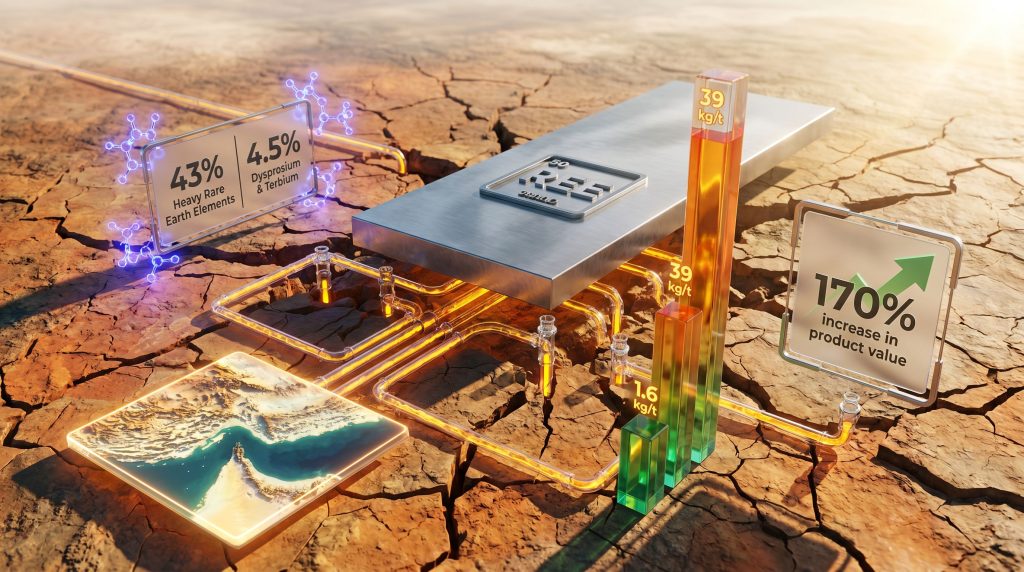
Consumption rates, measured in kilograms of sulphuric acid per tonne of ore processed, serve as the primary comparative metric for assessing external procurement exposure across competing projects. The spread across the Australian ionic REE development pipeline is remarkable in its breadth. Published benchmarks across six projects reveal a range spanning 1.6 kg/t to 39 kg/t, a differential exceeding an order of magnitude.
This spread is not a marginal technical distinction. At scale, the difference between consuming 39 kg/t and 1.6 kg/t of externally sourced acid represents a structurally different operating cost profile, procurement risk exposure, and sensitivity to supply chain disruption. Furthermore, understanding mining project economics is essential context for appreciating just how consequential these input cost differentials become at production scale.
Acid Consumption Benchmarks: Australian Ionic REE Peer Group
| Project | Developer | Acid Consumption (kg/t) | Relative Exposure |
|---|---|---|---|
| Koppamurra | AR3 | Up to 39 | Very High |
| North Standmore | Victory Metals | 30 | High |
| Splinter Rocks | OD6 Metals | 18.3 – 28.1 | High |
| Sybella | Red Metal | 9 – 38 | High (variable) |
| Kennedy | DevEx Resources | 3.4 – 5.8 | Low to Moderate |
| Boland | Cobra Resources (LSE: COBR) | 1.6 – 6.7 | Low |
Analyst Note: Consumption figures reflect published benchmarks and do not incorporate on-site acid generation offsets where applicable. The effective net consumption at projects with natural acid generation mechanisms will be lower than gross figures suggest. Until Total Organic Carbon and total sulphide content analyses are formally incorporated into resource modelling, the magnitude of any on-site offset remains directional.
Why Gross Figures Are Only Half the Picture
An important analytical distinction separates gross acid consumption from net external procurement requirement. Gross consumption represents the total volume of acid applied to the ore zone during leaching. Net external procurement is the portion that must actually be sourced from suppliers, after accounting for any acid generated on-site through formation mineralogy.
Where host rock contains sulphide minerals, particularly pyrite, oxidative leaching reactions can produce sulphuric acid as a natural by-product of that reaction. Projects hosted in such formations partially self-supply their acid requirement, reducing the volume that must be procured commercially. This distinction matters enormously when evaluating true exposure to sulphuric acid supply disruptions, because a project with a moderate gross consumption figure but significant on-site generation may carry lower effective procurement risk than a competitor with a nominally lower gross consumption but no geological offset.
Quantifying natural acid generation requires two specific analytical inputs:
- Total Organic Carbon (TOC) analysis measures the concentration of carbon-bearing organic compounds within the host formation, relevant to understanding the organic fraction of pyrite content
- Total sulphide content measurement quantifies the concentration of sulphide minerals including pyrite, which are the direct source of acid generation during oxidative leaching
Both measurements must be formally incorporated into resource modelling before on-site acid generation can be treated as a confirmed project variable rather than a geological observation.
In-Situ Recovery and the Acid Generation Mechanism Changing the Cost Calculus
How ISR Differs From Conventional Ionic REE Processing
In-situ recovery represents a structurally distinct extraction pathway from conventional open-pit or heap-leach ionic REE mining. Rather than excavating ore and processing it at surface facilities, ISR injects leach solution directly into the subsurface ore zone through a network of injection wells. The acid solution dissolves clay-hosted REE content in place, and the pregnant solution is then recovered through extraction wells for surface processing.
The operational implications are significant:
- No open-pit excavation means substantially lower surface disturbance and potentially reduced environmental rehabilitation requirements
- Capital intensity at the mining stage is lower, shifting the cost structure toward operating expenditure and reagent procurement
- Formation permeability becomes a critical variable, governing the flow of leach solution through the ore zone and directly influencing recovery efficiency
- The chemical character of the host formation interacts with the injected acid in ways that vary by geology, making mineralogical understanding essential to accurate cost modelling
The Pidinga and Garford Formations: A Geological Acid Generation Mechanism
Cobra Resources (LSE: COBR) operates the Boland project in South Australia, which has been identified as Australia's only rare earth project suited to ISR extraction. The project's geological setting creates an unusual operational dynamic rooted in the specific mineralogy of the Pidinga and Garford formations that host the mineralisation.
Both formations contain organic pyrite. During ISR leaching operations, pyrite undergoes oxidation when it contacts the acid solution, producing sulphuric acid as a natural chemical by-product of that reaction. This is not a characteristic common to all ionic REE deposits. It is formation-specific, dependent on the presence and concentration of sulphide minerals in the host geology. Consequently, a portion of the acid requirement during active leaching is generated on-site, reducing the volume that Cobra must source from external suppliers.
Bench-scale testing has established the operational parameters for this system:
- Acid consumption across tested pH levels ranges from 1.6 kg/t to 6.7 kg/t of ore
- At 3.88 kg/t of sulphuric acid applied, bench-scale testing has demonstrated 66% recovery of heavy rare earth oxide (HREO)
- This result establishes that low acid input does not compromise recovery performance where formation chemistry is favourable, a technically significant finding for project economics
Technical Insight: The 66% HREO recovery at 3.88 kg/t acid input is meaningful precisely because it demonstrates the efficiency of the leach chemistry in this specific formation. Many developers achieve higher recovery rates but at acid consumption rates ten times greater. The relevant comparison is not recovery in isolation but recovery per unit of acid consumed.
How Product Composition Amplifies the Economic Case for Low-Acid Projects
The Value Uplift Framework: From Leach Solution to Saleable Product
Reagent cost efficiency is only one dimension of the economic case for low-acid ionic REE projects. The composition of the final rare earth product determines revenue potential per tonne, and this is where the strategic significance of heavy rare earth element concentration becomes critical.
Cerium is the most abundant rare earth element in most deposits, but it commands among the lowest prices in the market. Its presence dilutes the value of unprocessed rare earth products. Removing cerium from the product stream concentrates the proportion of higher-value elements, improving both the per-unit price achievable and the strategic appeal of the product to end-users in the magnet supply chain.
Cobra's Boland project produces a mixed rare earth carbonate with the following composition characteristics:
- 43% heavy rare earth elements in the mixed rare earth carbonate output
- 4.5% dysprosium and terbium content within that heavy rare earth fraction
- Cerium effectively removed through the optimised flowsheet
- Product value approximately 170% higher than unprocessed leach solution
Why Dysprosium and Terbium Command Strategic Premium Pricing
Dysprosium and terbium are not simply high-value rare earths in a general sense. They are functionally critical to the manufacture of neodymium-iron-boron (NdFeB) permanent magnets, the type used in electric vehicle traction motors and direct-drive wind turbine generators. Dysprosium is added to NdFeB magnets to preserve their magnetic properties at elevated operating temperatures, a requirement that cannot currently be substituted without compromising magnet performance.
The supply concentration risk for these elements is acute. The overwhelming majority of global dysprosium and terbium production originates from ionic clay deposits in southern China. This geographic concentration makes ex-China HREE projects strategically significant to Western magnet supply chains, and it means HREE-weighted product from low-acid ISR operations carries a dual competitive advantage: lower input cost exposure during periods of sulphuric acid supply disruption in the ionic rare earth sector, and higher per-unit revenue from a product the market structurally needs to source outside China. The rare earth supply chains underpinning these dynamics are increasingly the focus of government and investor scrutiny alike.
The next major ASX story will hit our subscribers first
The Resource Definition Programme and What It Will Formally Establish
From Drilling Data to Mineral Resource Estimate
A mineral resource estimate for an ionic REE ISR project incorporates more modelled variables than a conventional hard-rock resource. Grade alone is insufficient. The MRE must formally integrate:
- Grade expressed as total rare earth oxide concentration in parts per million (ppm)
- Formation permeability governing leach solution flow and recovery efficiency across the ore zone
- Metallurgical recovery rates established through bench-scale and pilot-scale testing
- Natural acid generation quantified through TOC and total sulphide analysis
- Depth and geometry of mineralised zones determining ISR well spacing and capital requirements
A 74-drillhole resource definition programme spanning approximately 3,200 metres has been completed across the Boland and Head prospects to underpin an initial MRE. Cobra Resources is targeting a combined maiden resource of 200 million to 400 million tonnes at greater than 1,000 ppm TREO across these prospects. Critically, the Boland and Head prospects tested to date represent less than 5% of the company's total prospective landholding, preserving substantial exploration optionality beyond the initial resource definition.
The forthcoming MRE will be the first formal disclosure to incorporate natural acid generation as a quantified project variable. Until that modelling is complete, the cost offset attributable to the Pidinga and Garford formations remains an observed geological advantage rather than a confirmed economic input.
The Scoping Study as the First Formal Economic Disclosure
A Scoping Study will establish outputs that no prior disclosure has quantified: net present value, capital expenditure, operating cost per tonne, and project payback period. Independent technical consultants have been engaged to support both the MRE and the Scoping Study. The formal incorporation of natural acid generation into that study will be the first opportunity to translate Boland's geological characteristics into independently verified cost positioning.
Investor Caution: Management's assessment that the Boland project is on track for bottom-quartile production costs is a directional target, not a confirmed outcome. Independent validation through a Scoping Study and subsequent Prefeasibility Study is required before cost positioning claims can be treated as investment-grade disclosures. Investors should treat pre-study cost guidance as indicative only.
Scenario Analysis: How Disruption Severity Alters Competitive Positioning
Three Disruption Scenarios and Their Differential Project Impacts
Scenario A: Moderate Disruption (10–20% acid price increase, supply available)
- High-consumption projects absorb materially higher operating costs per tonne of ore processed
- Low-consumption projects with on-site generation see limited impact on unit economics
- Cost quartile rankings within the sector shift in favour of low-acid, geologically advantaged operations
- Development timelines are generally unaffected but feasibility study economics tighten for high-consumption peers
Scenario B: Severe Disruption (greater than 30% price increase, volume shortfalls)
- High-consumption projects face simultaneous cost escalation and potential throughput constraints if procurement volumes cannot be maintained
- Projects with captive or partially self-generating acid supply maintain operational continuity and cost predictability
- Development-stage projects with unhedged procurement strategies face feasibility reassessment risk at the Scoping Study stage
Scenario C: Prolonged Disruption (multi-year supply uncertainty)
- Processing economics for high-consumption operations may require flowsheet redesign or alternative reagent evaluation, neither of which is achievable on short timelines
- ISR projects with geological acid generation gain structural competitive advantage that compounds over time as procurement cost differentials widen
- Capital allocation within the sector is likely to shift toward lower-acid development pathways as investors apply more rigorous input-cost analysis
Frequently Asked Questions: Sulphuric Acid Supply Disruption and Ionic REE Processing
Why is sulphuric acid consumption measured per tonne of ore rather than per tonne of rare earth product?
Acid is applied to the ore mass during leaching, so consumption scales with the volume of ore processed rather than the quantity of rare earth recovered. Per-tonne-of-ore figures allow direct comparison of input requirements across projects processing similar ore types at different grades and recovery rates.
Can ionic REE projects switch to alternative leaching reagents if sulphuric acid becomes unavailable?
Alternative leaching systems including ammonium sulphate and other salt-based solutions have been used in Chinese ionic REE operations, though each carries different cost, recovery, and environmental profiles. Transitioning reagent systems at a development-stage project would require significant reengineering of the processing flowsheet and environmental permitting reassessment. This is not a viable short-term mitigation option.
Why is no acid pricing data publicly available for the Australian ionic REE sector?
Sulphuric acid is traded under bilateral commercial contracts with pricing negotiated between suppliers and buyers. Development-stage projects have not entered procurement markets, so no contracted pricing is available for disclosure. This creates a structural gap in sector-level cost comparison that prevents consumption rate differentials from being expressed in dollar terms.
What is the difference between Total Organic Carbon analysis and total sulphide content measurement?
TOC measures the concentration of carbon-bearing organic compounds in the host formation, relevant to understanding the organic fraction of pyrite content. Total sulphide content quantifies the concentration of sulphide minerals including pyrite, which are the direct source of acid generation during oxidative leaching. Both measurements are required to formally model the volume of acid generated on-site during ISR operations.
How does the fertiliser industry's demand affect rare earth developers competing for sulphuric acid?
Phosphate-based fertiliser production is among the largest global consumers of both sulphur and sulphuric acid. When geopolitical disruption tightens sulphur supply, fertiliser producers and mining operations compete for the same constrained feedstock, amplifying price pressure across all industrial acid users simultaneously. Fertiliser demand is price-inelastic over short timeframes, meaning it does not easily yield supply volume to competing industrial users when scarcity intensifies. The broader critical minerals demand picture only reinforces the urgency of resolving these procurement vulnerabilities.
What resource scale is generally required for an ionic REE ISR project to reach economic viability?
Scale is a primary driver of unit cost reduction in ISR operations because fixed infrastructure costs are spread across greater ore volumes. Resource targets in the range of hundreds of millions of tonnes at grades exceeding 1,000 ppm TREO are generally considered the minimum threshold for meaningful economic evaluation in the Australian context. However, project-specific configuration, acid consumption rates, and product composition all materially influence the viable scale threshold.
Geopolitical Disruption as a Permanent Variable in Critical Mineral Cost Modelling
The sulphuric acid supply disruption driven by Middle East conflict should not be modelled as a temporary anomaly that reverts to prior conditions once tensions ease. Geopolitical risk in commodity trade corridors is an enduring structural feature of the critical minerals landscape. The Strait of Hormuz has experienced recurring restrictions across multiple decades, and the trajectory of energy transition minerals demand growth ensures that competition for critical mineral inputs will intensify rather than diminish. Indeed, Queensland's sulphuric acid supply study highlights just how structurally exposed Australian processing operations already are to procurement constraints.
For investors evaluating the Australian ionic REE development pipeline, the acid consumption comparison establishes a preliminary risk ranking. However, the more sophisticated analytical framework requires assessing four dimensions simultaneously:
| Risk Dimension | Key Questions | Data Required |
|---|---|---|
| Gross Consumption | How much acid does the project apply per tonne? | Published bench or pilot test data |
| Net Procurement Requirement | Does on-site mineralogy offset any consumption? | TOC and sulphide analysis; formal MRE modelling |
| Supply Chain Configuration | Does the project rely on imported acid or domestic supply? | Procurement strategy disclosure |
| Cost Translation | What is the dollar impact of consumption differences? | Acid pricing data (currently not publicly available) |
Projects where geological characteristics reduce external reagent dependency are accumulating a differentiated attribute that extends beyond operational efficiency. In a world where geopolitical disruption to commodity trade corridors is a recurring rather than exceptional scenario, the capacity to self-generate a portion of your primary processing reagent represents a form of supply chain resilience that is increasingly difficult to replicate through procurement strategy alone. The sulphuric acid supply disruption in the ionic rare earth sector, therefore, is not merely a cost line item — it is a structural differentiator that will increasingly separate viable projects from those requiring fundamental redesign.
Disclaimer: This article is for informational purposes only and does not constitute financial advice or an investment recommendation. Readers should conduct their own due diligence before making any investment decisions. Forward-looking statements, management targets, and resource estimates referenced in this article are subject to material uncertainty and should not be relied upon as confirmed outcomes.
Want to Identify the Next Major Mineral Discovery Before the Broader Market Does?
Discovery Alert's proprietary Discovery IQ model delivers real-time alerts on significant ASX mineral discoveries across the critical minerals and rare earth sectors, translating complex geological and operational data into actionable investment insights — begin your 14-day free trial today, or explore Discovery Alert's dedicated discoveries page to understand how historic ASX discoveries have generated exceptional returns for well-positioned investors.