June 15, 2026
Why Firefighting Robots Rare Earth Elements Form an Inseparable Partnership
The periodic table contains no section labelled "essential to saving lives," yet a cluster of seventeen metallic elements quietly fulfils that role across dozens of advanced technologies. Nowhere is this relationship more direct, or more underappreciated, than inside the tracked firefighting platforms now deployed by major fire departments worldwide. Before examining which specific rare earth elements (REEs) power these machines, it is worth understanding why the shift toward robotic firefighting was always going to be a materials science problem first, and an engineering challenge second.
Traditional suppression tactics placed crews within the thermal envelope of active fires as a matter of operational necessity. There was simply no mechanism for projecting effective nozzle streams from safe distances while simultaneously gathering thermal intelligence. The development of compact, high-torque electric drivetrains changed that calculus, but only because rare earth magnet technology had matured enough to deliver the power density required in a mobile, field-maintainable platform. The connection between firefighting robots rare earth elements is therefore not incidental. It is foundational.
When big ASX news breaks, our subscribers know first
The Chemistry of Compact Power: REEs in Drive and Actuation Systems
The most mass-intensive rare earth application inside a firefighting robot sits in its drive motors. Neodymium (Nd) and praseodymium (Pr) are the principal constituents of neodymium-iron-boron (NdFeB) permanent magnets, the dominant magnet technology in mobile robotics. Compared to ferrite alternatives, NdFeB magnets deliver roughly ten times the energy product per unit volume, which translates directly to smaller, lighter motors producing equivalent torque output.
For a tracked platform that must climb debris piles, navigate curbs, and maintain mobility on uneven ground, this weight-to-power advantage is not a luxury — it is a design requirement. Furthermore, understanding REE processing challenges helps explain why producing these magnets at scale remains technically demanding.
However, standard NdFeB magnets have a critical vulnerability: they begin to lose their magnetic properties at temperatures that firefighting environments regularly exceed. This is where two heavy rare earth elements, dysprosium (Dy) and terbium (Tb), perform work that no other element class can replicate. When introduced into the NdFeB crystal structure, typically through a process called grain-boundary diffusion, Dy and Tb dramatically increase coercivity — the magnet's resistance to demagnetisation under thermal stress.
A robot operating adjacent to an active fire zone, or positioned near a hot pump housing running at sustained output, requires this protection to maintain drive performance throughout the incident. In addition, for actuators positioned closest to heat sources, such as nozzle gimbal systems and manipulator arm joints, engineers frequently specify samarium-cobalt (SmCo) magnets. SmCo tolerates operating temperatures up to 250 to 350 degrees Celsius, significantly outperforming even heavy-REE-enhanced NdFeB grades. The tradeoff is brittleness and considerably higher cost, which is why SmCo use is typically selective rather than blanket across all subsystems.
The following table captures where each magnet type fits within the broader robot architecture:
| Magnet Type | Key REE Content | Max Operating Temp | Primary Application | Cost Profile |
|---|---|---|---|---|
| NdFeB (Standard) | Nd, Pr | ~80–120°C | Drive motors, general actuators | Moderate |
| NdFeB (Heavy REE Enhanced) | Nd, Pr, Dy, Tb | ~150–200°C | Heat-exposed drive and gimbal motors | High |
| Samarium-Cobalt (SmCo) | Sm, Co | ~250–350°C | Actuators near heat sources, nozzle gimbals | Very High |
| Ferrite | None (REE-free) | ~250°C | Low-priority auxiliary systems | Low |
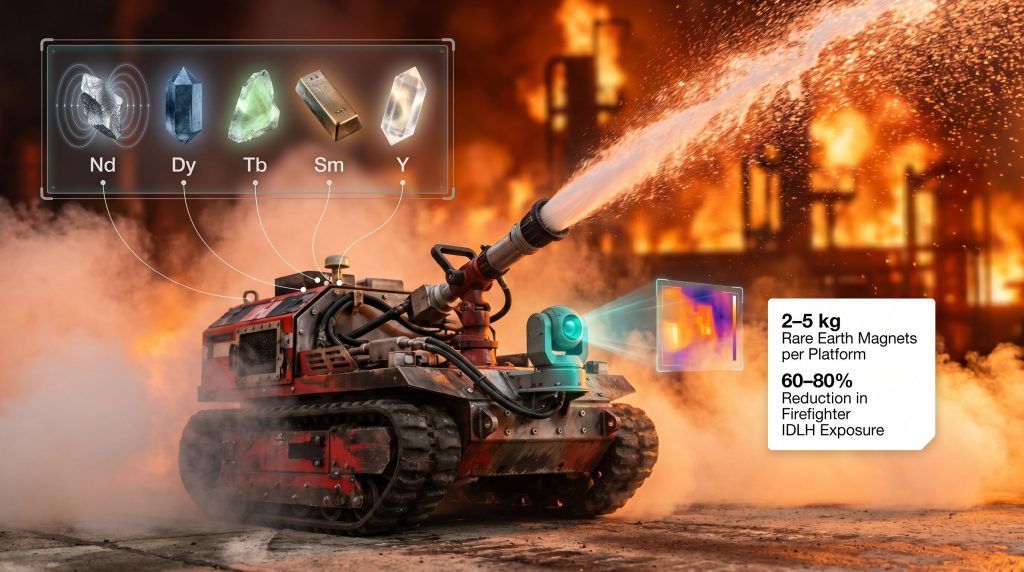
A typical medium-sized firefighting platform with a manipulator arm and high-flow water monitor carries approximately 2 to 5 kilograms of rare earth magnets distributed across these subsystems. That figure is small in absolute terms, but it represents a direct dependency on some of the most geographically concentrated and supply-constrained materials in industrial chemistry.
Beyond Motors: How REE Phosphors Enable Operator Situational Awareness
The rare earth content of a firefighting robot extends well beyond its magnet assemblies. Operator displays, status indicators, and thermal imaging systems all depend on REE-based phosphors to function reliably under field conditions.
Yttrium (Y), europium (Eu), terbium (Tb), and cerium (Ce) form the phosphor chemistry underlying display backlights and indicator systems. These elements produce efficient, stable visible light emission across specific wavelength bands — a property that makes them irreplaceable in applications where display legibility must be maintained in smoke-darkened command posts, high-glare outdoor environments, and the visually degraded conditions that accompany active fire scenes.
How Did Thermal Imaging Become Viable for Mobile Robots?
Thermal imaging capability, perhaps the most operationally significant sensor technology on a firefighting robot, underwent a transformation with the development of uncooled microbolometer detector arrays. Earlier thermal cameras required cryogenic cooling systems, making them impractical for mobile platforms. The elimination of that requirement, combined with REE phosphor-based display chains, produced compact thermal cameras that can be mounted on robot masts and gimbals without prohibitive weight or power penalties.
For incident commanders, the ability to receive live thermal feeds from inside a burning structure without committing personnel to entry represents a genuine operational paradigm shift. Consequently, the history of firefighting robot development shows how sensor advances and materials science have progressed in tandem to make this possible.
Mapping the Supply Chain: Five Stages from Ore to Operational Robot
Understanding why firefighting robots carry supply chain risk requires tracing the full journey from mine to deployment. Each stage introduces delay potential, and those delays compound.
-
Extraction and concentration — Ore is mined and upgraded to rare earth concentrate through physical separation. Major producing regions include China's Bayan Obo deposit (Inner Mongolia), which accounts for a substantial share of global light REE output, alongside deposits in Australia, the United States, and Myanmar for heavy REE fractions.
-
Chemical separation and oxide production — Concentrate is processed into individual oxides: Nd₂O₃, Pr₆O₁₁, Dy₂O₃, Sm₂O₃, and others. This stage is the most technically demanding in the chain, requiring solvent extraction chemistry, significant waste management infrastructure, and precise process control. Geographic concentration of this capability represents the supply chain's most significant single-point vulnerability.
-
Alloy and magnet manufacturing — Oxides are reduced to metals, alloyed into either NdFeB or SmCo compositions, milled to powder, pressed, sintered at high temperature, machined to specification, and coated for corrosion resistance. The magnet grade selected at this stage determines the thermal performance ceiling of the finished robot.
-
Component integration and qualification — Motors, thermal camera modules, and display assemblies are built and subjected to shock, vibration, ingress protection, and environmental testing. This qualification phase adds weeks to months to delivery timelines above and beyond raw material lead times.
-
Robot assembly and operational deployment — Final system integration, field qualification, and fire service certification complete the cycle. For public safety agencies, procurement lead times must account for all upstream stages simultaneously.
"Supply Chain Warning: Dysprosium and terbium, the two heavy rare earths most critical for high-temperature magnet performance, face tighter availability constraints than light REEs due to lower crustal abundance and more complex extraction chemistry. Fire departments procuring high-temperature-grade robots must factor this into multi-year sustainment planning, not just initial acquisition budgets."
Furthermore, broader rare earth supply chains remain heavily concentrated at the processing stage, meaning disruptions upstream can cascade rapidly into finished robot component shortages.
Market Scale and the Overlooked REE Demand Sector
The global firefighting robot market was valued at $1.5 billion in 2022 and is projected to expand at a compound annual growth rate of 13.7% through 2030. More than 200 major fire departments across the world have documented operational deployments, with municipal services in Paris, Los Angeles, and Tokyo among the early adoption leaders. Industrial facilities, particularly petrochemical plants, chemical warehouses, port terminals, and aviation incident response operations, account for roughly 40% of current installations.
The operational metrics that underpin this growth are compelling:
- Unmanned nozzle operations sustain effective suppression at standoff distances up to 300 feet
- Robots maintain continuous hot zone operation for 2 to 4 hours per deployment depending on battery configuration
- Departments report 60 to 80% reductions in direct firefighter exposure time during initial attack phases
- Thermal reconnaissance capability enables pre-entry intelligence gathering that was previously impossible without committing personnel to IDLH (immediately dangerous to life or health) environments
Despite these figures, firefighting applications remain a relatively small and historically overlooked segment in rare earth demand analysis. As adoption accelerates alongside broader emergency response robotics, the cumulative REE pull from this sector will become more visible in supply chain planning — particularly during simultaneous demand surges from electric vehicles, wind turbines, and defence applications. The broader picture of critical minerals demand underscores how these competing pressures are intensifying across multiple advanced technology sectors simultaneously.
The Real-World Deployment Picture: Capabilities and Documented Constraints
The Thermite robotic firefighter, deployed operationally by the Los Angeles Fire Department, represents one of the clearest demonstrations of current technology readiness. Platforms like this establish the operational protocols, maintenance cycles, and training structures that smaller departments can adapt when building their own programmes.
However, a balanced assessment of firefighting robots rare earth elements dependency requires acknowledging documented failure modes alongside proven strengths:
| Limitation Category | Specific Challenge | Operational Implication |
|---|---|---|
| Mobility | Stairs, tight doorways, soft ground, debris clutter | Requires pre-deployment site assessment |
| Thermal | Electronics damage, magnet demagnetisation beyond rated envelope | Limits sustained operation in extreme radiant heat |
| Communications | Signal loss in reinforced concrete, steel structures, underground spaces | Requires link-degradation procedures and retrieval protocols |
| Logistics | Heavy weight, transport requirements, setup time | Affects rapid deployment in time-critical incidents |
The key insight for procurement planners is that robots do not eliminate risk from the fireground. They transfer specific high-risk tasks — initial reconnaissance, unmanned stream application, exposure protection — from human operators to machines. New failure modes arrive with that transfer, and managing them requires dedicated training, operating procedures, and maintenance protocols that account for mechanical, thermal, and communications vulnerabilities.
The next major ASX story will hit our subscribers first
What the Next Decade Looks Like for Firefighting Robots and REE Supply
Several converging forces are accelerating adoption beyond simple technology maturation:
- Infrastructure complexity — Modern warehouse facilities storing lithium-ion batteries, mixed chemical inventories, and high-value goods create fire scenarios where conventional suppression approaches carry personnel risk levels that are increasingly difficult to justify
- Climate-driven incident frequency — Extreme weather events are increasing both the frequency and severity of large-scale incidents requiring standoff suppression capability
- Battery and motor advances — Improving energy density and motor efficiency are extending operational duration while reducing the REE magnet content required per unit of output
- Electric vehicle fire complexity — Large-format lithium battery fires present suppression challenges that favour robotic platforms over direct personnel involvement
On the materials side, manufacturers are actively pursuing strategies to reduce dependency on the scarcest heavy rare earths. Grain-boundary diffusion techniques allow dysprosium and terbium content to be reduced while preserving coercivity specifications. Selective ferrite substitution in non-critical subsystems reduces overall REE intensity, while SmCo retention in heat-critical actuators — where no viable substitute currently exists — remains a fixed cost of high-temperature performance.
Urban mining potential represents a longer-term supply augmentation pathway, but achieving commercial scale depends on establishing efficient collection networks, cost-effective disassembly processes, and competitive separation technologies. Large industrial equipment, including retired firefighting robots themselves, offers better recycling economics than mixed consumer electronics waste streams.
"Investor and Procurement Note: The following scenarios are speculative projections based on current market dynamics and should not be treated as guaranteed outcomes. Actual supply chain conditions will depend on geopolitical, technological, and demand variables that remain uncertain."
| Scenario | Primary Driver | Implication for Fire Departments |
|---|---|---|
| Demand Surge Pressure | EV and wind turbine magnet demand competing with fire robot procurement | Extended lead times, higher component costs |
| Midstream Processing Bottleneck | Limited alloying and sintering facility concentration | Delayed spare parts, qualification delays |
| Recycling Scale-Up | Urban mining reaching commercial viability | Reduced virgin REE dependency, more stable pricing |
| Domestic Processing Investment | New separation and refining capacity development | Improved supply security for public safety procurement |
Strategic Considerations for Public Safety Procurement Planners
For fire departments and industrial emergency response teams building multi-year equipment strategies, the rare earth dependency of firefighting robots is not an abstract supply chain concern. It is a practical planning variable with direct implications for spare parts availability, component pricing, and long-term platform sustainment. Consequently, rare earth geopolitics adds another layer of complexity that procurement planners cannot afford to overlook.
Several principles should guide procurement strategy:
- Multi-sourcing arrangements reduce single-supplier dependency for critical magnet assemblies and sensor components
- Conservative spare parts inventories, particularly for heavy-REE-dependent motor assemblies, provide buffer against demand surge disruptions
- Design-for-service specifications requiring field-replaceable magnet assemblies improve long-term maintainability
- Long-term sustainment contracts that lock in component pricing before anticipated demand surges offer cost protection against REE market volatility
- Monitoring developments in domestic rare earth processing capacity and trade policy provides early warning of supply disruptions that could affect lead times
The intersection of firefighting robots rare earth elements will only deepen as adoption scales. Departments that treat REE supply chain awareness as an operational planning input — rather than a procurement department abstraction — will be better positioned to maintain fleet readiness through the market cycles ahead.
For further analysis of rare earth supply chains, market developments, and application sectors across advanced technology industries, Rare Earth Exchanges provides ongoing coverage and structured research resources.
Want To Stay Ahead Of The Next Major Mineral Discovery?
Discovery Alert's proprietary Discovery IQ model delivers real-time alerts on significant ASX mineral discoveries — instantly translating complex data into actionable investment insights for both short-term traders and long-term investors. Explore Discovery Alert's dedicated discoveries page to see how historic finds have generated extraordinary returns, and begin your 14-day free trial today to position yourself at the forefront of the market.