June 15, 2026
The Mining Method That Could Shift Rare Earth Economics Outside China
The global rare earth industry has a structural problem that conventional mining cannot easily solve. The elements most critical to permanent magnets, electric motors, and clean energy hardware, particularly the heavy rare earths dysprosium and terbium, are overwhelmingly processed through a single extraction method practised almost exclusively in southern China: In-Situ Recovery from ionic clay deposits. The Cobra Resources Boland rare earth project ISR programme represents one of the rare attempts to replicate this low-disturbance, low-cost methodology outside Asia. Every tonne of heavy rare earth carbonate produced through this methodology outside the region represents a genuinely scarce event in the global supply landscape.
That scarcity is not primarily a geological one. Ionic rare earth mineralisation exists across multiple continents. The bottleneck is operational: the geology, hydrology, and processing chemistry must align within a single project before ISR becomes viable. When they do, the resulting production cost profile is structurally different from anything achievable through conventional open-pit or underground mining. Understanding why requires examining ISR not as a permitting category or a policy talking point, but as an engineering system with four interacting variables that jointly determine whether a project works.
Furthermore, the critical minerals demand driving global supply urgency makes understanding these variables more commercially relevant than ever before.
When big ASX news breaks, our subscribers know first
What Makes ISR a Fundamentally Different Engineering Proposition
The Core Mechanism: Dissolve Underground, Process at Surface
Conventional rare earth mining involves physical disturbance of the deposit, whether through open-pit blasting, heap leach pad construction, or underground extraction. ISR eliminates that disturbance entirely. A lixiviant solution, typically dilute sulphuric acid, is injected into a naturally permeable, confined aquifer where target elements are chemically dissolved in place. The pregnant solution is then pumped to the surface and processed through a series of pH-controlled stages.
This is not a new concept in mining. Uranium ISR has operated commercially in Kazakhstan, Australia, and the United States for decades. What makes rare earth ISR different is the deposit type it requires: ionic clay mineralisation, where rare earth elements are adsorbed onto clay mineral surfaces rather than locked within a hard crystalline lattice. That adsorption mechanism is why relatively dilute acid at controlled pH can release the target elements efficiently. The in-situ leaching benefits extend beyond cost, encompassing significantly lower surface disturbance compared to conventional extraction methods.
Why Geology Determines Whether ISR Is Even Possible
The confined aquifer geometry is critical. In a gravity-flow heap leach system, the lixiviant percolates downward through crushed ore under its own weight. In a confined ISR wellfield, the lixiviant must permeate laterally through the target horizon under controlled pressure. This means aquifer permeability is not a secondary consideration — it is a primary engineering constraint that determines wellfield spacing, injection pressure requirements, and the duration of each extraction cycle.
If permeability is too low, the lixiviant cannot travel far enough between injection and extraction wells to maintain economic throughput. If the aquifer is unconfined, solution containment becomes problematic. The geology must provide both the right permeability range and the right containment geometry simultaneously.
How the Boland Geology Addresses Each ISR Requirement
The Gawler Craton Setting and EL7074 Tenure
The Boland and Head prospects sit on the Gawler Craton, one of Australia's most ancient and geologically stable basement terranes in South Australia. The Boland project is held entirely through LAM Wudinna, a wholly-owned subsidiary of Cobra Resources (LSE: COBR), operating under Exploration Licence EL7074 within the broader Wudinna Project area. A Native Title Agreement is in place with the Barngarla people, and Alcrest Royalties Australia holds a 1.5% Net Smelter Return royalty over the project tenements.
Ionic Mineralisation: What the Deposit Type Means for Extraction Chemistry
Ionic rare earth deposits host elements adsorbed onto clay mineral surfaces through a process of weathering and lateritisation over geological time. This adsorption mechanism has a critical practical consequence: the energy required to release the rare earth ions from the clay surface is orders of magnitude lower than the energy required to break apart a hard-rock mineral lattice. The result is that acid-based lixiviants can achieve commercially meaningful recovery at relatively low concentrations and ambient temperatures.
Key characteristics of ionic rare earth mineralisation at Boland:
- Rare earth elements are held on clay mineral surfaces, not within crystalline mineral phases
- Acid-based lixiviants release target elements at low concentrations and ambient subsurface temperatures
- Heavy rare earth enrichment within the clay-adsorbed fraction indicates the ionic mechanism is operating, which is the specific deposit geometry that makes ISR extraction viable
- The laterally consistent sand aquifer geometry at Boland supports predictable lixiviant flow and containment across the Boland and Head prospect footprints
The Permeability Measurement: What 1.8 Metres Per Day Means in Practice
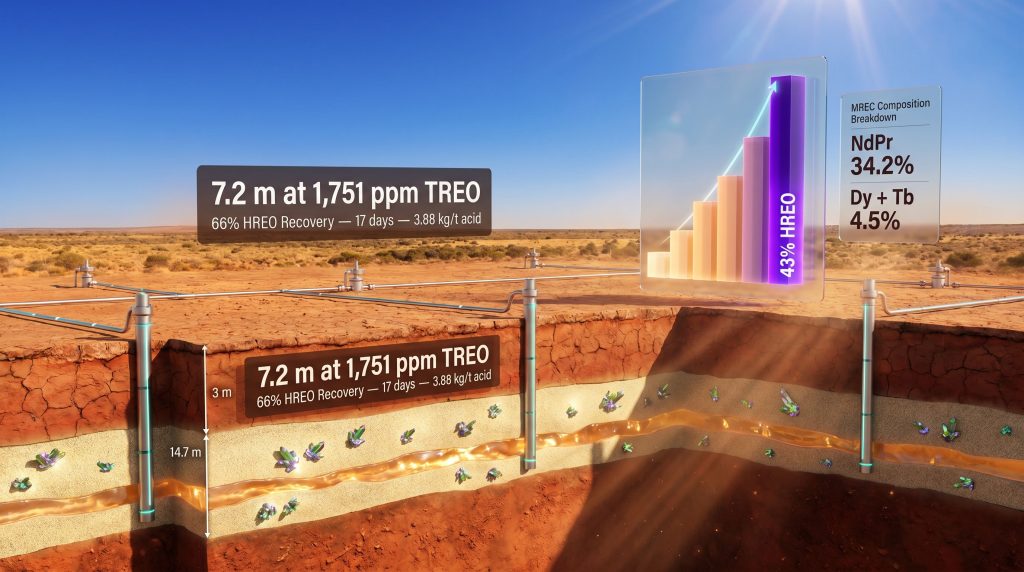
Field hydrology testing at Boland recorded aquifer permeability of approximately 1.8 metres per day. Visual core logging from one of the initial resource-definition holes identified a 3.0-metre permeable horizon at 14.7 metres depth, grading 2,558 ppm TREO. This is a particularly significant intersection because it collocates two of the four key ISR variables in a single geological unit: a permeable sand horizon with high-value mineralisation at shallow depth.
Technical Note: In a confined ISR wellfield, permeability governs how far the lixiviant can travel laterally between injection and extraction wells within an economically acceptable timeframe. A permeability of approximately 1.8 m/day is consistent with the thresholds used in commercially viable ISR wellfield design, and the 3.0-metre horizon at 14.7 metres represents an optimal combination of grade and flow geometry for wellfield spacing calculations.
Particle-size distribution analysis across the full 74-hole footprint is currently in progress to calculate permeability more comprehensively across the entire target zone.
The Four-Variable Framework: Why Grade Alone Does Not Determine Project Economics
Unlike conventional open-pit mining where grade multiplied by tonnage drives most economic models, ISR project economics are governed by four interacting variables that must be assessed as a unified system. Performing well on three of the four while failing on one can undermine the entire operating cost case.
| Variable | What It Controls | Key Metric at Boland |
|---|---|---|
| Grade (TREO) | Revenue per volume of solution processed | 590 to 2,558 ppm TREO across drilled intervals |
| Aquifer Permeability | Wellfield spacing and extraction cycle duration | ~1.8 m/day; 3.0 m permeable horizon at 14.7 m depth |
| Metallurgical Recovery | Acid consumption and HREO yield per cycle | 66% HREO recovery in 17 days at 3.88 kg/t acid |
| Natural Acid Generation | External sulphuric acid procurement cost reduction | Organic pyrite confirmed in Pidinga and Garford formations |
Variable 1: Grade Distribution Across the 74-Hole Programme
Preliminary assay results from the first 14 of 74 resource-definition drillholes at the Boland prospect returned intervals consistent with the ionic rare earth grade assumptions underpinning the project model. The highlighted intersections include:
- 7.2 m at 1,751 ppm TREO from 14 m depth
- 5.2 m at 1,674 ppm TREO from 26.4 m depth
- 1.7 m at 1,755 ppm TREO from 26.4 m depth
- 1.5 m at 891 ppm TREO from 31.3 m depth
- 1.1 m at 1,004 ppm TREO from 32.6 m depth
- 2.2 m at 590 ppm TREO from 42 m depth
Heavy rare earth enrichment within these intervals is considered a strong indicator of the ionic mineralisation mechanism, which is the deposit type that makes ISR extraction chemically feasible. The remaining 60 drillholes will determine whether these grades are consistent across the full resource footprint or represent localised high-grade zones within a more variable system.
Variable 2: Permeability and Wellfield Engineering
Aquifer permeability in a confined ISR system determines the practical spacing between injection and extraction wells, which in turn sets the capital cost of wellfield construction and the throughput achievable per unit of installed infrastructure. The 3.0-metre permeable sand horizon at 14.7 metres depth, grading 2,558 ppm TREO, represents an ideal geometry because the highest-grade intersection coincides with the most permeable unit identified to date.
Particle-size distribution analysis across samples from the full drilling programme will extend this permeability characterisation across the entire footprint, providing the spatial dataset needed for wellfield engineering within the Scoping Study.
Variable 3: Metallurgy, Acid Consumption, and HREO Recovery
The metallurgical programme at Boland has produced bench-scale data across a range of pH conditions. Understanding the acid consumption at each pH stage is essential because sulphuric acid is typically the largest single reagent cost in an ISR rare earth operation. Consequently, the rare earth processing challenges associated with acid procurement and management are central to any credible operating cost model.
| pH Level | Acid Consumption (kg/t) | Recovery Context |
|---|---|---|
| pH 3 | 6.7 kg/t | Maximum dissolution; highest acid cost |
| pH 4.5 | 1.95 kg/t | Cerium and iron removal stage |
| pH 5 | 1.60 kg/t | 44% HREO recovery at bench scale |
| pH 7 | Minimal | 20 to 25% recovery via sequential leach |
The critical data point from the scaled bench study is 66% recovery of Heavy Rare Earth Oxides using 3.88 kg per tonne of sulphuric acid within 17 days. This combination of relatively moderate acid input, commercially meaningful recovery, and short cycle duration is the kind of operational benchmark that feeds directly into an ISR economic model. A higher ionic proportion in the orebody reduces acid requirements further because fewer non-target elements are dissolved alongside the rare earths, simplifying both chemistry and downstream processing.
Variable 4: Natural Acid Generation and Its Impact on Operating Costs
Sulphuric acid supply has faced structural tightening due to geopolitical disruption affecting key production regions. For an ISR rare earth project, this is not a peripheral concern — it directly affects the largest reagent cost line in the operating cost model. In addition, the broader context of China rare earth restrictions has reinforced the urgency of establishing cost-competitive production pathways outside the region.
The Boland project addresses this through geological good fortune: organic pyrite within the Pidinga and Garford formations oxidises during the ISR process and generates sulphuric acid in situ, reducing the volume of acid that must be externally procured and transported to site.
Drilling at the Head prospect intersected 5.6 metres of heavily reduced Pidinga formation containing lignite interbeds from 25.9 metres depth, considered particularly favourable for this natural acid generation mechanism. Total Organic Carbon and total sulphide analyses are currently in progress on drill samples to quantify how much on-site acid generation can be incorporated into the operating cost model.
Investor Callout: Natural acid generation is not a speculative or marginal variable. In southern China's ionic rare earth ISR operations, proximity to naturally acidic geological environments has historically contributed to lower operating costs than external acid procurement alone would suggest. At Boland, confirming and quantifying this mechanism through Total Organic Carbon analysis is one of the remaining critical steps before the MRE can incorporate a defensible acid cost assumption.
The Five-Stage Flowsheet and Why Product Composition Is Commercially Significant
The Sequential pH Process That Removes Impurities Before Final Precipitation
The optimised flowsheet at Boland operates across five steps spanning four pH stages, each designed to selectively remove specific elements before the final mixed rare earth carbonate is precipitated:
- ISR extraction at pH 3: Target rare earth elements dissolved from the clay-adsorbed fraction into the pregnant solution
- Cerium and iron removal at pH 4.5: The most abundant rare earth by mass removed cost-effectively before final precipitation
- Aluminium removal at pH 6.2: Reduces impurity load entering the final product
- Uranium removal via resin exchange at pH 6.2: Addresses regulatory and product quality requirements
- Mixed Rare Earth Carbonate precipitation at pH 7.5: Final product formed with concentrated heavy rare earth composition
Removing cerium at pH 4.5 before final precipitation is commercially significant in a way that is not immediately obvious. Cerium is the most abundant rare earth element by mass in most deposits and, while it has industrial applications, it commands far lower pricing than heavy rare earths or neodymium-praseodymium. By eliminating cerium efficiently in an early pH stage rather than sending it through to the final product, the flowsheet concentrates the high-value fraction without requiring a separate, capital-intensive separation circuit downstream.
MREC Composition: Where Boland Sits in the Global Product Landscape
| Component | Proportion in MREC |
|---|---|
| Total Heavy Rare Earth Oxides (HREOs) | 43% |
| Neodymium + Praseodymium (NdPr) | 34.2% |
| Dysprosium + Terbium (Dy + Tb) | 4.5% |
| Total Impurities | Less than 0.9% |
Cobra Resources' Managing Director Rupert Verco has described the MREC composition as among the highest proportions of heavy rare earths in a mixed rare earth carbonate produced globally, noting that this translates directly into strategic, commercial, and marketability advantages for a product being produced through one of the lowest-cost mining methods available.
A 43% HREO proportion is materially higher than what most conventional mixed rare earth carbonate producers achieve from hard-rock or even most ionic-clay deposits without a cerium removal step. Dysprosium and terbium at 4.5% of the product are the specific elements that permanent magnet manufacturers require for high-temperature stability in electric vehicle motors and wind turbine generators, and they command pricing several multiples above the light rare earth equivalents. The sub-0.9% total impurity level reflects the effectiveness of the sequential pH removal process and reduces the downstream processing burden for any offtake partner.
From Resource Definition to Economic Evaluation: The Development Sequence
The 74-Hole Programme and MRE Target
The approximately 3,200-metre resource-definition drilling programme across the Boland and Head prospects is complete. Independent technical consultants have been engaged to support both the Mineral Resource Estimate and the subsequent Scoping Study. The collective resource target is 200 to 400 million tonnes at greater than 1,000 ppm Total Rare Earth Oxide, a scale that would position Boland among the larger ionic rare earth resource targets outside Asia.
Rupert Verco has outlined the direct link between completing the drilling programme and enabling economic evaluation, noting that closing out the resource-definition work at both prospects is what allows the team to concentrate on economic analysis for the rare earth projects while simultaneously advancing exploration at Manna Hill. Furthermore, the broader rare earth supply chain context means that projects of this scale and methodology are attracting increasing strategic interest from Western governments and manufacturers.
Remaining analytical work required before the MRE can be finalised:
- Assay results from the remaining 60 drillholes beyond the initial 14
- Particle-size distribution analysis to calculate aquifer permeability across the full prospect footprint
- Total Organic Carbon and total sulphide analyses to quantify natural acid generation potential
- Integration of all four variable datasets into a unified geological and economic model
Corporate Structure: How the 2025 Portfolio Restructuring Focuses Resources on Boland
Cobra Resources divested the Wudinna Gold Assets to Barton Gold in 2025 for up to A$15 million in cash and shares, including an entitlement to 6.45 million Barton Gold shares upon final settlement plus up to A$9.5 million in further contingent payments. The restructuring concentrated the company's technical capacity and capital on the Boland rare earth programme and the Manna Hill Copper Project, held through a binding option agreement over Hamelin Gully.
This portfolio simplification is operationally relevant because it removed the organisational complexity of managing a parallel gold programme during the technically demanding phase of resource definition at Boland. Those interested in the company's full portfolio can review Cobra Resources' projects for a comprehensive overview of its active exploration assets.
The next major ASX story will hit our subscribers first
Key Technical Risks Investors Should Monitor
The economic thesis for the Cobra Resources Boland rare earth project ISR programme does not rest on any single variable performing in isolation. All four variables must deliver within modelled parameters simultaneously for the operating cost case to hold. The primary risk categories at this stage of development are:
- Grade continuity risk: Whether the intervals from the initial 14 drillholes are representative of the full 74-hole footprint or reflect localised enrichment within a more variable system
- Permeability uniformity risk: Whether particle-size distribution analysis across the full programme confirms consistent permeability across multiple horizons, or reveals heterogeneity that complicates wellfield design
- Acid quantification risk: Whether Total Organic Carbon results support a material reduction in external acid procurement costs, or indicate a lower contribution from natural generation than the geological indicators suggest
- Metallurgical scaling risk: The 66% HREO recovery result was achieved at bench scale; transitioning those results to pilot and eventually commercial scale introduces process engineering uncertainty
- Regulatory pathway: ISR in South Australia is at an earlier stage of regulatory precedent than ISR uranium mining, requiring engagement with state environmental frameworks that will take time to navigate
Disclaimer: This article is intended for informational purposes only and does not constitute financial advice. Statements regarding future exploration results, resource estimates, and economic assessments are forward-looking in nature and subject to material uncertainty. Past exploration results do not guarantee future outcomes. Investors should seek independent financial and technical advice before making investment decisions.
Frequently Asked Questions
What Is ISR Mining and How Does It Apply to Rare Earth Projects?
In-Situ Recovery circulates a lixiviant solution through a naturally permeable, confined underground aquifer to dissolve target elements without physical excavation. For rare earths, ISR is only applicable to ionic clay deposits where elements are adsorbed onto clay surfaces rather than locked within hard rock, because the adsorption mechanism allows acid-based solutions to release them at low concentrations.
What Rare Earth Elements Does the Boland Project Target?
The project targets the full suite of ionic rare earth elements, with a product profile weighted toward heavy rare earths including dysprosium, terbium, neodymium, and praseodymium.
What Is the Difference Between Ionic and Hard-Rock Rare Earth Deposits?
Ionic deposits host rare earth elements adsorbed onto clay mineral surfaces through weathering. Hard-rock deposits lock rare earths within crystalline mineral structures. The practical consequence is that ionic deposits can be processed with dilute acid at ambient temperatures, while hard-rock deposits require energy-intensive roasting or aggressive chemical treatment.
When Is a Maiden Mineral Resource Estimate Expected for Boland?
The 74-hole drilling programme is complete. Independent technical consultants have been engaged. The MRE timeline depends on completion of remaining assays, particle-sizing, and geochemical analysis currently in progress.
Why Is Heavy Rare Earth Content in the Final Product Commercially Significant?
Dysprosium and terbium are essential additives in high-performance permanent magnets used in electric vehicle motors and wind turbine generators. They command pricing several multiples above light rare earth equivalents and are sourced almost exclusively from Chinese ionic clay ISR operations, making any non-Chinese HREO-rich product commercially differentiated.
Further Exploration
Readers seeking additional context on the Boland rare earth project and Cobra Resources' broader development strategy can explore related analytical content published at Crux Investor, which covers the company's project updates and corporate developments in detail.
Want to Be First When the Next Major Mineral Discovery Hits the ASX?
Discovery Alert's proprietary Discovery IQ model delivers real-time alerts on significant ASX mineral discoveries — including critical minerals like rare earths — instantly translating complex data into actionable opportunities for both short-term traders and long-term investors. Explore Discovery Alert's discoveries page to understand the historic returns major mineral discoveries have generated, and begin your 14-day free trial today to position yourself ahead of the broader market.