
July 18, 2026
From Single Mine to Silver District: The Geological and Capital Logic Behind First Majestic's Permits to Develop Santo Niño and Navidad in Mexico
Underground mining milestones rarely generate the same market excitement as discovery announcements, but seasoned mining investors understand that construction permits are where speculative potential converts into measurable capital commitment. Across Latin America's silver belt, the distance between a drill intercept and an operating portal is measured not just in metres but in regulatory cycles, metallurgical campaigns, community consultation processes, and engineering studies. The receipt of First Majestic permits to develop Santo Niño and Navidad in Mexico represents precisely this transition point at the Santa Elena property in Sonora, one of North America's most established silver-gold districts.
Understanding why this moment matters requires looking beyond the permit announcement itself and into the geological architecture, capital deployment logic, and processing economics that make the Santa Elena district an increasingly sophisticated multi-deposit platform. Furthermore, broader gold-silver supply trends across the Americas make this development timing particularly relevant for investors tracking mid-tier producer strategies.
When big ASX news breaks, our subscribers know first
How Mexico's Permitting Framework Defines the Value Inflection Point
In most Latin American silver-producing nations, the gap between mineral discovery and construction permitting is the single most underappreciated value inflection point in the development cycle. Peru, Argentina, and Chile each have their own regulatory frameworks governing underground mine development, but Mexico's system through the Secretaría de Medio Ambiente y Recursos Naturales (SEMARNAT), the Servicio Geológico Mexicano (SGM), and relevant municipal authorities presents a multi-agency process that, once completed, signals that environmental assessment, land access, and community engagement have all reached a substantive threshold.
Construction permits for underground portals are not planning signals. They are binding authorisations that commit the receiving company to defined development parameters and environmental management obligations. For First Majestic, securing these permits for both Santo Niño and Navidad simultaneously compresses the timeline for dual-target development and removes one of the most commonly cited risk factors in pre-development project assessments.
Sonora state, where Santa Elena is located, has historically been Mexico's most active mining jurisdiction by investment volume. Its geological endowment spans porphyry copper systems, epithermal silver-gold veins, and skarn deposits, giving it a diverse extractive base that has attracted sustained institutional capital across multiple commodity cycles.
The Four-Deposit Architecture of the Santa Elena District
How District Consolidation Reshapes the Per-Ounce Economics
The Santa Elena property has undergone a structural transformation over the past several years, evolving from a single-deposit silver-gold mine into a four-deposit district now anchored by distinct but spatially proximate mineralised systems. The four deposits currently comprising the property are:
- Santa Elena — the original producing mine and the source of the existing processing infrastructure
- Ermitaño — an established underground operation that validated the district's capacity to host multiple high-grade vein systems
- Navidad — a high-grade gold-silver vein system forming part of the broader Winter vein corridor, now with its own construction permit
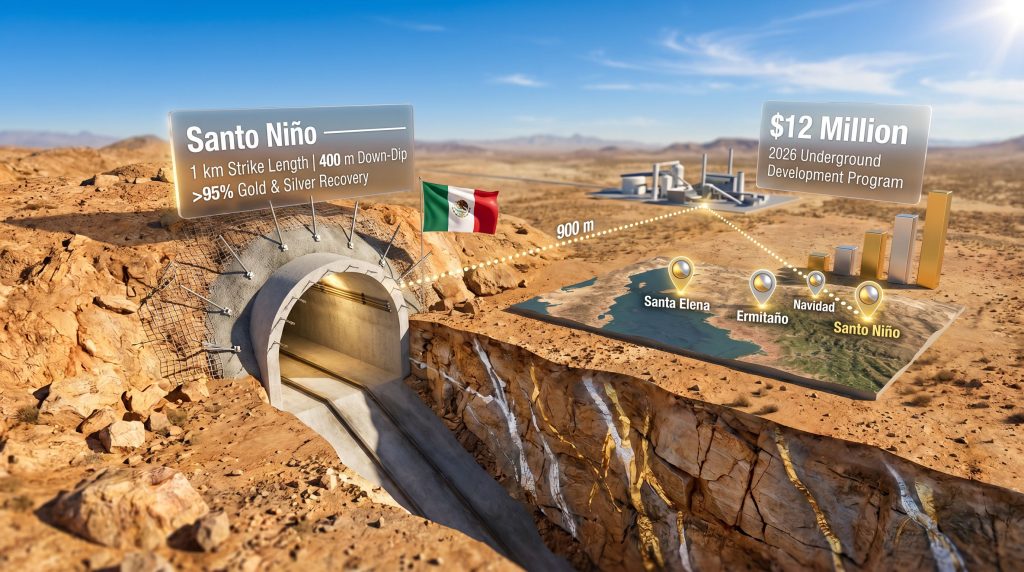
- Santo Niño — a newly permitted high-grade epithermal discovery located approximately 900 metres south of the existing Santa Elena processing plant
This four-deposit configuration creates what mining engineers refer to as a district-scale brownfield platform, where individual deposits feed a centralised processing facility rather than requiring standalone infrastructure. The economic implications are substantial. Greenfield underground mine development in Mexico typically requires capital expenditure for portal construction, decline development, underground infrastructure, surface facilities, and a standalone processing plant.
Within a brownfield district like Santa Elena, however, only the underground access and connecting infrastructure need to be funded for new deposits, because the processing plant already exists and has available throughput capacity. This dynamic closely mirrors the approach underpinning a broader silver expansion strategy seen across mid-tier producers operating in Latin America.
Comparing the Two Newly Permitted Targets
| Attribute | Santo Niño | Navidad |
|---|---|---|
| Deposit Type | High-grade epithermal gold-silver vein | Winter vein system gold-silver |
| Strike Length Traced | Over 1 km along strike | Expanding eastward, ongoing delineation |
| Down-Dip Extent | ~400 m down-dip | Continuing delineation |
| Distance to Processing Plant | ~900 m south of Santa Elena plant | Within Santa Elena property boundary |
| Metallurgical Recovery | Greater than 95% gold and silver (third-party tested) | Greater than 95% gold and silver (third-party tested) |
| Permit Status | Underground portal construction permit received | Underground portal construction permit received |
| Development Phase | Near-term underground access target | Advancing in parallel with Santo Niño |
What $12 Million in 2026 Underground Capital Actually Funds
Portal to Stope: The Development Sequencing Explained
The $12 million capital allocation for 2026 covers the foundational infrastructure required to convert surface discoveries into underground ore sources. For investors less familiar with underground mine development mechanics, the sequencing from permit to production involves distinct engineering stages:
- Portal collar establishment — excavating and lining the entry point where the underground access begins at surface
- Portal support installation — ground support systems including shotcrete, rock bolts, and steel sets to stabilise the opening
- Initial decline or ramp development — driving the primary access tunnel on a gradient that allows equipment and ore movement
- Underground drilling platforms — creating stations within the decline from which diamond drill holes can target vein intersections at depth
- Stope design and scheduling — once sufficient geological data is available from underground drilling, defining the mining blocks and integrating them into the Santa Elena plant's feed schedule
- First ore delivery to the processing facility — the near-term mining readiness milestone that marks the transition from development to production
The second half of 2026 commencement window is operationally significant. Sonora experiences its most challenging weather conditions during the summer monsoon season, which typically runs from July through September. Portal collar construction and initial surface works benefit from being timed around this seasonal pattern, and the H2 2026 schedule suggests the program accounts for these conditions in its planning assumptions.
Why Brownfield Capital Intensity Differs Fundamentally from Greenfield
"The existence of an operating processing plant within trucking distance of a new underground discovery fundamentally restructures the capital requirement profile. Instead of funding a complete mining operation from scratch, the capital requirement is limited to underground access and ore transport, with processing economics already proven at the existing facility."
The independent third-party metallurgical testing confirming gold and silver recoveries exceeding 95% at both Santo Niño and Navidad is a material de-risking outcome. In epithermal gold-silver systems, metallurgical complexity can vary significantly depending on the sulphide mineralogy, clay content, and oxidation state of the ore. A recovery rate above 95% confirmed through independent testing eliminates a variable that has derailed otherwise promising underground projects in the Mexican silver belt, where refractory ores or unexpected mineralogical transitions at depth have historically required costly plant modifications or process redesign.
The Geological Case for the Santo Niño Epithermal Discovery
Epithermal Systems in Sonora: Grade Distribution and Structural Controls
Epithermal gold-silver vein deposits form in the upper portions of hydrothermal systems, typically at depths of less than 1,500 metres below the palaeosurface, where ascending mineralised fluids encounter lower temperatures and pressures and precipitate their metal cargo within fractures and fault zones. In Sonora's geological setting, these systems tend to be hosted within Tertiary volcanic sequences and are structurally controlled by regional fault arrays.
What makes epithermal systems particularly important from a mining economics perspective is their characteristic grade distribution pattern. High-grade ore shoots within epithermal veins are often vertically and laterally discontinuous, concentrated at structural intersections or changes in vein dip. This means that while headline intercept grades can be exceptional, the critical evaluation metric is not the peak grade but the continuity and geometry of the mineralised shoot across both strike length and down-dip extent.
For Santo Niño, the combination of over 1 kilometre of strike length and 400 metres of down-dip continuity already established through surface drilling provides a structural framework that supports meaningful resource conversion once underground access platforms enable systematic infill drilling. Consequently, when interpreting drill results from epithermal targets like this, structural continuity data carries at least as much weight as peak grade intercepts. In comparison, many Mexican epithermal discoveries are permitted for underground development with shorter confirmed continuity data, making Santo Niño's current delineation footprint a relatively strong geological foundation at the permitting stage.
The Winter Vein System and Navidad's Eastward Expansion
Navidad occupies a position within the Winter vein system, a structural corridor that has demonstrated the capacity to host mineralisation across multiple zones within the Santa Elena property. The ongoing eastward expansion of Navidad's footprint increases the district's long-term resource optionality by extending a known mineralised trend rather than relying on isolated vein discoveries.
From an underground development sequencing standpoint, advancing Navidad simultaneously with Santo Niño rather than sequentially serves a specific throughput logic. The Santa Elena processing plant has finite capacity, and the ability to blend ore from multiple underground sources allows plant managers to optimise head grades, manage throughput variability, and extend the operational life of the facility beyond what a single vein system could sustain alone.
Risk Factors and Mitigation Framework
No underground development program is free of execution risk, and investors assessing this capital commitment should weigh the known risk categories against the mitigating factors already in place.
| Risk Category | Specific Consideration | Mitigation Already in Place |
|---|---|---|
| Regulatory | Permit amendments or environmental objections post-issuance | Construction permits already secured for both targets |
| Geological | Vein continuity at depth below current drill data | 400 m down-dip continuity established at Santo Niño before permitting |
| Metallurgical | Processing incompatibility with existing Santa Elena plant | Greater than 95% recovery confirmed via independent third-party testing |
| Capital | Cost overruns on underground development in Sonora | Defined $12M budget with scoped development activities for 2026 |
| Operational | Seasonal access and weather constraints | H2 2026 commencement window structured around Sonora's seasonal patterns |
One risk category less commonly discussed in project announcements is the grade reconciliation risk inherent in epithermal vein systems. Because high-grade shoots within epithermal veins are often narrower than the minimum mining width, mine plans in these systems frequently include dilution from lower-grade vein margins and wall rock. Understanding grade and permitting considerations is essential here, as the practical implication is that run-of-mine head grades delivered to the plant may be lower than the reported drill intercept grades, making the greater than 95% metallurgical recovery rate even more important as a compensating factor.
The next major ASX story will hit our subscribers first
What This Means for Mexico's Broader Mining Investment Landscape
Mexico accounts for approximately 23% of global silver production, making it the world's largest silver-producing nation by volume. Sonora is consistently the most active state within Mexico's mining sector by investment and output, hosting operations across multiple major and mid-tier producers. A $12 million underground development commitment within Sonora in 2026 represents a substantive private capital deployment in a jurisdiction that has faced investor scrutiny in recent years over regulatory changes affecting concession security and water use rights.
The significance of this investment extends beyond the individual project. When established producers commit capital to underground development in Sonora, it reflects an operator-level assessment that the jurisdiction's risk-reward profile supports multi-year development timelines. This kind of private capital commitment is distinct from any form of regulatory preferencing or government support and reflects purely commercial decision-making based on geological merit, metallurgical validation, and infrastructure proximity. Completing a definitive feasibility study for one or both targets may represent a logical next step as underground data accumulates in 2026 and beyond.
Key Takeaways for Tracking the Santa Elena District's Development
The progression of First Majestic permits to develop Santo Niño and Navidad in Mexico from exploration discovery to permitted underground development target encapsulates several distinct value-creation mechanisms operating simultaneously:
- Construction permits represent the formal regulatory threshold separating exploration assets from development-stage projects, with associated capital and operational implications
- The $12 million 2026 program advances both targets concurrently, maximising the throughput optionality available through the existing Santa Elena processing plant
- Metallurgical recoveries exceeding 95% for both gold and silver at both deposits, confirmed independently, eliminate one of the most consequential technical uncertainties in pre-development underground mine assessment
- The four-deposit district architecture positions Santa Elena as a long-duration multi-source production platform rather than a single-vein operation with a finite mine life
- Santo Niño's established 1 km strike length and 400 m down-dip extent provide the geological continuity foundation necessary to support a resource base capable of sustaining meaningful underground mining rates once portal access is established
Furthermore, recent drilling results from the Santa Elena mine continue to reinforce the geological case for accelerated district development, adding further confidence to the capital allocation decisions underpinning the 2026 program.
This article is intended for informational purposes only and does not constitute financial or investment advice. Forward-looking statements regarding development timelines, capital allocations, and geological continuity are subject to operational, regulatory, and geological risks. Readers should conduct their own due diligence and consult a qualified financial adviser before making investment decisions.
Want to Stay Ahead of the Next Major ASX Mineral Discovery?
Discovery Alert's proprietary Discovery IQ model delivers real-time alerts the moment significant mineral discoveries are announced on the ASX, transforming complex geological data into actionable investment insights for both short-term traders and long-term investors — explore historic discoveries and their remarkable returns, then begin your 14-day free trial at Discovery Alert to position yourself ahead of the broader market.