
July 9, 2026
When Security Risk Becomes a Balance Sheet Problem: Lessons From Dormant Silver Assets
The mining industry has long grappled with a paradox that rarely makes headlines: an asset can hold genuine geological value while simultaneously destroying economic value for its owner. This tension becomes acute when a producing mine is shuttered not because the ore has run out, but because the operating environment has become untenable. First Majestic to sell San Martin mine for $90 million is precisely the kind of headline that encapsulates this paradox, forcing investors to look beyond the dollar figure and examine what the transaction truly represents.
When big ASX news breaks, our subscribers know first
Deal at a Glance: Key Parameters
Before examining the strategic and financial mechanics, it helps to ground the analysis in the transaction's core details.
| Deal Parameter | Detail |
|---|---|
| Asset Being Sold | San Martin Silver Mine, Jalisco, Mexico |
| Seller | First Majestic Silver Corp. |
| Buyer | Flextronics Supply and Service, S. de R.L. de C.V. |
| Total Transaction Value | US$90 million |
| Additional Land Package | Jalisco Group of Properties (5,245 hectares) |
| Mine Status at Sale | Care and maintenance since July 2019 |
| Expected Closing | Q4 2026 |
| Regulatory Condition | Mexican Antitrust Approval Required |
The Strategic Case for Selling a Mine That Still Has Ore
Portfolio rationalisation is one of the most consequential yet least glamorous disciplines in resource company management. For precious metals producers, the temptation to hold dormant assets as optionality is powerful. Silver prices rise, and yesterday's uneconomic operation suddenly looks attractive on paper. However, this logic can obscure a more uncomfortable truth: the cost of holding an idle mine is not zero.
San Martin was placed under care and maintenance in July 2019 following a deterioration in regional security across Jalisco State. This was not a temporary operational pause driven by commodity price weakness or a processing bottleneck. It was a safety-driven suspension, which fundamentally alters the calculus of restart.
When an asset is idled due to resource depletion or market conditions, a recovery in prices can logically trigger a restart. When it is idled because the surrounding environment poses physical risk to workers and equipment, the path back to production requires far more than capital investment alone. Furthermore, broader silver market pressures have only added complexity to decisions around dormant assets in challenging jurisdictions.
Over seven years on care and maintenance, San Martin would have continued generating holding costs including site security, environmental compliance monitoring, regulatory reporting obligations, and infrastructure preservation. For a mid-tier producer like First Majestic, these costs represent not just a financial drain but a management distraction from higher-priority operating assets.
The critical inflection point for any dormant mine is when the expected value of future restart optionality falls below the cumulative cost of continued ownership. At that point, divestment becomes the rational capital allocation decision, regardless of the underlying resource quality.
Rising silver prices in recent years have provided precisely the kind of favourable market backdrop needed to attract credible buyers for assets of this type, creating a narrow but meaningful window for producers to achieve reasonable valuations on properties they might otherwise struggle to monetise.
San Martin Silver Mine: Understanding the Asset
Location, Scale, and Historical Production Context
San Martin sits approximately 250 kilometres north of Guadalajara within the San Martín de Bolaños mining district, a region with a centuries-long silver mining history. The asset's mineral tenure is substantial: 33 contiguous mining concessions covering 38,512 hectares of mineral rights. Surface land holdings add a further 1,296 hectares covering mine access corridors and infrastructure, plus a separate 160-hectare parcel hosting the processing plant, camp facilities, maintenance workshops, and tailings storage.
The scale of this infrastructure matters. A 1,300 tonne-per-day processing plant, expanded from its original 950 t/d capacity through a 2013 mill expansion, represents significant sunk capital. For an incoming buyer willing to restart operations, much of the fixed infrastructure investment has already been made. The question is whether the regional operating environment has stabilised sufficiently to justify that restart.
The Jalisco Group of Properties: Embedded Exploration Optionality
The transaction also encompasses the Jalisco Group of Properties, comprising 5,245 hectares of additional mining concessions held through the El Pilon subsidiary, located across the municipalities of Etzatlán and Tototlán in Jalisco State. Including this exploration tenure in the deal package is a structurally intelligent move from First Majestic's perspective.
Bundling exploration concessions with an established processing facility and mine infrastructure creates a more compelling value proposition for the buyer, who gains access to potential resource extensions and greenfield targets without needing to assemble the land position from scratch. This kind of land-plus-infrastructure bundling is a recognised technique in mining M&A trends to support headline transaction prices that might otherwise appear aggressive for a dormant asset.
Breaking Down the $90 Million Payment Structure
A Deal That Reads Very Differently Up Close
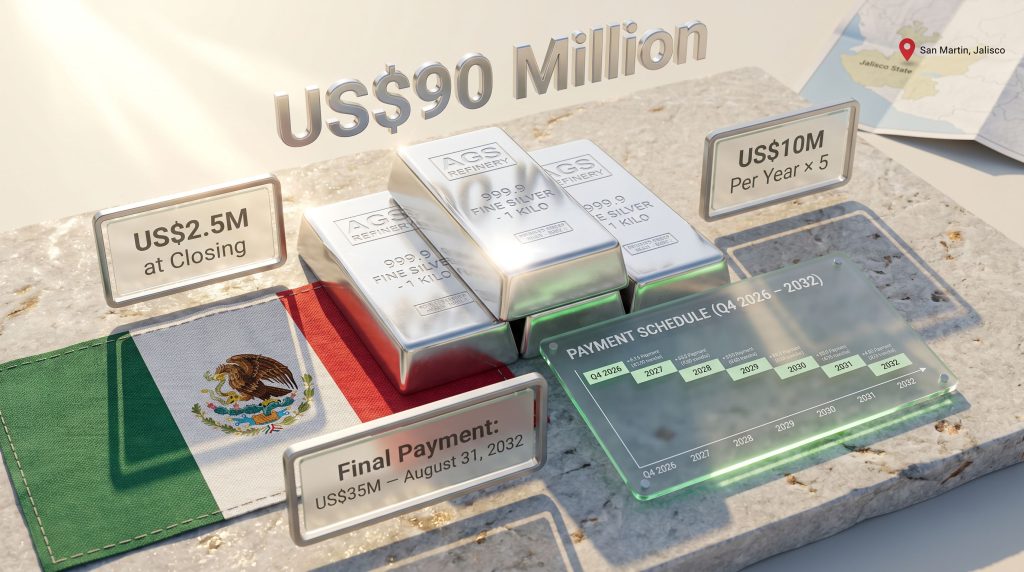
The US$90 million headline figure deserves careful scrutiny, because the payment architecture tells a story quite distinct from the headline number. According to the official definitive agreement, the payment schedule is structured as follows:
| Payment Tranche | Amount | Timing |
|---|---|---|
| Escrow Deposit (pre-closing) | US$500,000 | Already deposited |
| Cash at Closing | US$2.5 million | Upon transaction close |
| Second Cash Payment | US$2.5 million | Within 180 days of closing |
| Annual Installments (x5) | US$10 million per year | Years 1-5 post-closing |
| Final Balloon Payment | US$35 million | August 31, 2032 |
| Total Consideration | US$90 million | Across six-year horizon |
The immediate liquidity impact for First Majestic is modest. Only US$2.5 million is received at closing, against a total consideration of US$90 million. The overwhelming majority of proceeds, including a substantial US$35 million balloon payment due in August 2032, arrive over a six-year payment window. This structure has significant implications for both parties.
What the Deferred Payment Architecture Signals
From the buyer's perspective, staggered payments reflect the capital-intensive reality of restarting a mine that has been dormant for over seven years. Processing plants require recommissioning, workforces need to be rebuilt, supply chains must be reestablished, and community and regulatory relationships require careful management. Negotiating installment-based payments allows the buyer to align outflows with the ramp-up of cash flows from the mine itself.
From First Majestic's perspective, accepting a heavily back-loaded payment schedule represents a trade-off between maximising total deal value and receiving that value promptly. The structure carries counterparty risk: if Flextronics Supply and Service encounters operational or financial difficulties before 2032, First Majestic's ability to recover the full US$90 million could be compromised.
Investor note: A US$35 million balloon payment falling due six years from closing, combined with only US$2.5 million at close, means that roughly 39% of the total deal value arrives in a single payment nearly a decade from the time the asset was shuttered. This is not unusual for care-and-maintenance asset transactions, but it warrants attention when assessing the deal's contribution to near-term liquidity.
Who Is Buying San Martin and Why It Matters
The Significance of a Domestic Mexican Acquirer
Flextronics Supply and Service, S. de R.L. de C.V. is a privately held Mexican entity, and this detail carries more strategic weight than it might initially appear. Mexico's mining sector operates within a complex interplay of federal regulation, state-level political dynamics, and community relations frameworks.
In regions like Jalisco, where security challenges have historically been tied to organised criminal activity rather than straightforward political instability, the ability of an operator to navigate local relationships and security arrangements is a material operational advantage. A domestic buyer may bring existing regional networks, established relationships with local authorities, and a deeper understanding of the specific security dynamics that prompted First Majestic's original suspension.
None of this guarantees a successful restart, but it does represent a structural advantage that an international producer might struggle to replicate.
Regulatory Pathway: COFECE Review
The transaction is conditional on approval from Mexico's Federal Economic Competition Commission (COFECE), the country's antitrust authority. For mining asset transfers, COFECE review typically:
- Assesses whether the transaction would lead to significant market concentration in specific mineral supply chains
- Evaluates land tenure consolidation impacts
- Examines competitive effects on domestic processing and refining industries
This process adds a layer of regulatory certainty to the deal timeline, supporting First Majestic's Q4 2026 closing expectation while also providing a formal validation mechanism for the transaction structure.
The next major ASX story will hit our subscribers first
How This Transaction Fits Into Silver Sector M&A Trends
The Asset Recycling Phenomenon in Precious Metals
The San Martin divestment reflects a broader pattern playing out across the silver mining industry: producers are increasingly using elevated spot silver prices to unlock balance sheet value from assets that have been stranded by operational, security, or economic challenges. Indeed, silver's dual role as both a precious metal and an industrial commodity continues to attract sustained buyer interest, even for dormant assets with complex restart profiles.
The mechanics of care-and-maintenance asset sales differ substantially from acquisitions of producing operations.
| Deal Type | Typical Payment Structure | Buyer Risk Profile | Seller Motivation |
|---|---|---|---|
| Producing Mine Acquisition | Predominantly upfront | Lower | Premium realization |
| Care-and-Maintenance Asset Sale | Staggered/deferred | Higher | Balance sheet cleanup |
| Exploration Property Divestment | Royalty/equity hybrid | Highest | Early capital recovery |
The deferred, installment-heavy structure of the San Martin deal is characteristic of the middle category. Buyers of dormant assets are essentially taking on restart execution risk, and the payment schedule reflects the uncertainty embedded in that risk. In contrast, a silver acquisition strategy focused on producing assets typically commands a far more front-loaded payment structure.
Mexico's Jalisco State: A Jurisdiction With Layered Complexity
Jalisco has long been recognised as one of Mexico's historically significant precious metals jurisdictions, with silver and gold mineralisation occurring across multiple geological settings including epithermal vein systems and skarn deposits. However, the state has also become associated with elevated security risk, particularly in rural mining districts where institutional presence is limited.
This security premium represents a persistent valuation discount for assets in the region. Buyers willing to accept that risk at the right price point can potentially unlock significant value if they possess the operational capabilities and local relationships needed to operate safely and sustainably.
Financial Impact on First Majestic: Beyond the Headline Number
Immediate Benefits That Precede Cash Receipts
While much attention will focus on the US$90 million total consideration, the financial benefits of this divestment for First Majestic extend well beyond the payment schedule. Eliminating the ongoing carrying cost burden of a seven-year-old care-and-maintenance operation improves operational cash flow margins immediately upon closing.
These carrying costs typically encompass:
- Security personnel and equipment for site protection
- Environmental monitoring programmes and regulatory compliance reporting
- Infrastructure preservation and preventive maintenance
- Insurance, permitting renewals, and community engagement obligations
- Management time and corporate overhead allocation
Once these costs are removed from the income statement, the per-ounce operating cost profile of First Majestic's remaining active portfolio improves, even before a single dollar of sale proceeds is received.
Capital Redeployment Potential
The proceeds, as they arrive across the six-year payment schedule, provide First Majestic with capital that can be directed toward higher-return opportunities. The First Majestic production record achieved in recent periods demonstrates the company's operational momentum at its active mines, and consequently, capital recycled from the San Martin sale could further support that trajectory. For mid-tier producers, this kind of capital recycling is increasingly viewed by institutional investors as a sign of management discipline rather than an admission of failure.
Five Strategic Lessons From the San Martin Divestment
The decision by First Majestic to sell San Martin mine for $90 million is instructive well beyond its immediate financial parameters. It encapsulates a set of strategic principles that apply broadly to precious metals producers managing complex, geographically diverse portfolios.
-
Security-driven suspensions create a fundamentally different restart calculus than economically-driven ones. Resource depletion and price-driven shutdowns can reverse when conditions change. Security-driven suspensions require changes in the external environment that are largely outside the producer's control.
-
Deferred payment structures are the market's way of pricing restart risk. When a buyer negotiates installment payments rather than upfront cash, they are signalling that restart execution uncertainty justifies a payment schedule aligned with future cash flows rather than current asset value.
-
Domestic buyers carry structural operational advantages in security-sensitive jurisdictions. Local entities with established regional networks may be better positioned to manage the community and security dynamics that international producers find difficult to navigate.
-
Bundling exploration tenure with a dormant operation is a proven deal-enhancement technique. The inclusion of the 5,245-hectare Jalisco Group of Properties increases the buyer's resource optionality and supports the headline transaction value.
-
Removing idled assets from a portfolio improves operational metrics even before proceeds arrive. The elimination of carrying costs creates an immediate positive impact on cash flow margins that is separate from, and additional to, the value of the sale proceeds themselves.
Frequently Asked Questions
Why Was San Martin Placed on Care and Maintenance?
First Majestic suspended operations at San Martin in July 2019 due to deteriorating security conditions across Jalisco State, Mexico. The decision prioritised workforce safety over continued production and was not related to the underlying resource quality or commodity price conditions at the time.
What Is the Total Value of the Deal, and When Will It Be Received?
The definitive agreement establishes US$90 million in total cash consideration. However, only US$2.5 million is payable at closing, with the remaining US$87.5 million structured across installment payments and a final US$35 million balloon payment due by August 31, 2032. Analysts covering the transaction at Investing News Network have noted the extended payment horizon as a key consideration for investors assessing near-term liquidity impact.
What Exactly Is Being Sold?
The transaction encompasses all shares of Minera El Pilon, the subsidiary holding the San Martin Silver Mine and its associated mineral concessions (33 concessions, 38,512 hectares), surface land parcels totalling approximately 1,456 hectares, and the Jalisco Group of Properties (5,245 hectares of additional mining concessions).
When Is the Transaction Expected to Close?
First Majestic anticipates a Q4 2026 closing, subject to standard conditions and COFECE antitrust approval from Mexican regulatory authorities. Notably, First Majestic to sell San Martin mine for $90 million remains one of the more structurally complex divestments the company has undertaken, given the multi-year payment horizon and the regulatory pathway required.
Who Is the Buyer?
Flextronics Supply and Service, S. de R.L. de C.V. is a privately held Mexican company acquiring the asset through a share purchase of Minera El Pilon, the legal entity that holds the San Martin mine and associated properties.
This article is intended for informational purposes only and does not constitute financial or investment advice. The deal structure, payment timelines, and regulatory outcomes described are subject to change. Readers should conduct independent research and consult qualified financial advisors before making investment decisions. Forward-looking statements regarding transaction closing, payment receipt, and operational outcomes involve risks and uncertainties that may cause actual results to differ materially from those anticipated.
For ongoing coverage of mining transactions and operational developments across Latin America and beyond, Engineering & Mining Journal at e-mj.com provides detailed regional reporting and industry analysis.
Want to Stay Ahead of Significant ASX Mineral Discoveries Before the Broader Market?
Discovery Alert's proprietary Discovery IQ model delivers real-time alerts on major ASX mineral discoveries, transforming complex geological and market data into clear, actionable investment insights for both short-term traders and long-term investors — begin your 14-day free trial today, or explore the historic returns major discoveries have generated to understand the scale of opportunity that early identification can unlock.