June 27, 2026
District-Scale Ambition: Inside the First Majestic Santa Elena Expansion Taking Shape in Sonora
Silver mining in Mexico has always rewarded patience and geological conviction. The country's vein-hosted silver-gold systems, shaped by ancient hydrothermal activity across the Sierra Madre Occidental, are notoriously complex to unlock. Yet the operators who commit to district-scale thinking, rather than single-orebody extraction, consistently outperform over multi-decade horizons. That is precisely the framework guiding the First Majestic Santa Elena expansion, which entered a new operational phase in mid-2026 after receipt of construction permits for two high-grade underground targets within the Sonora district.
When big ASX news breaks, our subscribers know first
From Single Mine to Multi-Deposit District: A Structural Transformation
What distinguishes the Santa Elena district from most silver operations in Mexico is not any single drill result, impressive as some of them are. It is the convergence of four distinct deposits within one operating footprint, each at a different stage of maturity, all sharing the same processing infrastructure.
| Deposit | Status | Key Attribute |
|---|---|---|
| Santa Elena | Producing | Established processing hub |
| Ermitaño | Producing | Underground haul road network |
| Santo Niño | Development | Maiden resource declared mid-2025 |
| Navidad | Development | Highest-grade intercepts in district |
This configuration creates what mining analysts call operational leverage through shared infrastructure. When multiple orebodies feed a single processing plant, the per-tonne capital intensity of bringing a new deposit into production drops substantially compared to greenfield development. The existing Ermitaño haul road network serves as the connective tissue linking new portals to the central mill, avoiding the cost of duplicating haulage infrastructure from scratch.
The Navidad portal, notably, sits approximately 300 metres from the Santa Elena processing facilities, a proximity that compresses construction lead times and reduces capital required to establish ore delivery. In underground mining, every hundred metres of unnecessary haulage adds cost and scheduling risk. That 300-metre figure is a meaningful structural advantage.
Why District Consolidation Matters More Than Individual Drill Hits
Vein-hosted silver-gold systems in Sonora tend to be geologically discontinuous at scale, meaning they branch, pinch, and swell unpredictably along strike and at depth. Individual intercepts, even spectacular ones, carry limited standalone value unless surrounded by a pattern of consistent results across multiple holes. District consolidation addresses this risk by creating a portfolio of orebodies within one operating licence area, so that underperformance at one deposit can be offset by upside at another.
Furthermore, global silver production trends demonstrate that the most resilient operations are those with geological redundancy built into the mine plan. The Santa Elena district is now structured along exactly these lines. With four deposits at varying stages, First Majestic has built geological redundancy into the mine plan, a feature rarely available to operators working a single vein system.
Santo Niño: What the Drilling Data Actually Shows
Santo Niño is the more advanced of the two development targets. As of mid-2026, the program has delivered 26,904 metres across 69 holes, representing roughly 60% of the full-year target of approximately 45,000 metres.
The drilling has not simply confirmed the deposit's existence. Results have consistently exceeded initial geological models, with higher-grade mineralisation concentrated in the western portion of the vein. That western zone is now the focal point for mine planning, because grade concentration in a specific structural position within a vein system is predictable and traceable, provided infill drilling confirms continuity.
Standout drill intercepts from Santo Niño:
| Intercept | True Width | Silver (g/t) | Gold (g/t) | AgEq (g/t) |
|---|---|---|---|---|
| Result A | 3.68m | 252 | 8.46 | 886 |
| Result B | 5.58m | 90 | 5.23 | 482 |
| Result C | 1.57m | 333 | 15.21 | 1,474 |
The vein currently traces approximately 1,100 metres along strike and 425 metres down dip, with an average true width of roughly 4.0 metres. That geometry, combined with grade distribution, supports a mineralised system of meaningful scale rather than a narrow high-grade shoot.
A top intercept of 1,474 g/t silver-equivalent over 1.57 metres positions the western zone of Santo Niño as the anchor for near-term mine planning. Grade concentration in a defined structural corridor is one of the most reliable indicators of mineable continuity in vein-hosted systems.
The Mechanics of Resource Category Conversion
One technical point often overlooked by non-specialist observers is the distinction between Inferred and Indicated Mineral Resources. Under international reporting standards such as JORC and NI 43-101, Inferred Resources carry the lowest geological confidence. They cannot be used in bankable feasibility studies or as collateral for project financing without conversion to higher categories.
Interpreting drill results correctly is therefore essential to understanding what the infill program at Santo Niño is actually achieving. The infill drilling program is explicitly targeting this conversion. Higher drilling density reduces the geological uncertainty that separates Inferred from Indicated, unlocking the ability to incorporate the resource into binding mine schedules and attract institutional project finance. This is not a cosmetic exercise. It is the critical technical step between discovery and production.
Navidad: Early Results and What 2,128 g/t AgEq Signals
Navidad is at an earlier stage of definition, with 7,704 metres across 10 holes completed against a full-year target of 17,000 metres. Yet the grades returned so far are the highest reported from anywhere within the Santa Elena district. First Majestic's announcement of a second gold-silver discovery within a year underscores the scale of what is emerging at Navidad.
Top Navidad intercepts from the Winter vein:
| Intercept | True Width | Silver (g/t) | Gold (g/t) | AgEq (g/t) |
|---|---|---|---|---|
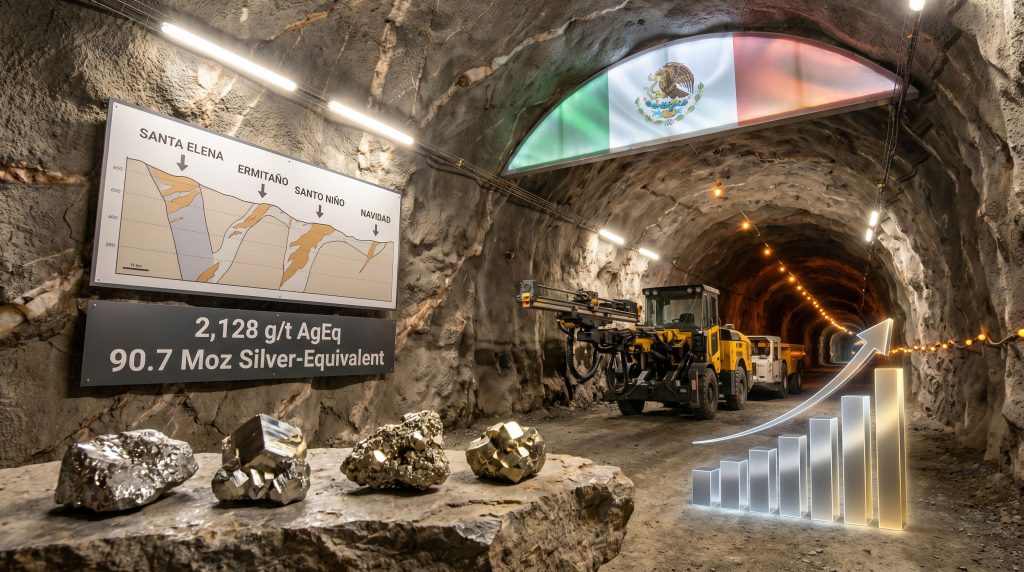
| Result A | 2.49m | 359 | 23.59 | 2,128 |
| Result B | 3.43m | 358 | 11.99 | 1,257 |
The Winter vein extends approximately 1,000 metres along strike and 350 metres down dip, dimensions that suggest a structurally coherent mineralised corridor rather than an isolated vein pod. Navidad was first identified through exploratory drilling that intersected high-grade quartz veins with visible silver sulfides near the Ermitaño mine, a geological indicator that experienced exploration geologists treat as a strong predictor of bulk mineralisation at depth.
A top result of 2,128 g/t AgEq over 2.49 metres represents one of the most significant grade announcements made from the Santa Elena district to date, reinforcing the case that Navidad could become a cornerstone deposit within the mine plan over the medium term.
Contextualising These Grades Within Mexican Silver Mining
To understand what grades above 1,000 g/t AgEq actually mean in an operational context, it helps to consider silver's dual role as both a precious metal and industrial commodity, which amplifies the significance of exceptional grades at a producing operation. Mexico is the world's largest silver-producing nation, accounting for roughly 23% of global primary silver output in recent years according to the Silver Institute.
The country's most productive operations, concentrated in Zacatecas, Durango, and Sonora, typically report head grades ranging from 150 to 400 g/t AgEq in established underground mines. Intercepts consistently returning two to five times those grades do not translate directly into average mill feed, as high-grade zones represent a portion of total mineralisation. However, they do signal the potential to blend premium-grade ore into the feed mix in a way that materially improves mill economics without increasing tonnes processed.
Capital Deployment: What US$12 Million Buys Underground in Sonora
The US$12 million 2026 development budget covers a specific and sequenced set of construction activities at both targets:
| Work Component | Target | Notes |
|---|---|---|
| Portal construction | Santo Niño and Navidad | Permits secured; construction scheduled 2H 2026 |
| Haul road construction | Santo Niño | Approximately 450m linking to Ermitaño haul road |
| Decline development | Santo Niño | Approximately 800m planned |
| Ramp development | Navidad and Ermitaño | Approximately 1,300m combined |
| Hydrogeological studies | Both targets | Required for water management planning |
Benchmarking this figure against comparable underground development projects in Sonora and Zacatecas suggests it represents credible but tight capital programming. Portal construction and early decline development in Mexican underground operations typically costs between US$3,000 and US$6,000 per metre depending on rock hardness, ventilation requirements, and ground support intensity.
An 800-metre decline at Santo Niño alone could absorb US$3 to 5 million of the budget, leaving the balance to cover the Navidad portal, haul road, ramp development, and hydrogeological studies. Consequently, the US$12 million allocation is best understood as seed capital to establish access infrastructure, not a complete development budget. Additional capital from the group's US$213 to US$236 million 2026 capex envelope will almost certainly be required to advance both targets into stoping.
Why Dedicated Portals Were Selected Over Alternative Access Routes
A scoping-level study evaluated whether Santo Niño and Navidad could be accessed via extensions of existing Ermitaño workings, avoiding the need for surface portals. The study concluded that dedicated portals offered a more direct and operationally flexible solution, particularly given the geometry of the Winter vein at Navidad relative to existing infrastructure.
The decision to develop secondary egress from Ermitaño to Navidad via ramp serves a different purpose: ventilation and safety compliance. Underground mining regulations in Mexico require secondary egress from all working areas as a condition of operating permits. By routing a ramp from Ermitaño's lower levels to Navidad, First Majestic satisfies that requirement while also creating an alternative ore haulage path that adds operational resilience.
The Regulatory Pathway: Mexico's Mining Permit Framework
Receipt of construction permits for both portals in mid-2026 represents a defined de-risking milestone. Mexico's mining sector operates under the Ley Minera framework, with environmental permits administered through SEMARNAT, the federal environment ministry. Underground portal construction requires separate approvals from those covering surface exploration, because portal development constitutes a permanent physical modification to the landscape rather than reversible exploratory activity.
The sequential nature of this permitting process means that companies must plan 12 to 24 months ahead for construction timelines. First Majestic's construction permits for Santo Niño and Navidad position the project to commence construction in the second half of 2026 without regulatory delay, assuming no challenges are filed by third parties.
It is worth noting that permit receipt signals regulatory process completion, not broader government backing or preferential treatment. The approval reflects standard regulatory administration applicable to all operators meeting the technical and environmental criteria under Mexican law.
The next major ASX story will hit our subscribers first
Resource Base: The Combined Santo Niño and Navidad Inventory
The combined resource estimate for the two development targets establishes the quantitative foundation for the First Majestic Santa Elena expansion's long-term investment case:
| Resource Metric | Combined (Santo Niño and Navidad) |
|---|---|
| Total tonnage | 10.5 Mt (Inferred) |
| Silver content | 27.4 Moz |
| Gold content | 660,000 oz |
| Total AgEq | 90.7 Moz |
| Average grade | 268 g/t AgEq |
Santa Elena delivered the largest percentage increase in Inferred Resources across First Majestic's entire portfolio during the year, with AgEq ounces more than doubling on a year-on-year basis. This was driven by Navidad drilling results and the declaration of the maiden resource at Santo Niño, the latter announced in mid-2025.
At a throughput rate of 3,500 tonnes per day, 10.5 million tonnes represents approximately 8.2 years of mill feed if drawn exclusively from Santo Niño and Navidad. In practice, these deposits will blend with production from Santa Elena and Ermitaño, extending the life of the integrated district rather than replacing existing sources. The operative question is not years of resource life in isolation, but how the high-grade feed blend improves unit economics across the whole operation.
Production Profile Implications: The Grade-Tonnage Relationship
The most important near-term production implication of bringing Santo Niño and Navidad into the mine plan is not additional tonnes, but grade uplift on existing tonnes. Preliminary mining and processing schedules modelled by First Majestic indicate that higher-grade output from both deposits would displace lower-grade material from other parts of the district.
This grade-substitution effect is a powerful economic lever. If the processing plant runs at 3,500 tpd regardless of which ore source it receives, feeding higher-grade material at the same tonnage improves recovered silver and gold ounces without increasing operating costs proportionally. Mill economics improve, all-in sustaining costs per ounce decline, and margins expand.
| Metric | Current (2026) | Post-2027 Trajectory |
|---|---|---|
| Mill throughput target | 3,300 to 3,500 tpd | 3,500 tpd sustained |
| Santa Elena 2026 silver guidance | 1.3M to 1.5M oz | Growth trajectory |
| Q4 2025 quarterly AgEq (actual) | 2.3 Moz | Expansion phase |
| Quarterly throughput record (Q4 2025) | 283,721 tonnes | Higher-grade blend incoming |
First Majestic's 2026 Group Guidance: Reading the Production Dip Correctly
Group-level 2026 guidance of 13.0 to 14.4 million ounces of attributable silver sits below the first majestic record production of 15.4 Moz achieved in 2025. Headline readers may interpret this as retreat. The more accurate read is capital reallocation.
Analyst Note: Below-record 2026 production guidance reflects deliberate capital deployment toward multi-year growth infrastructure, including the US$12 million Santa Elena commitment, rather than operational underperformance. Operators who sacrifice near-term output for mine life extension and grade improvement typically deliver superior five-year returns compared to those who maximise current production at the expense of future capacity.
This pattern, investing through the production cycle rather than extracting maximum near-term output, is a defining characteristic of long-cycle mining strategy. It tends to be underappreciated in quarterly earnings analysis but rewarded in asset valuation over longer holding periods. In addition, First Majestic production records from Q1 2025 provide useful context for evaluating how the company manages the transition between peak output and capital-intensive growth phases.
Execution Risks: What Could Disrupt the Development Timeline
No development project in underground mining is immune to execution risk. The Santa Elena expansion carries several variables that investors and analysts should monitor:
- Timeline compression: Any delay in portal construction during 2H 2026 pushes the first production contribution from Santo Niño beyond 2027, narrowing the medium-term growth window.
- Cost escalation: Underground development in Sonora is exposed to labour market tightening, energy cost variability, and materials pricing pressure, factors that have affected Mexican mining costs broadly since 2022.
- Grade continuity at depth: Infill drilling must confirm that the high-grade western zone at Santo Niño persists below currently drilled depths. Vein grade distribution in epithermal systems often changes character with depth as temperature gradients shift.
- Hydrogeological uncertainty: Water management in Sonora's geological environment can slow decline development if groundwater is encountered at unexpected depths or volumes. The hydrogeological studies budgeted in the US$12 million allocation are specifically designed to de-risk this variable before major development commitments.
- Regulatory evolution: Mexico's mining policy framework has experienced periods of regulatory change. Future amendments to land-use, water, or royalty legislation could affect project economics, though currently permitted construction activities are governed by approvals already in hand.
Three Development Scenarios to Frame the Outlook
- Scenario A (On schedule): Portal construction completes in 2H 2026 as planned. Santo Niño begins contributing to the mine plan in 2027. District productive capacity moves toward potential doubling by 2028 to 2029.
- Scenario B (Six-month delay): Construction slippage shifts Santo Niño's production contribution to late 2027, compressing the medium-term output growth window by one to two quarters.
- Scenario C (Cost overrun): The US$12 million allocation proves insufficient. Additional capital is drawn from the group's 2026 capex envelope, potentially delaying other portfolio investments.
Sonora's Position in Mexico's Precious Metals Landscape
Sonora is Mexico's second-largest mining state by total mineral production value, trailing only Zacatecas. The state hosts a geological environment particularly well-suited to epithermal vein systems, the same structural setting that produced the original Santa Elena discovery and continues to yield new targets through systematic exploration.
First Majestic's sustained capital commitment to Sonora, including the US$12 million specifically allocated to the First Majestic Santa Elena expansion in 2026, reflects operational confidence in the state's regulatory stability, infrastructure quality, and geological prospectivity. For junior exploration companies operating in the same region, the presence of an established operator advancing multi-deposit development creates district-level credibility and reduces perceived jurisdictional risk for the entire area.
Mexico's contribution to global silver supply remains structurally significant. Any sustained production growth from established Sonoran operations contributes to the country's ability to maintain its position as the world's leading silver producer, a designation that carries weight in international commodity market positioning.
Disclaimer: This article is for informational purposes only and does not constitute financial advice or an investment recommendation. Mineral resource estimates, production guidance figures, and development timelines referenced herein are drawn from company announcements and public sources. Forecasts and scenario projections are speculative in nature. Readers should conduct independent due diligence before making any investment decisions related to mining equities or projects discussed in this article.
Want to Catch the Next Major Silver or Gold Discovery Before the Market Does?
Discovery Alert's proprietary Discovery IQ model scans ASX announcements in real time, delivering instant alerts on significant mineral discoveries across silver, gold, and 30-plus other commodities — turning complex geological data into actionable insights for investors at every experience level. Start your 14-day free trial today, or explore Discovery Alert's dedicated discoveries page to see how historic mineral discoveries have generated substantial returns for early movers.