
June 27, 2026
The Infrastructure-Led Playbook Reshaping Junior Silver Mining in Mexico
When capital markets evaluate junior mining companies, the greatest valuation discount typically applies to projects requiring the most development capital before first production. Greenfield builds carry permitting risk, construction risk, and timeline risk simultaneously. The most capital-efficient path to production is not discovering new ore, but rather reactivating infrastructure that already exists. This logic sits at the core of the Sierra Madre Del Toro silver mine acquisition, a transaction that closed on June 22, 2026, and positions Sierra Madre Gold and Silver to operate two producing-ready assets in Mexico simultaneously.
Understanding why this deal matters requires stepping back from the transaction itself and examining the structural advantage that comes with acquiring a past-producing mine that retains its permits, processing plant, and underground access in operational condition.
When big ASX news breaks, our subscribers know first
Del Toro's Operational Foundation: What "Infrastructure-Ready" Actually Means
The term "past-producing" in mining can range from a collapsed shaft with expired permits to a fully equipped facility awaiting a restart decision. Del Toro sits firmly at the higher end of that spectrum, and the distinction carries substantial financial implications.
Located in the Chalchihuites District of Zacatecas, Mexico, the property comprises 70 mining concessions spanning 2,129 hectares. Three underground mining centres, Perseverancia, San Juan, and Dolores, remain accessible via more than 62.5 kilometres of existing underground development. The mine operated continuously from 2013 to 2019, producing an average of 2.54 million ounces of silver equivalent (AgEq) per year between 2015 and 2018.
What makes Del Toro particularly unusual among past-producing assets is the state of its surface infrastructure:
- A 3,000 tonne-per-day (tpd) flotation circuit with three mills remains on site
- The processing plant is configured to treat both sulphide and oxide material, providing metallurgical flexibility
- A dry stack tailings facility is designed for 12 years of operations at 2,000 tpd, eliminating one of the more capital-intensive infrastructure components of a new mine build
- Permits are described as current and maintained in an operations-ready condition by the previous owner, First Majestic Silver
For junior mining investors, the absence of permitting delays and the presence of a functioning processing plant represent a fundamental de-risking of the capital timeline. The most expensive phases of mine development, infrastructure construction and permit acquisition, are effectively bypassed.
The current mineral resource, drawn from First Majestic's March 2025 regulatory filings, provides a baseline for the asset's restart economics.
| Resource Category | Tonnage | Silver Grade | Gold Grade | Lead | Zinc | AgEq (Moz) |
|---|---|---|---|---|---|---|
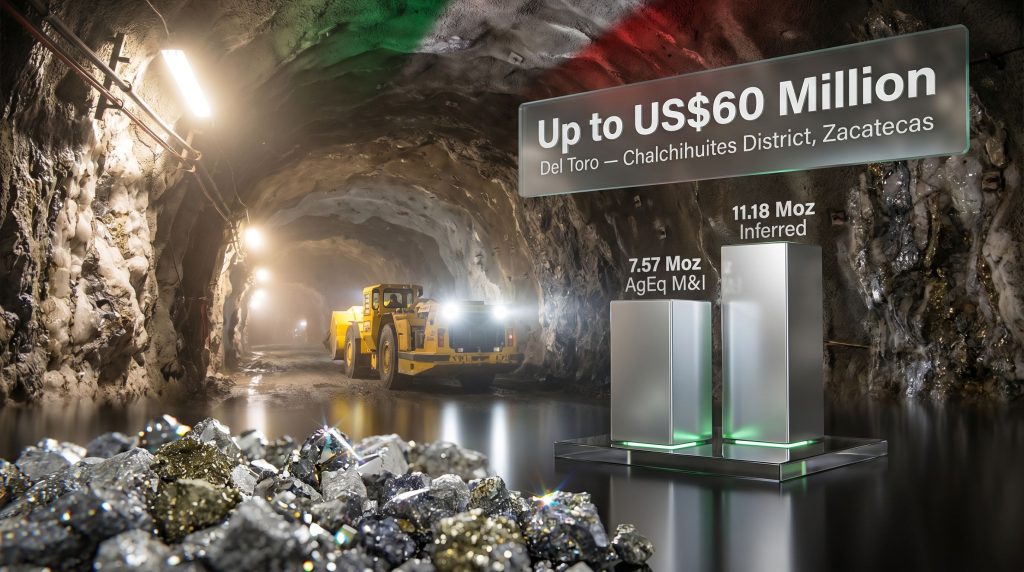
| Measured and Indicated | 592,000t | 201 g/t | 0.43 g/t | 3.90% | 4.27% | 7.57 Moz |
| Inferred | Not specified | Not specified | Not specified | Not specified | Not specified | 11.18 Moz |
A silver grade of 201 grams per tonne (g/t) is meaningfully above average for an operating underground silver mine. For context, many operating underground silver mines globally process material at grades between 100 and 150 g/t. The lead and zinc co-products at Del Toro are also commercially significant, generating revenue credits that reduce the effective cash cost of silver production, an important factor in assessing economic viability at various silver price scenarios.
Deal Architecture: How a US$60 Million Transaction Manages Capital Exposure
The Sierra Madre Del Toro silver mine acquisition was structured to distribute financial risk across time rather than concentrating it at closing. This milestone-linked payment architecture deserves careful analysis, as it reflects a growing trend in junior-to-mid-tier mining M&A where sellers accept deferred consideration in exchange for ongoing equity participation. A similar approach has been observed in other silver acquisition strategy deals across the sector.
| Deal Component | Specification |
|---|---|
| Total Consideration | Up to US$60 million |
| Upfront Cash Payment | US$20 million |
| Shares Issued at Closing | 10,870,000 common shares at CA$1.30/share |
| 18-Month Contingent Payment | US$10 million (cash or shares) |
| Resource Milestone Payment | US$10 million (triggered at ≥100Moz AgEq NI 43-101 report within 48 months) |
| Production Milestone Payment | US$10 million (triggered at ≥4,000tpd for 30 consecutive days within 60 months) |
| Private Placement Raised | CA$57.5 million gross proceeds |
| Seller's Post-Closing Ownership | ~24.77% of Sierra Madre issued shares |
Three layers define the payment structure:
- Closing consideration: US$20 million in cash plus 10,870,000 Sierra Madre shares at CA$1.30 per share
- 18-month deferred payment: US$10 million payable in cash or shares, with the share conversion capped at 10,575,385 common shares to limit dilution
- Performance-contingent tranches: Two separate US$10 million payments, one linked to achieving a 100 million ounce AgEq NI 43-101 resource within 48 months, and a second tied to sustaining commercial production at 4,000 tpd for 30 consecutive days within 60 months
From a capital allocation perspective, this structure means Sierra Madre must fund only US$20 million at closing rather than the full US$60 million. The contingent payments are, in effect, self-financing, because they are triggered by resource or production milestones that themselves generate either exploration value or cash flow.
The CA$57.5 million private placement, led by Beacon Securities with Canaccord Genuity, BMO Capital Markets, and VSA Capital in the syndicate, closed across two tranches in January 2026. The involvement of BMO Capital Markets, a major Canadian bank, in the syndicate signals institutional-grade due diligence on the asset's restart economics. Subscription receipt structures are common in mining M&A because proceeds are held in escrow until closing conditions are satisfied, protecting investors if the transaction fails to complete.
First Majestic retains 62,433,076 Sierra Madre shares, representing approximately 24.77% of issued capital. These shares are subject to a four-month statutory hold and released in four equal tranches between December 2026 and June 2028. This staged release schedule is noteworthy for market participants, as it limits the overhang of a large block seller during the early critical period of Del Toro's resource expansion drilling program.
The La Guitarra Benchmark: Validating the Reactivation Model
One of the most analytically important elements of the Sierra Madre Del Toro silver mine acquisition is that investors can evaluate the company's reactivation methodology against a live precedent rather than a theoretical model.
Sierra Madre acquired the La Guitarra silver-gold mine from First Majestic in 2023 for approximately US$44.89 million. La Guitarra, located in Temascaltepec in the State of Mexico, covers more than 39,000 hectares and had been suspended since 2018. The operational outcomes achieved since restart are instructive:
| Comparison Factor | La Guitarra (2023) | Del Toro (2026) |
|---|---|---|
| Seller | First Majestic Silver | First Majestic Silver |
| Location | Temascaltepec, State of Mexico | Chalchihuites District, Zacatecas |
| Property Size | >39,000 hectares | 2,129 hectares |
| Acquisition Value | ~US$44.89 million | Up to US$60 million |
| Mine Status at Acquisition | Suspended operations | Past-producing, permits current |
| Post-Acquisition Result | Three mining centres opened; silver grades 40% above model, gold grades 30% higher | Restart targeted mid-2027 |
The grade outperformance at La Guitarra is particularly significant from a geological standpoint. When reconciled grades at a producing mine run 40% above the declared resource model for silver and 30% above model for gold, it typically indicates one of three conditions: the original resource model was inherently conservative, selective mining is accessing higher-grade domains within the declared envelope, or the mine is intersecting new high-grade structures not captured in the NI 43-101 estimate.
For Del Toro, this precedent raises a speculative but analytically grounded possibility: if the Chalchihuites District contains similarly under-modelled high-grade structures, the 30,000-metre expansion drilling program may deliver resource estimates that materially exceed the baseline 18.75 Moz AgEq currently outlined across measured, indicated, and inferred categories.
Furthermore, when interpreting drill results from the planned expansion program, investors should apply this La Guitarra precedent carefully. The planned 30,000-metre near-term drilling program at Del Toro is specifically designed to support an updated NI 43-101 mineral resource estimate. The resource milestone payment structure, which requires filing a report demonstrating at least 100 Moz AgEq within 48 months to trigger a US$10 million payment to First Majestic, reveals management's internal confidence that the Chalchihuites District contains substantially more resource than currently defined.
Zacatecas and Mexico's Silver Sector: Regulatory Progress Intersects Geological Opportunity
The Chalchihuites District in Zacatecas sits within one of the world's most prolific silver-producing jurisdictions. Mexico accounts for approximately 25% of global silver production, maintaining its position as the world's leading silver-producing nation. The country is also among the top 15 producers in 19 minerals, 12 of which the United States classifies as critical minerals.
Zacatecas itself has a long history of silver mining extending back to colonial-era operations. The district's geology is characterised by epithermal vein systems, the same deposit type that hosts many of Mexico's highest-grade historic silver mines. Del Toro's mineralisation, combining silver, gold, lead, and zinc in a polymetallic sulphide system, is consistent with intermediate-sulphidation epithermal deposits, which commonly exhibit strong vertical and lateral grade continuity where structural controls are well-understood.
The regulatory environment, historically one of the more significant risk factors for Mexican mining investment, has evolved considerably since the 2023 Federal Mining Law reform. That reform introduced several structural changes:
- Concession terms were reduced from 50 years to 30 years, increasing renewal frequency and associated regulatory interaction
- Stricter environmental and social compliance requirements were imposed, extending permit timelines for new projects
- As of early 2026, approximately 160 projects remained stalled due to outstanding environmental permit approvals
However, the Sheinbaum administration has moved to address the backlog, clearing 100 of 175 pending permits and unlocking an estimated US$11 billion project pipeline across Mexico's mining sector. Zacatecas specifically reduced its local permit backlog from 25 pending approvals to just 5 within a single year, according to state economy officials.
For Del Toro specifically, the fact that First Majestic maintained permits in current, operations-ready condition throughout the mine's idle period from 2019 to 2026 effectively insulates the restart timeline from the broader backlog issue.
Sector Momentum: Institutional Capital Returns to Mexican Silver
The Sierra Madre Del Toro silver mine acquisition is not occurring in isolation. Institutional and capital markets activity across Mexico's silver sector suggests a broader re-rating cycle may be underway. Indeed, silver's dual demand drivers — both monetary and industrial — continue to attract investors seeking exposure to the metal's long-term fundamentals.
Several concurrent developments illustrate the trend:
- Guanajuato Silver Company launched a record 75,000-metre drill program for 2026, spanning five producing underground mines across Guanajuato and Durango, signalling aggressive resource expansion across a multi-asset platform
- Sinda Ltd., backed by The Electrum Group, filed with the US Securities and Exchange Commission in June 2026 for a NYSE IPO targeting up to US$100 million to advance a pre-production silver-gold project in Guanajuato, marking a significant institutional vote of confidence in Mexican silver assets
- Projections presented at the Mexico Mining Forum PDAC 2026 estimated that a comprehensive critical minerals policy framework could attract US$43 billion in investment by 2030 and generate 500,000 jobs nationally
This convergence of expanded drill programs, new public listings, and accelerating permit clearances creates a constructive backdrop for Sierra Madre's Del Toro restart program. In addition, Endeavour Silver expansion activity elsewhere in Latin America further demonstrates that mid-tier silver producers are actively building out multi-asset portfolios. Infrastructure-ready assets with established resource profiles tend to attract premium valuation multiples during periods of rising silver prices and improving jurisdictional sentiment, because they offer shorter paths to production than exploration-stage competitors. Mining Weekly has noted Sierra Madre's progress as representative of this broader re-rating dynamic in Mexican silver.
This article contains references to forward-looking timelines, milestone payments, resource estimates, and production targets. These involve inherent uncertainties and do not constitute financial advice. Readers should conduct independent due diligence before making any investment decisions.
The next major ASX story will hit our subscribers first
Frequently Asked Questions: Sierra Madre Del Toro Silver Mine Acquisition
What is the Del Toro silver mine and where is it located?
Del Toro is a permitted, past-producing underground silver-gold-lead-zinc mine situated in the Chalchihuites District of Zacatecas, Mexico. The property covers 2,129 hectares across 70 mining concessions and includes three underground mining centres with more than 62.5 kilometres of existing development.
How much did Sierra Madre pay for the Del Toro mine?
Total consideration reaches up to US$60 million, structured as US$20 million cash at closing, 10,870,000 common shares at CA$1.30 per share, an 18-month deferred payment of US$10 million, and two performance-contingent payments of US$10 million each tied to resource and production thresholds.
Who sold Del Toro to Sierra Madre?
First Majestic Silver Corp. sold the Del Toro mine to Sierra Madre Gold and Silver. Following the transaction, First Majestic retained approximately 24.77% of Sierra Madre's issued shares, with those shares released across four equal tranches between December 2026 and June 2028.
When is Del Toro expected to restart production?
Based on Sierra Madre's disclosed timeline, a mine restart is planned for mid-2027, with commercial production targeted for mid-2028, subject to the completion of resource expansion drilling and an updated NI 43-101 mineral resource estimate.
What approvals were required to complete the acquisition?
The transaction required shareholder approval, obtained at a special meeting on April 28, 2026, and antitrust clearance from COFECE, Mexico's Federal Economic Competition Commission, both secured prior to closing on June 22, 2026.
How does Del Toro compare to Sierra Madre's La Guitarra mine?
Both assets were acquired from First Majestic Silver and share an infrastructure-led reactivation profile. La Guitarra, acquired in 2023 for approximately US$44.89 million, has delivered silver reconciliation grades running 40% above the original resource model and gold grades 30% higher, establishing a meaningful performance benchmark for the Del Toro strategy.
Want to Track the Next Major Silver Discovery Before the Market Does?
Discovery Alert's proprietary Discovery IQ model delivers real-time alerts the moment significant ASX mineral discoveries are announced, transforming complex resource data into actionable insights for investors at every level — explore the historic returns major discoveries have generated and begin your 14-day free trial to position yourself ahead of the market.