June 26, 2026
The Structural Silver Crisis That Monetary Policy Cannot Fix
Every commodity market occasionally experiences a gap between what financial instruments price and what physical reality demands. In silver's case, that gap has widened into something more significant: a multi-year structural supply deficit colliding head-on with one of the most aggressive monetary tightening cycles in recent memory. Understanding the silver supply deficit and Fed rate expectations, and why these two forces are pulling in opposite directions, is essential for anyone attempting to assess silver's medium-term trajectory with any analytical rigour.
The critical insight is this: interest rate policy operates on financial demand, reducing the appeal of non-yielding assets by raising the opportunity cost of holding them. What it cannot do is accelerate mine permitting, shorten the five-to-ten-year timeline from discovery to production, or conjure new silver deposits into existence. The silver supply deficit and Fed rate expectations are therefore not two sides of the same coin. They are forces operating on entirely different timescales and through entirely different mechanisms.
When big ASX news breaks, our subscribers know first
What the Gold-Silver Ratio Reveals Right Now
The gold-silver ratio analysis is one of the oldest relative-value indicators in commodity markets. When it widens, it signals that investors are offloading silver more aggressively than gold, typically during periods of monetary tightening or risk-off positioning. When it compresses, it has historically preceded sharp silver price recoveries as physical fundamentals reassert themselves.
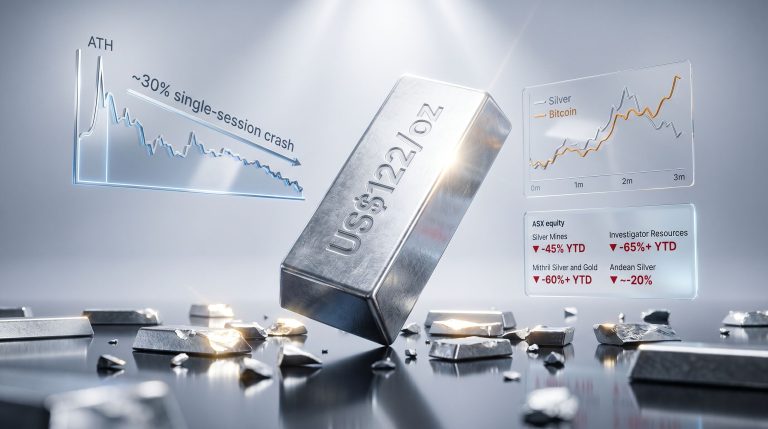
As of late June 2026, the ratio widened to 65.6, its highest level since the peak of the US-Iran conflict. Silver was trading at $57.34 per troy ounce, down 53% from its January 2026 all-time high of $121.64, yet still 56.42% higher year-over-year. This data creates an important interpretive question: does a 53% price decline represent deteriorating fundamentals, or does it represent the temporary dominance of monetary signals over physical ones?
Furthermore, monitoring gold-silver ratio trends during monetary tightening cycles has frequently signalled undervaluation relative to silver's industrial and monetary fundamentals rather than any genuine deterioration in those fundamentals.
Historical compression episodes in the gold-silver ratio have consistently preceded silver's most explosive price recoveries. A widening ratio during monetary tightening cycles has frequently signalled undervaluation rather than any genuine deterioration in those fundamentals.
How the Fed's June 2026 Dot Plot Is Suppressing Silver Prices
Decoding the Summary of Economic Projections
The Federal Open Market Committee's dot plot, formally part of its Summary of Economic Projections, maps each FOMC member's anonymous interest rate expectations for the coming years. Markets treat it as one of the most direct windows into Fed thinking available between official meetings.
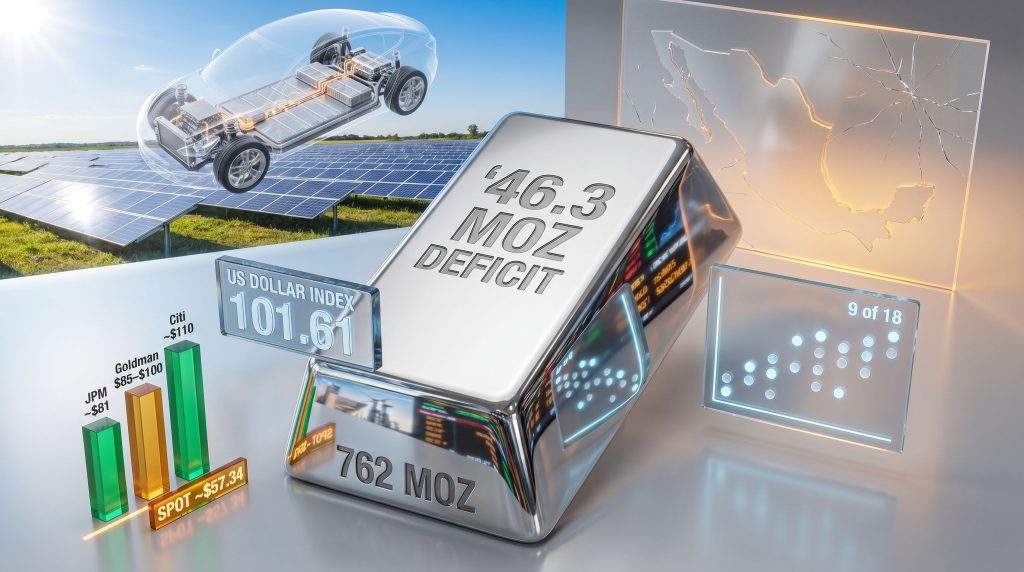
The June 16-17, 2026 FOMC meeting produced a notably hawkish configuration. Nine of eighteen officials projected at least one additional rate hike before year-end. The Fed simultaneously revised its 2026 PCE inflation forecast upward from 2.7% to 3.6%, with core PCE projected at 3.3%. That revision came after May 2026 CPI reached 4.2% year-over-year, its highest reading since April 2023, and May non-farm payrolls printed at 172,000, more than double the 85,000 consensus estimate.
Bank of America subsequently forecast three consecutive 25-basis-point rate hikes in September, October, and December, which would push the federal funds rate to a target range of 4.25%-4.50%. Deutsche Bank projected two hikes, citing persistent inflation and a resilient labour market. These forecasts carry institutional weight and have directly shaped near-term positioning in precious metals.
The Transmission Mechanism: From Rate Expectations to Silver Prices
The pathway from Fed hawkishness to silver price suppression follows a clear sequential logic:
-
Higher rate expectations strengthen the US dollar – The US Dollar Index climbed above 101.61 in late June 2026, a 13-month high, making dollar-denominated commodities more expensive for international buyers.
-
A stronger dollar reduces global purchasing power – Non-dollar economies effectively pay a premium for silver, dampening import demand from major consuming nations.
-
Higher real yields increase opportunity cost – With the 2-year Treasury yield above 4%, income-generating assets become increasingly competitive against non-yielding metals like silver.
-
Rising opportunity cost drives portfolio reallocation – Institutional allocators reduce precious metals exposure in favour of bonds and cash equivalents, accelerating paper-market selling.
-
Paper-market selling disconnects spot prices from physical reality – COMEX positioning and ETF redemptions drive price discovery in the short term, even as physical inventories continue to tighten.
CME FedWatch Probability Data: The Market's Rate Hike Expectations
| Rate Decision Event | CME FedWatch Probability (Late June 2026) |
|---|---|
| September 2026 rate hike | 72.8% |
| October 2026 rate hike | 80.6% |
| December 2026 rate hike | 87.9% |
| Bank of America projected terminal rate | 4.25%-4.50% |
| Deutsche Bank projected hikes | Two 25bp hikes |
The Bureau of Economic Analysis published May PCE data on June 25, 2026. With April headline PCE running at 3.8% year-over-year and core PCE at 3.3%, economists forecast May readings of 4.1% headline and 3.4% core. This data created a binary outcome for silver:
-
Scenario A (Core PCE at or below 3.3%): Reduces September hike probability, softens dollar, supports precious metals recovery.
-
Scenario B (Core PCE at or above 3.4%): Validates further tightening, reinforces dollar strength, extends silver's selloff.
The Physical Silver Market: Six Years of Structural Deficit
Scale of the Supply Shortfall
According to the Silver Institute's supply and demand data, the World Silver Survey 2026, produced in conjunction with Metals Focus and released April 15, 2026, confirmed a sixth consecutive annual supply deficit. The 2026 shortfall is projected at 46.3 million ounces, representing a 15% expansion from the 40.3 Moz deficit recorded in 2025. Cumulative above-ground inventory drawdowns since 2021 have now reached 762 million ounces, roughly equivalent to an entire year of global mine production.
COMEX registered silver inventories stood at approximately 82 Moz in mid-June 2026, representing a structurally thin buffer given the scale of ongoing consumption. Notably, silver supply deficits have been compounded by ETF holdings falling 13.4 Moz between mid-May and mid-June 2026, reflecting paper-position liquidation by investors responding to monetary signals rather than any genuine reduction in underlying physical demand.
Mine Production Cannot Close the Gap
Total global silver supply is forecast to increase 1.5% to approximately 1.05 billion ounces in 2026, with mine production forecast to grow just 1% to 820 Moz. Against industrial demand growth running at 3%-5% annually, the arithmetic is straightforward: supply cannot keep pace.
| Silver Supply and Demand Metric | 2026 Data |
|---|---|
| Total global silver supply forecast | ~1.05 billion ounces (+1.5% YoY) |
| Mine production forecast | ~820 Moz (+1% YoY) |
| Industrial demand growth rate | 3%-5% annually |
| Annual supply deficit | 46.3 Moz |
| Cumulative inventory drawdown since 2021 | 762 Moz |
| Typical mine development timeline | 5-10 years |
A structural constraint compounds this problem that is rarely discussed in mainstream analysis: approximately 70% of global silver production is extracted as a byproduct of zinc, lead, and copper mining. This means the silver industry cannot independently scale output in response to price signals the way a primary commodity producer can. When demand for zinc or lead falls, silver production falls with it, regardless of silver's own price trajectory.
Senior industry executives in the silver sector have reinforced this point consistently, noting that primary silver producers are therefore bringing increasingly scarce metal to market against a backdrop where output cannot simply be switched on when demand accelerates.
Mexico's Regulatory Environment and Its Supply Implications
Mexico supplies approximately 23%-25% of global mined silver, making it the world's single largest source nation. Post-2023 mining legislation has left approximately 160 projects in regulatory limbo, effectively removing a substantial tranche of potential future supply from the development pipeline. This is a structural, not cyclical, constraint. No central bank policy adjustment can resolve it.
The combination of byproduct dependency, long development timelines, and regulatory bottlenecks in the world's leading silver-producing nation means the supply response to rising demand is fundamentally slow. This is precisely why the deficit has persisted for six consecutive years and why the cumulative drawdown has reached such a significant scale.
Industrial Demand: Why Silver Is Decoupling From Traditional Monetary Cycles
The Demand Architecture Has Fundamentally Changed
Industrial applications now account for more than 50% of total global silver consumption. Unlike investment demand, which responds directly to interest rate movements and dollar strength, industrial demand from solar energy, electric vehicles, and digital infrastructure grows according to technology adoption curves and energy transition mandates that operate independently of central bank decisions.
This represents a profound structural shift in silver's demand architecture. Silver's dual role as both a monetary asset and an industrial commodity has become increasingly important, as industrial applications now dominate physical consumption in ways that reduce sensitivity to rate cycles.
Solar Photovoltaics: The Dominant Industrial Demand Growth Driver
Solar PV's share of global silver demand has expanded from approximately 11% in 2014 to roughly 29% in 2026, making it the fastest-growing source of consumption within the industrial segment. Silver's electrical conductivity properties remain difficult to substitute with copper or aluminium at equivalent efficiency levels, which is why silver loadings in solar panels have proven more resilient to cost-reduction pressure than industry observers initially anticipated.
The European Union's target of 700 gigawatts of installed solar capacity by 2030, alongside expanding programmes across Asia and North America, represents policy-anchored demand that has little sensitivity to the US rate cycle.
Electric Vehicles: Higher Silver Intensity Per Unit Than Legacy Vehicles
| Vehicle Type | Silver Content | Market Trajectory |
|---|---|---|
| Internal combustion engine vehicle | Baseline | Declining market share |
| Battery-electric vehicle | 25-50 grams (67%-79% more than ICE) | Accelerating globally |
| EV share of automotive silver demand by 2027 | Majority | Largest automotive segment |
| EV share of automotive silver demand by 2031 | ~59% | Dominant segment |
| Automotive silver demand CAGR (2025-2031) | ~3.4% | Sustained structural growth |
The higher silver intensity in EVs is not arbitrary. Battery management systems, power electronics, and charging infrastructure all require silver's unique combination of conductivity and thermal properties. As the EV fleet scales, so does the cumulative demand increment relative to the internal combustion baseline.
AI Data Centres: An Underappreciated and Rapidly Growing Demand Vector
Global IT power capacity has grown approximately 5,252% since 2000, reaching roughly 50 gigawatts in 2025. Data centres use silver in connectors, power distribution equipment, and thermal management systems. This demand is structurally linked to technology capital expenditure cycles rather than monetary policy, meaning it continues to expand even during periods of elevated interest rates. It represents a demand driver that many silver market commentators have been slow to incorporate into their forecasts.
Senior industry figures operating in the silver space have noted that silver sits at the intersection of industrial growth and monetary concern, and that when investor attention shifts toward silver's industrial credentials, the price moves that follow can be unusually sharp. This is a market dynamic that seasoned observers of the silver space treat as one of its defining characteristics: long periods of underperformance relative to gold, followed by rapid and dramatic catch-up moves.
The Investment Framework: How Different Parts of the Silver Sector Navigate Price Weakness
Producers: Operating Margins Under Pressure But Intact
All-in sustaining cost, or AISC, is the critical metric for assessing a silver producer's resilience during price downturns. Americas Gold and Silver reported consolidated AISC of $34.12 per silver ounce sold in Q1 2026, within its full-year guidance range of $30-$35 per ounce. At a spot price near $57, that implies an operating margin of approximately $23 per ounce, which is far from an existential threat to operations.
Q1 2026 silver production at Americas Gold and Silver reached 787,000 ounces, up 76% year-over-year, while revenue increased 187% to $67.8 million and adjusted EBITDA reached $33.6 million. Operational momentum can persist through price weakness when cost structures are well-managed and production growth is genuine.
Development Projects: Feasibility Economics That Withstand Stress Testing
Vizsla Silver completed a Feasibility Study for its Panuco silver-gold project in Sinaloa, Mexico in November 2025. The study outlined annual silver-equivalent production of 17.4 Moz over an initial 9.4-year mine life, with an after-tax NPV (5%) of US$1.8 billion, an IRR of 111%, and a capital payback period of just 7 months, using base-case assumptions of $35.50 per ounce silver and $3,100 per ounce gold. These are feasibility study estimates, not operating results, and actual outcomes could differ materially.
The analytical point is that projects with IRRs exceeding 100% at conservative pricing assumptions retain compelling economics even at current spot levels. Lower silver prices during development phases can also reduce construction and equipment costs, partially offsetting the revenue impact of weaker pricing.
Exploration: High-Grade Results Retain Strategic Value in Any Price Environment
GR Silver Mining reported high-grade drill results from its Plomosas Project on May 19, 2026. Hole SMS26-04 returned 45.1 metres true width grading 1,623 g/t silver, including 8.25 metres grading 8,579 g/t silver with 1.6% lead and 5.5% zinc. These are exploration results, and no economic study has yet been published for the SE Area.
The strategic logic for high-grade exploration is straightforward: with silver inventories at historical lows, access to new physical supply becomes increasingly competitive. Wide, true-width intercepts at grades exceeding 1,000 g/t silver equivalent define the resource base for future production decisions. Industry commentary from corporate development professionals active in the sector has emphasised that silver's historically low inventory levels are precisely what makes new high-grade discoveries strategically significant, regardless of where spot prices sit at the moment of discovery.
The next major ASX story will hit our subscribers first
What Institutional Forecasters Are Projecting
Major Bank Silver Price Forecasts Versus Current Spot
| Institution | 2026 Silver Forecast | Key Rationale |
|---|---|---|
| J.P. Morgan Global Research | ~$81/oz average; ~$85/oz in Q4 | Continued deficits; stronger physical demand |
| Goldman Sachs | $85-$100/oz average | Physical demand outweighs monetary headwinds |
| Citigroup | ~$110/oz in H2 2026 | Physical supply shortages as primary driver |
| Current spot (late June 2026) | ~$57.34/oz | Monetary tightening pressure dominant |
The gap between current spot pricing and institutional forecasts quantifies how much the market is currently discounting physical fundamentals in favour of monetary signals. All three forecasts are predicated on the assumption that supply constraints will eventually reassert dominance over rate-driven selling pressure. However, whether that repricing happens in months or quarters depends heavily on the inflation data trajectory. Conditions such as silver market backwardation could further accelerate the repricing timeline if physical tightness intensifies.
Five Variables That Will Determine Silver's Next Major Move
Investors navigating the intersection of the silver supply deficit and Fed rate expectations should monitor the following indicators:
-
Monthly PCE and CPI prints – These directly determine whether the Fed's hawkish stance is validated or softened, and carry the most immediate impact on near-term silver pricing.
-
Fed forward guidance language – Any shift in dot plot projections or official communication that signals a pause or pivot will directly affect real yield expectations and dollar strength.
-
COMEX registered inventories and ETF holdings – These provide real-time signals on whether physical demand is absorbing paper-market selling pressure or whether inventory depletion is accelerating.
-
Mexico permitting and mine development milestones – Progress through the regulatory logjam created by post-2023 mining legislation will determine how quickly new primary supply can enter the market.
-
Solar installation rates and EV sales data – These are leading indicators for silver's largest and fastest-growing industrial demand segments, and they operate independently of monetary policy.
Physical bar and coin demand, forecast to reach 227 Moz in 2026, a three-year high representing a 20% increase, provides additional context. According to Crux Investor's analysis of silver market dynamics, US retail physical demand is expected to rebound approximately 57% as price-sensitive buyers take advantage of lower spot prices. This counter-cyclical retail demand pattern has historically provided a price floor during institutional selling episodes, limiting the downside in spot prices even when paper-market positioning turns sharply negative.
Frequently Asked Questions
Why does silver fall when rates rise even if physical demand is strong?
Silver is a non-yielding asset. When interest rates rise, bonds and cash generate competitive returns, increasing the opportunity cost of holding silver. A stronger US dollar simultaneously makes silver more expensive for international buyers. These financial-market dynamics can dominate price action in the short term, even when physical supply fundamentals remain structurally tight. The key distinction is between paper-market price discovery and physical market reality.
Can mine supply increase quickly enough to close the deficit?
No. Two structural constraints prevent rapid supply responses. First, approximately 70% of silver is produced as a byproduct of base metal mining, meaning output cannot be independently scaled regardless of silver's price. Second, new primary silver mines typically require five to ten years to progress from discovery to production. Regulatory environments in key producing nations add further delays to an already long development timeline.
Is the silver deficit figure potentially overstated?
Some analysts argue that deficit calculations which include gross investment demand rather than net demand may overstate the true shortfall, as speculative investment flows can represent paper-market positioning rather than physical consumption. This is a legitimate analytical debate. Furthermore, investors benefit from considering both the headline deficit figure and the underlying trend in industrial consumption when forming a long-term view. For additional context, Sprott's silver investment outlook provides a useful institutional perspective on how to interpret these structural supply figures.
What would cause silver to recover despite ongoing Fed tightening?
A combination of softer-than-expected inflation data reducing rate hike probabilities, continued physical inventory depletion creating supply scarcity, and sustained industrial demand growth could collectively shift market sentiment. Historically, silver price recoveries have been rapid and significant once monetary headwinds ease, given the compressed supply pipeline and the structural demand growth now embedded in the energy transition. Consequently, understanding the interplay between the silver supply deficit and Fed rate expectations remains one of the most important analytical tasks for silver investors in the current cycle.
Disclaimer: This article is for informational purposes only and does not constitute financial advice. All forecasts, feasibility study estimates, and exploration results involve material uncertainty and actual outcomes may differ significantly. Investors should conduct their own due diligence before making investment decisions. Past price performance is not indicative of future results.
Want to Track the Next Major Silver Discovery Before the Market Does?
Discovery Alert's proprietary Discovery IQ model scans ASX announcements in real time, instantly identifying high-grade mineral discoveries — including silver — and converting complex data into actionable insights for traders and investors at every level. Explore historic discoveries and the exceptional returns they've generated, then begin your 14-day free trial to position yourself ahead of the broader market.