August 24, 2026
Why Phosphate Supply Chain Geography Is Reshaping Junior Mining Valuations
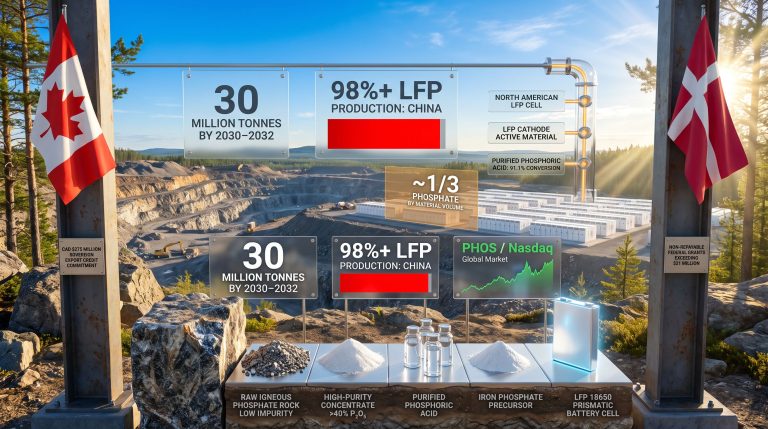
Few commodities carry as much structural tension as phosphate. On one hand, it underpins global food security as a core ingredient in fertiliser production. On the other, it is increasingly central to the battery revolution through its role in lithium iron phosphate chemistry. Yet the geography of global phosphate supply remains deeply concentrated, and that imbalance is quietly reshaping how investors, battery manufacturers, and mining developers view projects in politically stable jurisdictions like Quebec.
It is within this context that the First Phosphate Bégin-Lamarche MRE, released with an effective date of May 1, 2026, deserves careful examination. The updated mineral resource estimate does not simply add tonnes to a tally. It reflects a fundamental shift in geological confidence, repositions the project within North American critical mineral conversations, and raises questions about how markets price exploration milestones in junior resource equities.
When big ASX news breaks, our subscribers know first
Understanding Mineral Resource Classification Before Interpreting the Numbers
Before drawing any conclusions from the Bégin-Lamarche figures, it is worth understanding the technical scaffolding that underpins how mineral resources are reported in Canada. The NI 43-101 standard, administered by the Canadian Securities Administrators, governs all public disclosure of mineral resource estimates for companies listed on Canadian exchanges including the CSE and TSX, as well as cross-listed issuers on the NASDAQ.
Under this framework, resources are classified by the density and reliability of geological data supporting them, not by economic certainty or proximity to production. The three tiers are:
| Classification | Geological Confidence | Typical Use in Mine Planning |
|---|---|---|
| Measured | Highest — tight drill spacing, high data density | Basis for Proven Reserves |
| Indicated | Moderate — reasonable geological continuity assumed | Basis for Probable Reserves |
| Inferred | Lowest — limited drill data, conceptual confidence only | Exploration-stage planning only |
A critical distinction worth internalising is that Inferred resources cannot be included in economic studies such as Preliminary Economic Assessments without triggering specific disclosure caveats. Reclassifying Inferred material into the Indicated category is therefore not a cosmetic change — it is a meaningful technical upgrade. Understanding mineral deposit tiers in this context helps explain why that reclassification expands the suite of studies a company can legally and credibly pursue.
The Bégin-Lamarche MRE was prepared by P&E Mining Consultants Inc., satisfying the independent Qualified Person requirement under NI 43-101. This independence is not a formality. It is the mechanism that prevents companies from self-reporting resource estimates, a structural safeguard that gives the numbers published credibility in both equity markets and project financing contexts.
Breaking Down the Bégin-Lamarche MRE: A Resource-by-Resource Analysis
The updated estimate, reported by Canadian Mining Journal on August 24, 2026, was built on a substantial geological dataset. First Phosphate's drill programme incorporated 276 drill holes across 68,345 metres of total drilling, providing the data density required to support category upgrades across significant portions of the deposit.
The resulting pit-constrained resource figures are as follows:
| Resource Category | Tonnage | P₂O₅ Grade |
|---|---|---|
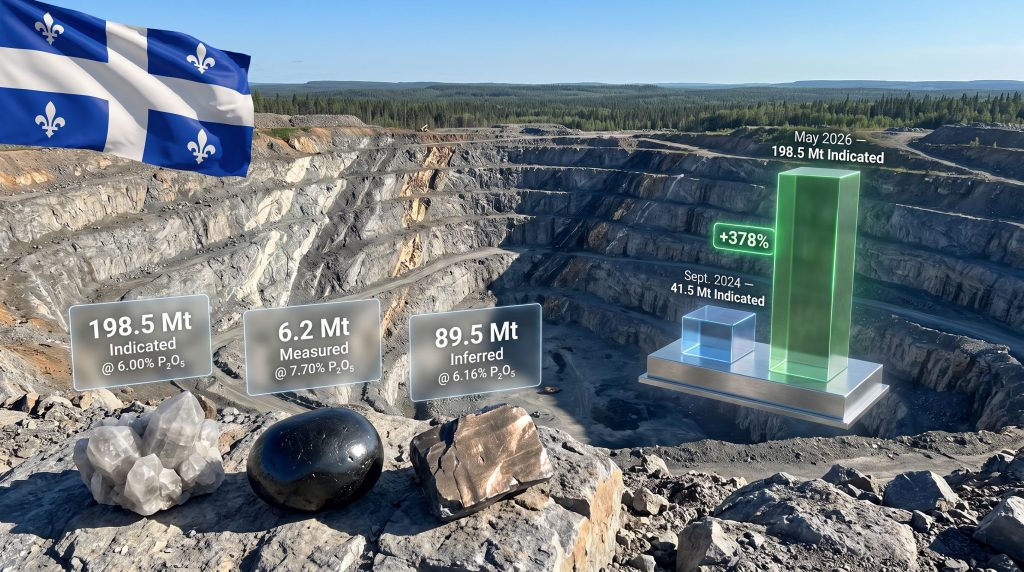
| Measured | 6.2 million tonnes | 7.70% |
| Indicated | 198.5 million tonnes | 6.00% |
| Inferred | 89.5 million tonnes | 6.16% |
| Combined Total | ~294.2 million tonnes | blended |
The Measured category, while representing a smaller proportion of overall tonnes, carries the highest grade at 7.70% P₂O₅. This figure is commercially meaningful. Global phosphate mining operations typically target grades above 5% P₂O₅ for open-pit viability, with premium operations in Morocco and Jordan commonly working between 7% and 12% depending on ore type and processing requirements. A Measured resource averaging 7.70% sits comfortably within the range of economically interesting material.
By-Product Mineralisation: A Factor That Could Reshape Project Economics
What is less commonly discussed in coverage of the Bégin-Lamarche project is the presence of potential co-product mineralisation beyond phosphate. The deposit contains:
- Magnetite — a primary iron ore mineral with well-established industrial markets and established metallurgical processing pathways
- Ilmenite — a titanium-bearing mineral used in titanium dioxide pigment production, aerospace alloys, and welding electrodes
- Apatite — the primary phosphate mineral hosting the P₂O₅ values reported in the MRE
The economic recoverability of magnetite and ilmenite has not been confirmed at this stage, and investors should not assume by-product credits are a certainty. However, in large-tonnage deposits, even modest co-product contributions can materially alter project-level unit economics. This is a dimension of Bégin-Lamarche that future metallurgical studies will need to quantify before it can be responsibly incorporated into financial modelling.
How the 2026 MRE Compares to the Original 2024 Estimate
The scale of change between the initial September 2024 MRE and the May 2026 update is one of the more striking features of this technical development. Understanding what drove those changes is essential for interpreting what they mean.
| Metric | Initial MRE (Sept. 2024) | Updated MRE (May 2026) | Change |
|---|---|---|---|
| Indicated Tonnage | 41.5 Mt | 198.5 Mt | +378% |
| Indicated Grade | 6.49% P₂O₅ | 6.00% P₂O₅ | Slight decrease |
| Inferred Tonnage | 214.0 Mt | 89.5 Mt | Reclassified upward |
| Inferred Grade | 6.01% P₂O₅ | 6.16% P₂O₅ | Marginal increase |
| Measured Category | Not reported separately | 6.2 Mt @ 7.70% | New category added |
The 378% growth in Indicated resources does not represent new mineralisation discovered beneath previously untested ground. It reflects the reclassification of previously Inferred material into the higher-confidence Indicated category, driven entirely by the expanded drill programme providing the data density required under NI 43-101 to support that upgrade.
This distinction matters enormously for geological interpretation. Resource upgrades of this type are sometimes misread by retail investors as equivalent to new discoveries, inflating perceived upside. In reality, the value of a category upgrade is more nuanced — it confirms that the mineralisation already known to exist does so with sufficient geological continuity to underpin economic studies, which is a prerequisite for advancing toward a Preliminary Economic Assessment. Furthermore, interpreting drill results correctly is a skill that separates informed investors from those reacting purely to headlines.
Why Did the Grade Decrease Despite Tonnage Growth?
The modest decline in Indicated grade from 6.49% to 6.00% P₂O₅ is a natural mathematical outcome of resource envelope expansion. When drilling extends the modelled volume outward into peripheral zones, it frequently incorporates lower-grade transitional material at the edges of the economic shell. This dilutes the average grade while increasing total contained metal.
In the context of a bulk-tonnage open-pit phosphate operation, a grade of 6.00% P₂O₅ across nearly 200 million tonnes remains commercially interesting, particularly given the scale of contained phosphate represented. The grade reduction should not be interpreted as a deterioration in deposit quality at the core.
The Strategic Context: Why Quebec Phosphate Is Attracting Attention
Global Phosphate Supply Concentration and Its Implications
Understanding why projects like Bégin-Lamarche are attracting investor interest requires a brief examination of global phosphate supply geography. According to the United States Geological Survey, approximately 70% of the world's economically recoverable phosphate reserves are located in Morocco and Western Sahara alone. China holds the next largest reserve base, followed by Russia, Egypt, and Algeria.
North American phosphate production has historically been dominated by Florida's phosphate belt, operated primarily by Mosaic Company. However, environmental constraints, land availability limitations, and the gradual depletion of accessible Florida deposits have introduced structural questions about the long-term sustainability of domestic US supply.
This geographic reality creates a strategic gap that Quebec-based phosphate projects are positioned within, even if they remain years from production. In addition, the Ammaroo phosphate project in Australia illustrates how developers globally are racing to establish alternative supply sources outside of traditional concentrated regions.
The LFP Battery Connection: A Demand Driver Beyond Fertilisers
Lithium iron phosphate battery chemistry has gained significant market share in the electric vehicle sector, driven by its superior thermal stability, longer cycle life, and declining cost per kilowatt-hour relative to nickel-manganese-cobalt alternatives. According to BloombergNEF, LFP batteries accounted for a growing proportion of global EV battery deployments in recent years, with Chinese manufacturers CATL and BYD leading adoption.
The phosphate input required for LFP cathode active material is not standard fertiliser-grade phosphate. Battery applications require high-purity phosphoric acid, which in turn demands a clean, low-contaminant phosphate ore source. This creates a material quality threshold that not all phosphate deposits can meet, and it explains why companies positioning their projects as potential LFP feedstock sources are emphasising purity characteristics alongside tonnage.
Western battery manufacturers and automotive original equipment manufacturers face increasing pressure from procurement policies in North America and Europe to reduce dependence on Chinese-sourced critical minerals, including phosphate compounds used in LFP cathode production. The broader shift in critical minerals demand driven by the energy transition has consequently elevated phosphate's strategic profile well beyond its traditional role in agriculture. Quebec's Saguenay-Lac-Saint-Jean region, where Bégin-Lamarche is located, offers geographic proximity to planned North American gigafactory infrastructure and operates within a stable regulatory and political environment.
Is the Deposit Open at Depth?
One frequently overlooked technical detail in MRE releases is whether the resource remains open along strike or at depth. In the case of Bégin-Lamarche, available technical reporting indicates the mineralisation has not been closed off at depth, meaning drilling has not yet intersected the lower boundary of economic phosphate mineralisation.
This matters for a specific reason: pit-constrained resource estimates, by definition, model only the portion of the deposit accessible within an assumed open-pit shell. Mineralisation extending below that shell at depth may be recoverable via underground methods in future, or it may simply expand the pit-constrained resource if commodity price assumptions improve. Open-at-depth deposits retain genuine exploration upside that is structurally invisible in current resource estimates.
How Should Investors Interpret the Market Reaction?
The Price Action on August 24, 2026
According to reporting by Canadian Mining Journal, First Phosphate shares fell approximately 7.84% on the day of the MRE release, declining from C$2.55 to C$2.35 (approximately US$1.70 before the decline). On the surface, a resource expansion announcement producing a negative price reaction appears contradictory.
Several factors contextualise this dynamic:
- Pre-announcement appreciation: The stock had climbed steadily throughout 2026 ahead of the MRE release, suggesting meaningful forward pricing of the anticipated catalyst
- Offtake agreement execution: The company had previously secured international agreements that secured investment ahead of the MRE
- NASDAQ listing: First Phosphate's listing on the NASDAQ exchange expanded the investor base and contributed to pre-MRE price momentum
- Sell-the-news behaviour: In junior resource markets, anticipated milestones frequently produce short-term selling pressure as traders unwind positions opened in anticipation of the event
In junior resource equities, the relationship between fundamental news and immediate price action is often inverted relative to large-cap markets. When a milestone has been building in narrative form for months, the actual release of the technical document can mark the end of a sentiment trade rather than the beginning of one.
Investors evaluating the First Phosphate Bégin-Lamarche MRE should resist drawing linear conclusions from single-day price movements. The technical merit of the estimate is assessed over quarters and years through subsequent development milestones, not through the reaction in the first session following publication.
The next major ASX story will hit our subscribers first
The Development Pathway: From MRE to Production
Key Technical Steps for a Large-Scale Phosphate Project
Understanding where Bégin-Lamarche sits within the broader development lifecycle provides essential context for risk assessment:
- Mineral Resource Estimate (MRE) — Completed with an effective date of May 1, 2026
- Preliminary Economic Assessment (PEA) — Economic scoping study using resource data; can include Indicated resources
- Pre-Feasibility Study (PFS) — More detailed engineering, processing flowsheet definition, and capital cost estimation
- Feasibility Study (FS) — Bankable technical document required for project-level debt financing; a comprehensive definitive feasibility study at this stage is considered a critical de-risking milestone by institutional lenders
- Environmental and Social Impact Assessment — Quebec regulatory process involving Indigenous consultation
- Mine Construction — Capital deployment, infrastructure, and processing plant commissioning
- Production Commencement — First ore extraction and revenue generation
The transition from a completed MRE to commercial production for a large-scale open-pit operation of this type typically spans five to ten years, influenced heavily by permitting complexity, financing market conditions, and commodity price cycles.
The Pit-Constrained Methodology: Why It Adds Credibility
A detail worth highlighting for investors unfamiliar with resource reporting conventions is the significance of the pit-constrained methodology used in the First Phosphate Bégin-Lamarche MRE. Rather than reporting all mineralisation encountered within the drill database regardless of economic accessibility, pit-constrained estimates model resources within a theoretical open-pit shell constructed using assumed commodity prices, mining costs, processing recoveries, and pit slope parameters.
The practical implication is that pit-constrained estimates are inherently more conservative and commercially grounded than unconstrained resource envelopes. Mineralisation that cannot be economically extracted at the modelling assumptions is excluded from the reported figures. Consequently, this approach produces a resource number that more closely represents what a mine could actually process, rather than what the ground contains in total, making it a more meaningful baseline for subsequent economic studies.
FAQ: First Phosphate Bégin-Lamarche MRE Key Questions Answered
What is the total resource size at Bégin-Lamarche as of the 2026 MRE?
The combined pit-constrained resource totals approximately 294.2 million tonnes: 6.2 Mt Measured at 7.70% P₂O₅, 198.5 Mt Indicated at 6.00% P₂O₅, and 89.5 Mt Inferred at 6.16% P₂O₅, as reported in the updated technical report with an effective date of May 1, 2026.
Who prepared the updated MRE technical report?
The estimate was prepared by P&E Mining Consultants Inc., satisfying the independent Qualified Person requirement under Canada's NI 43-101 standard.
What drove the 378% increase in Indicated resources?
The expansion reflects a reclassification of previously Inferred material into the higher-confidence Indicated category, supported by a drilling programme totalling 276 holes across 68,345 metres.
Is the Bégin-Lamarche deposit open at depth?
Based on available technical reporting, mineralisation has not been closed off at depth, preserving the potential for resource growth in future drill programmes beyond what is currently captured in the pit-constrained estimate.
What by-products might accompany phosphate production?
The deposit contains potential co-product mineralisation including magnetite and ilmenite. Economic recoverability has not been confirmed and would require detailed metallurgical testing and economic modelling in future feasibility-stage studies.
Why did the share price fall after the MRE was released?
The decline most likely reflects profit-taking following a strong year-to-date price run, consistent with sell-the-news dynamics that are frequently observed in junior mining equities when anticipated catalyst events are finally published.
Key Takeaways: Assessing Bégin-Lamarche in a Broader Critical Minerals Context
- The First Phosphate Bégin-Lamarche MRE represents one of the more substantial phosphate resource estimates reported in Canadian mining, with a combined resource base approaching 300 million tonnes
- The 378% growth in Indicated resources reflects geological de-risking through systematic drilling, not new discovery, and carries important implications for the company's ability to advance toward economic studies
- The 7.70% P₂O₅ Measured grade sits within commercially interesting territory relative to global benchmarks for open-pit phosphate operations
- The deposit's potential positioning within North American LFP battery supply chains creates a demand-side rationale that extends well beyond conventional agricultural fertiliser markets
- The resource remains open at depth, preserving exploration upside that current estimates do not capture
- Short-term share price volatility following MRE releases should be evaluated against the multi-year development trajectory, not treated as a signal of fundamental project quality
- The pit-constrained reporting methodology adds credibility to the published figures by limiting the resource to what is theoretically economically extractable under defined assumptions
This article contains forward-looking statements and speculative analysis regarding mineral resource estimates, development timelines, and market dynamics. Readers should conduct their own due diligence and consult qualified financial advisers before making investment decisions. Mineral resource estimates are not mineral reserves and do not have demonstrated economic viability. The full NI 43-101 technical report for the Bégin-Lamarche project is available at firstphosphate.com/projects/begin-lamarche-3.
Want to Stay Ahead of the Next Major Mineral Discovery on the ASX?
Discovery Alert's proprietary Discovery IQ model delivers real-time alerts on significant ASX mineral discoveries across 30+ commodities — instantly translating complex geological data into actionable investment insights for both short-term traders and long-term investors. Explore how major mineral discoveries have historically generated substantial returns on Discovery Alert's dedicated discoveries page, and begin your 14-day free trial today to position yourself ahead of the broader market.