June 19, 2026
The LFP Battery Supply Chain Crisis Nobody Is Talking About
The global race to electrify transportation has generated enormous attention around lithium, cobalt, and rare earth elements. Yet the material sitting quietly at the foundation of the world's fastest-growing battery chemistry has received almost no scrutiny in Western policy circles until very recently. First Phosphate G7 support for LFP battery supply chain development is now reshaping how sovereign nations and institutional investors view phosphate as a strategic asset, not merely an agricultural commodity.
Lithium iron phosphate batteries now account for more than half of all electric vehicle battery deployments globally by volume, and their market share continues to expand as cost competitiveness improves. The uncomfortable reality for G7 nations is that essentially the entire processing and manufacturing chain for LFP cathode material sits within Chinese-controlled facilities. That near-total dependency is now driving one of the more significant realignments in critical minerals demand seen in decades.
When big ASX news breaks, our subscribers know first
Why Phosphate Is the Overlooked Bottleneck in LFP Manufacturing
When analysts map critical mineral vulnerabilities, lithium, cobalt, and nickel typically absorb the most attention. Phosphate rarely appears on those lists, in part because it is not a rare element. The earth's crust contains substantial phosphate reserves, and it is mined in large volumes for agricultural fertiliser production. This abundance, however, creates a false sense of security.
The critical distinction is between commodity-grade phosphate rock used in fertilisers and the ultra-high-purity phosphoric acid required for battery-grade LFP cathode manufacturing. These are fundamentally different products requiring entirely different processing infrastructure. Battery-grade purified phosphoric acid demands removal of contaminants, including heavy metals and fluorine compounds, to levels that standard phosphate processing facilities are not designed to achieve.
North America currently has no commercial-scale facility capable of producing purified phosphoric acid to battery-grade specifications. This infrastructure gap represents a foundational barrier to any meaningful Western LFP supply chain independent of Chinese processing capacity.
The processing complexity explains why China has maintained dominance not through control of phosphate rock reserves, but through decades-long investment in specialised downstream processing infrastructure. Replicating that infrastructure in Western jurisdictions is a capital-intensive, technically demanding undertaking that requires both engineering expertise and long-term offtake certainty before financing institutions will engage. Furthermore, the battery raw materials market continues to tighten, adding urgency to every stage of Western supply chain development.
What the G7 Critical Minerals Resilience and Production Alliance Actually Represents
At the G7 summit held in France, participating nations formalised commitments under a framework called the Critical Minerals Resilience and Production Alliance. The alliance structure is designed to coordinate sovereign capital, export credit facilities, and engineering partnerships around qualifying projects that can demonstrably advance Western supply chain independence in critical battery materials.
The G7's stated objective of reducing dependency on Chinese-controlled critical mineral supply chains to 50% by 2030 from near-total dependency in several categories — including LFP phosphate materials — represents an extraordinary structural demand signal. The timeline is aggressive. Current dependency levels mean that achieving even a 50% reduction within five years requires moving projects from development stage to commercial production at a pace rarely seen in resource development.
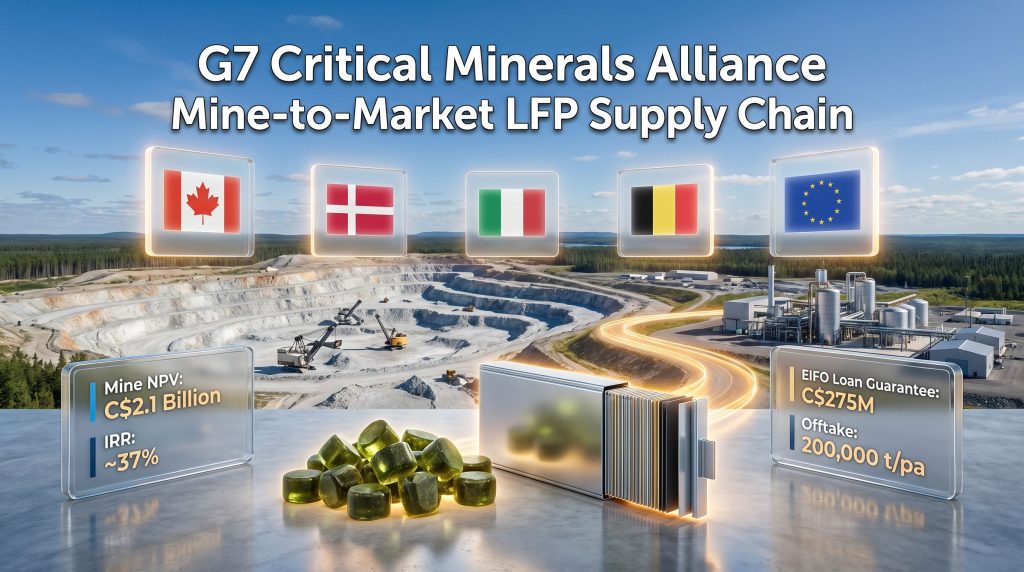
What makes the alliance framework meaningful beyond political declarations is the involvement of sovereign capital entities with genuine financial firepower. The nations and institutions now engaged around First Phosphate's integrated development programme illustrate the breadth of that commitment:
| Country / Entity | Role | Nature of Commitment |
|---|---|---|
| Canada | Federal contributor | C$16.7M non-repayable contribution toward feasibility |
| Denmark (EIFO) | Export credit financing | Letter of intent for up to C$275M in loan guarantees |
| Italy | Government + engineering consortium | Engineering services and offtake support |
| Belgium | Capital participation | Sovereign capital engagement |
| European Union | Multilateral framework | Alliance membership and policy coordination |
The Danish Export and Investment Fund (EIFO) involvement is particularly notable. Export credit agencies typically engage at project finance stage when bankable feasibility studies and construction timelines are established. An early-stage letter of intent covering loan guarantees approaching C$275 million signals a level of institutional confidence that substantially repositions the project's risk profile relative to conventional junior mining development.
Understanding the Mine-to-Market Architecture
First Phosphate's development model spans three distinct production stages, each generating different economic characteristics and serving different end markets. Understanding this structure is essential for evaluating why sovereign capital is engaging at this particular juncture.
Stage One: Bégin-Lamarche Phosphate Mine, Quebec
The Bégin-Lamarche deposit in Quebec's Saguenay-Lac-Saint-Jean region hosts the mine-level operations underpinning the entire downstream chain. The preliminary economic assessment has established a mine-level net present value of C$2.1 billion and an internal rate of return of approximately 37%, against capital expenditure of roughly USD $500 million inclusive of a 20% contingency allowance.
The deposit supports a mine life exceeding 20 years, and importantly, the deposit remains open in multiple directions, suggesting the resource base could expand materially with additional drilling. A second deposit adds further long-term optionality to the resource base.
Stage Two: Purified Phosphoric Acid Processing at Port Saguenay
Phosphate concentrate from the mine feeds a processing facility being developed at Port Saguenay designed to produce purified phosphoric acid at battery-grade specifications. This stage of the project has attracted the involvement of Italy's Maire Group, a publicly listed engineering firm on the Milan Stock Exchange carrying a market capitalisation of approximately 5 billion euros.
Maire Group's subsidiary BSTRA is providing engineering services for the phosphoric acid plant design and construction. Three entities connected to the Italian government are also providing support for this processing stage. The purified phosphoric acid plant represents the critical infrastructure gap in Western LFP supply chains, and its absence anywhere in North America to date underscores the significance of what is being developed here. In addition, the application of direct lithium extraction technologies in adjacent projects highlights the broader trend of investing in processing innovation across battery supply chains.
Stage Three: LFP Cathode Active Material Production
The third segment involves transformation of purified phosphoric acid into lithium iron phosphate cathode active material — the direct battery input product. This segment commands premium pricing relative to upstream phosphate products and represents the highest value-added component of the chain.
The three-segment structure means that conventional junior mining valuation frameworks, which focus primarily on mine-level NPV and IRR metrics, significantly understate the total economic opportunity embedded in an integrated mine-to-market LFP developer. Each segment carries its own NPV, margin profile, and market exposure.
The Commercial Agreements: What Has Been Contracted and What It Means
The transition from indicative to definitive offtake agreements marks a critical inflection point in project finance readiness. Bankable offtake agreements — those structured with sufficient commercial terms to satisfy project finance lenders — are typically a prerequisite for accessing debt capital at scale. First Phosphate has now secured definitive, bankable offtake agreements across two product categories:
- Phosphate concentrate: 200,000 tonnes per annum, definitive and bankable, with prepayment provisions included
- Purified phosphoric acid: 60,000 tonnes per annum, representing approximately 33% of projected plant output, also on definitive and bankable terms
- Pricing structure: Floating market-linked pricing with no floor or ceiling, allowing full participation in commodity price upside
The combined contracted revenue from these agreements is estimated at over $200 million per annum at prevailing prices. The absence of a price floor is a structural feature rather than a risk: it means the developer retains full exposure to commodity price appreciation without being locked into fixed pricing that could erode margins during periods of high demand.
The floating pricing structure is particularly relevant given that LFP battery material demand is projected to grow rapidly through the decade. Offtakers accepting market-linked pricing are effectively signalling confidence that supply constraints will support sustained or rising price levels.
The EIFO loan guarantee covering approximately USD $200 to $220 million against mine capex of around USD $500 million means sovereign-backed financing is positioned to cover close to half of mine-stage capital requirements. This materially de-risks the capital stack before a feasibility study has even been completed — an unusual circumstance that reflects the geopolitical urgency attached to Western LFP supply chain development.
Project Economics at a Glance
| Metric | Reported Figure |
|---|---|
| Mine-Level NPV | C$2.1 billion |
| Mine-Level IRR | ~37% |
| Mine Capital Expenditure | ~USD $500M (incl. 20% contingency) |
| EIFO Loan Guarantee Coverage | |
| Mine Life | 20+ years (open in multiple directions) |
| Contracted Phosphate Concentrate Offtake | 200,000 tpa |
| Contracted Phosphoric Acid Offtake | 60,000 tpa (~33% of plant output) |
| Combined Contracted Revenue | >$200M per annum |
The phosphoric acid plant NPV has not yet been publicly disclosed. The existence of internal figures suggests the economics are being evaluated but are not yet at the stage where public disclosure would be appropriate ahead of feasibility study completion. This undisclosed segment represents a meaningful source of additional value not yet reflected in market assessments that rely solely on the mine-level PEA.
The next major ASX story will hit our subscribers first
Development Timeline and Key Milestones
The development schedule being pursued is by conventional mining standards exceptionally compressed. The rationale for that compression is both commercial and geopolitical: offtakers want material as soon as it is available, and the G7's 2030 dependency reduction target creates a policy-driven urgency that effectively rewards execution speed.
| Milestone | Target Date |
|---|---|
| Feasibility Study Completion | End of 2026 / Early 2027 |
| Permitting Process | 2027 |
| Final Investment Decision (FID) | End of 2027 |
| Mine Construction Commencement | 2028 |
| Target First Production | 2029 |
A key insight from the project's development approach is the deliberate sequencing of capital stack assembly ahead of the feasibility study closing. Many junior mining projects reach feasibility study completion only to then spend years negotiating financing, offtake, and construction contracts in sequence. By establishing sovereign loan guarantee commitments and bankable offtake agreements concurrently with feasibility work, this model compresses the post-feasibility commercialisation timeline considerably.
The G7 alliance framework itself appears to have accelerated deal timelines. Relationships and negotiations that might normally take a year or more to mature were concluded in a matter of months, with the political momentum of the summit providing both motivation and deadline pressure for all parties to finalise terms.
Investor Framework: How to Think About Valuation
Valuing an integrated LFP supply chain developer requires a multi-segment analytical framework that differs substantially from standard junior mining approaches. Three distinct valuation anchors apply:
Segment 1: Mine-level economics are assessable through conventional NPV and IRR analysis. The C$2.1 billion NPV at a 37% IRR provides a quantified baseline, though this figure alone understates the total opportunity.
Segment 2: Purified phosphoric acid processing carries industrial chemical margin characteristics and benefits from the first-mover advantage of being North America's only facility of its type. This segment's NPV has not been publicly disclosed but represents a material additional value layer.
Segment 3: LFP cathode active material production commands battery materials premium pricing and represents the highest-value endpoint of the chain. The global LFP battery market is projected to reach USD $100 to $200 billion in scale within the next four to five years. Even a modest share of that market channelled through a Western integrated producer represents a substantial commercial opportunity.
The financing raise of approximately C$15 million, completed at three times oversubscription during a period of broader market weakness, provides a useful sentiment data point. Institutional and strategic investors choosing to increase exposure to a junior developer at a premium to prevailing market prices — during a market downturn — suggests conviction in the long-term thesis rather than short-term price speculation.
Capital Position and Execution Risk
The combined accessible capital position provides meaningful runway through to final investment decision:
- Prior quarter treasury: approximately C$20 million
- Recent financing raise: approximately C$15 million (3x oversubscribed)
- Canadian federal non-repayable contribution: C$16.7 million
- Combined accessible capital: in excess of C$50 million
This capital base, combined with the sovereign loan guarantee framework for construction-stage financing, positions the project to reach final investment decision without requiring additional dilutive equity raises, assuming no material cost escalations or timeline extensions. The non-repayable nature of the federal contribution is significant: it functions as equity-equivalent capital without the dilutive characteristics of a share issuance.
The Broader Geopolitical Context
China's response to Western critical mineral alliance formation — reported through major international news wire services — reflects the genuine strategic stakes involved. When Western nations begin coordinating sovereign capital around specific supply chain alternatives, it represents a direct challenge to the structural advantages that Chinese processors have built over decades of investment and policy support.
LFP onshoring presents more complex challenges than lithium or rare earth onshoring for several reasons. The processing chemistry is highly specialised. The capital requirements for integrated processing facilities are substantial. Furthermore, the end market — automotive-grade battery manufacturing — demands consistency and traceability standards that take years to establish credibly with major customers.
The G7's 50% China dependency reduction target by 2030 across critical mineral categories implies that qualifying Western producers operating within traceable, mine-to-market frameworks will face structurally elevated demand for their output throughout this decade. Policy ambition of this scale, backed by sovereign capital mechanisms, creates a demand environment that is difficult to replicate through normal market forces alone.
Consequently, a coherent critical minerals strategy at both the national and project level has become a prerequisite for attracting the sovereign backing that transforms development-stage assets into bankable projects. The alignment between a 2029 first production target and the G7's 2030 dependency reduction objective is not coincidental. It reflects a deliberate effort to position production capacity to coincide with the window when Western procurement frameworks will be actively seeking qualified non-Chinese supply. Moreover, the broader push toward green transition materials is accelerating the timeline for every qualifying project in this space.
First Phosphate G7 support for LFP battery supply chain development has, in this respect, arrived at precisely the right moment in the policy cycle.
Frequently Asked Questions
What is the G7 Critical Minerals Resilience and Production Alliance?
It is a formal framework established among G7 nations designed to coordinate sovereign capital, export credit facilities, and policy alignment around qualifying critical mineral projects that can advance Western supply chain independence. It operates as a multilateral structure allowing member nations to collectively support specific projects with financial and technical resources.
How does phosphate connect to LFP battery manufacturing?
Lithium iron phosphate batteries use a cathode material in which phosphate is a primary structural component. Manufacturing that cathode material requires ultra-high-purity phosphoric acid processed to specifications far beyond what standard fertiliser-grade phosphate facilities can produce. The purified phosphoric acid is then combined with lithium and iron compounds to produce the cathode active material used in battery cell production.
Why does North America lack purified phosphoric acid processing capacity?
The specialised processing required for battery-grade purified phosphoric acid did not develop commercially in Western jurisdictions because Chinese facilities captured that market during the early growth phase of LFP battery manufacturing. The capital cost and technical complexity of establishing equivalent Western capacity required both policy support and long-term offtake certainty to attract project finance — conditions that have only recently aligned.
What does a floating-price offtake agreement mean for project revenue?
A floating-price agreement links revenues to prevailing market prices rather than fixing them at a set rate. This means the developer fully participates in commodity price appreciation without being constrained by a price ceiling, while offtakers accept market price exposure. It typically signals that offtakers expect supply constraints to support sustained demand and pricing over the contract term.
What is EIFO and why is a Danish export credit agency involved in a Canadian mining project?
The Danish Export and Investment Fund is Denmark's sovereign export credit and investment agency. Its involvement reflects the G7 alliance framework, under which member nation financial institutions can support qualifying projects beyond their own borders when those projects contribute to collective supply chain security objectives. Danish industrial and technology companies with interests in battery supply chains benefit from a functioning Western LFP supply chain, providing the commercial rationale alongside the political mandate.
Disclaimer: This article is intended for informational purposes only and does not constitute financial advice. All financial metrics, project timelines, and market projections referenced herein are drawn from publicly available company announcements and should be independently verified. Preliminary economic assessments are not equivalent to feasibility studies and carry inherent uncertainty. Investors should conduct their own due diligence before making any investment decisions. Forward-looking statements involve risks and uncertainties, and actual outcomes may differ materially from projections.
Want to Identify the Next Major Critical Minerals Discovery Before the Market Does?
Discovery Alert's proprietary Discovery IQ model delivers real-time alerts on significant ASX mineral discoveries — including critical battery materials such as phosphate — instantly translating complex resource data into actionable investment insights for both short-term traders and long-term investors. Explore Discovery Alert's dedicated discoveries page to understand how historic ASX mineral discoveries have generated substantial returns, and begin your 14-day free trial today to position yourself ahead of the broader market.