June 19, 2026
The Trillion-Dollar Gap Holding Back Industrial Decarbonisation
Decarbonising heavy industry is fundamentally different from switching a power grid to renewables. When a utility replaces a coal plant with a wind farm, the underlying service, electricity delivery, remains structurally unchanged. Steel is a different story entirely. The metallurgical processes that have underpinned steel production for over a century are chemically embedded into the economics, infrastructure, and supply chains of global manufacturing. Changing them requires rebuilding industrial systems from the ground up, and that reality is now colliding violently with the ambitions of the net-zero agenda. Green steel project delays are emerging as one of the most consequential obstacles to industrial decarbonisation globally.
The result is a sector in crisis, not from lack of intention, but from a catastrophic mismatch between the scale of investment required and the capital actually being deployed.
When big ASX news breaks, our subscribers know first
Steel's Disproportionate Role in the Emissions Ledger
Few industries carry as much weight in global emissions accounting as steel. The sector contributes between 7% and 9% of total global greenhouse gas emissions, placing it alongside aviation and shipping as one of the hardest industrial categories to clean up. Unlike sectors where electrification offers a relatively direct substitution pathway, steelmaking involves high-temperature chemical reactions, specifically the reduction of iron ore using carbon-based reductants, that cannot simply be replaced by plugging into a renewable energy grid.
This complexity makes the stakes exceptionally high. If steelmaking cannot be decarbonised at pace, net-zero targets across multiple economies become structurally unachievable, regardless of how aggressively other sectors reduce their footprints.
Furthermore, what makes the current situation particularly alarming is not just the emissions profile of the industry, but the trajectory of investment designed to change it.
The Funding Chasm: Numbers That Expose the Problem
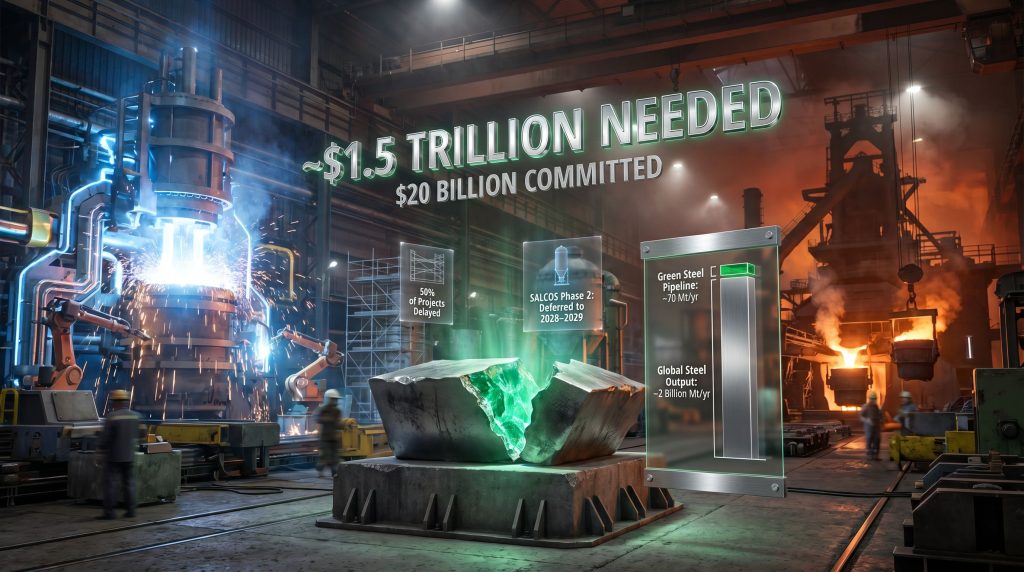
The World Steel Association has estimated that fully decarbonising the global steel sector requires approximately $1.5 trillion in cumulative capital investment. Against that benchmark, the current state of government commitment is stark.
As of mid-2026, governments worldwide have collectively committed approximately $20 billion toward steel decarbonisation, representing less than 1.4% of the total funding required.
The project pipeline itself tells a similarly sobering story. Even if every currently planned green steel project were delivered on time and on budget, the combined output would reach only around 70 million metric tons per year by the end of this decade. That figure sits against a backdrop of total global steel production forecast to reach approximately 2 billion metric tons annually, meaning green steel would represent roughly 3.5% of total output under the most optimistic scenario.
| Metric | Figure |
|---|---|
| Total investment needed to decarbonise steel | ~$1.5 trillion |
| Government funding committed globally to date | ~$20 billion |
| Funding gap as a percentage of requirement | ~98.7% |
| Projected green steel pipeline capacity by decade end | ~70 million metric tons/year |
| Total global steel production forecast (end of decade) | ~2 billion metric tons/year |
| Green steel as a share of total projected output | ~3.5% |
Perhaps most troubling of all is a decade-long data point that rarely receives the attention it deserves: the carbon emissions intensity of global steel production has remained essentially flat over the past ten years, despite widespread corporate commitments to reduce it. The gap between announced targets and the structural capital required to achieve them has not narrowed — it has widened.
Why Green Steel Project Delays Keep Accumulating
Approximately half of all planned green steel projects globally have already experienced delays, according to World Steel Association reporting. Understanding why requires examining several converging pressures that interact and compound one another.
Financing Without Buyers: The Offtake Problem
Project finance for large-scale industrial infrastructure does not flow without bankable revenue certainty. In the green steel context, that means securing offtake agreements with buyers willing to pay a meaningful premium over conventionally produced steel. The problem is that most downstream purchasers, spanning automotive manufacturers, construction firms, and appliance producers, operate in highly competitive, margin-sensitive environments.
Without regulatory mandates requiring them to prioritise low-carbon procurement, their purchasing decisions default to cost. The green steel premium represents a real and significant cost increase that the market, left to its own devices, is broadly unwilling to absorb.
Green Hydrogen: The Missing Input
One of the most technologically promising pathways toward low-carbon steelmaking involves replacing metallurgical coal with green hydrogen through hydrogen iron ore reduction, a process known as hydrogen-based direct reduced iron, or H-DRI. In conventional blast furnace steelmaking, carbon acts as both a fuel and a chemical reductant, stripping oxygen molecules from iron ore. Green hydrogen can perform that same chemical function without generating carbon dioxide emissions.
The catch is that green hydrogen markets remain deeply immature. Production costs are still elevated relative to fossil fuel alternatives, and the large-scale supply infrastructure required to feed industrial-scale steelmaking facilities is largely absent in the regions where steel production is most concentrated. Projects built around H-DRI therefore face a compounding uncertainty: both the hydrogen supply they depend on and the premium steel market they need to sell into remain underdeveloped at the same time.
The Policy Vacuum Stalling Investment Decisions
Industry executives have consistently identified regulatory uncertainty as a primary brake on capital deployment. Promised policy mechanisms, including carbon pricing reform, mandatory green procurement standards, and state-backed financing guarantees, have either failed to materialise or have arrived too slowly to change the investment calculus for major project decisions.
The consequences are visible in high-profile cases. ArcelorMittal has deferred final investment decisions across multiple European low-carbon steel facilities, citing unfavourable market conditions, inadequate carbon market momentum, and slow green hydrogen development. European steel decarbonisation challenges are further illustrated by Salzgitter's SALCOS project in Germany, one of the continent's most closely watched green steel initiatives, which has pushed back its expansion by three years, with a decision on Phase 2 now expected no earlier than 2028 or 2029, revised from an earlier target of 2026.
Importantly, Phase 1 of SALCOS remains operational and is projected to reduce Salzgitter's emissions by around 30% across roughly 2 million tonnes of steel production. That is meaningful progress, but it also illustrates the pattern that has become increasingly common across European green steel: partial advancement followed by strategic retreat on the deeper transformation needed to reach actual net-zero targets.
Energy Cost Exposure: A First-Order Risk
European steelmakers face a structural competitiveness challenge that extends beyond policy uncertainty. Electricity prices across the continent remain significantly elevated, and green steelmaking pathways are inherently electricity-intensive. Electric arc furnaces and hydrogen-based production routes cannot draw on coal as both a reductant and an energy source the way blast furnaces can. Every increase in wholesale electricity prices therefore hits green steel producers harder than their conventional competitors.
Permitting delays extend pre-construction timelines further, increasing carrying costs and eroding the net present value of projects that already carry significant technology and market risk.
The Asian Expansion Problem: Locking In Emissions for Decades
While European producers deliberate, construction activity in Asia is moving in the opposite direction. New conventional blast furnace capacity being planned and built across India and Southeast Asia between 2024 and 2026 is, according to OECD forecasting data, broadly equivalent in scale to the entire current global green steel project pipeline.
This creates a deeply uncomfortable arithmetic: conventional capacity additions in high-growth Asian economies are effectively neutralising planned low-carbon output before a single tonne of green steel has been produced from those facilities.
The economic logic driving this expansion is straightforward. Conventional blast furnace steelmaking remains significantly cheaper, and in rapidly industrialising economies where infrastructure demand is surging, cost competitiveness takes precedence over emissions performance. Blast furnaces constructed today carry operational lifespans of up to 40 years, meaning investment decisions being made now will embed carbon-intensive steelmaking into the global production base well into the 2060s.
The Malaysia Iron and Steel Industry Federation has articulated the commercial reality facing producers in cost-sensitive markets with notable directness: that making green iron production viable is a worthwhile objective, but commercial survival must come first. That sentiment reflects a broader truth that decarbonisation advocates have been slow to fully reckon with: in markets without strong carbon pricing or regulatory pressure, the financial incentive structure simply does not yet support the green transition.
This also creates what economists describe as a carbon leakage dynamic. If green steel producers in Europe raise their cost base to meet environmental requirements while Asian competitors continue expanding low-cost conventional capacity without equivalent obligations, global market share shifts without global emissions declining. The challenges facing China steel and iron ore markets further compound this global imbalance.
What a Workable Policy Framework Actually Requires
The single most consistent theme emerging from industry leaders is that decarbonisation policy has been almost exclusively oriented toward the supply side, targeting producers through incentives and requirements, while leaving the demand side of the market largely unaddressed.
Industry voices at major international forums have increasingly argued that governments must go further, specifically by mandating the use of low-carbon steel in public infrastructure projects, defence procurement, and regulated construction. Without that demand-side signal, the market for green steel remains dependent on voluntary corporate sustainability commitments that are structurally insufficient to underpin large-scale project finance.
A comprehensive acceleration framework would need to operate across multiple levers simultaneously:
| Intervention Type | Mechanism | Expected Impact |
|---|---|---|
| Demand-side mandates | Government procurement requirements for low-carbon steel | Creates guaranteed offtake, de-risks project finance |
| Carbon border adjustment | Tariffs on high-emission steel imports | Levels competitive playing field for green producers |
| Green hydrogen subsidies | Direct production incentives or contracts for difference | Reduces input cost gap for H-DRI steelmaking |
| Blended finance structures | Public-private risk sharing on capital expenditure | Unlocks private investment at scale |
| Emissions intensity standards | Mandatory reduction targets per tonne of steel produced | Drives producer-side transformation |
The European Union's Carbon Border Adjustment Mechanism represents a meaningful step in the right direction, but its current scope covers only a subset of steel products and a limited range of trading partners. Expanding its reach while coupling it with domestic demand mandates would create a far more durable market signal. Notably, analysts examining what went wrong with Europe's green steel transition point to precisely this absence of comprehensive policy architecture as a root cause of recurring delays.
Critically, the $1.5 trillion investment requirement cannot be met by public balance sheets alone. Blended finance structures, combining concessional public capital with institutional private investment, are essential to de-risk the first generation of large-scale green steel projects and establish the commercial proof points that can attract subsequent waves of private capital. Multilateral development banks and sovereign wealth funds have a structural role to play here that has not yet been meaningfully activated.
The next major ASX story will hit our subscribers first
The Investor Sentiment Paradox
There is an intriguing contradiction sitting at the heart of the green steel financing problem. At the macro level, investor appetite for clean energy and low-carbon industrial assets has been renewed by rising oil and gas prices linked to geopolitical instability. The energy security argument for the clean transition has arguably never been stronger.
Yet at the project level, execution is stalling. The disconnect between macro-level investor interest in the energy transition and micro-level project viability reflects the absence of structured, de-risked investment vehicles capable of translating broad sentiment into committed capital. Closing that gap requires active policy intervention to create the bankable conditions that market forces alone cannot currently generate.
Regions such as South Australia green iron development demonstrate that targeted regional policy frameworks can create more favourable conditions — however, these remain isolated examples rather than the global norm. Until those conditions exist at scale, green steel project delays will continue to accumulate, the funding gap will continue to widen, and the decade of flat emissions intensity that the World Steel Association has already documented will extend further into a future that can ill afford the delay.
This article contains forward-looking assessments based on industry data, association reporting, and analyst projections available as of mid-2026. Figures relating to investment requirements, project pipelines, and production forecasts are subject to revision and should not be relied upon as the basis for individual investment decisions. Readers are encouraged to consult independent financial advice before making any investment commitments related to the sectors discussed.
Want to Track the Mineral Discoveries Fuelling the Green Steel Revolution?
Discovery Alert's proprietary Discovery IQ model delivers real-time alerts on significant ASX mineral discoveries — including the iron ore, manganese, and critical minerals central to low-carbon steelmaking — ensuring subscribers can identify actionable opportunities the moment they are announced. Explore historic discoveries and their substantial market returns, then begin your 14-day free trial at Discovery Alert to position yourself ahead of the market.