July 29, 2026
When a Single Mine Reshapes an Entire Balance Sheet
The global copper market has rarely faced a supply disruption as structurally significant as the one that unfolded in Panama in late 2023. When large-scale mining operations are forced offline not by geological depletion or technical failure, but by the intersection of sovereign politics, environmental activism, and legal process, the financial consequences ripple outward for years. Understanding how a company navigates that kind of disruption requires looking beyond headline profit figures and into the mechanical relationship between idled assets, hedging programmes, and the operational mines left carrying the full production burden.
That is precisely the lens through which First Quantum Minerals' second-quarter 2026 results deserve to be examined. The numbers tell a story that is simultaneously encouraging and cautionary, and the First Quantum Cobre Panamá mine earnings trajectory sits at the centre of both narratives. Furthermore, the broader Cobre Panamá arbitration impacts continue to shape how investors interpret the company's financial disclosures.
When big ASX news breaks, our subscribers know first
Q2 2026 in Numbers: A Recovery Built on Narrow Foundations
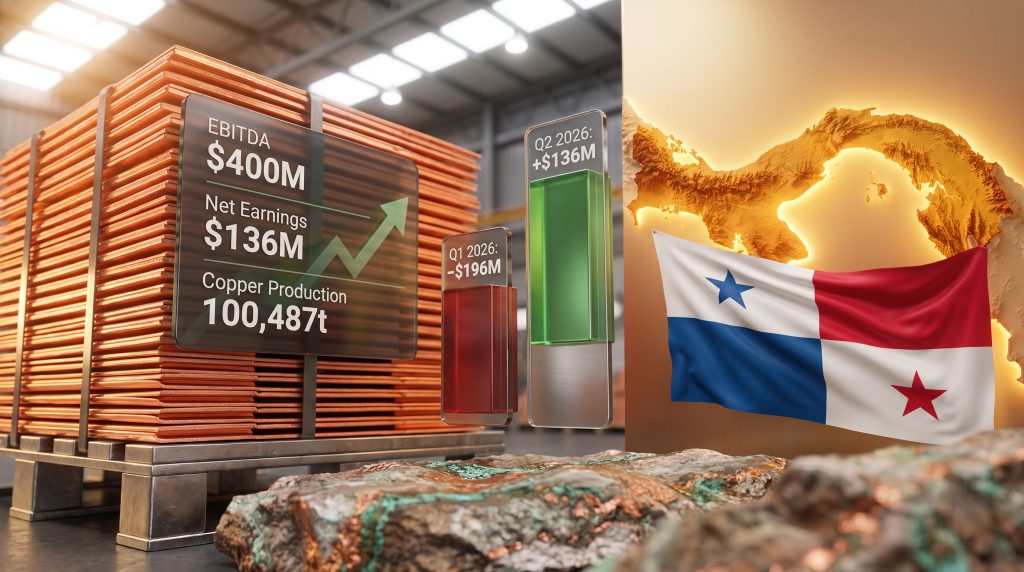
First Quantum reported net earnings attributable to shareholders of $136 million, or $0.16 per share, for the three months ended June 30, 2026. Compared with the net loss of $196 million posted in Q1 2026, this turnaround is striking. Yet it demands careful interpretation.
The adjusted loss figure of $106 million, or $0.13 per share, strips away non-cash and non-recurring items to expose what recurring operational capacity actually looks like. That divergence between reported and adjusted earnings is not cosmetic. It reflects genuine structural headwinds embedded within the results.
| Financial Metric | Q2 2026 Result | Year-on-Year Change |
|---|---|---|
| Net Earnings (Attributable) | $136 million | Improvement from Q1 loss |
| Earnings Per Share | $0.16 | Positive swing |
| Adjusted Loss | $106 million | Ongoing |
| Adjusted Loss Per Share | $0.13 | Ongoing |
| Gross Profit | $297 million | +$19 million YoY |
| EBITDA | $400 million | +$74 million YoY |
| Copper Concentrate Production | 100,487 t | +4% YoY |
The $74 million year-on-year EBITDA improvement was driven primarily by two forces acting in tandem: stronger realised copper prices and higher sales volumes from the Zambian operations. Both are cyclical tailwinds that can reverse. What cannot easily reverse is the structural cost base associated with Cobre Panamá.
The Real Price of Keeping Cobre Panamá Alive
Preservation Costs and Their EBITDA Impact
A mine that is not producing at full scale is not a neutral asset. It is an active cost centre. In Q2 2026, Cobre Panamá generated a negative EBITDA contribution of $51 million, composed entirely of expenditures required for preservation and safe site management. No conventional mining revenue offset this cost.
Annualised, this preservation burden approaches $200 million per year, a figure that investors in copper miners rarely model for assets that have no scheduled restart date. It is worth understanding what preservation at this scale actually involves. For additional context on how decisions around capital allocation in copper mining affect balance sheets, the structural pressures here are considerable.
Large open-pit copper operations rely on complex water management infrastructure, ongoing geotechnical monitoring of pit walls and waste dumps, and continuous maintenance of processing equipment to prevent irreversible mechanical degradation. Allowing these systems to go unmaintained does not simply reduce future restart costs; it can make restart impossible altogether. The preservation expenditure is therefore not optional spending. It is the minimum cost of keeping the optionality of resumption alive.
The distinction between a mine in care-and-maintenance mode and one in active preservation is important. Care and maintenance typically implies a lower-cost holding posture, while active preservation involves continuous expenditure to prevent both environmental damage and physical asset deterioration that would otherwise foreclose future production.
The Stockpile Processing Programme: Mechanism and Limits
In April 2026, Panamanian authorities granted authorisation for on-site ore stockpiles to be processed through existing mill circuits. The environmental rationale behind this decision centres on acid rock drainage, a geochemical process in which sulphide-bearing minerals in exposed ore react with oxygen and water to generate acidic leachate. If left unprocessed, large stockpiles of sulphidic copper ore can become persistent sources of environmental contamination, particularly threatening to surrounding watersheds.
The practical implications of this environmental risk effectively gave First Quantum a pathway back into limited processing activity. One of three milling circuits was successfully restarted to handle stockpile material. You can find further detail on the Cobre Panamá operations directly from First Quantum's operational disclosures.
Key metrics from the stockpile processing activity in Q2 2026:
- 3,216 tonnes of copper produced from stockpile ore during the quarter
- Zero copper sales recorded from Cobre Panamá in Q2 2026, reflecting the early stage of the processing ramp-up
- Gross loss of $44 million generated by the mine in Q2 despite partial circuit restart
- Total on-site stockpile estimated at approximately 38 million tonnes of mineralised ore
- Recoverable copper within the stockpile estimated at approximately 70,000 tonnes
- At current processing rates, the stockpile is sufficient to support roughly 12 months of operations
The contrast with Q1 2026, when only 14 tonnes of copper were attributed to Cobre Panamá, underscores how rapidly the Q2 restart accelerated site activity. A progression from 14 tonnes to 3,216 tonnes in a single quarter is operationally significant even if the financial contribution remains deeply negative for now.
Cobre Panamá: Q1 vs Q2 2026 Side-by-Side
| Metric | Q1 2026 | Q2 2026 |
|---|---|---|
| Copper Production | 14 t | 3,216 t |
| Copper Sales | Negligible | $0 |
| Gross Loss | Undisclosed | $44 million |
| EBITDA Contribution | Negative | -$51 million |
| Operational Status | Shutdown / Preservation | Stockpile Processing Active |
Acid Rock Drainage: The Environmental Factor Driving Regulatory Decisions
The concept of acid rock drainage, or ARD, deserves closer examination because it is not merely an environmental talking point. It is the specific chemical mechanism that gave Panamanian authorities a practical reason to authorise continued processing at a politically contested mine site.
When copper sulphide minerals such as chalcopyrite and bornite are exposed to oxygen and water during stockpiling, they oxidise. This oxidation generates sulphuric acid within the ore pile, which then leaches heavy metals from surrounding rock and material. The resulting acidic, metal-laden runoff can contaminate groundwater and surface water over timeframes measured in decades.
For the Panamanian government, allowing ore stockpiles to sit indefinitely while a political resolution is negotiated creates an ongoing and worsening environmental liability. Processing those stockpiles through existing mill circuits converts the mineralised material into saleable concentrate, removes it from the site, and terminates the ARD risk associated with that material. The environmental logic therefore aligned with First Quantum's commercial interest in partial operations, producing a narrow but workable regulatory opening.
The Hedge Programme: An Invisible Drag on Reported Performance
Why $164 Million in Hedge Losses Changes the Earnings Story
Buried within First Quantum's Q2 2026 EBITDA figure is a $164 million realised loss from the company's copper sales hedge programme. This is not a mark-to-market paper loss. It is a cash realised loss embedded in reported EBITDA of $400 million.
To understand why this matters, consider the mechanics of copper hedging. When a miner faces acute liquidity pressure, as First Quantum did following the forced Cobre Panamá closure, it may sell forward a portion of future copper production at fixed prices to secure revenue certainty for debt service and operational continuity. The cost of that certainty becomes apparent when spot copper prices rise above the hedged levels. At that point, every tonne of hedged production sold below spot price generates a realised loss. The wider copper supply crunch affecting the industry has only amplified this dynamic.
The combined headwind from hedging losses and Cobre Panamá preservation costs in Q2 2026 amounts to:
- $164 million in realised hedge losses
- $51 million in Cobre Panamá EBITDA drag
- Total combined headwind: $215 million against Q2 EBITDA
This means the Zambian operations, primarily Sentinel and Kansanshi, generated operating cash margins substantially higher than the consolidated EBITDA figure of $400 million would suggest. The active mining portfolio is performing well. The consolidated financials are being suppressed by legacy liabilities and strategic hedging decisions made under financial duress.
Zambia Carries the Load: Sentinel and Kansanshi S3
Operational Outperformance in a Constrained Portfolio
With Cobre Panamá generating no conventional production revenue, First Quantum's Zambian assets have become the sole pillars of operational cash flow. Two operations in particular define the near-term production trajectory.
Sentinel Mine delivered the primary volume contribution to the 4% year-on-year increase in copper concentrate output to 100,487 tonnes. As a large-scale, open-pit copper operation in the Zambian Copperbelt region, Sentinel benefits from relatively straightforward ore mineralogy and a well-established processing infrastructure. Its consistent output is the backbone of First Quantum's guidance delivery.
Kansanshi Mine brings additional upside through its S3 circuit expansion. The S3 circuit, commissioned in August 2025, represents a substantial capital investment in extending the productive life of one of Africa's most significant copper deposits. Several aspects of its current performance stand out:
- The circuit is consistently delivering throughput above its designed nameplate capacity, which signals that the engineering design was conservatively specified or that ore characteristics in the current mining zone are more amenable than anticipated
- A new monthly processing rate record was set in May 2026, the highest since the circuit began operations
- Consistent above-nameplate performance typically translates into lower unit processing costs over time as fixed costs are spread across a larger production base
Processing circuits that consistently run above design capacity are not automatically positive. Sustained over-throughput can accelerate wear on grinding media, liners, and pumping systems, increasing maintenance frequency. The key question for Kansanshi is whether the above-capacity throughput is being achieved within planned maintenance cycles or at the cost of accelerated component wear.
The next major ASX story will hit our subscribers first
Portfolio Simplification: Asset Sales Completed in Q2 2026
Two divestments were completed during the quarter. The Çayeli underground copper-zinc mine in Turkey and the Cobre Las Cruces copper project in Spain were both sold, closing in Q2 2026. These transactions remove non-core assets from the portfolio and likely generated proceeds that provide balance sheet support during the ongoing Cobre Panamá resolution process.
The strategic logic is straightforward: concentrating capital and management resources on Zambian operations while the Panama situation remains unresolved reduces operational complexity and helps ensure that the assets most capable of generating cash flow receive appropriate focus and investment. In this context, the earlier Panama arbitration withdrawal also forms part of the company's broader repositioning strategy.
Production Guidance and Full-Year Trajectory
Despite the ongoing constraints from Cobre Panamá, First Quantum confirmed it remains on track to meet its full-year 2026 production guidance across all three primary commodities.
| Commodity | Full-Year 2026 Guidance Range |
|---|---|
| Copper | 405,000 to 475,000 tonnes |
| Gold | 150,000 to 175,000 oz |
| Nickel | 30,000 to 40,000 t |
The confidence in guidance delivery rests on the combined performance of Sentinel and Kansanshi, supplemented by incremental copper contributions from Cobre Panamá's stockpile processing programme. The range within the copper guidance is relatively wide, which provides flexibility to accommodate variability in the stockpile processing ramp-up pace.
The Unresolved Question: What Happens Next at Cobre Panamá?
Regulatory Uncertainty and Its Financial Consequences
As of mid-2026, no formal determination has been issued regarding the long-term operational future of Cobre Panamá. The mine was one of the largest copper operations in the Western Hemisphere prior to its closure, and its absence from the global supply pool continues to influence the copper concentrate market. Consequently, the First Quantum Cobre Panamá mine earnings outlook remains closely tied to how this regulatory uncertainty resolves.
Several structural considerations shape the outlook:
- The Panamanian government's April 2026 authorisation for stockpile processing was granted on environmental grounds, not as a signal of intent to permit full operational resumption
- The approximately 12-month processing window created by the stockpile inventory creates a natural negotiating timeline, as that window will close unless additional authorisations are granted or full operations resume
- No publicly announced timeline exists for a final governmental decision
- The estimated 70,000 tonnes of recoverable copper in stockpiles represents, at prevailing copper prices above $9,000 per tonne, a latent value exceeding $600 million that can only be realised through continued processing access
- Preservation costs of approximately $200 million per annum accumulate regardless of the political outcome
From an investor perspective, the binary nature of the Cobre Panamá situation creates an asymmetric risk profile. A resumption scenario transforms the company's EBITDA capacity materially. A permanent closure determination would almost certainly trigger substantial impairment charges and force a fundamental renegotiation of First Quantum's capital structure.
The stockpile processing timeline is worth watching as a proxy indicator. If the Panamanian government extends processing authorisation beyond the initial 12-month window, it would signal a degree of pragmatic engagement with the mine's future that the political rhetoric has not yet made explicit. For a broader view of how the copper price outlook factors into these projections, market conditions remain a key variable.
What the Consolidated Financials Obscure About Operational Strength
The analytical challenge in evaluating First Quantum's Q2 2026 results is separating the performance of the active mining portfolio from the cost drag of a politically suspended asset. When these are viewed in isolation, the picture changes considerably.
The active Zambian operations generated gross profit of $297 million and contributed to EBITDA that, before the $215 million combined headwind from hedge losses and Cobre Panamá preservation costs, would have reflected a significantly stronger underlying result. For analysts modelling normalised earnings capacity, this distinction between reported and underlying performance is not a technicality. It is the central valuation question.
The gradual reduction in hedge book exposure over time, as previously hedged positions roll off and are replaced at higher prevailing prices, should progressively reduce the hedge loss drag on reported EBITDA. Combined with the potential resolution of the Cobre Panamá situation, these two structural headwinds represent the largest upside levers in First Quantum's near-to-medium-term financial profile. Indeed, the First Quantum Cobre Panamá mine earnings potential locked within the idled asset remains one of the most consequential variables in the company's investment thesis.
Furthermore, the cost of Panama's prolonged mine closure has been extensively documented, with Panama's economic losses from the shutdown adding another dimension to the political calculus that will ultimately determine the mine's fate. First Quantum's own first quarter 2026 results provide additional context for the trajectory seen in the Q2 figures discussed here.
This article contains forward-looking statements and scenario analysis that involve uncertainty. Nothing in this article constitutes financial advice. Investors should conduct their own due diligence before making investment decisions.
Want to Spot the Next Major Copper Discovery Before the Market Does?
Discovery Alert's proprietary Discovery IQ model delivers real-time alerts on significant ASX mineral discoveries, instantly translating complex mineral data into actionable investment insights — explore the historic returns major discoveries have generated to understand the opportunity, then begin your 14-day free trial at Discovery Alert to position yourself ahead of the broader market.