June 22, 2026
The Compliance Audit That Could Reshape Global Copper Supply
The copper market has spent the better part of three years adjusting to a supply gap that nobody anticipated would last this long. When large-scale mining operations are removed from the global production ledger, commodity markets adapt through price signals, substitution, and the gradual ramp-up of alternative sources. However, few assets carry the same weight as a single mine that once contributed meaningfully to both national GDP and global refined copper availability. Understanding what the recent compliance audit of Cobre Panama actually means requires stepping back from the headline score and examining the layered commercial, political, and environmental dynamics that will ultimately determine whether the First Quantum Cobre Panama mine restart becomes reality.
When big ASX news breaks, our subscribers know first
Why Cobre Panama Still Commands Global Attention
Before its production halt in late 2023, Cobre Panama ranked among the world's largest copper mines by annual output capacity. The operation sits within Panama's Colón Province, embedded in a tropical rainforest ecosystem that gives the site both its extraordinary mineral endowment and its environmental sensitivity. The orebody itself is a large porphyry copper deposit, a geological formation characterised by disseminated copper mineralisation spread across an enormous rock volume.
Porphyry deposits typically carry lower grades than some other copper deposit types, but they compensate through sheer scale, making them economically viable at production volumes that justify the substantial capital infrastructure required. Furthermore, at a time when the copper supply crunch is driving structural demand growth across electric vehicles, grid infrastructure, and renewable energy systems, understanding Cobre Panama's role in the global picture is essential.
Prior to closure, the mine was processing tens of millions of tonnes of ore annually and represented approximately 5% of Panama's entire GDP, an extraordinary concentration of economic activity for a single industrial asset. Its removal from the global copper supply picture was not a marginal event. The sustained absence of a producer of this scale has measurable consequences for supply-demand balance modelling across the entire industry.
The 2023 Shutdown and Its Aftermath
The sequence of events that led to the mine's suspension is important context for interpreting the current audit process. Widespread civil protests emerged in Panama in late 2023, driven by public concern over environmental damage, the perceived inadequacy of fiscal returns flowing to the Panamanian state, and broader questions about sovereignty over natural resources. A Supreme Court ruling compounded the pressure, and the Panama mine shutdown took effect in November 2023.
First Quantum subsequently transitioned the site into what is termed a preservation and safe management configuration. This operational mode is distinct from simple abandonment. Under preservation and safe management protocols, a mining company maintains active site monitoring, continues environmental controls, keeps processing infrastructure in a serviceable condition, and retains a workforce sufficient to prevent deterioration.
It is a deliberately reversible posture, carrying ongoing costs but preserving the optionality to recommission relatively quickly compared to a fully decommissioned facility. For an asset of Cobre Panama's capital intensity, this distinction is commercially significant.
What the 88% Compliance Score Actually Reveals
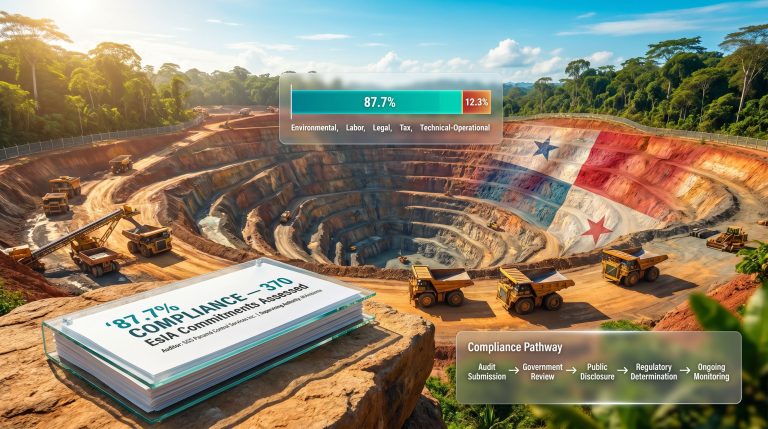
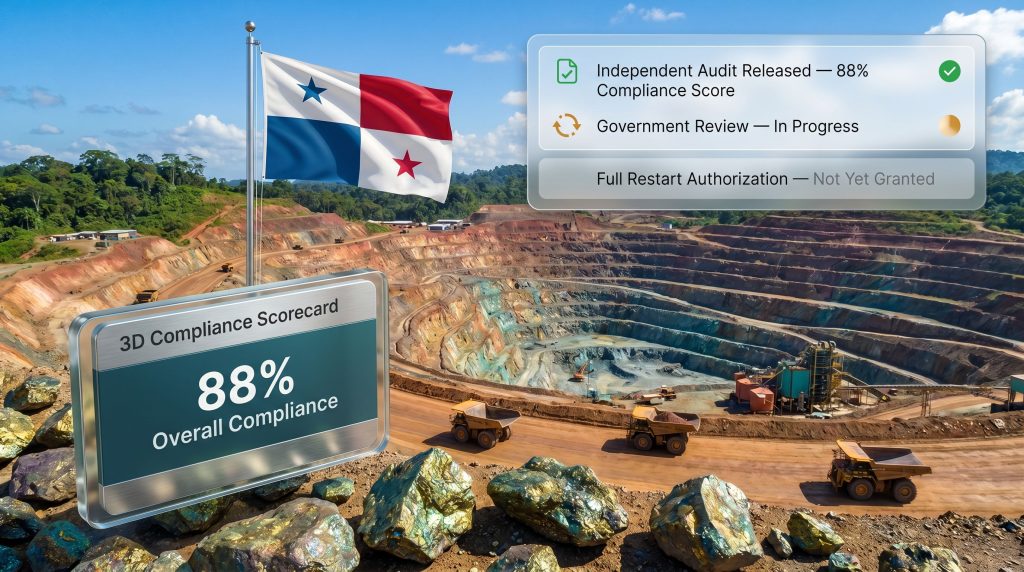
Panama's environment ministry commissioned an independent audit assessing Cobre Panama across three primary domains: environmental obligations, legal obligations, and operational standards. The overall result of 88% compliance placed the mine in the broadly compliant classification, one tier below the top-rated optimised category.
The audit findings can be summarised as follows:
| Compliance Category | Audit Outcome |
|---|---|
| Environmental Obligations | Broadly Compliant |
| Legal Obligations | Broadly Compliant |
| Operational Standards | Broadly Compliant |
| Reforestation and Habitat Restoration | Weaknesses Identified |
| Tailings Facility Management | Future Liabilities Flagged |
| Water Quality and Acid Drainage | Ongoing Risks Noted |
| Biodiversity Protection | Gaps Identified |
The 12% shortfall from full compliance is not trivial, and investors or analysts who interpret the 88% score as a straightforward green light would be misreading the situation. The gaps are concentrated in areas that carry long-term environmental liability: reforestation, biodiversity protection, and the tailings storage facility.
Tailings management deserves particular attention. Tailings are the fine-grained waste material remaining after ore processing, and their storage represents one of the highest-risk legacy issues in large-scale copper mining. The audit's flagging of future liabilities in this area signals that the regulatory pathway forward will require First Quantum to make credible commitments on tailings facility upgrades and long-term monitoring.
Acid mine drainage, also identified as an ongoing risk, is a well-documented challenge in tropical environments where high rainfall accelerates leaching of acidic compounds from disturbed rock into surrounding waterways.
What Gaps in Reforestation Indicate
The reforestation and biodiversity shortfalls identified in the audit are worth examining from a technical standpoint. Tropical forest rehabilitation is among the most complex environmental remediation challenges in mining. Unlike temperate environments where revegetation can proceed relatively quickly with standard species, tropical forest ecosystems involve layered canopy structures, specialised soil microbiomes, and complex species interdependencies that cannot be replicated through simple replanting programmes.
The audit's identification of weaknesses here suggests that the scope of ecological restoration commitments will consequently be a substantive component of any renegotiated operational agreement.
The Political Architecture Surrounding a Potential Restart
The audit's release represents a process milestone, not a decision point. Panama's Trade Minister Julio Moltó made clear publicly that any determination on the mine's future would be grounded in data, evidence, and technical rigour, signalling that the government intends to proceed methodically rather than respond to market or commercial pressure.
President Mulino faces a genuinely complex political calculus. The protest movement that precipitated the 2023 shutdown has not dissolved, and any restart announcement carries the risk of reigniting civil opposition. At the same time, the economic cost of the mine's continued closure is visible in Panama's fiscal accounts. The three scenarios currently under consideration reflect this tension:
- Full operational restart under a renegotiated fiscal and environmental framework that addresses the concerns that drove the original protests.
- Limited stockpile processing as an interim revenue-generating measure, allowing First Quantum to process stockpiled ore already extracted before the shutdown without resuming active mining.
- Continued closure while political, legal, and arbitration processes run their course, accepting the ongoing economic cost as the price of social and political stability.
The stockpile processing option is particularly interesting from an investor perspective because it represents a path to partial value recovery that sidesteps the most politically sensitive aspects of the restart debate. First Quantum had accumulated substantial ore stockpiles prior to the shutdown, and processing these through the existing concentrator circuit would generate copper concentrate exports without expanding the mine's physical footprint or triggering the most direct environmental concerns.
The Arbitration Dimension
Running parallel to the domestic political process is an international arbitration claim that First Quantum filed following the mine's forced closure. The Cobre Panama arbitration is widely understood to be a prerequisite for any substantive restart negotiation. President Mulino has pointed to arbitration resolution as a necessary condition, and this linkage creates a sequencing challenge.
First Quantum needs to see sufficient progress on restart terms before withdrawing a claim that represents a significant financial backstop, while Panama's government is unlikely to negotiate seriously on fiscal terms while an arbitration claim remains active.
How Renegotiated Terms Are Expected to Be Structured
Based on analysis from Scotiabank, which characterised the audit outcome as broadly positive in a note to clients, a restart under renegotiated terms is viewed as the probable trajectory. The bank's analysts suggested the findings are likely to support a presidential recommendation favouring full resumption of operations with First Quantum retaining the operator role, albeit under substantially revised commercial conditions.
The anticipated structural changes to any new agreement include:
- A higher combined tax and royalty burden on copper revenues, reflecting Panama's stated position that the economic return to the state under the previous contract was insufficient.
- A potential direct equity stake of approximately 5% for the Panamanian government, transforming the state from a regulator and tax recipient into a co-owner with aligned interests in operational success.
- Strengthened environmental performance bonds and independently verified remediation milestones, particularly around tailings management and reforestation.
- Potentially revised community benefit frameworks targeting employment, local procurement, and infrastructure investment in surrounding regions.
A direct state equity stake would represent a structural shift in how the Panama government relates to the asset, moving from an adversarial regulatory posture toward a model where the state has direct financial incentive to support operational continuity. This dynamic has been observed elsewhere in Latin American resource nationalism episodes and tends to reduce the probability of future politically motivated shutdowns once implemented.
Cobre Panama's Restart in the Context of Global Copper Markets
The timing of any First Quantum Cobre Panama mine restart decision intersects with a copper market that is navigating competing forces. On the demand side, electrification programmes across major economies continue to drive structural consumption growth. On the supply side, the global copper supply gap means a limited number of large-scale greenfield deposits are available to fill the coming deficit.
A full restart would reintroduce a meaningful volume of refined copper equivalent to global markets, potentially moderating near-term price pressure. In addition, with new large copper projects still years from production, the timing of Cobre Panama's return becomes all the more consequential for market participants.
However, the ramp-up trajectory matters considerably. Mining infrastructure that has been in preservation mode for over two years does not recommission instantaneously. Processing plants require mechanical inspection, reagent systems need reactivation, and workforces need to be rebuilt to full operational capacity. Industry precedent suggests a realistic recommissioning timeline of six to twelve months from a formal restart decision to sustained production.
The next major ASX story will hit our subscribers first
Restart Timeline: Key Milestones and Current Status
| Milestone | Status as of June 2026 |
|---|---|
| Independent Audit Released | Completed, 88% Compliance Score |
| Government Review of Findings | In Progress |
| Arbitration Withdrawal Discussions | Unresolved |
| Fiscal Term Renegotiation | Not Yet Formally Commenced |
| Stockpile Processing Approval | Under Consideration |
| Full Restart Authorisation | Not Yet Granted |
The Broader Lesson for Resource-Intensive Jurisdictions
The Cobre Panama situation has become a reference case for how resource nationalism, environmental activism, and sovereign fiscal interests interact in emerging market mining jurisdictions. Latin America has seen a series of similar dynamics in recent years, where the social licence framework for large-scale mining has been fundamentally renegotiated under public pressure, with varying outcomes for operators and host governments alike.
The use of an independent technical audit as the bridge between political impasse and negotiated resolution is a mechanism worth noting. By commissioning a credible third-party assessment, Panama's government has created a defensible evidentiary basis for whatever decision ultimately follows. Analysts at UBS have also upgraded First Quantum ahead of an anticipated restart, further reinforcing the broadly constructive market view of the audit outcome.
For mining companies operating in jurisdictions with strong civil society engagement and evolving environmental standards, the First Quantum Cobre Panama mine restart experience underscores several operational principles:
- Social licence must be actively maintained, not assumed as a consequence of legal permit holding.
- Environmental performance gaps, even in areas that seem secondary to core operations, can become focal points for opposition that ultimately threatens the entire operation.
- Fiscal structures perceived as inequitable by host populations carry political risk that standard contract law cannot fully mitigate.
- Preserving assets in a reversible state during disputes, rather than accepting permanent closure, is a strategically valuable but financially costly posture.
Disclaimer: This article contains forward-looking analysis regarding potential mine restart scenarios, renegotiated fiscal terms, and copper market implications. These represent analytical assessments based on publicly available information and should not be construed as investment advice. Actual outcomes may differ materially from projections discussed herein.
Want to Stay Ahead of the Next Major Mineral Discovery?
Discovery Alert's proprietary Discovery IQ model scans ASX announcements in real time, delivering instant alerts on significant mineral discoveries — including copper — so subscribers can identify actionable opportunities before the broader market reacts. Explore historic examples of major discoveries and their returns, then begin your 14-day free trial at Discovery Alert to position yourself ahead of the market.