June 25, 2026
The Processing Bottleneck Blocking the Clean Energy Transition
The global race to secure critical minerals demand is not simply a mining problem. Even where ore deposits or recycling feedstocks exist in abundance, the extraction and refining of materials like gallium, germanium, rare earth elements, and battery metals remains constrained by processing technologies that were designed for a different era. Conventional methods, whether acid leaching, hydrometallurgical circuits, or high-temperature pyrometallurgical smelting, carry environmental liabilities, lengthy cycle times, and chemical input costs that make them structurally unsuited to the complexity of modern waste streams and low-grade secondary feedstocks.
This processing gap is quietly becoming one of the most consequential chokepoints in the clean energy supply chain. Metallium Flash Joule Heating technology represents one of the more technically credible attempts to close it, and recent operational milestones suggest the platform is advancing from laboratory promise toward commercial reality.
When big ASX news breaks, our subscribers know first
How Flash Joule Heating Actually Works
The Physics of Ultra-Short Electrical Pulses
At its core, Metallium Flash Joule Heating technology is built on a deceptively simple physical principle: electrical resistance generates heat. What makes flash joule heating distinct from conventional Joule heating is the intensity and duration of the energy delivery. Rather than applying sustained heat over hours, FJH delivers ultra-short, high-intensity electrical pulses directly through a feedstock material, generating extreme internal temperatures almost instantaneously.
This process restructures molecular bonds within metal-bearing compounds, destabilising the chemical architecture that locks critical metals inside complex matrices. The result is a processing outcome that conventional methods require hours or even days to achieve, accomplished in seconds. Furthermore, the thermal gradient generated inside the feedstock is both steeper and more targeted than anything achievable through furnace-based or acid-dissolution approaches.
From Electrical Pulse to Metal Recovery: The Chlorination Stage
The base FJH process operates without chemical inputs. In advanced processing stages, chlorine gas and proprietary catalytic agents are introduced to convert metal oxides into recoverable chloride compounds. This chlorination chemistry is where a significant portion of Metallium's intellectual property is concentrated, as catalyst selection directly determines metal selectivity, recovery yield, and product purity across different feedstock types.
The progression from inert-feed mechanical testing to full chlorination chemistry campaigns is a deliberate engineering sequence. Validating reactor stability, material handling, and process control under sustained conditions before introducing reactive chemistry reduces risk and generates cleaner datasets for each development phase.
Technology Lineage: From Rice University to Commercial Reactor
FJH was developed at Rice University, where foundational research demonstrated that ultra-rapid electrical heating could restructure carbon and metal-bearing materials at scales previously confined to theoretical models. Metallium secured a global commercialisation licence for the technology in 2024, positioning itself as the primary vehicle for translating that academic breakthrough into sustained industrial processing.
The engineering challenge involved in this translation is non-trivial. A laboratory-scale pulse system operating on gram quantities of material bears little mechanical resemblance to a multi-unit industrial reactor platform designed for sustained throughput. Bridging that gap requires not just electrical engineering but materials science, process control systems, fluidisation dynamics, and industrial safety infrastructure, all of which are active components of Metallium's current development programme.
Processing Method Comparison
| Processing Method | Chemical Inputs | Processing Time | Wastewater Generated | Energy Profile |
|---|---|---|---|---|
| Acid Leaching | High (HCl, H₂SO₄) | Hours to days | Significant | Moderate |
| Pyrometallurgical Smelting | Flux agents, coke | Hours | Moderate | Very High |
| Flash Joule Heating (FJH) | None (base process) | Seconds | Minimal | Low-to-moderate |
What the Texas Multi-Unit Campaign Proved
Mechanical Validation at Scale: The 12-Hour Run
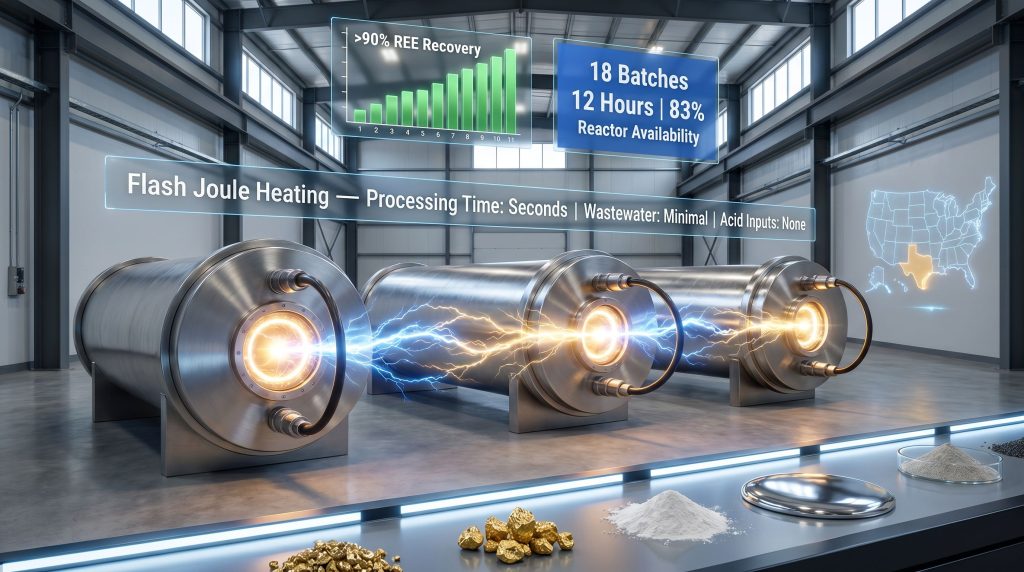
Metallium's technology development facility is located on the Gator Point Technology Campus in Texas, operated through its subsidiary Flash Metals USA Inc. In mid-2026, the company successfully completed its first multi-unit FJH commissioning campaign at that site, running three reactor units simultaneously under a nitrogen atmosphere using inert feedstock material.
The results of that campaign were materially significant for the platform's development trajectory:
- Duration: 12 continuous hours of multi-unit operation
- Batches completed: 18 successful processing cycles
- Material processed: approximately 0.3 metric tonnes (660 pounds) of inert feed
- Reactor availability: 83% across the full campaign period
- Active utilisation: near-100% of available operating time
The distinction between single-unit proof-of-concept testing and three units operating in sustained parallel conditions is not merely quantitative. It generates fundamentally different engineering data, including fluidisation behaviour across multiple simultaneous material flows, instrumentation calibration under real operating loads, and process control protocols that cannot be modelled from single-unit datasets alone.
What the Campaign Deliberately Excluded
It is equally important to understand what the Texas campaign did not attempt. There was no chlorination chemistry, no proprietary catalyst introduction, and no metal recovery measurement. This was a conscious engineering decision. Separating mechanical platform validation from chemical recovery testing allows each phase to generate clean, interpretable data without the confounding variables that reactive chemistry would introduce into a first multi-unit run.
This phased methodology is standard practice in industrial process development, but it is also frequently misunderstood by observers expecting a single campaign to demonstrate end-to-end performance. The 83% reactor availability and near-total utilisation of active operating time are metrics that speak directly to the mechanical reliability of the platform, not yet to its recovery economics.
Permit Status and Interim Facility Context
A structural deficiency identified in the primary reactor development building led Metallium to construct an interim testing facility to maintain programme continuity while roof replacement works proceed. The company is currently awaiting permit amendments for this interim facility before multi-unit chlorination campaigns can commence. Once those approvals are in place, the next phase of testing will shift from mechanical performance into the recovery dimension of the technology.
The Feedstock Universe: What FJH Can Process
Electronic Waste and Semiconductor Scrap
Electronic waste represents one of the most heterogeneous and value-dense secondary feedstock categories available. Circuit boards, semiconductor scrap, and e-waste concentrates contain simultaneous deposits of gallium, germanium, gold, rare earth elements, and other high-value metals in physical configurations that defeat conventional single-stream processing approaches.
FJH's ability to process heterogeneous feedstocks in a single step, recovering multiple co-located metals simultaneously, is a structural commercial advantage in this segment. Metallium has reinforced its position in this space through a binding e-scrap supply agreement with Glencore, one of the world's largest commodity traders and e-waste aggregators. This agreement provides long-term feedstock volume visibility and substantially de-risks the commercial ramp-up of FJH processing capacity.
Rare Earth-Bearing Concentrates and Magnet Waste
Rare earth element recovery from mineral concentrates and magnet waste presents unique technical challenges. The rare earth processing challenges associated with heavy REEs in particular are significant, as they tend to occur in low concentrations within complex mineral matrices, making selective extraction difficult and expensive through conventional acid leaching routes.
FJH has demonstrated recovery rates exceeding 90% purity for rare earth elements extracted from both NdFeB (neodymium-iron-boron) and SmCo (samarium-cobalt) magnet waste streams, achieved without acid inputs. The NdFeB magnet type dominates permanent magnet production for electric vehicle motors and wind turbine generators, making magnet waste recycling a strategically significant feedstock category as first-generation EV fleets approach end-of-life volumes.
Black Mass, Industrial Byproducts, and Secondary Streams
Beyond e-waste and magnet scrap, the FJH platform has been tested across a notably broad secondary feedstock range:
- Black mass from degraded lithium-ion batteries — the battery recycling process yields materials containing lithium, cobalt, and nickel in partially oxidised form
- Bauxite residue (red mud), the voluminous byproduct of aluminium refining, which contains recoverable scandium, titanium, and REE concentrations
- Coal fly ash, which carries germanium, gallium, and rare earth oxide concentrations in quantities that conventional processing cannot economically address
- Monazite and other REE-bearing mineral concentrates
- Refinery scrap and catalytic converter waste
The commercial logic targeting these streams is compelling: feedstock acquisition costs are low or negative (in the case of waste remediation contracts), while the metal values locked within these materials can be substantial.
Critical and Precious Metals Recoverable via FJH
| Metal | Primary Applications | Strategic Context |
|---|---|---|
| Gallium | Semiconductors, defence electronics | Subject to Chinese export controls since 2023 |
| Germanium | Fibre optics, infrared optics, photovoltaics | Critical supply concentration risk |
| Antimony | Flame retardants, military munitions, batteries | NATO-identified critical material |
| Rare Earth Elements | EV motors, wind turbines, defence systems | Heavily concentrated in Chinese processing |
| Gold | Electronics, refinery scrap | High unit value recovery from e-waste |
Metallium's completed U.S. Department of Defense-funded gallium recovery programme is particularly noteworthy in this context. Gallium has been subject to China's rare earth export restrictions since mid-2023, creating acute supply vulnerability for U.S. semiconductor and defence electronics manufacturing. A domestically validated gallium recovery pathway consequently carries clear strategic weight beyond its immediate commercial metrics.
The Development Pathway: From Commissioning to Demonstration Scale
Phase-by-Phase Progression
The roadmap from the completed multi-unit commissioning campaign to full demonstration-scale operation can be understood in three sequential phases:
Phase 1: Design Refinement (Immediate)
- Minor reactor design modifications based on commissioning campaign data
- Instrumentation upgrades and calibration improvements
- Permit amendments for the interim testing facility
Phase 2: Multi-Unit Chlorination Campaigns (Near-Term)
- Introduction of commercial feedstocks: catalytic converter scrap and e-waste-derived materials
- Chlorine gas and proprietary catalyst integration across multiple simultaneous reactor units
- Data collection across metal recovery rates, product purity, reagent consumption, throughput, and operating condition optimisation
Phase 3: Demonstration-Scale Operation (Medium-Term)
- Scaling validated multi-unit protocols to demonstration-level throughput
- Product qualification for offtake and commercial supply chain integration
- Full commercial operations ramp at the Texas facility
The chlorination campaign data will be the most commercially consequential information set Metallium has yet generated. Recovery rates, product purity levels, and reagent consumption figures across multiple simultaneous units will determine whether the economics of FJH processing are competitive with, or superior to, the conventional methods it aims to displace.
Strategic Partnerships and Commercial Infrastructure
The Ucore Integration: Building a Complete REE Refining Chain
One of the less widely understood aspects of Metallium Flash Joule Heating technology's current position is its collaboration with Ucore Rare Metals, which operates the proprietary RapidSX solvent extraction and separation technology. RapidSX is designed to separate individual rare earth oxides from a mixed REE input stream, the downstream step that converts a bulk REE concentrate into commercially usable separated products.
Metallium's FJH platform operates upstream of RapidSX, converting complex feedstocks into REE-enriched intermediate products compatible with the separation process. The combination creates a vertically integrated, fully domestic rare earth processing chain spanning from heterogeneous waste feedstock to individual separated oxide products — a pathway that currently does not exist at commercial scale within the United States outside of China-influenced supply structures.
Glencore Feedstock Agreement: Volume Security at the Input Stage
The binding e-scrap supply contract with Glencore addresses what has historically been one of the most underappreciated risks in secondary processing ventures: feedstock consistency and volume reliability. Processing technology that performs brilliantly in testing but cannot secure consistent high-quality feedstock at commercial volumes will not translate into a viable business.
Glencore's position as a global commodity aggregator gives it unparalleled access to e-waste volumes across multiple geographies. Locking that supply access through a binding agreement before demonstration-scale operations begin is a commercially sophisticated sequencing decision. In addition, Metallium's Texas scale-up target of 8,000 tonnes per annum capacity by 2026 further reinforces the commercial seriousness of the programme.
The next major ASX story will hit our subscribers first
FJH vs. Competing Technologies: Where the Structural Advantage Lies
Comprehensive Technology Comparison
| Evaluation Dimension | Conventional Hydrometallurgy | Pyrometallurgical Smelting | Flash Joule Heating |
|---|---|---|---|
| Acid consumption | High | Low-Moderate | None (base process) |
| Processing cycle time | Hours to days | Hours | Seconds to minutes |
| Wastewater management cost | Significant | Moderate | Minimal |
| Feedstock flexibility | Limited | Limited | High (multi-stream) |
| REE recovery purity | Variable | Low | >90% demonstrated |
| Carbon intensity | Moderate-High | Very High | Low |
| Co-recovery capability | Limited | Very Limited | High |
| Scalability pathway | Capital-intensive | Capital-intensive | Modular, parallel unit |
The co-recovery characteristic deserves particular emphasis. Conventional processing technologies are generally optimised for single-metal or single-stream applications. Smelting infrastructure designed for copper recovery performs poorly when confronted with a circuit board containing gallium, gold, and rare earth elements in the same physical matrix. FJH's ability to process heterogeneous feedstocks without selectivity constraints at the input stage means the same reactor system can generate value from materials that would be uneconomical or technically problematic for competing technologies.
The Modular Scaling Advantage
A point often overlooked in discussions of FJH commercial potential is the architectural implication of parallel reactor operation. Conventional processing facilities scale throughput by building larger, more capital-intensive single installations. FJH scales, however, by adding parallel reactor units, each independently operable and maintainable.
This modular architecture reduces the minimum viable scale for a commercial installation, lowers the capital exposure at each expansion step, and provides operational redundancy that large centralised processing facilities cannot easily replicate. The 83% reactor availability figure recorded during the Texas campaign is an early data point on the reliability profile of individual FJH units operating under sustained conditions.
Frequently Asked Questions About Flash Joule Heating Technology
What is Flash Joule Heating and who developed it?
Flash Joule Heating is an advanced materials processing method that applies ultra-short, high-intensity electrical pulses to rapidly heat feedstock materials, restructuring molecular bonds to enable metal extraction without acids, smelting, or significant wastewater generation. The technology was developed at Rice University and subsequently commercialised under a global licence by Metallium Ltd. in 2024.
What critical metals can Flash Joule Heating recover?
FJH has demonstrated recovery capability across gallium, germanium, antimony, rare earth elements including heavy REEs, and precious metals such as gold. The technology has been tested on electronic waste, semiconductor scrap, NdFeB and SmCo magnet waste, rare earth-bearing mineral concentrates, bauxite residue, coal fly ash, and black mass from recycled batteries.
What were the results of Metallium's multi-unit commissioning campaign?
The campaign ran three FJH reactor units simultaneously for 12 continuous hours, completing 18 successful processing batches and handling approximately 0.3 metric tonnes of inert feed material. Reactor availability reached 83%, with near-total utilisation of active operating time. The campaign focused on mechanical performance and process control rather than metal recovery.
How does FJH compare to acid leaching for rare earth recovery?
FJH has demonstrated greater than 90% recovery and purity of rare earth elements from NdFeB and SmCo magnet waste without any acid inputs, compared to conventional acid leaching processes that generate significant chemical waste streams, require extended processing times, and face increasingly stringent environmental compliance costs.
What is the next development phase for Metallium's FJH platform?
Following minor design refinements and instrumentation upgrades, Metallium plans to conduct multi-unit chlorination campaigns using commercial feedstocks including catalytic converter scrap and e-waste-derived materials. These campaigns will generate data on metal recovery rates, product purity, reagent consumption, and throughput, advancing the technology toward demonstration-scale operation.
Key Takeaways for Investors and Industry Observers
Several dimensions of Metallium Flash Joure Heating technology's current position merit careful consideration by anyone tracking critical metal processing innovation:
- The mechanical validation of multi-unit parallel operation is a qualitatively different milestone from single-unit proof-of-concept testing. It addresses scalability, not just technology performance.
- Feedstock flexibility across e-waste, magnet scrap, mineral concentrates, and industrial byproducts gives FJH a broader addressable market than any technology optimised for a single input stream.
- The Glencore supply agreement and the Ucore downstream integration position FJH not as a standalone technology but as the processing core of an emerging vertically integrated supply chain.
- Chlorination campaign results from Phase 2 testing will be the most commercially definitive data the company has yet produced. Those figures will determine whether FJH economics can be validated at throughput rates relevant to commercial offtake agreements.
- The modular reactor architecture is not merely a technical characteristic but a commercial and capital allocation advantage, enabling incremental scaling without proportional increases in upfront investment.
Disclaimer: This article is intended for informational purposes only and does not constitute financial advice. Forward-looking statements regarding technology development timelines, recovery performance, and commercial outcomes involve uncertainty and should not be relied upon as guarantees of future results. Readers should conduct their own due diligence before making investment decisions.
Want to Identify the Next Major Critical Minerals Discovery Before the Broader Market?
Discovery Alert's proprietary Discovery IQ model instantly scans ASX announcements across more than 30 commodities — including the critical minerals driving the clean energy transition — delivering real-time alerts on significant discoveries directly to subscribers. Explore historic examples of major mineral discoveries and their market returns, then begin your 14-day free trial at Discovery Alert to position yourself ahead of the market.