
June 24, 2026
The Architecture of Control: How China Is Rewiring Rare Earth Compliance From the Inside Out
Enforcement systems built entirely on punishment have a structural weakness: they depend on regulators catching violations before they compound. China's rewards for reporting rare earth export control violations represent a fundamental shift in how Beijing manages the outflow of strategically critical minerals. However, punitive mechanisms only work when the state has visibility, and in a global supply chain as complex and opaque as rare earths, visibility is never guaranteed.
That calculus is now shifting. By layering financial incentives onto an existing punitive architecture, Beijing is effectively outsourcing surveillance to the market itself, turning suppliers, competitors, logistics providers, and even foreign nationals into potential compliance monitors. The implications for global rare earth supply chains, manufacturer compliance obligations, and the competitive dynamics of critical mineral sourcing extend well beyond what headline summaries tend to capture.
When big ASX news breaks, our subscribers know first
How China's Rare Earth Export Control System Is Structured
The Dual-Track Model: Punishment, Licensing, and Incentivised Reporting
China's export control framework for rare earths operates across multiple legislative pillars, including the Export Control Law, Dual-Use Item Export Control regulations, and an expanding set of strategic mineral-specific frameworks introduced and tightened progressively since 2023.
Historically, the system relied on a punitive model. Violations triggered financial penalties calibrated as a percentage of the value of goods involved, export privilege suspensions, and placement on a national dishonesty registry that effectively blacklists firms and individuals from future export activity. Mine closures and product seizures provided an operational enforcement dimension for illegal producers operating outside the licensed system.
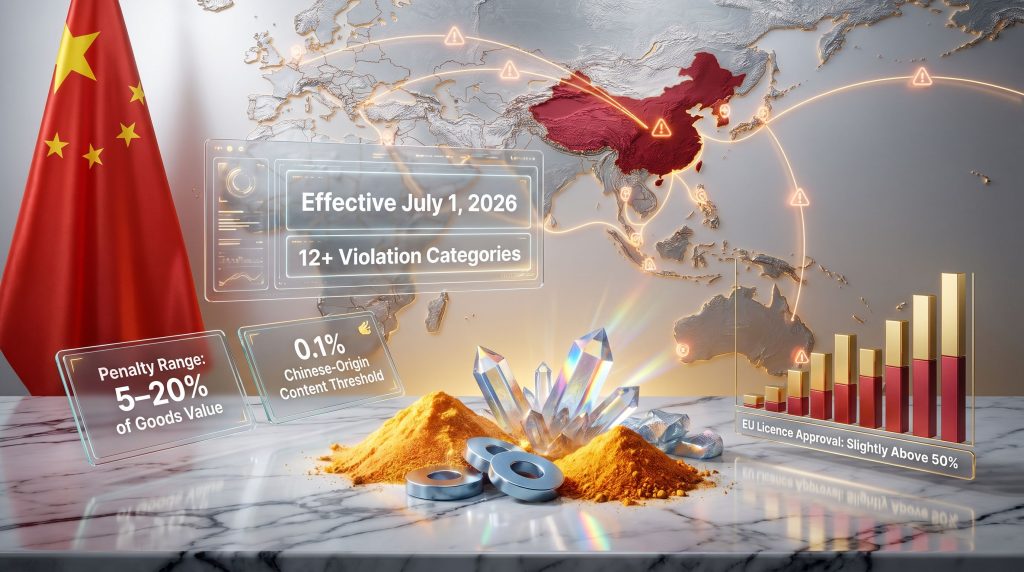
The introduction of a whistleblower reward mechanism, effective July 1, 2026, adds a structurally distinct layer. Rather than waiting for regulatory inspections or customs flagging to surface violations, the state is now actively incentivising third-party reporting, extending the reach of enforcement into spaces where administrative oversight alone cannot penetrate.
Key Violations Now Subject to Incentivised Reporting
China's Ministry of Commerce outlined more than a dozen reportable violation categories under the new measures. The range of conduct covered is notably broad:
| Violation Category | Description | Enforcement Risk Level |
|---|---|---|
| Unlicensed exports | Shipments without Ministry of Commerce approval | Critical |
| Circumvention attempts | Routing goods through third-party jurisdictions | Critical |
| Technology transfer via IP licensing | Exporting controlled mineral-related IP without authorisation | High |
| Service provision to violators | Knowingly supporting unlicensed exporters | High |
| False declarations | Misrepresenting composition, origin, or end-use | High |
| Investment-channel transfers | Moving strategic mineral assets abroad via capital structures | Medium-High |
A particularly significant inclusion is the extension of liability to service providers who knowingly assist unlicensed exporters. This captures logistics firms, freight forwarders, financial intermediaries, and legal advisers who may facilitate non-compliant transactions without directly handling controlled materials.
The self-disclosure provision adds further nuance: entities that voluntarily report their own potential violations before a third party does may receive reduced or mitigated penalties, creating a competitive incentive for pre-emptive transparency.
The Geopolitical Catalyst Behind the July 2026 Announcement
Timing, Detention, and Deliberate Signalling
The timing of China's whistleblower reward announcement was not incidental. On the same day Beijing published the new measures, Japan confirmed that two of its nationals had been detained in China on allegations related to the attempted smuggling of rare earth-related goods. The convergence of these two events, one enforcement action and one policy announcement, on the same date reflects a calculated communication strategy rather than administrative coincidence.
Beijing has been escalating rare earth export restrictions progressively since 2025, when it expanded controls to cover a broader set of strategic minerals and introduced extraterritorial licensing requirements for foreign-manufactured products. The whistleblower mechanism amplifies this trajectory, signalling to international trade partners, particularly those in East Asia, the European Union, and North America, that circumvention attempts carry compounding legal and reputational risk. Furthermore, China's rare earth trade strategy has consistently used these enforcement tools as instruments of broader geopolitical leverage.
The simultaneous announcement of detentions and reward-based reporting measures suggests a deliberate effort to demonstrate that enforcement is both active and expanding in scope, from state-led prosecution to socially distributed surveillance.
The detention of foreign nationals is itself a significant escalation. It communicates that non-Chinese actors operating within Chinese territory, or handling Chinese-origin materials, are not insulated from domestic enforcement jurisdiction. For a detailed analysis of these broader consequences, the CSIS assessment of China's rare earth restrictions offers valuable independent context.
The 0.1% Chinese-Origin Threshold: Extraterritorial Reach Into Global Manufacturing
How Foreign Manufacturers Are Now Caught in China's Compliance Net
One of the most consequential and least widely understood provisions introduced in 2025 is the 0.1% Chinese-origin rare earth content rule. Under this requirement, foreign-manufactured products that contain Chinese-origin rare earth inputs at or above a 0.1% concentration threshold are now subject to Chinese export licensing requirements when re-exported or incorporated into downstream goods.
This is structurally analogous to the United States Foreign Direct Product Rule (FDPR), which extends U.S. export control jurisdiction to foreign-made goods incorporating U.S.-origin technology above defined thresholds. China's adoption of a mirrored mechanism represents a significant strategic alignment of regulatory architecture, and a meaningful expansion of Beijing's jurisdictional reach over global industrial supply chains.
The compliance implications are substantial for manufacturers across multiple sectors:
- Automotive and EV manufacturers in Europe, Japan, and South Korea sourcing rare earth magnets for motors
- Defence and aerospace contractors using rare earth alloys in guidance and propulsion systems
- Consumer electronics producers incorporating rare earth phosphors into display technologies
- Clean energy manufacturers using dysprosium and neodymium in wind turbine generators
For these industries, even trace concentrations of Chinese-origin rare earth content in a finished product can now trigger a licensing obligation when that product is sold or transferred internationally.
How the Enforcement Landscape Has Evolved: Old Tools vs. New Architecture
The whistleblower system does not replace existing mechanisms. It operates in parallel with a set of tools that have been progressively refined over the past decade:
| Enforcement Mechanism | Type | Introduced | Primary Target |
|---|---|---|---|
| Financial penalties (5-20% of goods value) | Punitive | Pre-2025 | Exporters |
| Export privilege suspension | Administrative | Pre-2025 | Exporters |
| National dishonesty list | Reputational | Pre-2025 | Firms and individuals |
| Mine closures and product seizures | Operational | Ongoing | Illegal producers |
| Whistleblower reward system | Incentive-based | July 1, 2026 | Informants and public |
| 0.1% Chinese-origin content rule | Extraterritorial | 2025 | Foreign manufacturers |
One enforcement tool that receives comparatively little analytical attention is the national dishonesty list. Placement on this registry functions as a supply chain weapon: firms blacklisted for compliance failures effectively lose access to the Chinese export system entirely, severing relationships with state-owned enterprise partners and cutting off the upstream supply relationships on which their businesses may depend.
VAT rebate policy adjustments have also been used as an indirect steering mechanism, with periodic reviews creating financial uncertainty for exporters who rely on rebate structures to maintain cost competitiveness.
What Compliant Rare Earth Exporters Must Now Document
Step-by-Step: The Modern Compliance Workflow
The combination of licensing requirements, the 0.1% content rule, and the new whistleblower incentive system significantly raises the documentation burden on exporters. A compliant export process under the current framework requires:
- Origin verification – Trace and document the full extraction, processing, and transformation chain for all rare earth inputs, including sub-supplier sourcing records
- Composition disclosure – Declare precise percentage concentrations of controlled materials in finished products, including intermediary components
- Licence application – Submit complete end-use declarations to the Ministry of Commerce with full technical specifications
- Third-party review – Engage state-owned enterprise co-signatories where joint licensing requirements apply to the transaction
- Post-shipment reporting – Maintain transfer records subject to biannual regulatory review cycles
- Self-monitoring – Proactively identify and voluntarily disclose potential compliance gaps before third-party reporting triggers a formal investigation
This last step has taken on heightened strategic significance. With the whistleblower reward system now active, the probability that a compliance gap surfaces through third-party reporting, rather than internal discovery, has materially increased. Self-disclosure as a penalty-mitigation strategy is no longer merely a procedural option; it has become a rational risk management calculation.
EU Approval Rates Signal Underlying Market Stress
Regulatory signals from major importing regions reinforce how stretched the current licensing system has become. By late 2025, only slightly above 50% of EU export licence applications were being approved, a figure that reflects both tightening Chinese policy settings and the practical friction of operating within an increasingly complex dual-use classification environment. Rising enquiry volumes to the Ministry of Commerce about unclear product classifications further indicate that exporters across multiple jurisdictions are navigating genuine ambiguity about their compliance obligations. The rare earth processing challenges that non-Chinese producers face only compound this pressure.
The next major ASX story will hit our subscribers first
Strategic Implications for Non-Chinese Critical Mineral Supply Chains
Diversification Pressure Is Accelerating
The progressive tightening of Chinese rare earth export controls, capped by the introduction of socially distributed enforcement through whistleblower incentives, is accelerating buyer behaviour changes that were already underway. Manufacturers and governments across the EU, United States, Japan, Australia, and Canada are intensifying efforts to develop alternative supply anchors for critical mineral inputs.
Australia's significant rare earth deposit base, Canada's emerging critical mineral development pipeline, and America's rare earth supply chain reshoring efforts have all gained commercial urgency against this backdrop. Investment flows into non-Chinese rare earth projects reflect both the supply security concerns of downstream manufacturers and the pricing leverage implications of a tightening Chinese export framework.
If China's whistleblower reward system generates actionable intelligence on circumvention networks, particularly those routing materials through Southeast Asian intermediaries, Beijing could effectively map and disrupt the informal rare earth trade that has historically undermined its export quota system, simultaneously tightening global supply and strengthening its pricing leverage.
The Intelligence Dividend of Social Surveillance
A dimension of the whistleblower system that has received limited attention in mainstream analysis is its intelligence value. Beyond deterring individual violations, confirmed reports provide Beijing with granular visibility into the networks, intermediaries, and routing mechanisms that have historically enabled quota circumvention. Rare earth smuggling through Vietnamese, Malaysian, and other Southeast Asian processing intermediaries has been a persistent structural vulnerability in China's export control system for over a decade.
By incentivising reporting from organisations and individuals, including potentially cross-border informants, the Ministry of Commerce gains access to intelligence streams that no administrative inspection regime could replicate at comparable scale or cost. Consequently, this is not simply an enforcement upgrade; it is a strategic intelligence operation embedded within a trade compliance framework. The Chatham House analysis of China's export restrictions reinforces this interpretation, framing the measures as a deliberate warning to Western nations dependent on Chinese critical mineral flows.
Frequently Asked Questions: China Rare Earth Export Controls and Whistleblower Rewards
What rewards does China offer for reporting rare earth export control violations?
China's Ministry of Commerce announced in June 2026 that individuals and organisations whose reports of rare earth export control violations are confirmed will be eligible for financial rewards under the new measures, effective July 1, 2026.
What penalties apply for rare earth export control violations in China?
Penalties include financial fines set at 5-20% of the value of the goods involved, suspension of export privileges, and listing on China's national dishonesty registry, which can effectively bar firms from future participation in the export system.
Which materials fall under China's strategic mineral export controls?
Controls cover rare earth elements, processed rare earth compounds, related dual-use strategic minerals, rare earth-containing technologies, and, as of 2025, foreign-manufactured products containing 0.1% or more of Chinese-origin rare earth content.
Does China's 0.1% content rule apply to finished products made outside China?
Yes. The extraterritorial scope of China's 2025 rule means foreign-manufactured goods incorporating Chinese-origin rare earth inputs above the 0.1% threshold require Chinese export licences when re-exported or transferred internationally.
How does China's export control framework compare to U.S. FDPR rules?
China's 0.1% Chinese-origin content threshold mirrors the structural logic of the U.S. Foreign Direct Product Rule (FDPR), which extends American export jurisdiction to foreign-made goods containing U.S.-origin technology above defined thresholds. Both mechanisms represent extraterritorial assertions of regulatory authority over global supply chains.
Key Metrics at a Glance
| Metric | Detail |
|---|---|
| Policy effective date | July 1, 2026 |
| Number of listed violation categories | 12+ |
| Penalty range (financial) | 5-20% of goods value |
| Chinese-origin content threshold for foreign products | 0.1% or more |
| EU licence approval rate (late 2025) | Slightly above 50% |
| Enforcement actions to date | Hundreds of millions of yuan in fines; mine closures; product seizures |
China's rewards for reporting rare earth export control violations are best understood not as a standalone regulatory tweak but as a signal of strategic intent. Beijing is building toward full-spectrum visibility over the global rare earth trade, distributing compliance enforcement across commercial and social networks, and extending its regulatory jurisdiction into foreign manufacturing ecosystems. For supply chain managers, procurement officers, and investors in critical mineral markets, the compliance environment has structurally shifted, and the window for informal tolerance of ambiguous trade practices is closing faster than many have anticipated.
This article is intended for informational purposes only and does not constitute legal, financial, or investment advice. Regulatory frameworks and enforcement actions described are subject to change. Readers with specific compliance obligations should seek qualified legal counsel.
Want to Track the Next Major Rare Earth Discovery Before the Market Does?
As China tightens its grip on rare earth exports and compliance obligations reshape global supply chains, the race to identify alternative critical mineral sources is intensifying — and Discovery Alert's proprietary Discovery IQ model delivers real-time ASX alerts the moment a significant rare earth or critical mineral discovery is announced, turning complex geological data into actionable investment insights. Explore historic discoveries and their returns to understand what's at stake, and begin your 14-day free trial today to position yourself ahead of the market.