July 21, 2026
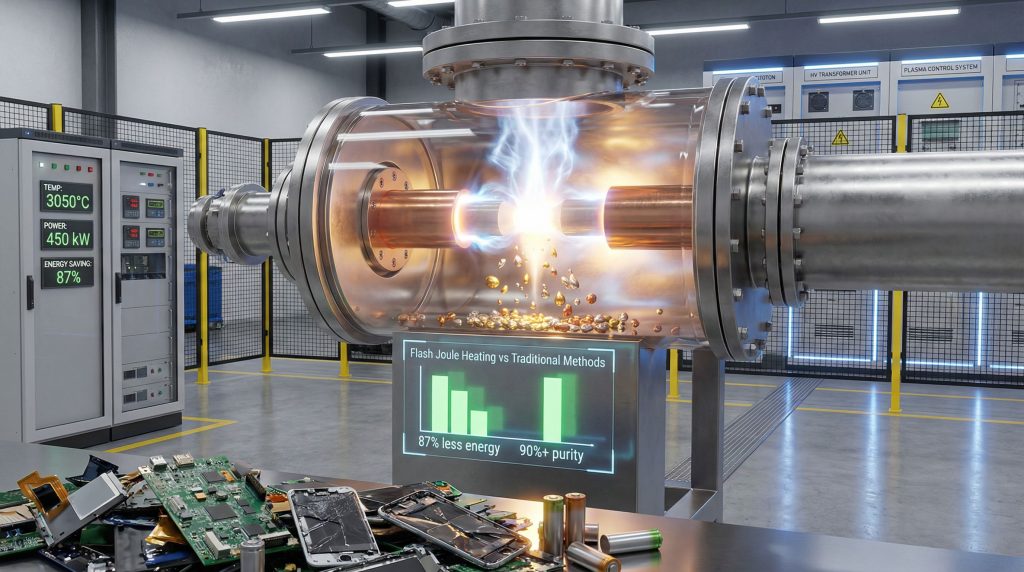
Flash Joule Heating technology represents a transformative advancement in materials processing that addresses mounting challenges from energy costs, environmental regulations, and supply chain security concerns. These systemic pressures have accelerated the development of revolutionary processing methods that can achieve extreme temperatures through fundamentally different mechanisms, with rapid electrical pulses creating instantaneous heating effects that transform how industries approach metal recovery and materials synthesis.
This technological shift represents more than incremental improvement. It embodies a paradigm change from sustained-temperature processes requiring hours of energy input to ultrafast thermal cycling measured in milliseconds. Furthermore, the implications extend across multiple industrial sectors, from electronic waste processing to the emerging battery recycling breakthrough, where conventional methods have struggled with efficiency, environmental impact, and economic viability.
Understanding these emerging thermal technologies requires examining their fundamental operating principles, comparative advantages, and commercial deployment strategies. The transition from laboratory validation to industrial implementation reveals critical insights about the future of materials processing and its role in addressing global supply chain vulnerabilities.
The Science Behind Ultrafast Electrical Heating
Flash Joule Heating technology operates through the controlled application of ultrafast electrical pulses that generate extreme temperatures in milliseconds rather than the hours required by conventional thermal methods. The process achieves temperatures exceeding 3,000 degrees Celsius (5,432 degrees Fahrenheit) through rapid electrical energy conversion, creating thermal conditions that enable selective material separation without chemical dissolution.
The fundamental mechanism relies on Joule heating principles, where electrical current passing through resistive materials generates thermal energy. However, unlike traditional resistive heating that builds temperature gradually, Flash Joule Heating concentrates electrical energy delivery into extremely short pulses. Consequently, this creates instantaneous thermal spikes that cause rapid evaporative separation of target materials.
Temperature Thresholds and Energy Conversion Mechanisms
The extraordinary temperature achievement in Flash Joule Heating technology stems from its ability to concentrate electrical energy delivery into millisecond timeframes. This rapid energy conversion creates thermal gradients steep enough to cause selective vaporisation of different materials based on their respective boiling points and thermal properties.
At temperatures exceeding 3,000°C, most metals transition into gaseous phases, allowing for physical separation based on vapour pressure differences. This thermal processing environment eliminates the need for chemical solvents or sustained high-temperature maintenance, as the brief but intense heating pulse provides sufficient energy for materials separation while minimising overall energy consumption.
The energy conversion efficiency derives from the elimination of heat loss typically associated with prolonged thermal processing. Traditional smelting operations must maintain furnace temperatures over extended periods, losing significant energy to radiation, conduction, and convection. Flash Joule Heating's millisecond duration minimises these loss mechanisms, concentrating energy directly into materials transformation.
Equipment Components and System Architecture
Flash Joule Heating systems utilise specialised electrical pulse generation equipment capable of delivering controlled high-energy discharges to target materials. The technology can operate using modified standard electrical equipment, making it potentially accessible for various scale operations from laboratory research to industrial processing facilities.
The processing chamber must accommodate the extreme temperatures generated during the heating pulse while containing any vaporised materials for collection and recovery. This requires specialised materials and design considerations to handle thermal shock and rapid temperature cycling without equipment degradation.
Feedstock preparation systems play a critical role in Flash Joule Heating effectiveness. Materials must be properly sized and positioned to ensure optimal electrical conductivity and heat transfer during the pulse event. For instance, electronic waste processing typically involves shredding circuit boards and semiconductor components into consistent particle sizes that enable uniform heating distribution.
When big ASX news breaks, our subscribers know first
Energy Efficiency Metrics and Performance Benchmarks
The energy efficiency advantages of Flash Joule Heating technology become apparent when comparing total energy consumption across complete processing cycles. While conventional smelting requires sustained energy input over hours or days, Flash Joule Heating concentrates energy delivery into millisecond pulses, potentially reducing overall energy requirements by significant margins.
Traditional metal recovery methods face inherent efficiency limitations due to heat loss mechanisms during extended processing times. Furnace operations lose energy through radiation, thermal mass heating, and maintaining processing temperatures between batch cycles. However, Flash Joule Heating eliminates many of these loss mechanisms by completing thermal processing before significant heat dissipation occurs.
Processing Time Comparisons Across Recovery Technologies
The temporal differences between Flash Joule Heating and conventional methods represent one of the most dramatic performance distinctions. While traditional smelting operations require hours to days for complete processing cycles, Flash Joule Heating achieves materials separation in milliseconds.
This processing speed advantage extends beyond operational efficiency to impact facility design, throughput capacity, and capital requirements. Faster processing enables higher throughput rates from smaller equipment footprints, potentially reducing capital investment requirements for equivalent production capacity.
Hydrometallurgical processes, which rely on chemical dissolution and precipitation, typically require extended contact times between solvents and target materials. These chemical processes may take hours or days to achieve complete metal extraction, particularly for complex materials containing multiple metal species.
Environmental Impact Assessment and Chemical Usage
Flash Joule Heating technology eliminates the need for chemical solvents typically required in hydrometallurgical processing, addressing environmental concerns related to acid usage, chemical waste generation, and water contamination risks. This chemical-free approach reduces operational complexity while eliminating waste management challenges associated with spent processing solutions.
The absence of acid requirements represents a significant environmental advantage, as conventional metal recovery often relies on strong acids for metal dissolution. These chemical processes generate acidic waste streams requiring neutralisation and disposal, creating environmental liability and operational costs.
Air quality impacts also differ significantly between Flash Joule Heating and conventional methods. While traditional smelting generates continuous emissions over extended operating periods, Flash Joule Heating's brief processing cycles may produce fewer total emissions per unit of material processed.
Comparison of Processing Methods
| Method | Energy Profile | Processing Duration | Chemical Requirements | Recovery Efficiency |
|---|---|---|---|---|
| Flash Joule Heating | Pulsed, high-intensity | Milliseconds | Chemical-free operation | Variable by material |
| Conventional Smelting | Sustained high temperature | Hours to days | Minimal chemicals | Established baselines |
| Hydrometallurgy | Moderate temperature | Hours to days | Extensive acid usage | 85-95% typical |
| Pyrometallurgy | High sustained temperature | Hours | Flux additives | Variable by process |
Electronic Waste Processing and Circuit Board Recovery
Electronic waste represents one of the most promising applications for Flash Joule Heating technology due to the complex, heterogeneous composition of discarded electronics that challenges conventional recovery methods. Circuit boards contain valuable metals including gold, silver, copper, and palladium intermixed with ceramics, polymers, and other materials that require sophisticated separation techniques.
The rapid thermal cycling capability of Flash Joule Heating appears particularly suited to electronic waste processing because it can achieve selective vaporisation of different materials based on their thermal properties. This physical separation mechanism avoids the chemical complexity required for dissolving metals from complex electronic assemblies.
Current commercial deployment focuses specifically on shredded circuit board processing, with Metallium Ltd.'s Texas facility configured to handle up to 2,400 metric tons of electronic scrap annually through its agreement with Glencore. This represents the first large-scale application of Flash Joule Heating technology to electronic waste recovery operations.
Battery Recycling and Critical Material Extraction
Battery recycling presents another significant opportunity for Flash Joule Heating applications, particularly given the growing volumes of lithium-ion batteries reaching end-of-life from consumer electronics, electric vehicles, and energy storage systems. These batteries contain valuable materials including lithium, cobalt, nickel, and graphite that require specialised recovery techniques.
The thermal processing capabilities of Flash Joule Heating may enable direct recovery of battery materials without the extensive preprocessing required by conventional recycling methods. Traditional battery recycling often requires dismantling, material separation, and chemical processing steps that increase operational complexity and costs.
However, battery recycling through Flash Joule Heating requires careful consideration of safety factors, as lithium-ion batteries can present fire and explosion risks during thermal processing. The rapid heating characteristics of the technology may help minimise these risks by reducing exposure time to dangerous temperature ranges.
Advanced Materials Manufacturing and Synthesis
Beyond waste recovery applications, Flash Joule Heating technology may enable new approaches to advanced materials manufacturing and synthesis. The extreme temperatures and rapid thermal cycling create processing conditions not easily achievable through conventional methods, potentially enabling novel material properties and compositions.
The precise control over thermal pulse characteristics allows for fine-tuning of processing conditions to achieve specific material properties. This capability may prove valuable for specialty alloy production, nanomaterial synthesis, or other advanced manufacturing applications requiring precise temperature control.
Research institutions continue exploring these advanced applications, though commercial deployment remains focused on waste recovery operations where the technology offers clear economic and environmental advantages over existing methods.
Capital Investment Requirements and Equipment Costs
The capital requirements for Flash Joule Heating systems present both opportunities and challenges for commercial deployment. While the basic electrical pulse generation equipment may utilise relatively standard components, complete processing systems require specialised chambers, materials handling equipment, and recovery systems capable of withstanding extreme thermal conditions.
Early cost estimates suggest that basic Flash Joule Heating equipment may be constructed using modified standard electrical components, potentially making the technology accessible to smaller-scale operations. However, scaling to industrial processing volumes requires additional infrastructure for materials handling, environmental control, and product recovery.
The Texas facility established by Metallium represents the first commercial-scale deployment, providing real-world data on capital requirements and operating costs. This facility's performance will serve as a benchmark for future commercial implementations and technology scaling decisions.
Throughput Capacity and Production Volume Metrics
Processing capacity represents a critical factor in determining the economic viability of Flash Joule Heating systems for various applications. Current commercial deployment targets 2,400 metric tons of annual processing capacity, equivalent to approximately 6.6 metric tons per day assuming continuous operation.
This processing capacity must be evaluated against the energy consumption, staffing requirements, and facility costs associated with achieving these throughput levels. The rapid processing characteristics of Flash Joule Heating may enable higher throughput rates from smaller facilities compared to conventional processing methods.
Scaling to higher processing volumes will require multiple parallel processing lines or larger individual systems capable of handling increased feedstock volumes. The modular nature of electrical pulse systems may facilitate scaling through parallel operation rather than requiring completely new equipment designs.
Supply Chain Integration and Feedstock Considerations
Successful commercial deployment of Flash Joule Heating technology requires reliable, consistent feedstock supply chains that can provide appropriate materials for processing. The Glencore supply agreement demonstrates the importance of establishing long-term feedstock contracts with major materials suppliers.
Feedstock quality and consistency significantly impact processing efficiency and recovery rates in Flash Joule Heating systems. Electronic waste must be properly prepared through shredding and sorting operations to ensure optimal electrical conductivity and thermal transfer during processing.
The geographic distribution of feedstock sources affects transportation costs and supply security for Flash Joule Heating facilities. Establishing regional processing centres near major electronic waste generation sources may optimise supply chain economics and reduce environmental impacts from materials transportation.
Domestic Processing Capabilities and Strategic Independence
Flash Joule Heating technology addresses critical supply chain vulnerabilities in the United States by enabling domestic processing of valuable waste streams that historically require overseas processing. The lack of domestic electronic waste processing capacity has resulted in the export of high-value circuit board scrap to foreign facilities, creating supply chain dependencies and economic inefficiencies.
The establishment of domestic Flash Joule Heating capabilities aligns with national strategic priorities regarding critical mineral supply security and supply chain resilience. This technology enables the recovery of valuable metals from waste streams within the United States rather than relying on foreign processing facilities.
Commercial deployment in Texas represents a significant step toward establishing domestic processing infrastructure capable of handling complex electronic waste materials. This facility demonstrates the feasibility of onshoring critical materials recovery operations using advanced processing technologies.
Rare Earth Element Recovery and Purification Rates
Rare earth elements present particular challenges for recovery and purification due to their chemical similarities and the complex mineral matrices in which they occur. Flash Joule Heating technology may offer advantages for rare earth processing by providing thermal conditions capable of selective vaporisation and separation.
The extreme temperatures achievable through Flash Joule Heating exceed the vaporisation points of most rare earth elements, potentially enabling physical separation techniques that avoid the chemical complexity of conventional rare earth processing. This approach could reduce environmental impacts and processing costs associated with rare earth extraction.
However, rare earth element recovery through Flash Joule Heating requires careful optimisation of processing parameters to achieve acceptable purity levels and recovery rates. The chemical similarities between rare earth elements may limit the selectivity achievable through purely thermal separation methods.
Economic Viability for Small-Scale Operations
The accessibility of Flash Joule Heating equipment components may enable smaller-scale operations that are not economically viable using conventional processing methods. Traditional smelting and refining operations typically require large-scale facilities to achieve economic efficiency, creating barriers to entry for smaller operators.
Flash Joule Heating's lower capital requirements and simpler operational procedures may democratise access to metal recovery capabilities, enabling regional processing centres and specialised recovery operations. This scalability could support more distributed processing infrastructure rather than centralised large-scale facilities.
The economic viability of small-scale Flash Joule Heating operations depends on feedstock costs, recovery rates, and product pricing. Local processing capabilities may command premium pricing by reducing transportation costs and providing faster service to regional customers.
Material Optimisation and Reactor Design Requirements
The extreme thermal conditions generated during Flash Joule Heating operations present significant engineering challenges for reactor design and materials selection. Processing chambers must withstand rapid temperature cycling from ambient conditions to over 3,000°C without degradation or failure.
Reactor materials must exhibit exceptional thermal shock resistance, high-temperature stability, and chemical compatibility with vaporised metals and processing atmospheres. Traditional refractory materials may prove inadequate for the rapid thermal cycling and extreme temperature gradients encountered in Flash Joule Heating systems.
The design of electrical contacts and pulse delivery systems requires careful optimisation to ensure reliable energy transfer while withstanding repeated thermal cycling. These components represent critical reliability points that directly impact system availability and processing consistency.
Flow Field Engineering and Heat Distribution Control
Achieving uniform heating distribution across processed materials requires sophisticated understanding of electrical current flow patterns and thermal transfer mechanisms during pulse events. Non-uniform heating can result in incomplete processing and reduced recovery efficiency.
The rapid nature of Flash Joule Heating pulses limits the time available for thermal equilibration within processed materials, making initial heat distribution patterns critical for achieving consistent results. This requires careful consideration of feedstock positioning, electrical contact design, and pulse characteristics.
Computational modelling and simulation capabilities play important roles in optimising flow field designs and predicting thermal distribution patterns. These tools enable design optimisation without extensive physical testing and prototyping.
Quality Control and Consistency Standards
Establishing reliable quality control procedures for Flash Joule Heating operations requires understanding the relationship between processing parameters and final product quality. The rapid processing characteristics create challenges for real-time monitoring and process control during heating events.
Product consistency depends on maintaining uniform processing conditions across different batches and feedstock compositions. Variations in feedstock preparation, electrical pulse characteristics, or environmental conditions can impact recovery rates and product purity.
Development of appropriate quality control standards requires extensive testing across different feedstock types and processing conditions to establish acceptable parameter ranges and product specifications.
The next major ASX story will hit our subscribers first
Research Institution Partnerships and Technology Transfer
The commercialisation of Flash Joule Heating technology demonstrates the critical role of research institutions in developing and validating emerging processing methods. Rice University's initial demonstration of the technology provided the scientific foundation necessary for commercial development and scale-up efforts.
Academic partnerships enable access to specialised research facilities, scientific expertise, and validation capabilities that support technology development and credibility establishment. These collaborations facilitate the transition from laboratory-scale demonstrations to commercial implementations.
Technology transfer mechanisms between research institutions and commercial entities require careful structuring to protect intellectual property while enabling commercial development. Successful partnerships balance academic research objectives with commercial development timelines and investment requirements.
Industrial Implementation Case Studies
The Metallium Texas facility represents the first major commercial implementation of Flash Joule Heating technology, providing valuable real-world data on operational performance, costs, and challenges. This case study will inform future commercial deployments and technology optimisation efforts.
Industrial implementation requires addressing scale-up challenges not encountered in laboratory settings, including materials handling, environmental control, worker safety, and regulatory compliance. These operational considerations significantly impact commercial viability and deployment timelines.
Monitoring and documenting performance data from early commercial implementations provides essential feedback for technology improvement and optimisation. This information supports both operational improvements and investment decision-making for future projects.
Regional Manufacturing and Processing Facilities
The development of regional Flash Joule Heating capabilities may support more distributed processing infrastructure rather than centralised large-scale facilities. This approach could reduce transportation costs while providing processing services closer to feedstock sources.
Regional facilities must achieve sufficient scale to maintain economic viability while serving local market needs. This balance between scale and geographic distribution represents a key strategic consideration for technology deployment planning.
The establishment of regional processing networks may require coordination regarding technology standards, operator training, and quality control procedures to ensure consistent performance across multiple facilities.
Flash Joule Heating Technology Applications: Key Questions and Answers
What temperatures can Flash Joule Heating achieve?
Flash Joule Heating technology can achieve temperatures exceeding 3,000 degrees Celsius (5,432 degrees Fahrenheit) through ultrafast electrical pulse delivery. These extreme temperatures surpass the melting and vaporisation points of most metals, enabling physical separation through evaporative processes rather than chemical dissolution methods.
The rapid achievement of these temperatures distinguishes Flash Joule Heating from conventional thermal processing methods that require extended heating periods to reach operational temperatures. This temperature capability enables processing of high-melting-point materials and complex alloy systems.
How long does the heating process take?
The Flash Joule Heating process operates in milliseconds, representing a dramatic time reduction compared to conventional thermal processing methods that require hours or days for completion. This rapid processing enables higher throughput rates and reduced energy consumption per unit of processed material.
The brief processing duration minimises heat loss mechanisms and reduces overall energy requirements while achieving equivalent or superior processing results compared to extended-duration methods. This time efficiency translates directly into operational cost advantages and facility productivity improvements.
What types of materials can be processed?
Flash Joule Heating technology is particularly suited for processing shredded circuit boards, semiconductor scrap, and other complex electronic waste materials containing multiple metal species. The rapid thermal cycling enables selective separation of different materials based on their thermal properties and vaporisation characteristics.
The technology shows promise for battery recycling applications, including lithium-ion batteries containing valuable materials like lithium, cobalt, and graphite. However, battery processing requires careful safety considerations due to potential fire and explosion risks associated with rapid heating of battery materials.
Is Flash Joule Heating environmentally safe?
Flash Joule Heating technology eliminates the need for chemical solvents and acids typically required in conventional metal recovery operations, reducing environmental impacts associated with chemical waste generation and disposal. The chemical-free processing approach addresses water contamination risks and reduces operational complexity.
The brief processing duration and elimination of sustained high-temperature operation may reduce overall emissions compared to conventional smelting methods. However, proper emission control systems remain necessary to capture and treat any vapours generated during the rapid heating process.
Safety considerations include proper handling of electrical systems capable of generating extreme temperatures and ensuring adequate ventilation and containment systems for processing operations.
Market Size Projections and Growth Potential
The market potential for Flash Joule Heating technology encompasses multiple sectors including electronic waste processing, battery recycling, and critical materials recovery. The growing volumes of electronic waste and increasing demand for critical mineral recovery create expanding market opportunities for advanced processing technologies, particularly as the mining industry evolution continues to drive innovation.
Electronic waste generation continues increasing globally due to shorter product lifecycles and expanding electronics usage across consumer, commercial, and industrial applications. The valuable metal content of this waste stream provides economic incentives for improved recovery technologies and processing efficiency.
Battery recycling markets are experiencing rapid growth driven by electric vehicle adoption and energy storage system deployment. The valuable materials contained in lithium-ion batteries create strong economic incentives for developing more efficient recycling technologies and processes.
Competitive Landscape and Technology Differentiation
Flash Joule Heating technology competes with established metal recovery methods including conventional smelting, hydrometallurgy, and pyrometallurgy. The primary competitive advantages include energy efficiency, processing speed, and elimination of chemical requirements.
Technology differentiation focuses on the unique capabilities enabled by ultrafast electrical heating, including processing of complex materials that challenge conventional methods and elimination of environmental impacts associated with chemical processing approaches. This aligns with broader trends towards sustainable mining transformation across the industry.
Competitive positioning requires demonstrating superior economics, environmental performance, and operational reliability compared to established processing methods. This requires comprehensive cost comparisons and performance validation across different feedstock types and operating conditions.
Risk Assessment and Commercial Viability Timeline
Commercial viability of Flash Joule Heating technology depends on achieving cost-effective operation at industrial scale while maintaining acceptable recovery rates and product quality. The current commercial deployment provides critical data for evaluating these factors and optimising system performance.
Technical risks include equipment reliability under extreme operating conditions, consistency of processing results across different feedstock compositions, and scaling challenges associated with increasing processing volumes. These risks require ongoing monitoring and technology optimisation efforts.
Market risks encompass feedstock supply reliability, competition from alternative processing technologies, and regulatory changes affecting electronic waste management and critical mineral recovery operations. These factors influence long-term commercial sustainability and investment attractiveness.
Investment Analysis Framework
| Factor | Current Status | Development Timeline | Risk Assessment |
|---|---|---|---|
| Technology Maturity | Laboratory validated, initial commercial deployment | 2-3 years to widespread adoption | Moderate technical risk |
| Market Demand | Strong for critical materials recovery | Immediate opportunity | Low market risk |
| Capital Requirements | Moderate equipment costs | Ongoing optimisation needed | Moderate financial risk |
| Regulatory Support | Favourable policy environment | Increasing government support | Low regulatory risk |
Integration with Circular Economy Principles
Flash Joule Heating technology aligns closely with circular economy principles by enabling efficient recovery of valuable materials from waste streams that would otherwise require disposal or export for processing. This approach reduces the need for primary resource extraction while creating economic value from waste materials.
The chemical-free processing approach eliminates many environmental impacts associated with conventional metal recovery while enabling domestic processing capabilities that reduce transportation requirements and supply chain dependencies. This supports both environmental sustainability and economic security objectives, contributing to mining decarbonisation benefits.
Integration with circular economy frameworks requires developing comprehensive material flow systems that connect waste generation sources with processing facilities and end markets for recovered materials. This systems approach maximises resource utilisation while minimising environmental impacts.
Potential Impact on Traditional Mining Operations
The development of efficient metal recovery technologies like Flash Joule Heating may reduce demand for primary mining operations by providing alternative sources of critical materials from waste streams. This trend supports resource conservation while potentially impacting traditional mining industry economics.
However, the volumes of materials recoverable from waste streams remain limited compared to primary mining production, suggesting that Flash Joule Heating will supplement rather than replace traditional mining operations for most materials. The technology may prove most impactful for specialty metals and elements where waste stream concentrations are particularly valuable.
The integration of waste processing technologies with traditional mining operations may create hybrid business models that combine primary production with waste stream processing to optimise resource utilisation and economic returns. This is particularly relevant for direct lithium extraction applications where processed materials can be integrated into existing supply chains.
Technology Evolution and Next-Generation Applications
Future developments in Flash Joule Heating technology may expand applications beyond waste processing to include primary materials synthesis, advanced manufacturing processes, and specialised material treatment applications. The unique thermal characteristics enable processing conditions not easily achievable through conventional methods.
Research continues into optimising pulse characteristics, reactor designs, and processing parameters to improve efficiency and expand material compatibility. These developments may enable processing of increasingly complex feedstock materials and achievement of higher recovery rates.
The evolution toward more sophisticated control systems and process optimisation may enable automated operation and real-time process optimisation, reducing operational costs while improving consistency and reliability of processing results.
Disclaimer: This analysis is based on publicly available information and should not be considered as investment advice. The commercial viability of Flash Joule Heating technology remains under development, and actual performance may differ from projections. Readers should conduct independent research and consult qualified professionals before making investment or business decisions related to this technology.
Want to Capitalise on Revolutionary Materials Processing Breakthroughs?
Discovery Alert's proprietary Discovery IQ model delivers instant notifications when ASX-listed companies announce significant technological breakthroughs in materials processing, mining innovation, and critical mineral recovery. Stay ahead of market-moving developments by exploring Discovery Alert's proven track record of identifying transformative discoveries that have generated substantial returns for early investors. Begin your 30-day free trial today and position yourself to capture opportunities in the rapidly evolving materials processing sector before they reach mainstream awareness.