May 22, 2026
Revolutionary Flotation Technology Transforms Fine Particle Recovery
Modern copper operations face mounting pressure to extract maximum value from increasingly complex ore bodies. As mineral deposits become more challenging to process, traditional flotation methods struggle with ultra-fine particles that represent significant recoverable copper losses. Advanced pneumatic flotation systems have emerged as a critical technology for addressing these processing bottlenecks, offering operators new pathways to optimise recovery rates whilst maintaining concentrate quality standards.
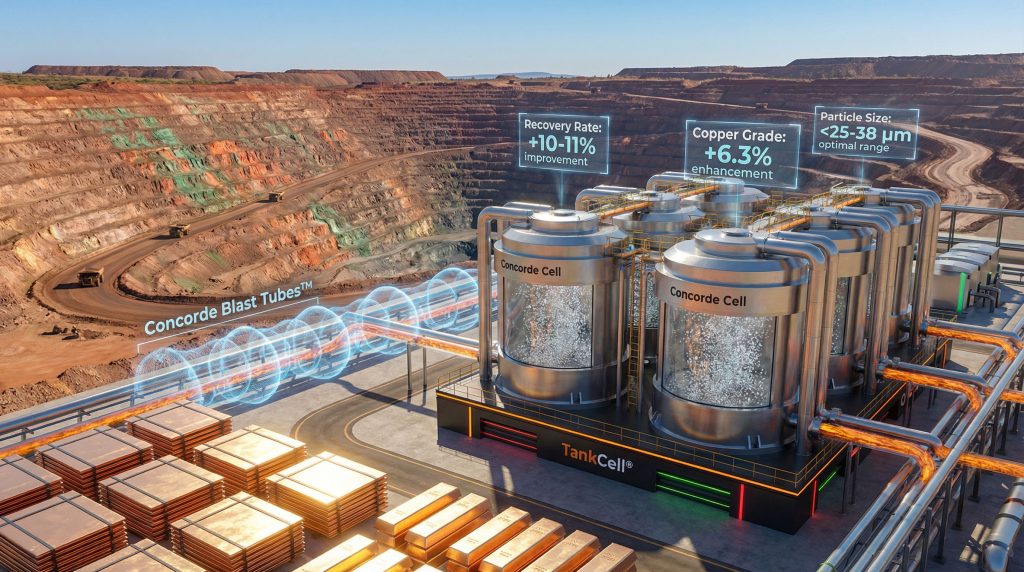
Concorde Cell technology in Lumwana copper project represents a paradigm shift in how mining operations approach fine particle recovery. This innovative flotation system utilises supersonic mechanisms to generate ultra-fine bubbles specifically engineered for particles below 20 microns, addressing longstanding challenges in mineral processing efficiency. The technology's integration with existing flotation circuits provides operators with enhanced recovery capabilities without requiring complete plant redesigns.
When big ASX news breaks, our subscribers know first
Engineering Mechanisms Behind Ultra-Fine Mineral Separation
The core innovation of Concorde Cell technology lies in its pneumatic flotation approach, which fundamentally differs from conventional mechanical flotation systems. Through specialised blast tube configurations, the technology generates supersonic shockwaves that create extremely fine bubble populations. These bubbles measure significantly smaller than traditional flotation bubbles, dramatically increasing the interfacial contact area available for particle-bubble interactions.
Conventional flotation cells typically produce bubbles in the 2-8 millimetre range, whilst pneumatic systems like Concorde Cell technology aim for sub-millimetre bubble sizes. This size reduction creates exponentially more surface area for particle attachment, particularly critical for ultra-fine particles that conventional methods cannot effectively capture. The forced-air injection mechanism eliminates the need for mechanical impellers, reducing energy consumption whilst improving flotation kinetics.
Performance metrics demonstrate substantial improvements across key operational parameters:
• Recovery enhancement: 10-11% increase for fine particle fractions below 25 micrometers
• Grade optimisation: Median copper grade improvements of 6.3% in concentrate streams
• Energy efficiency: Reduced power consumption per ton of metal recovered
• Residence time reduction: Shortened retention periods in flotation circuits
The technology's particle size targeting capabilities represent a significant advancement in flotation science. Traditional flotation cells experience decreased recovery efficiency as particle sizes approach 20 micrometers, creating a recovery dead zone where valuable minerals are lost to tailings. Concorde Cell technology in Lumwana copper project specifically addresses this gap through optimised bubble-particle collision dynamics and enhanced attachment probabilities.
Critical Challenges in Modern Copper Processing Operations
The global copper industry faces unprecedented challenges as ore grades continue declining across major mining districts. Average copper ore grades have decreased from approximately 2.5% in the 1930s to less than 0.6% in contemporary operations, forcing miners to process substantially larger volumes of material to maintain production levels. This trend intensifies the importance of maximising recovery from each ton of ore processed.
Finely disseminated ore bodies present particular processing difficulties because copper-bearing minerals are dispersed throughout the ore matrix in microscopic quantities. These deposits require sophisticated separation techniques to liberate valuable minerals without over-grinding, which can create additional ultra-fine particles that conventional flotation cannot effectively recover. Furthermore, data-driven mining operations are becoming essential for addressing these complex challenges.
Economic implications of fine particle losses are substantial:
• Lost copper in tailings typically represents 15-25% of total recoverable metal
• Fine particle losses translate to millions of dollars annually in larger operations
• Declining ore grades amplify the financial impact of recovery inefficiencies
• Environmental regulations increasingly demand higher recovery rates
Traditional flotation circuits create processing bottlenecks when handling ultra-fine particles because these particles remain suspended in flotation cells for extended periods without adequate recovery. This suspension increases water consumption, extends residence times, and reduces overall plant throughput capacity. The accumulated effect creates operational inefficiencies that compound across the entire processing circuit.
Modern environmental regulations add additional pressure for improved recovery efficiency. Tailings storage facilities face increasing scrutiny regarding copper content, pushing operators toward technologies that minimise metal losses. Water consumption restrictions in many mining regions further emphasise the need for flotation systems that operate efficiently with reduced water volumes.
Integration Strategies for Hybrid Flotation Systems
The integration of Concorde Cell technology with existing TankCell flotation systems creates a complementary processing approach where different technologies handle distinct particle size fractions. This hybrid configuration allows each technology to operate within its optimal performance window rather than attempting universal application across all particle sizes. Moreover, this approach aligns with broader mining industry innovation trends transforming mineral processing.
| Technology Component | Primary Function | Optimal Particle Size | Key Advantage |
|---|---|---|---|
| TankCell® | Bulk flotation | >38 micrometers | High throughput capacity |
| Concorde Cell | Fine particle capture | <25 micrometers | Superior fine particle recovery |
| Integrated System | Complete recovery | Full size spectrum | Maximised overall efficiency |
The flowsheet design for hybrid systems requires careful consideration of particle size distribution, feed characteristics, and operational parameters. Primary bulk flotation in TankCell units removes coarse and medium particles, whilst secondary fine particle flotation in Concorde Cell units captures the ultra-fine fraction that conventional cells cannot effectively process.
Water circuit optimisation represents a critical integration benefit:
• Reduced circulating loads through flotation circuits
• Lower overall water consumption per ton processed
• Improved water quality through enhanced particle capture
• Simplified tailings management with higher recovery rates
The modular nature of Concorde Cell installations allows for staged implementation, enabling operators to validate performance before full-scale deployment. Pre-installed component systems reduce on-site construction complexity and installation timeframes compared to conventional flotation cell fabrication. This modularity also provides expansion flexibility as mining operations evolve or ore characteristics change.
Process control integration enables real-time optimisation of feed distribution between TankCell and Concorde Cell units based on actual ore characteristics and particle size distribution. Advanced instrumentation monitors particle size, bubble characteristics, and recovery performance continuously, allowing automated adjustments that maintain optimal operating conditions across both flotation systems.
Technical Specifications and Performance Parameters
Concorde Cell technology in Lumwana copper project operates through pneumatic flotation mechanisms that generate supersonic conditions for ultra-fine bubble production. The system utilises specialised blast tubes that inject air at high velocity, creating shockwave effects that fragment air into extremely small bubbles. These bubbles interact with mineral particles through enhanced collision dynamics compared to conventional flotation approaches.
Key technical specifications include:
• Air injection system: Forced-air delivery through supersonic blast tubes
• Bubble size range: Sub-millimetre to optimise fine particle attachment
• Pressure requirements: Elevated air pressure for shockwave generation
• Modular configuration: Scalable capacity through multiple unit installation
Real-time monitoring capabilities provide operators with comprehensive process visibility through advanced instrumentation suites. Particle size analysis systems track feed characteristics and concentrate quality continuously, enabling immediate response to changing ore conditions. Bubble size distribution monitoring ensures optimal flotation conditions across varying operational parameters.
How Does Pneumatic Flotation Compare to Traditional Methods?
The pneumatic flotation approach eliminates mechanical agitation components, reducing maintenance requirements and energy consumption compared to conventional flotation cells. Without rotating impellers or mechanical drives, the system operates with fewer moving parts and simplified maintenance protocols. This reliability advantage becomes particularly valuable in remote mining locations where equipment downtime creates significant operational disruptions.
Process optimisation algorithms utilise real-time data to adjust air flow rates, feed distribution, and chemical reagent dosages automatically. These control systems respond to particle size variations, ore grade changes, and flotation kinetics in real-time, maintaining consistent performance across diverse operating conditions. The automated optimisation reduces operator intervention requirements whilst ensuring maximum recovery efficiency.
Application in Zambian Copperbelt Operations
The Zambian Copperbelt represents one of the world's most significant copper-producing regions, with geological characteristics that present both opportunities and challenges for advanced flotation technologies. Sulfide ore bodies in the region typically contain finely disseminated copper minerals that require sophisticated processing approaches for optimal recovery.
Lumwana mine operates as an open-pit operation utilising truck-and-shovel extraction methods approximately 100 kilometres west of Solwezi in Zambia's North-Western Province. The operation processes sulfide ore through conventional flotation circuits to produce copper concentrate for export to international markets. The mine's geological setting presents typical challenges associated with finely disseminated ore bodies that require enhanced fine particle recovery capabilities.
Regional copper industry characteristics include:
• Complex sulfide mineralogy requiring selective flotation approaches
• Declining ore grades consistent with global copper industry trends
• Infrastructure constraints affecting processing technology options
• Environmental regulations emphasising water conservation and waste minimisation
The integration of advanced flotation technology addresses specific challenges associated with Zambian copper operations. Water availability represents a critical constraint in many Copperbelt operations, making water-efficient processing technologies increasingly valuable. Improved recovery rates through advanced flotation reduce the volume of tailings requiring storage and management, addressing both environmental and operational concerns.
Zambian copper operations compete in global markets where operational efficiency directly impacts profitability. Enhanced recovery rates through Concorde Cell technology in Lumwana copper project extend mine life by extracting additional copper from existing reserves without requiring expanded mining areas. This efficiency improvement provides competitive advantages in international copper markets whilst maximising resource utilisation. Additionally, these developments often feature prominently at industry events such as the mining innovation expo, where professionals share technological advancements.
The next major ASX story will hit our subscribers first
Investment Analysis and Economic Implications
The economic rationale for advanced flotation technology adoption centres on improved metal recovery from existing mining operations without requiring additional ore reserves. This approach provides capital-efficient production expansion that generates positive returns through enhanced efficiency rather than increased mining capacity. Furthermore, successful implementations align with broader mineral exploration insights that emphasise value maximisation from existing resources.
Capital expenditure considerations for Concorde Cell technology integration include equipment costs, installation expenses, and operational modifications. The €70 million equipment package represents substantial investment that requires careful financial analysis to validate return projections. However, the modular installation approach allows staged implementation that spreads capital requirements across multiple phases.
Economic benefits include:
• Production capacity expansion: Increased copper recovery without additional mining
• Operating cost reduction: Lower processing costs per pound of copper produced
• Mine life extension: Enhanced recovery extends economic reserves
• Capital efficiency: Improved returns on existing infrastructure investment
The technology's proven performance in industrial applications provides risk mitigation compared to unproven technologies. Multiple installations across different ore types and operating conditions demonstrate consistent performance improvements, reducing implementation risks for new adopters. This track record enables more confident financial projections and investment decisions.
Operational expenditure optimisation emerges from improved energy efficiency, reduced maintenance requirements, and enhanced water management. The pneumatic flotation approach typically requires less energy per ton of material processed compared to mechanical flotation systems, reducing ongoing operational costs. Simplified maintenance protocols further contribute to operational cost reductions over the equipment's operating life.
Industrial Performance Validation and Test Results
Comprehensive industrial testing validates Concorde Cell technology performance across diverse operating conditions and ore types. Copper cleaner circuit retrofit applications demonstrate significant improvements compared to conventional mechanical flotation cells, providing quantifiable performance data for investment analysis.
Validated performance improvements include:
• Overall recovery gains: Greater than 1% improvement in total copper recovery
• Concentrate grade enhancement: Approximately 2% increase in final concentrate quality
• Fine particle recovery: Superior performance compared to conventional flotation methods
• Energy efficiency: Reduced power requirements per unit of copper production
Comparative testing against alternative pneumatic technologies demonstrates Concorde Cell's performance advantages through side-by-side trials under identical operating conditions. Column flotation performance benchmarking shows enhanced selectivity and improved kinetics through the supersonic processing approach, validating the technology's competitive positioning.
The technology's selectivity improvements enable operators to achieve higher concentrate grades whilst maintaining recovery rates, creating additional economic value through premium pricing for high-quality concentrates. This selectivity advantage becomes particularly valuable as copper smelters increasingly demand higher-grade feed materials.
Industrial test programmes across multiple sites provide performance validation under varying geological and operational conditions. These trials demonstrate consistent improvements across different ore types, confirming the technology's broad applicability within the copper processing industry. The accumulated test data supports confident performance projections for new installations.
Future Technological Evolution and Industry Adoption
The advancement of flotation technology continues evolving toward increasingly sophisticated particle recovery mechanisms and automated control systems. Concorde Cell technology represents current-generation pneumatic flotation capabilities, whilst future developments may incorporate artificial intelligence optimisation, predictive maintenance capabilities, and enhanced environmental performance. Consequently, integration with renewable energy mining solutions becomes increasingly important for sustainable operations.
Industry adoption trends indicate growing interest in advanced flotation technologies across copper, gold, and nickel operations globally. Technology scaling enables applications across different operation sizes, from large-scale industrial operations to smaller specialised facilities. The proven performance record facilitates broader adoption as operators seek competitive advantages through improved processing efficiency.
Technological development pathways include:
• Next-generation flotation cell designs with enhanced recovery capabilities
• Artificial intelligence integration for predictive process optimisation
• Advanced materials engineering for improved equipment durability
• Environmental impact reduction through enhanced efficiency
What Challenges Remain for Widespread Implementation?
Integration with existing plant infrastructure remains a critical consideration for technology adoption. The modular design approach pioneered by Concorde Cell technology enables retrofit applications that minimise operational disruptions during installation. This integration capability accelerates adoption timelines and reduces implementation costs compared to complete plant redesigns.
The learning curve associated with new flotation technologies continues improving as operators gain experience with advanced pneumatic systems. Operational knowledge transfer between installations accelerates technology optimisation and reduces commissioning timeframes for subsequent projects. This accumulated expertise enhances the value proposition for advanced flotation technology adoption across the mining industry.
Disclaimer: This analysis is based on available technical information and industry data. Actual performance results may vary depending on specific ore characteristics, operating conditions, and implementation approaches. Investment decisions should consider comprehensive technical and economic evaluations specific to individual operations.
Ready to Capitalise on the Next Major Copper Discovery?
Discovery Alert's proprietary Discovery IQ model delivers instant notifications on significant ASX mineral discoveries, including breakthrough copper processing technologies and mining innovations that drive exceptional market returns. Explore historic examples of transformative mining discoveries and begin your 30-day free trial today to position yourself ahead of the market with real-time actionable insights.