June 7, 2026
Global fluorite markets are experiencing unprecedented transformation as supply chain vulnerabilities expose critical infrastructure dependencies across allied economies. The semiconductor revolution, electric vehicle expansion, and nuclear technology advancement have created insatiable demand for acid-grade fluorspar, yet production remains concentrated in geopolitically unstable regions. This convergence of technological necessity and supply chain fragility has triggered a strategic repositioning of mineral extraction capabilities, where initiatives like the Tivan Speewah fluorite project US-Japan backing represent fundamental shifts in how nations approach resource security in the 21st century.
Strategic Resource Positioning Reshapes Global Fluorite Dynamics
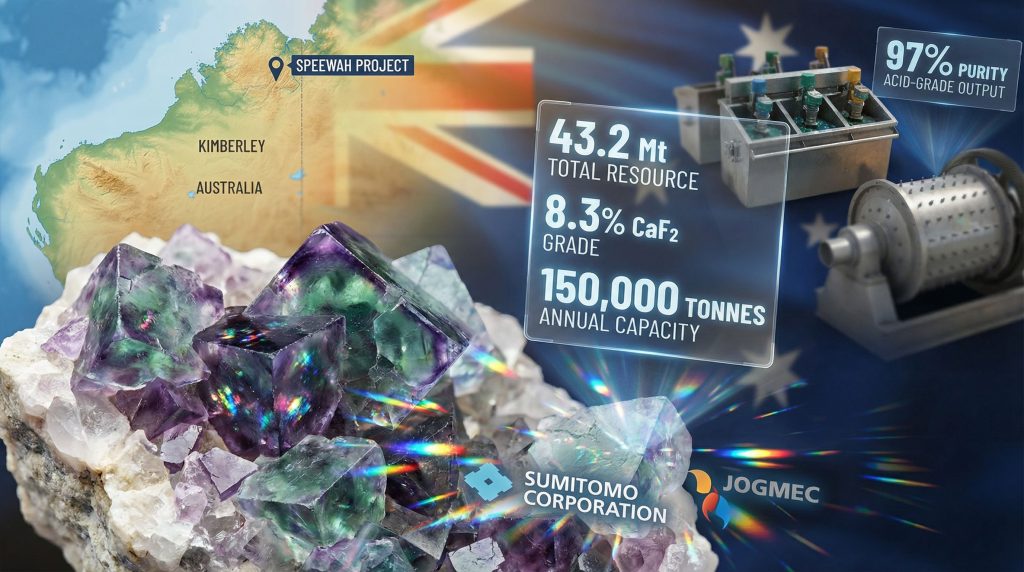
Fluorite's emergence as a cornerstone material for advanced manufacturing has elevated the Speewah project beyond conventional mining development into the realm of national security infrastructure. The resource hosts 43.2 million tonnes at an average grade of 8.3% CaF₂, with a premium core zone containing 9.6 million tonnes at an exceptional 20.6% CaF₂. This geological endowment positions the project among the world's top-tier fluorite deposits, offering strategic advantages that extend far beyond commercial metrics.
Understanding Fluorite's Critical Role in Modern Technology
Acid-grade fluorspar represents the highest purity classification of processed fluorite, requiring 97% CaF₂ content for commercial applications. This ultra-refined material serves as the primary feedstock for hydrofluoric acid production, enabling semiconductor fabrication at increasingly sophisticated node sizes. Furthermore, the precision etching processes that create modern microprocessors rely on hydrofluoric acid's unique chemical properties, making fluorite an irreplaceable component in global technology manufacturing.
The material's strategic importance extends across multiple sectors:
• Semiconductor Manufacturing: Critical for silicon wafer processing and photolithography
• Electric Vehicle Batteries: Essential for electrolyte formulations and thermal management
• Nuclear Technology: Required for uranium hexafluoride production in fuel enrichment
• Industrial Chemicals: Fundamental for refrigerants, pesticides, and pharmaceutical compounds
Western Australia's Geological Advantages
The Kimberley region's geological characteristics provide optimal conditions for large-scale fluorite extraction and processing. The deposit's two-tier structure allows for selective mining strategies that can optimise ore quality during extraction phases. In addition, the substantial high-grade core enables initial production focusing on premium material while maintaining long-term access to the broader resource envelope.
Infrastructure proximity to established mining corridors reduces capital requirements for project development. However, the region's established regulatory framework and skilled workforce provide additional advantages for rapid project advancement, particularly crucial given the strategic urgency surrounding supply chain security.
Geopolitical Context Driving Investment Priorities
The strategic classification of fluorite as a critical minerals strategy reflects fundamental shifts in global trade relationships and supply chain architecture. Historical dependence on single-source suppliers has created systemic vulnerabilities that threaten advanced manufacturing capabilities across allied economies. Consequently, projects focusing on energy transition minerals address these concerns through diversified supply chain development within trusted jurisdictional frameworks.
This strategic repositioning aligns with broader efforts to establish resilient supply networks capable of supporting technological advancement without compromising national security interests. The project's western-aligned positioning offers particular value given its proximity to major Asian industrial markets while maintaining operational control within allied territorial boundaries.
When big ASX news breaks, our subscribers know first
International Partnership Framework Accelerates Development Timeline
The US-Japan critical minerals reserve framework established in October 2025 represents a paradigm shift in resource development cooperation, moving beyond traditional commercial arrangements to encompass coordinated strategic planning. The framework's implementation through grant mechanisms, preferential lending arrangements, and guaranteed offtake agreements creates unprecedented development acceleration opportunities for qualifying projects.
Framework Architecture and Implementation Mechanisms
The bilateral agreement establishes multiple support pathways designed to reduce project development risks while ensuring supply security for participating nations. Moreover, the recent executive order on minerals has reinforced these cooperative mechanisms. These mechanisms include:
• Direct Grant Funding: Non-dilutive capital for feasibility studies and infrastructure development
• Concessional Lending: Below-market financing rates for major capital expenditures
• Offtake Guarantees: Long-term purchase agreements providing revenue certainty
• Regulatory Streamlining: Coordinated approval processes across multiple jurisdictions
Sumitomo Corporation's Strategic Investment Logic
Sumitomo Corporation's involvement reflects sophisticated supply chain integration planning extending beyond simple commodity trading relationships. The company's participation indicates confidence in both project fundamentals and long-term demand security across Japanese industrial sectors. Furthermore, this partnership structure combines commercial expertise with strategic resource planning, optimising development efficiency while ensuring market access.
The corporation's established relationships across Japanese manufacturing sectors provide direct pathways from mine production to end-use applications. This vertical integration reduces market development risks while ensuring product specifications align with customer requirements from project inception.
JOGMEC's Supply Chain Security Mission
The Japan Organisation for Metals and Energy Security operates as a strategic investment vehicle designed to secure critical material supplies for Japanese industrial infrastructure. JOGMEC's participation signals government-level prioritisation of fluorite supply security, elevating the Speewah project beyond commercial development into strategic resource planning.
This institutional involvement provides access to patient capital structures that enable optimal development timelines rather than market-driven acceleration. For instance, the organisation's mandate encompasses long-term supply security rather than short-term returns, aligning perfectly with the extended development cycles typical of major mining projects.
Technical Specifications Define World-Class Resource Quality
The Speewah resource demonstrates exceptional characteristics that position it favourably against global fluorite deposits. Resource delineation reveals a sophisticated geological structure supporting multiple development scenarios and production optimisation strategies.
Resource Classification and Grade Distribution
| Resource Category | Tonnage (Mt) | CaF₂ Grade (%) | Classification Status |
|---|---|---|---|
| Total Resource | 43.2 | 8.3 | Globally Significant |
| High-Grade Core | 9.6 | 20.6 | Premium Tier |
| Processing Target | 97% purity | Commercial Grade | Export Quality |
| Annual Capacity | 150,000 tonnes | Acid-Grade Output | Strategic Scale |
The resource classification demonstrates substantial flexibility for production planning and market optimisation. The high-grade core provides immediate access to premium material while the broader resource envelope ensures long-term production sustainability across multiple decades.
Processing Technology and Production Capabilities
Achieving 97% CaF₂ purity requires sophisticated beneficiation processes combining multiple separation technologies. The processing flowsheet must address complex mineralogy while maintaining high recovery rates across the grade spectrum. Advanced flotation circuits, gravity separation, and magnetic separation technologies enable selective concentration of fluorite minerals while rejecting gangue materials.
Production specifications target 150,000 tonnes per annum of acid-grade fluorspar, representing substantial market presence for a new entrant. This scale enables significant market share capture while maintaining production flexibility across different grade specifications and customer requirements.
Infrastructure Advantages in Regional Context
The Kimberley region offers established infrastructure corridors supporting large-scale mineral extraction and export operations. Existing port facilities, transportation networks, and service industries reduce project development complexity while accelerating construction timelines. Additionally, regional workforce availability and established regulatory processes provide further advantages for project execution.
Power supply availability through regional grid connections or standalone generation options ensures reliable operations for energy-intensive processing requirements. Water supply access through surface sources or groundwater development supports processing needs while meeting environmental management requirements.
Industrial Applications Drive Sustained Demand Growth
The convergence of multiple technological revolutions has created unprecedented demand for high-purity fluorite across diverse industrial sectors. Each application represents substantial growth potential as technological advancement accelerates across global markets.
Semiconductor Manufacturing Integration
The semiconductor industry's continued miniaturisation requires increasingly pure chemical inputs to maintain yield rates and device reliability. Hydrofluoric acid derived from acid-grade fluorspar enables the precision etching processes essential for advanced node manufacturing. As semiconductor production scales to meet artificial intelligence and IoT device demand, fluorite consumption increases proportionally.
Advanced packaging technologies and three-dimensional chip architectures create additional fluorite demand through expanded processing requirements. The industry's shift toward more sophisticated manufacturing processes increases consumption per unit output, amplifying total demand growth beyond simple volume expansion.
Electric Vehicle Battery Technology Requirements
Electric vehicle battery production relies on fluorite-derived compounds for multiple applications within cell chemistry and thermal management systems. Electrolyte formulations increasingly incorporate fluorinated compounds to enhance performance characteristics including energy density, charging rates, and operational temperature ranges.
Battery manufacturing scale-up across global markets creates substantial fluorite demand growth as production volumes increase exponentially. Each gigafactory represents significant fluorite consumption for ongoing operations, with capacity expansion creating sustained demand increases.
Renewable Energy Infrastructure Dependencies
Solar panel manufacturing processes utilise hydrofluoric acid for silicon purification and surface texturing applications. Wind turbine component production requires fluorite-derived materials for specialised coatings and chemical processes. As renewable energy deployment accelerates globally, these applications create additional demand vectors for acid-grade fluorspar.
Energy storage system manufacturing incorporates fluorite-derived materials across multiple components including battery cells, thermal management systems, and electronic control units. The integration of storage systems with renewable generation creates compounding demand effects as deployment scales increase.
Government Support Mechanisms Enhance Project Viability
Strategic project designation within the US-Japan framework provides access to support mechanisms typically unavailable through conventional development pathways. These instruments reduce project risks while accelerating development timelines through coordinated government assistance.
Major Project Status Benefits and Implications
Recognition within the bilateral framework signals priority treatment across multiple government agencies and regulatory bodies. This designation typically enables:
• Streamlined Permitting: Coordinated approval processes reducing regulatory delays
• Infrastructure Support: Government assistance for transportation and utility development
• Trade Facilitation: Preferential treatment for export licensing and logistics
• Investment Incentives: Tax advantages and depreciation allowances for capital expenditure
International Partnership Program Integration
The framework creates formal cooperation mechanisms between Australian, US, and Japanese government agencies supporting coordinated project development. This trilateral coordination reduces regulatory uncertainty while ensuring alignment with each nation's strategic resource objectives.
Cross-border cooperation enables technical expertise sharing and best practices transfer across participating agencies. The framework facilitates knowledge exchange between mining regulators, trade promotion agencies, and strategic planning organisations from each participating country.
Strategic Alignment with Resource Security Objectives
Government support reflects broader policy objectives encompassing supply chain resilience, technological sovereignty, and economic security considerations. The project's alignment with these strategic goals ensures sustained political support across multiple election cycles and changing administrative priorities.
The framework emphasises creating western-aligned sources of critical materials to reduce dependence on potentially unstable supply regions while maintaining competitive market dynamics.
Investment Milestones Chart Path to Commercial Production
Project development follows a disciplined milestone-based approach designed to minimise risks while optimising capital efficiency. Each development phase incorporates specific deliverables and decision points ensuring systematic progress toward commercial operations.
ETFS Capital Equity Investment Structure
The equity investment arrangement with ETFS Capital provides essential development funding while maintaining operational control within the joint venture structure. This financing approach balances capital access with strategic partnership benefits, enabling accelerated development without compromising long-term project control.
Investment terms reflect sophisticated risk-sharing arrangements that align investor returns with project success while providing management flexibility for operational decisions. The structure enables additional capital raising for construction phases while maintaining core partnership relationships.
Feasibility Study Timeline and Key Deliverables
Comprehensive feasibility studies are advancing across multiple technical disciplines including:
• Resource Modelling: Detailed orebody characterisation and reserve definition
• Process Engineering: Flowsheet optimisation and equipment selection
• Infrastructure Design: Transportation, power, and water supply systems
• Environmental Assessment: Impact studies and management plan development
• Market Analysis: Customer qualification and offtake agreement negotiation
Study completion targets align with 2026 Final Investment Decision timing, enabling construction commencement and 2028 financial year production startup. This timeline reflects aggressive but achievable development scheduling given project fundamentals and support mechanisms.
Final Investment Decision Framework for 2026
The FID process incorporates multiple approval layers including joint venture partner consent, government regulatory clearance, and financing arrangement finalisation. Decision criteria encompass technical feasibility confirmation, market security through offtake arrangements, and capital cost certainty through engineering completion.
Risk mitigation measures implemented prior to FID include:
• Customer Qualification: Direct engagement with end-use manufacturers
• Technology Validation: Pilot plant testing and process optimisation
• Regulatory Approval: Environmental and mining permit obtainment
• Financial Closure: Complete funding arrangements for construction phase
The next major ASX story will hit our subscribers first
Supply Chain Vulnerability Analysis Reveals Strategic Importance
Current global fluorite supply chains demonstrate critical vulnerabilities that threaten advanced manufacturing capabilities across allied economies. The concentration of production capabilities in geopolitically unstable regions creates systemic risks requiring strategic intervention through diversified supply development.
US Import Dependency and Market Dynamics
The United States maintains 100% import dependency for acid-grade fluorspar, creating complete reliance on foreign suppliers for critical industrial processes. This dependency encompasses both commercial supply chains and strategic reserve capabilities, representing a fundamental national security vulnerability.
Current import sources lack diversity and reliability assurance, particularly during geopolitical tensions or trade disputes. The absence of domestic production capabilities eliminates supply security options during crisis periods, potentially compromising critical manufacturing sectors including defence, aerospace, and advanced electronics.
Japan's Industrial Base Protection Strategy
Japanese industrial policy prioritises supply chain diversification to protect core manufacturing capabilities from external disruption. The fluorite supply security initiative reflects broader resource diplomacy efforts designed to establish reliable supplier relationships within allied economic frameworks.
JOGMEC's strategic investment approach encompasses long-term supply agreements that provide Japanese manufacturers with assured access to critical materials regardless of global market conditions. This approach reduces vulnerability to supply manipulation while ensuring competitive pricing through diversified sourcing arrangements.
Allied Nations' Resource Security Coordination
The trilateral cooperation framework establishes precedents for coordinated resource development across allied economies. This approach combines individual national interests with collective security benefits, creating mutually reinforcing supply chains that enhance overall resilience.
Coordination mechanisms include:
• Joint Investment: Shared funding for strategic resource development
• Technology Transfer: Best practices sharing across participating nations
• Trade Facilitation: Reduced barriers for critical mineral commerce
• Emergency Cooperation: Crisis response protocols for supply disruptions
Production Scenarios Could Transform Global Market Dynamics
The Speewah project's 150,000 tonnes annual capacity represents substantial market presence capable of influencing global pricing dynamics and supply chain configurations. This production scale enables significant market share capture while providing foundation for additional capacity expansion based on demand growth.
Market Impact Assessment of Production Scale
Annual production targets position Speewah as a major global supplier capable of serving multiple regional markets simultaneously. The scale enables direct customer relationships with major industrial consumers while maintaining flexibility for spot market participation during favourable pricing periods.
Production timing coincides with anticipated demand growth across key sectors including semiconductor expansion, electric vehicle scaling, and renewable energy deployment. This alignment provides optimal market entry conditions while establishing long-term customer relationships during capacity expansion phases.
Regional Supply Chain Reconfiguration Possibilities
Western-aligned production capacity enables fundamental restructuring of Asian Pacific supply chains toward more resilient configurations. Japanese and South Korean manufacturers could reduce dependence on traditional suppliers while maintaining competitive cost structures through regional sourcing arrangements.
Australian production provides geographic diversification benefits that enhance supply security while reducing transportation costs for Asian Pacific customers. This positioning offers particular advantages during global logistics disruptions or shipping capacity constraints that periodically affect international commodity markets.
How Will Long-Term Demand Growth Through 2035 Impact Market Dynamics?
Multiple technological trends converge to create sustained demand growth extending well beyond initial production capacity. Electric vehicle adoption alone represents exponential growth potential as global automotive markets transition toward electrification. Semiconductor demand continues expanding through artificial intelligence, IoT deployment, and advanced computing applications.
Projected demand drivers include:
• EV Battery Scale-Up: Gigafactory deployment across global markets
• Semiconductor Advancement: Smaller node sizes requiring higher purity inputs
• Renewable Energy Storage: Grid-scale battery deployment for intermittent sources
• Nuclear Technology: Small modular reactor development increasing fuel demand
According to analysis from ListCorp, Speewah's inclusion in the Japan-US joint fact sheet highlights the project's strategic importance within broader critical minerals cooperation initiatives. Moreover, technical progress at the Speewah project demonstrates advancing capabilities that support these ambitious production targets.
Australian Critical Minerals Strategy Benefits from Success Template
The Tivan Speewah fluorite project US-Japan backing establishes replicable frameworks for future critical mineral partnerships combining commercial viability with strategic resource security objectives. This template enables systematic development of additional projects addressing other critical material dependencies.
Sovereign Capability Development Beyond Mining
Project success demonstrates Australia's capacity to develop complete value chains extending from resource extraction through processed product delivery to end-use manufacturers. This capability encompasses technical expertise, regulatory frameworks, and international partnership management across complex trilateral arrangements.
The development of domestic processing capabilities reduces dependence on foreign value-adding while capturing additional economic benefits within Australian operations. This approach creates skilled employment opportunities while building technical expertise applicable to other critical mineral development projects.
Technology Transfer and Local Value-Add Opportunities
International partnerships facilitate technology transfer arrangements that enhance Australian capabilities across multiple technical disciplines. Japanese expertise in precision manufacturing and quality control systems complements Australian mining capabilities to create world-class production operations.
Local workforce development through international training programs builds expertise applicable across the broader critical minerals sector. This capability development creates foundation for additional project development while establishing Australia as a preferred partner for future resource security initiatives.
Template for Future Allied Resource Partnerships
The trilateral cooperation structure provides proven mechanisms for coordinated resource development addressing multiple critical materials simultaneously. Success demonstrates the viability of sustained cooperation across different political administrations and changing economic conditions.
Replicable framework elements include:
• Integrated Financing: Combined government and private sector investment
• Coordinated Regulation: Streamlined approval processes across multiple jurisdictions
• Market Development: Direct customer engagement and offtake arrangements
• Risk Sharing: Distributed project risks across multiple stakeholders
Development Challenges Require Systematic Risk Management
Large-scale project development involves multiple risk categories requiring comprehensive mitigation strategies. Systematic risk assessment and management protocols ensure project resilience across various disruption scenarios while maintaining development timeline integrity.
Technical Risk Assessment and Mitigation Strategies
Processing complex fluorite ores to achieve 97% purity specifications requires sophisticated beneficiation technologies that must perform consistently across varying ore characteristics. Technical risks encompass equipment reliability, process optimisation, and product quality maintenance throughout operational phases.
The evolution of mining innovation trends has provided proven solutions for complex processing challenges. Mitigation approaches include:
• Pilot Plant Testing: Comprehensive process validation using representative ore samples
• Technology Redundancy: Multiple processing pathways ensuring production continuity
• Quality Systems: Advanced monitoring and control systems maintaining specifications
• Maintenance Planning: Preventive maintenance programs minimising operational disruptions
Market Price Volatility Considerations
Fluorite markets historically demonstrate price volatility reflecting supply-demand imbalances and geopolitical disruptions affecting major producing regions. Long-term projects must incorporate price risk management strategies that ensure financial viability across various market scenarios.
Offtake agreement structures provide price stability through long-term contracts while maintaining exposure to favourable market conditions during price appreciation periods. This approach balances revenue predictability with upside participation as market conditions evolve.
Environmental and Social License Requirements
Operating in the Kimberley region requires comprehensive environmental management addressing unique ecological characteristics while respecting Indigenous cultural values and land rights. Social license maintenance requires ongoing community engagement and shared benefit arrangements.
Environmental monitoring programs ensure operational compliance while demonstrating stewardship of regional ecological resources. Cultural heritage protection protocols maintain respectful relationships with Traditional Owners while enabling responsible resource development.
Commercial Operations Timeline Drives Market Entry Strategy
Production scheduling reflects systematic development progression from current feasibility studies through construction completion and operational ramp-up. Timeline optimisation balances development speed with quality assurance across all project phases.
Development Phase Timeline and Critical Path Analysis
2026 Milestones:
• Q2: Feasibility study completion and regulatory approval obtainment
• Q3: Final Investment Decision and construction financing closure
• Q4: Construction commencement and long-lead equipment procurement
2027 Activities:
• Infrastructure development including power, water, and transportation systems
• Processing plant construction and equipment installation
• Workforce recruitment and training program implementation
• Environmental management system deployment
2028 Production Startup:
• Commissioning phase completion and production optimisation
• Product qualification with major customers
• Full-scale operation achievement targeting 150,000 tonnes annually
Production Ramp-Up Strategy for Target Markets
Initial production focuses on premium-grade material serving established customer relationships while building operational expertise and market presence. Progressive capacity utilisation enables optimisation of both technical operations and customer service capabilities.
Market development prioritises long-term strategic relationships with major industrial consumers while maintaining flexibility for spot sales during favourable market conditions. This approach builds sustainable revenue streams while maximising market value capture.
Long-Term Expansion Potential Beyond Initial Capacity
The substantial resource base supports multiple expansion scenarios based on market development and demand growth across target sectors. Additional processing capacity could increase annual production significantly while serving broader geographical markets including North American and European customers.
Expansion planning incorporates modular development approaches that enable incremental capacity additions based on market demand without compromising initial operation efficiency. This flexibility ensures optimal capital allocation while maintaining growth optionality as the Tivan Speewah fluorite project US-Japan backing continues to demonstrate strategic value.
Disclaimer: This analysis contains forward-looking statements and projections based on current market conditions and development plans. Actual results may differ materially due to technical, regulatory, market, or other factors beyond current expectations. Investment decisions should consider comprehensive due diligence and professional advice appropriate to individual circumstances.
Ready to Capitalise on Critical Mineral Opportunities?
Discovery Alert's proprietary Discovery IQ model delivers instant notifications on significant ASX mineral discoveries, including strategic projects like fluorite developments that could reshape global supply chains. Explore how major discoveries have generated exceptional returns for early investors by visiting Discovery Alert's dedicated discoveries page, then begin your 14-day free trial today to position yourself ahead of the market in this rapidly evolving critical minerals sector.