June 11, 2026
When Heavy-Duty Capability Meets Industrial Demand: The Pickup Truck Segment's Next Frontier
Southeast Asia's commercial vehicle landscape has spent decades being shaped by two dominant forces: the relentless growth of extractive industries and the infrastructure boom connecting regional economies. Pickup trucks have long occupied a unique position within this landscape, serving simultaneously as lifestyle vehicles for urban consumers and critical workhorses for remote operations. But the boundaries between these roles are shifting. As mining, construction, and agribusiness expand deeper into challenging terrain across the ASEAN bloc, demand is crystallising around a new category of vehicle altogether: one that goes far beyond the capabilities of conventional dual-cab utes. The Ford Ranger Super Duty launch in Thailand represents precisely this inflection point, introducing commercial-grade specifications into a segment that has historically been dominated by lifestyle-oriented models.
When big ASX news breaks, our subscribers know first
What Makes the Ranger Super Duty a Different Animal Entirely
Understanding the Ranger Super Duty requires stepping away from the conventional pickup truck conversation. Standard mid-size pickups sold across Thailand, from the Toyota Hilux Revo to the Isuzu D-Max, have been engineered to balance everyday usability with moderate commercial capability. Their towing ratings typically fall in the 2,500 kg to 3,500 kg range, and their GVM figures rarely exceed 3,500 kg. These are genuinely useful vehicles, but they occupy a different operational tier from what mining operations, large-scale construction sites, and intensive agricultural enterprises actually need.
The Ranger Super Duty is built to a fundamentally different specification brief. Rather than splitting the difference between lifestyle and light commercial, it has been engineered specifically for heavy-duty applications, with engineering decisions that reflect the operational realities of Thailand's industrial sectors and the broader Southeast Asian resource economy.
Key distinctions from the standard Ranger include:
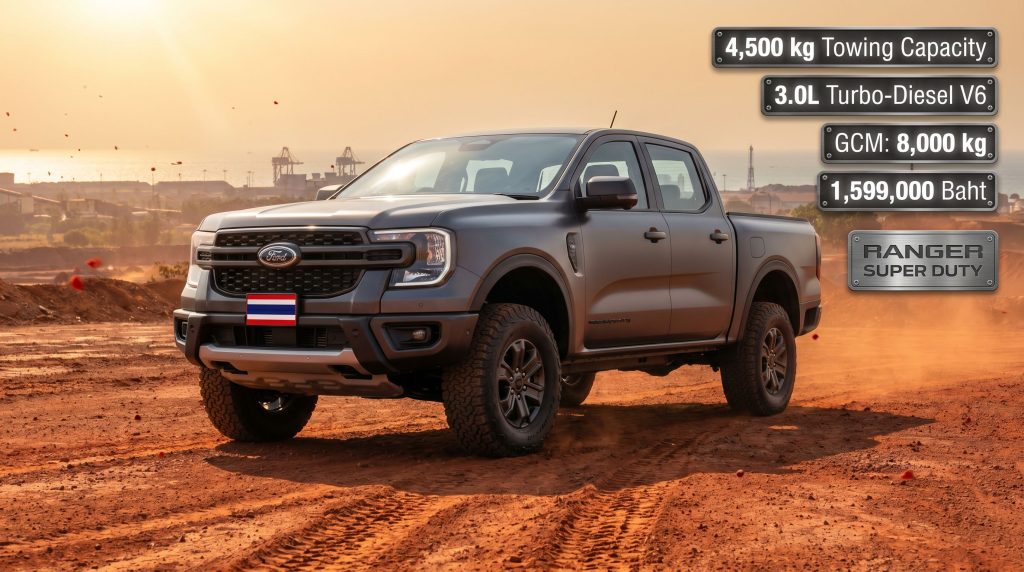
- A 3.0-litre turbo-diesel V6 engine, stepping beyond the four-cylinder architecture found across virtually all competing mid-size pickups in the region
- A 4,500 kg towing capacity, representing a step-change increase above the segment average
- A 4,500 kg Gross Vehicle Mass (GVM) rating, reflecting substantially reinforced chassis and suspension architecture
- An 8,000 kg Gross Combination Mass (GCM) figure that accounts for the combined weight of the vehicle and trailer under load
- A singular cab and body configuration targeted specifically at commercial and industrial operators rather than lifestyle buyers
Ford Ranger Super Duty Thailand Specs: The Numbers That Define the Vehicle
Engine and Powertrain Architecture
The powertrain choice at the heart of the Ranger Super Duty is itself a significant statement. The 3.0-litre turbo-diesel V6 is a departure from the four-cylinder diesel engines that dominate virtually every competitor in the Thai pickup market. The V6 configuration provides inherently smoother power delivery, improved thermal management under sustained load, and a torque output profile better suited to extended towing operations in demanding environments.
For commercial operators running vehicles under maximum load across extended duty cycles, the thermal stability of a V6 architecture matters considerably more than fuel economy or compact packaging. This is a powertrain specification that speaks directly to operators who push vehicles to their limits consistently, rather than intermittently.
Towing, Payload, and Mass Ratings at a Glance
The headline capability figures position the Ranger Super Duty in a class of its own within the Thai pickup segment:
| Specification | Ford Ranger Super Duty (Thailand) | Typical Mid-Size Pickup (Thailand) |
|---|---|---|
| Engine Configuration | 3.0L Turbo-Diesel V6 | 2.4–2.8L Turbo-Diesel I4 |
| Towing Capacity | 4,500 kg | 2,500–3,500 kg |
| Gross Vehicle Mass (GVM) | 4,500 kg | 3,000–3,500 kg |
| Gross Combination Mass (GCM) | 8,000 kg | 5,500–6,500 kg |
| Primary Market | Commercial / Industrial | Lifestyle / Light Commercial |
The gap between 3,500 kg and 4,500 kg in towing capacity is not merely numerical. It represents a qualitative difference in what types of trailers, equipment, and loads can be safely moved, fundamentally changing the operational utility of the vehicle in mining and construction contexts.
Competitive Positioning Against Regional Rivals
When positioned against the top-specification variants of Thailand's two best-selling pickups, the Super Duty's commercial credentials become immediately apparent:
| Feature | Ford Ranger Super Duty | Toyota Hilux Revo (Top Spec) | Isuzu D-Max (Top Spec) |
|---|---|---|---|
| Towing Capacity | 4,500 kg | ~3,500 kg | ~3,500 kg |
| Engine Displacement | 3.0L V6 Turbo-Diesel | 2.8L I4 Turbo-Diesel | 3.0L I4 Turbo-Diesel |
| GVM | 4,500 kg | ~3,100 kg | ~3,200 kg |
| Market Positioning | Heavy Commercial | Lifestyle + Light Commercial | Light to Medium Commercial |
| Price Range (THB) | ~1,599,000 | ~1,000,000–1,300,000 | ~900,000–1,200,000 |
The Super Duty commands a significant price premium over its competitors, but this reflects a different value proposition entirely. Where the Hilux Revo and D-Max compete on breadth of appeal, the Ranger Super Duty competes on depth of capability for a specific, underserved commercial buyer. You can explore Ford's full Thai truck range directly to compare variants and configurations available in market.
Manufacturing Base: Auto Alliance Thailand and the Rayong Advantage
Why Rayong and the Eastern Seaboard Matter
The Ford Ranger Super Duty is manufactured at the Auto Alliance Thailand (AAT) facility in Rayong, located within Thailand's Eastern Seaboard industrial corridor. This is not an arbitrary location choice. Rayong sits at the heart of Thailand's most concentrated automotive manufacturing zone, adjacent to the Laem Chabang deep-water port, which serves as one of Asia's highest-throughput container terminals. The proximity of AAT to export logistics infrastructure gives Ford a material advantage in distributing vehicles across the ASEAN region efficiently.
Thailand has developed one of Southeast Asia's most sophisticated automotive supply chains over several decades of investment from global OEMs. This depth of local supplier development, combined with a skilled technical workforce, means that producing a complex heavy-duty variant like the Ranger Super Duty in Rayong carries fewer production risk factors than attempting the same in a less established manufacturing location.
RMA Group and the Industrial Customisation Ecosystem
One of the more strategically significant aspects of the Ranger Super Duty's Thai manufacturing context involves the broader customisation ecosystem operating in the same industrial zone. According to Mining Magazine, RMA Group operates a 90,000 square metre factory inside the Laem Chabang Export Industrial Estate, situated close to one of Asia's most active container ports on Thailand's eastern seaboard. RMA's specialisation in adapting and customising light vehicles for mining and resource sector applications globally means that the Ranger Super Duty enters a market where the infrastructure for converting stock vehicles into site-ready units is already well established.
This customisation layer is critically important for understanding why Thailand is not just a launch market but a genuine operational hub. Mining companies operating across Southeast Asia, Africa, and other resource regions frequently source vehicles in Thailand, customise them for site conditions, and export them as ready-to-deploy assets. The Ranger Super Duty's commercial-grade baseline specifications make it a natural candidate for this workflow.
Pricing, Market Entry, and the 1,599,000 Baht Equation
Decoding the Price Point
The Ford Ranger Super Duty Thailand price of 1,599,000 Thai Baht places it in a category that separates it decisively from mainstream pickup truck buyers. At this price level, the vehicle is not competing for the household or lifestyle segment. Its buyer profile is almost entirely commercial: fleet operators, mining companies, construction firms, and industrial enterprises for whom the vehicle's towing and payload capabilities represent operational value that justifies a premium over standard pickup alternatives.
The premium over top-specification variants of the Hilux Revo and D-Max is substantial, ranging from roughly 300,000 to 700,000 Baht depending on the comparison model. However, for commercial buyers, the relevant comparison is not other pickups but rather alternative solutions for achieving similar towing and payload performance, such as light or medium-duty trucks. Against those alternatives, the Ranger Super Duty potentially offers cost, versatility, and operational advantages that narrow the premium considerably.
Target Buyer Profile
The commercial buyers most likely to evaluate the Ranger Super Duty at this price point typically share several characteristics:
- They operate in industries where vehicle downtime creates measurable production losses
- They require towing and payload capabilities that standard pickups cannot safely deliver
- They value the multipurpose nature of a pickup over a dedicated truck platform
- They operate across mixed terrain, requiring four-wheel drive capability alongside commercial load ratings
- They have access to fleet procurement budgets rather than individual consumer financing
The Bangkok International Motor Show Debut
The 2026 Bangkok International Motor Show served as the vehicle's official public debut in Thailand, providing Ford Thailand with a high-visibility platform to communicate the Super Duty's commercial positioning to the market. Motor shows in Thailand carry particular significance for commercial vehicle segments because they attract both consumer buyers and fleet procurement professionals, offering manufacturers an opportunity to generate interest across both audiences simultaneously.
Ford Thailand's decision to use this platform for the Ford Ranger Super Duty launch in Thailand signals confidence in the vehicle's immediate commercial relevance, rather than treating it as a gradual rollout requiring extended market education. Furthermore, detailed coverage of the Bangkok debut offers additional insight into the specification highlights and regional reception at the show.
The next major ASX story will hit our subscribers first
Thailand's Industrial Economy as a Strategic Driver
Why Thailand's Pickup Market Is Unlike Any Other
Thailand consistently ranks among the world's most pickup-truck-intensive markets on a per-capita basis. Pickups account for a substantial proportion of total vehicle sales in Thailand, far exceeding their share in European or North American markets. This structural feature of the Thai automotive market reflects the country's economic composition: a significant proportion of economic activity involves industries, agriculture, and commercial operations where pickups serve functional rather than primarily aesthetic roles.
Within this context, there is a well-established commercial appetite for vehicles with serious working credentials. The Ranger Super Duty's arrival adds a new tier to an already competitive commercial segment. Consequently, this launch connects to broader shifts in resource and energy exports across the Indo-Pacific region, where demand for capable workhorses is intensifying alongside resource sector growth.
The Three Sectors Fuelling Super Duty Demand Across ASEAN
Three industrial sectors are particularly relevant to understanding the demand dynamics that make the Ranger Super Duty commercially viable across Southeast Asia:
Mining and Resource Extraction
Southeast Asia's resource endowment includes significant deposits of copper, nickel, bauxite, tin, and various industrial minerals distributed across Indonesia, the Philippines, Myanmar, Vietnam, and Thailand itself. Mining operations in this region frequently operate in remote locations with limited infrastructure, where heavy-duty pickup trucks serve as primary personnel and equipment transport vehicles. The ability to tow heavy trailers carrying equipment while operating on unsealed roads at high GVM is directly relevant to these applications.
In addition, critical minerals demand driven by the global energy transition is accelerating exploration and extraction activity across ASEAN, further underpinning the need for vehicles rated to commercial-grade specifications.
Construction and Infrastructure Development
ASEAN economies are in various stages of major infrastructure investment cycles, encompassing road networks, energy infrastructure, urban development, and industrial estates. Construction sites at scale require vehicles capable of moving significant loads across partially developed terrain. The Ranger Super Duty's 4,500 kg GVM and towing capacity positions it as a practical alternative to dedicated light commercial trucks for many of these applications.
Agribusiness and Plantation Operations
Large-scale agricultural and plantation operations across Southeast Asia, particularly in palm oil, rubber, and sugarcane sectors, operate extensive internal road networks and require vehicles capable of hauling heavy loads regularly. The commercial utility of a pickup with the Ranger Super Duty's specifications in this context is substantial.
Southeast Asia's expanding industrial base across these three sectors generates sustained, structural demand for vehicles built to commercial-grade rather than lifestyle-grade specifications. The Ranger Super Duty's arrival does not create this demand; it finally addresses it within the pickup segment.
How the Super Duty Reflects Broader ASEAN Industrial Momentum
Reading OEM Decisions as Industrial Confidence Indicators
When a major global OEM invests in developing, manufacturing, and launching a specialised heavy-duty variant of an existing platform in a specific regional market, that decision reflects significant upstream market research and commercial confidence. Ford's choice to produce the Ranger Super Duty at AAT in Rayong and introduce it at the Bangkok International Motor Show is a meaningful signal about where Ford's commercial intelligence places ASEAN industrial growth trajectories.
OEM product decisions of this nature typically involve multi-year planning horizons, meaning the research and development investment behind the Ford Ranger Super Duty launch in Thailand reflects expectations about commercial demand over an extended period rather than short-term market conditions. Furthermore, the rise of data-driven mining operations across the region is raising the operational bar, making fleet procurement decisions increasingly sophisticated and specification-focused.
Thailand as a Regional Supply Chain Node
The combination of AAT's manufacturing capability, RMA Group's vehicle customisation expertise at Laem Chabang, and the port's export infrastructure creates a vertically integrated supply chain for mining-specification and industrial-specification vehicles. This positions Thailand as a natural hub for regional fleet procurement across ASEAN and beyond.
However, the real advantage lies in the efficiency of mine-to-port logistics workflows that operators are increasingly optimising across the region. The Ranger Super Duty's commercial specifications make it a logical platform for this customisation and export workflow. Moreover, broader mining industry trends point toward heavier-duty, more capable vehicles becoming standard expectations rather than premium options for serious operators.
Frequently Asked Questions: Ford Ranger Super Duty Thailand
What engine does the Ford Ranger Super Duty have in Thailand?
The Ford Ranger Super Duty in Thailand is powered by a 3.0-litre turbo-diesel V6 engine, distinguishing it from the four-cylinder diesel powertrains found across all major competing pickup trucks in the Thai market.
How much does the Ford Ranger Super Duty cost in Thailand?
The vehicle is priced at 1,599,000 Thai Baht, positioning it firmly in the commercial and industrial fleet segment rather than the consumer lifestyle category.
Where is the Ford Ranger Super Duty manufactured for the Thai market?
It is produced at the Auto Alliance Thailand (AAT) facility in Rayong, located within Thailand's Eastern Seaboard industrial corridor near the Laem Chabang deep-water port.
What is the towing capacity of the Ford Ranger Super Duty?
The Ranger Super Duty is rated at 4,500 kg towing capacity, substantially exceeding the 2,500–3,500 kg figures typical of the mid-size pickup segment in Thailand.
Is the Ford Ranger Super Duty available in Thailand right now?
The vehicle made its official Thai public debut at the 2026 Bangkok International Motor Show and is listed through Ford Thailand's retail network. Prospective buyers should contact authorised Ford Thailand dealerships for current availability and delivery timelines.
How does the Ranger Super Duty differ from the standard Ford Ranger in Thailand?
The Super Duty variant is engineered for heavy commercial and industrial applications, featuring a V6 rather than four-cylinder engine, a 4,500 kg GVM versus the standard Ranger's lower rating, significantly increased towing capacity, and a price point and specification brief oriented entirely toward commercial fleet buyers rather than lifestyle consumers.
What industries is the Ford Ranger Super Duty designed to serve in Southeast Asia?
The vehicle's specifications align most directly with mining and resource extraction, large-scale construction, and intensive agribusiness operations across Southeast Asia, where the combination of heavy towing capacity, high GVM, and four-wheel drive capability addresses genuine operational requirements that standard pickup trucks cannot safely meet.
Key Takeaways: Ford Ranger Super Duty Thailand at a Glance
- Launch venue: 2026 Bangkok International Motor Show served as the official Thai market debut
- Manufacturing base: Auto Alliance Thailand (AAT), Rayong, within Thailand's Eastern Seaboard industrial corridor
- Powertrain: 3.0-litre turbo-diesel V6, unique within the Thai pickup segment
- Towing capacity: 4,500 kg, representing a significant capability increase above segment averages
- GVM / GCM: 4,500 kg / 8,000 kg, reflecting heavy commercial-grade chassis engineering
- Price: 1,599,000 Thai Baht, targeting commercial and industrial fleet buyers
- Customisation ecosystem: RMA Group's 90,000 sq.m facility at Laem Chabang positions Thailand as a vehicle customisation and export hub for mining-spec applications
- Target sectors: Mining, construction, and agribusiness across ASEAN
- Strategic significance: Positions Thailand as both a production and distribution base for heavy-duty commercial vehicles serving the broader regional industrial economy
This article is intended for informational purposes only and does not constitute financial or investment advice. Specifications, pricing, and availability information should be verified directly with Ford Thailand or authorised dealerships, as product details are subject to change. Forward-looking statements regarding market demand and commercial adoption involve inherent uncertainty.
Want to Stay Ahead of the Mineral Discoveries Fuelling ASEAN's Industrial Expansion?
As mining and resource extraction accelerate across Southeast Asia — driving demand for heavy-duty commercial vehicles like the Ranger Super Duty — the investors best positioned are those who act on significant mineral discoveries the moment they are announced. Discovery Alert's proprietary Discovery IQ model scans ASX announcements in real time, delivering instant alerts on high-potential discoveries across more than 30 commodities, so subscribers can identify actionable opportunities ahead of the broader market — explore historic discovery returns or start your 14-day free trial today.