June 11, 2026
Foreign direct investment represents far more than simple capital injection in South Africa's mining sector. The strategic infusion of international capital creates cascading effects that transform entire regional economies while establishing sustainable industrial ecosystems. Understanding these mechanisms becomes essential as global commodity markets shift toward critical minerals strategy and energy transition materials.
Understanding FDI's Role in Economic Transformation
Foreign direct investment mining South Africa encompasses long-term capital commitments that extend beyond portfolio investments or speculative positions. Unlike short-term financial flows, mining FDI typically involves 20-year operational lifespans with substantial infrastructure development requirements.
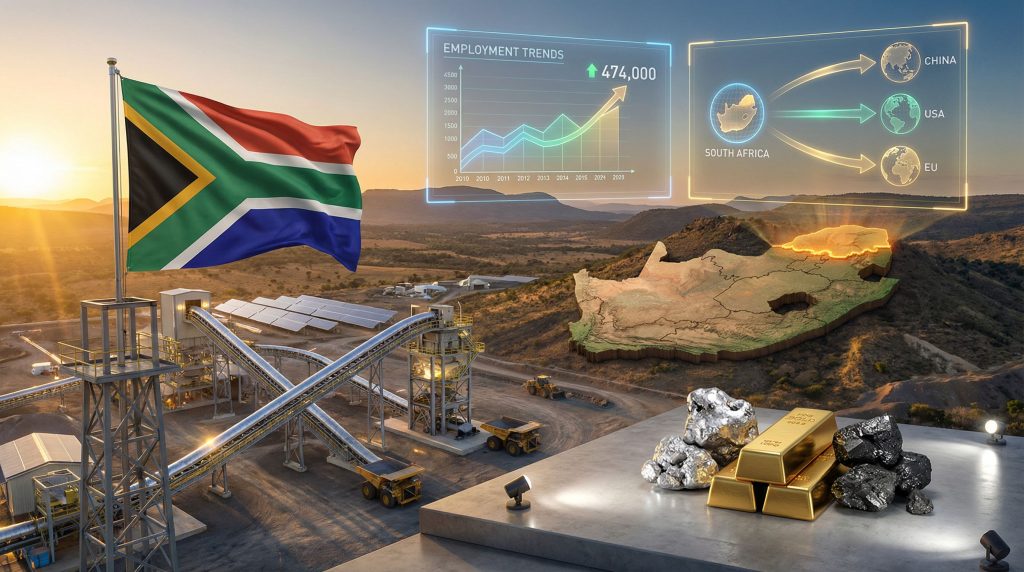
South Africa's mining sector contributed 6% of GDP in 2024, according to recent Minerals Council data, while employing 474,000 workers as of the third quarter. This employment figure represents a 5,000 job increase on a quarter-on-quarter basis, with 2,000 additional positions created year-on-year compared to 2023.
The sector's wage progression demonstrates sustained value creation, with average mining wages increasing from R79,957 in Q3 2019 to R108,759 in Q3 2025, representing a 36% increase over six years. This wage growth trajectory significantly outpaced general inflation rates during the same period.
The Multiplier Effect of Mining FDI
Mining investments generate employment multiplication factors that extend well beyond direct operational requirements. Industry analysis indicates that each mining position typically supports between three to five additional jobs in supporting industries, including equipment suppliers, logistics providers, and professional services.
Regional economic development patterns show concentrated benefits in previously underdeveloped areas. Furthermore, mining FDI establishes permanent infrastructure including roads, power systems, water treatment facilities, and telecommunications networks that benefit entire communities long after mine closure.
The fiscal contributions through mining FDI flow through multiple channels:
- Direct corporate taxation on mining profits
- Personal income tax from employee wages
- Property taxes on mining facilities and equipment
- Sales taxes on goods and services procurement
- Royalty payments on mineral extraction
When big ASX news breaks, our subscribers know first
Why Are International Investors Reassessing South Africa's Mining Potential?
Global investment patterns in mining reflect fundamental shifts in commodity demand structures and geopolitical supply chain considerations. South Africa's position as holder of 80% of world platinum reserves and significant deposits of critical minerals positions the country strategically for energy transition investments.
Commodity Demand Drivers Reshaping Investment Decisions
Recent market developments demonstrate renewed investor confidence in South African mining assets. The country recently commissioned its first new underground gold mine in 15 years, responding to rising gold prices that reached $4,316.14 per ounce as of December 2025.
Platinum prices have similarly strengthened to $1,919.45 per ounce, reflecting supply constraints and growing industrial demand for hydrogen economy applications. These price movements create attractive investment returns for long-term mining projects.
Critical minerals demand from electric vehicle manufacturing, renewable energy storage, and advanced technology applications drives strategic investor interest. Supply chain diversification strategies by major economies seek alternatives to concentrated production sources, particularly for lithium, cobalt, and rare earth elements.
Regulatory Framework Evolution and Investor Confidence
South Africa's mining regulatory environment provides sophisticated legal frameworks that attract institutional investors seeking transparent operational conditions. The Mining Charter compliance requirements, while demanding, create predictable investment parameters that reduce regulatory uncertainty.
Social and Labour Plan obligations channel mining investments toward community development initiatives, creating shared value propositions that enhance long-term operational sustainability. Environmental authorisation processes align with international environmental, social, and governance standards increasingly required by global institutional investors.
International investors particularly value South Africa's advanced financial markets infrastructure, established banking systems, and technical expertise availability that reduce project implementation risks compared to other African mining jurisdictions.
Which Sectors Are Attracting the Most Foreign Mining Investment?
Recent investment patterns reveal strategic focus on sectors that address both domestic industrial needs and global supply chain diversification objectives. Hard coking coal, platinum group metals, and critical minerals attract the highest international investor interest.
Hard Coking Coal and Steel Industry Integration
The $91 million investment by Hong Kong-listed Kinetic Development Group in MC Mining demonstrates international investor commitment to South African coking coal assets. This investment targets the Makhado project in Limpopo province's Vhembe region, positioned for early 2026 production commencement.
Hard coking coal production addresses South Africa's steel industry dependence on imported metallurgical coal. Domestic steel producers currently rely heavily on international suppliers, creating import substitution opportunities worth hundreds of millions of dollars annually.
The investment enables development of integrated supply chains connecting mining operations with downstream steel production facilities. This vertical integration reduces transportation costs, improves supply security, and creates additional employment in processing activities.
| Mining Employment Trends | Q3 2024 | Q3 2023 | Change |
|---|---|---|---|
| Total Employment | 474,000 | 472,000 | +2,000 |
| Quarterly Change | +5,000 | – | – |
| Average Wage (ZAR) | 108,759 | – | – |
| 2019 Wage Baseline | – | – | 79,957 |
Beneficiation and Value-Added Processing Opportunities
Mining investments increasingly focus on downstream processing capabilities that capture greater value from raw material extraction. The Musina Makhado special economic zone offers business development incentives specifically designed to encourage vertical integration opportunities.
Technology transfer requirements embedded in major mining investments bring advanced processing techniques, equipment, and operational knowledge to South African operations. Additionally, automation in mining capabilities often extend beyond immediate project requirements, creating spillover benefits for broader industrial development.
Local capacity building initiatives associated with foreign mining investments typically include:
- Advanced metallurgical processing training programmes
- Equipment maintenance and repair capabilities
- Quality control and assurance systems
- Environmental management technologies
- Safety management systems implementation
How Do Regional Development Patterns Influence FDI Allocation?
Regional development strategies increasingly drive mining FDI allocation decisions, with investors seeking locations that offer both geological potential and infrastructure development opportunities. Limpopo province emerges as a primary focus area for new mining investments.
Limpopo Province as an Emerging Mining Hub
The Vhembe region of Limpopo province attracts significant mining FDI due to geological endowments combined with underdeveloped socio-economic conditions that create transformational investment opportunities. The Greater Soutpansberg projects and Vele Aluwani colliery represent major development anchors for regional economic growth.
Skills development requirements in the region create employment opportunities beyond direct mining operations. Training programmes for mining-specific technical skills, equipment operation, and management capabilities generate lasting human capital improvements that benefit entire communities.
Community upliftment integration with mining operations addresses both regulatory compliance requirements and sustainable development objectives. These programmes typically include healthcare facility construction, educational infrastructure development, and small business support initiatives.
Infrastructure Investment Catalysts
Mining FDI serves as infrastructure development catalyst, particularly in transportation and logistics networks. Heavy equipment transportation requirements, bulk commodity shipment needs, and worker accommodation necessitate road improvements, rail line upgrades, and port facility enhancements.
Energy security considerations drive substantial investment in mining operation power systems. Given South Africa's electricity supply challenges, mining projects increasingly incorporate renewable energy generation capacity, backup power systems, and energy efficiency technologies.
Water resource management represents another critical infrastructure component of mining FDI. Projects must demonstrate sustainable water use practices, wastewater treatment capabilities, and environmental protection measures that meet both regulatory standards and community expectations.
What Economic Indicators Demonstrate FDI Success in Mining?
Economic impact measurement requires comprehensive analysis of direct investment effects, employment creation patterns, and broader regional development outcomes. Key metrics demonstrate the transformational potential of strategic mining investments.
Employment Growth Metrics and Wage Progression
The mining sector's 474,000 total employment in Q3 2024 represents sustained workforce expansion despite global economic uncertainties. Quarter-on-quarter growth of 5,000 jobs indicates continued investment in operational capacity and project development activities.
Year-on-year employment growth of 2,000 positions demonstrates steady sector expansion supported by commodity price recovery and new project implementations. This employment growth occurs across multiple skill levels, from entry-level positions to specialised technical roles.
Wage progression from R79,957 in Q3 2019 to R108,759 in Q3 2025 reflects both inflationary adjustments and genuine productivity improvements. This 36% increase over six years substantially exceeds consumer price inflation, indicating real income growth for mining sector workers.
GDP Contribution and Fiscal Impact Analysis
Mining's 6% GDP contribution in 2024 represents substantial economic value creation relative to sector employment levels. This high value-added ratio reflects the capital-intensive nature of mining operations and premium commodity pricing environments.
Tax revenue generation from foreign-invested mining operations contributes significantly to government fiscal capacity. Corporate income taxes, employee income taxes, and various indirect taxes provide sustainable revenue streams for public investment in infrastructure and social programmes.
Foreign exchange earnings from mineral exports help stabilise South Africa's balance of payments position. Mining exports generate hard currency inflows that support import capacity and external debt service requirements.
Strategic Investment Insight: Mining FDI success requires alignment between investor financial objectives, community development needs, and national economic priorities. Long-term value creation depends on sustainable operational practices and meaningful stakeholder engagement.
How Are Geopolitical Factors Reshaping Mining Investment Flows?
Global supply chain security concerns increasingly influence mining investment decisions, with major economies seeking diversified mineral supply sources. South Africa benefits from strategic competition between international investors pursuing secure access to critical materials.
Strategic Competition for Critical Mineral Access
United States, European Union, and Chinese investment strategies in African mining reflect different approaches to supply chain security. American and European investors emphasise governance standards, environmental compliance, and technology transfer. Chinese investors focus on infrastructure development, processing capacity, and long-term supply agreements.
This competitive dynamic creates opportunities for South African mining projects to negotiate favourable terms while maintaining operational flexibility. Multiple investor options enable project developers to select partnerships that align with their development objectives and community commitments.
Technology transfer requirements increasingly feature in international mining investment agreements. These arrangements bring advanced exploration techniques, processing technologies, and environmental management systems to South African operations.
International Development Finance and Mining Projects
Multilateral development banks increasingly support mining projects that demonstrate sustainable development outcomes. Green financing mechanisms reward mining operations that incorporate renewable energy systems, water conservation technologies, and community benefit programmes.
Risk mitigation instruments for foreign investors include political risk insurance, currency hedging facilities, and international arbitration mechanisms. However, understanding geopolitical market impact becomes crucial for reducing investment uncertainties and enabling longer-term project commitments.
International development finance institutions provide technical assistance for regulatory compliance, environmental management, and social impact assessment. This support helps ensure mining projects meet international standards while addressing local development needs.
The next major ASX story will hit our subscribers first
What Challenges Must Foreign Investors Navigate in South Africa's Mining Sector?
Foreign mining investors face complex regulatory compliance requirements, operational risk management challenges, and community engagement obligations. Understanding these factors becomes essential for successful project implementation and sustainable operations.
Regulatory Compliance and Local Content Requirements
Black Economic Empowerment partnership structures require foreign investors to establish meaningful local ownership arrangements. These partnerships typically involve equity sharing, management participation, and skills transfer commitments that extend throughout project lifecycles.
Local procurement obligations mandate sourcing goods and services from South African suppliers where feasible. These requirements create opportunities for domestic business development while potentially increasing operational costs and supply chain complexity.
Environmental impact assessment processes require comprehensive analysis of project effects on local ecosystems, water resources, and community welfare. Community consultation requirements ensure stakeholder input throughout project planning and implementation phases.
Operational Risk Management Strategies
Energy supply reliability challenges necessitate backup power solutions and energy efficiency measures. Mining operations increasingly invest in renewable energy generation capacity, battery storage systems, and demand management technologies.
Transportation infrastructure dependencies require contingency planning and alternative route development. Rail line capacity constraints, port facility limitations, and road maintenance issues affect operational cost structures and production scheduling.
Labour relations and community engagement demand ongoing attention and resource allocation. Successful mining operations maintain regular dialogue with worker representatives, community leaders, and government officials to address concerns and optimise mutual benefits.
Which Investment Models Are Proving Most Successful?
Successful mining FDI in South Africa typically employs partnership approaches that combine international capital and expertise with local knowledge and stakeholder relationships. Joint venture structures provide risk sharing while ensuring regulatory compliance and community support.
Joint Venture and Strategic Partnership Approaches
The $91 million KDG investment in MC Mining demonstrates effective partnership structuring that combines Hong Kong capital markets access with South African operational expertise. This majority shareholding arrangement provides strategic control while maintaining local management and community relationships.
Risk sharing mechanisms between foreign and local partners distribute financial, operational, and regulatory risks according to each party's capabilities and risk tolerance. Furthermore, effective joint ventures insight and operational expertise exchange create value for both international investors and domestic partners.
Long-term commitment strategies ensure mining investments generate sustainable development outcomes that persist beyond immediate project lifecycles. These approaches typically include community infrastructure development, educational programmes, and local business capacity building initiatives.
Greenfield vs. Brownfield Investment Considerations
Greenfield project development offers greater design flexibility and community engagement opportunities but requires longer development timelines and higher capital commitments. New project development enables incorporation of latest technologies and environmental management systems from project inception.
Brownfield asset acquisitions provide faster production timelines and existing infrastructure advantages but may inherit legacy environmental or community issues. Due diligence processes for existing operations require comprehensive assessment of technical conditions, regulatory compliance status, and stakeholder relationships.
Investment timing considerations reflect commodity price cycles, regulatory stability, and infrastructure development status. Successful investors typically maintain flexible project development schedules that accommodate market conditions and operational readiness factors.
How Does Mining FDI Compare Across African Markets?
Foreign direct investment mining South Africa competes with other African mining jurisdictions for international investment capital. Comparative advantages include sophisticated financial markets, established regulatory frameworks, and technical expertise availability.
Competitive Positioning Analysis
| African Mining Investment Destinations | Regulatory Maturity | Infrastructure Quality | Primary Commodities |
|---|---|---|---|
| South Africa | High | Moderate | PGMs, Coal, Gold |
| Ghana | Moderate | Moderate | Gold, Bauxite |
| DRC | Developing | Limited | Copper, Cobalt |
| Zambia | Moderate | Moderate | Copper, Emeralds |
Differentiation Factors for South African Mining Investment
South Africa's advanced regulatory and legal framework provides investor protections and operational certainty that reduce investment risks compared to other African jurisdictions. Established commercial law systems, international arbitration access, and property rights protections attract institutional investors seeking predictable returns.
Financial markets infrastructure enables efficient capital raising, currency hedging, and profit repatriation. The Johannesburg Stock Exchange provides listing opportunities for mining companies while sophisticated banking systems support project financing and operational cash management.
Technical expertise and engineering capabilities available in South Africa reduce project implementation risks and operational costs. Local consulting firms, equipment suppliers, and specialised service providers offer world-class capabilities that support complex mining operations.
What Future Trends Will Shape Mining FDI in South Africa?
Technological advancement, sustainability requirements, and global supply chain evolution will significantly influence future mining investment patterns. Digital transformation, automation, and environmental performance standards increasingly determine investment attractiveness and operational success.
Technology Integration and Digital Transformation
Automation and remote operation capabilities enable mining operations in challenging locations while improving safety performance and operational efficiency. Investment in autonomous equipment, remote monitoring systems, and predictive maintenance technologies becomes essential for competitive positioning.
Data analytics and artificial intelligence applications optimise exploration success rates, processing efficiency, and equipment utilisation. These technologies require substantial capital investment but generate significant operational improvements and cost reductions over project lifecycles.
Cybersecurity considerations become increasingly critical as mining operations incorporate digital technologies and connectivity systems. Investment in cybersecurity infrastructure and personnel training protects operational systems and sensitive business information from emerging threats.
Sustainability and ESG Investment Criteria
Environmental performance standards increasingly influence investor decision-making and capital allocation. Mining projects must demonstrate water conservation, emission reduction, and ecosystem protection measures that meet international sustainability benchmarks.
Social impact measurement and community benefit sharing mechanisms become standard requirements for major mining investments. Investor expectations include quantifiable community development outcomes, local employment creation, and skills development programmes.
Governance frameworks for transparent operations address investor concerns about corruption, regulatory compliance, and stakeholder engagement. These systems provide assurance that mining investments generate appropriate returns while meeting ethical and legal obligations.
How Can Investors Maximise Returns While Managing Risks?
Successful mining investment in South Africa requires comprehensive due diligence, risk management strategies, and long-term value optimisation approaches. Understanding geological, regulatory, and market factors enables informed investment decisions and operational excellence.
Due Diligence Framework for Mining FDI
Geological assessment and resource verification processes require independent technical evaluation of mineral reserves, ore quality, and extraction feasibility. Professional geological surveys, metallurgical testing, and mine planning studies provide foundation for investment decisions.
Political and regulatory risk evaluation methodologies assess government stability, policy continuity, and regulatory compliance requirements. These analyses help investors understand operational constraints and develop appropriate risk mitigation strategies.
Market analysis and commodity price forecasting inform investment timing and production planning decisions. Understanding supply and demand dynamics, price volatility patterns, and end-user industry trends enables optimised revenue generation strategies.
Exit Strategy Planning and Asset Optimisation
Long-term value creation through operational improvements focuses on efficiency enhancement, cost reduction, and production optimisation. Continuous improvement programmes generate sustained competitive advantages and improved financial returns throughout project lifecycles.
Divestment timing and market conditions assessment require ongoing monitoring of asset values, commodity markets, and investor demand patterns. Successful investors maintain flexibility to capitalise on optimal exit opportunities while ensuring operational continuity.
In addition, incorporating investment strategy essentials into legacy planning for sustainable community development ensures mining investments create lasting positive impacts that extend beyond mine closure. These programmes build community capacity, economic diversification, and environmental restoration that support long-term regional development.
Foreign direct investment mining South Africa requires sophisticated understanding of geological opportunities, regulatory frameworks, and community development requirements. Success depends on strategic partnerships, technological innovation, and commitment to sustainable development principles that create shared value for investors, communities, and the broader economy.
Ready to Stay Ahead of Africa's Mining Investment Opportunities?
Discovery Alert's proprietary Discovery IQ model delivers real-time notifications on significant ASX mineral discoveries, empowering investors to identify emerging opportunities in mining stocks with African operations before broader market awareness. Begin your 30-day free trial today and position yourself to capitalise on the next wave of foreign investment flowing into mining projects across the continent.