
August 21, 2026
Foreign Investment Patterns in Australia's Resource Infrastructure
The global commodities landscape continues to witness substantial cross-border capital flows, particularly in sectors where resource security intersects with industrial policy objectives. Australia's mining sector has emerged as a critical focal point for international investors seeking exposure to high-grade mineral assets, driven by both geological advantages and regulatory stability. Chinese-backed coal mine acquisition activity exemplifies these patterns, with recent transactions demonstrating how mining consolidation trends reshape market dynamics across the sector.
Steel production dependencies in Asia-Pacific economies maintain robust demand for specific coal grades, despite broader energy transition narratives. Metallurgical coal markets operate under fundamentally different supply-demand dynamics compared to thermal coal, with steelmaking requirements driving sustained price premiums for premium coking coal grades. This distinction has created investment opportunities for entities seeking exposure to industrial commodities with longer-term demand visibility.
When big ASX news breaks, our subscribers know first
Strategic Resource Security vs. Climate Transition Tensions
International energy companies increasingly pursue overseas asset acquisition strategies to diversify supply chains and secure access to critical raw materials. Chinese state-owned enterprises have demonstrated particular interest in Australian mining assets, leveraging substantial capital resources to acquire controlling stakes in established operations. Furthermore, Chinese mining expansion reflects broader resource security considerations, where access to reliable supply sources outweighs short-term commodity price volatility.
The regulatory environment surrounding foreign investment in mining assets balances economic benefits against national security considerations. Australia's Foreign Investment Review Board evaluates transactions based on multiple criteria, including infrastructure criticality, supply chain implications, and strategic asset concentration. Approval frameworks consider both direct economic impacts and broader geopolitical relationships when assessing major acquisitions.
Metallurgical Coal's Resilience in Steel-Dependent Economies
Industrial steel production across Asia-Pacific regions maintains structural dependence on metallurgical coal inputs, creating sustained demand for premium coking coal grades. Infrastructure development initiatives across emerging economies drive steel consumption growth, supporting long-term demand projections for high-quality metallurgical coal. This demand profile differs significantly from thermal coal markets, where renewable energy adoption creates substitution pressures.
Geological advantages in Australia's Bowen Basin region provide access to some of the world's highest-grade metallurgical coal deposits, creating competitive advantages for mining operations in terms of product quality and export market positioning. Underground mining operations in this region can achieve premium pricing due to superior coal characteristics and enhanced rail logistics infrastructure connecting to international markets.
Corporate Consolidation Reshaping Market Structure
Valuation Metrics and Transaction Structures
Large-scale mining acquisitions increasingly reflect sophisticated financial engineering, with transaction structures balancing upfront payments against performance-based earnouts and production milestones. Multi-billion dollar transactions in the coal sector demonstrate investor confidence in long-term demand fundamentals, despite environmental policy uncertainties. Recent acquisition activity suggests valuations based on reserve life, production capacity, and infrastructure connectivity rather than short-term commodity price cycles.
| Transaction Component | Typical Structure | Risk Allocation |
|---|---|---|
| Upfront Payment | 60-80% of total value | Buyer assumes operational risk |
| Deferred Payments | 20-40% tied to milestones | Seller retains performance exposure |
| Working Capital | Separate adjustment mechanism | Shared transition risk |
| Infrastructure Assets | Included in base valuation | Buyer assumes maintenance obligations |
Financial structuring considerations include currency hedging strategies, given the international nature of coal exports and the exposure to exchange rate fluctuations. Acquisition financing often involves multiple funding sources, including corporate debt facilities, project financing, and equity contributions from parent companies.
Market Concentration and Competitive Dynamics
The Australian coal sector has experienced ongoing consolidation as companies seek operational synergies and portfolio optimization. Horizontal integration strategies allow companies to achieve economies of scale across mining operations, processing facilities, and export logistics. Vertical integration opportunities include coal handling and preparation plants, rail transport capacity, and port terminal access.
Yancoal Australia's expansion strategy demonstrates how Chinese-backed coal mine acquisition programmes can build significant market presence through systematic transaction approaches. In addition, the company's portfolio now encompasses multiple mining operations across Queensland and New South Wales, creating operational flexibility and supply chain optimization opportunities. This consolidation pattern reflects broader industry trends toward larger, more efficient operating platforms.
Geopolitical Dimensions of State-Backed Resource Investments
Foreign Investment Review Board Considerations
Regulatory approval processes for large mining acquisitions involve comprehensive assessments of national interest criteria, including infrastructure criticality and supply chain security implications. The Foreign Investment Review Board evaluates transactions based on established frameworks that consider both economic benefits and strategic asset concentration. Precedent cases suggest approval likelihood correlates with operational continuity commitments and maintaining existing export relationships.
Critical infrastructure assessments examine whether mining assets constitute essential national infrastructure requiring additional oversight or operational restrictions. Coal mining operations typically receive less scrutiny than telecommunications or energy distribution assets, though large-scale acquisitions by state-owned enterprises may trigger enhanced review processes.
Supply Chain Sovereignty and Trade Relationship Dynamics
Australia-China trade relationships in the resources sector create complex interdependencies that influence both commercial and policy decisions. Export concentration risks emerge when significant portions of national production flow to single markets, potentially creating vulnerability to trade disruptions or policy changes. Diversification strategies involve developing alternative market relationships and reducing dependence on any single export destination.
Resource diplomacy considerations affect how governments approach foreign investment approvals, balancing economic benefits against broader bilateral relationship objectives. Mining sector investments often proceed despite periodic trade tensions, reflecting the strategic importance of resource trade relationships for both countries.
Environmental Opposition and Economic Reality Tensions
Climate Policy Contradictions and Transition Economics
Environmental advocacy groups consistently oppose coal mining expansion, arguing that continued production undermines climate objectives and delays necessary energy transitions. Climate policy analysis suggests that any additional coal production contributes to cumulative emissions and extends the timeline for achieving carbon neutrality targets. This perspective emphasises the incompatibility between continued fossil fuel extraction and international climate commitments.
Federal treasury modelling indicates that Australian coal and gas export values may decline approximately 50 percent by 2035, reflecting global energy transition trends and renewable energy adoption. This projection creates uncertainty around long-term investment returns and suggests potential stranded asset risks for mining operations with extended reserve lives.
Community Impact and Just Transition Considerations
Mining-dependent communities face complex challenges as global energy systems evolve, with employment and economic activity concentrated in sectors experiencing long-term structural change. Regional economic development strategies increasingly focus on economic diversification and alternative industry development to reduce dependence on mining activities. Just transition frameworks aim to support workers and communities through economic transformation processes.
Employment implications of mining ownership changes typically involve maintaining existing workforce levels during transition periods, though long-term employment projections depend on operational efficiency improvements and market conditions. Community stakeholders often emphasise the importance of ongoing economic contribution and local hiring preferences.
Technical Asset Evaluation and Investment Decision Frameworks
Production Capacity and Reserve Life Analysis
Underground mining operations require different evaluation criteria compared to open-cut mining, with factors including geological complexity, extraction costs, and safety considerations affecting operational planning and capital requirements. However, Yancoal's acquisition of underground operations demonstrates how Chinese-backed coal mine acquisition strategies prioritise high-quality metallurgical coal deposits while minimising surface environmental impacts compared to open-cut alternatives.
| Operational Metric | Kestrel Mine Specifications |
|---|---|
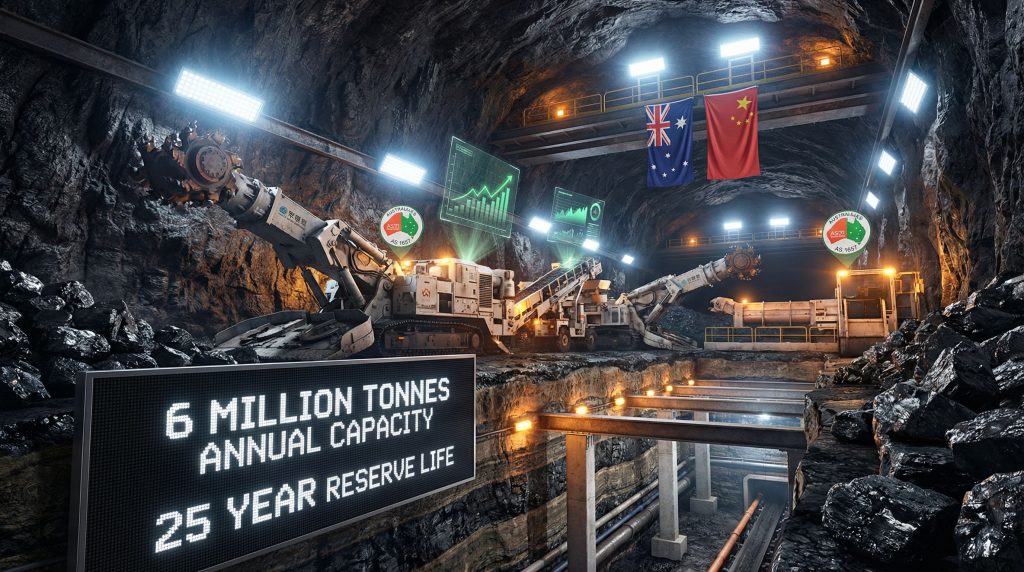
| Annual Production Capacity | 6 million tonnes |
| Reserve Life Expectancy | 25 years |
| Primary Coal Type | Metallurgical (coking coal) |
| Export Destinations | Asia-Pacific markets |
| Workforce | 800+ employees |
| Infrastructure Access | Rail connection to Gladstone port |
Reserve quality assessments consider coal characteristics including ash content, sulfur levels, and coking properties that determine suitability for steelmaking applications. Premium metallurgical coal commands significant price premiums over thermal coal grades, making reserve quality a critical valuation factor.
Infrastructure Connectivity and Logistics Advantages
Export logistics infrastructure provides competitive advantages for mining operations with established rail connections to major ports and existing customer relationships in target markets. The Bowen Basin's rail network connects mining operations to Gladstone port facilities, enabling efficient export operations to Asian steel producers.
Operational integration opportunities arise when companies acquire multiple assets in the same region, allowing for shared infrastructure utilisation, coordinated production planning, and optimised logistics operations. These synergies can generate significant cost savings and operational flexibility benefits.
The next major ASX story will hit our subscribers first
Market Forces Driving Coal Asset Valuations
Commodity Price Volatility and Risk Assessment
Metallurgical coal pricing exhibits cyclical patterns driven by global steel production levels, supply disruptions, and inventory cycles across major consuming markets. Investment decisions must account for price volatility while focusing on long-term demand fundamentals and asset-specific competitive advantages. Currency movements add additional complexity, as coal prices are typically denominated in US dollars whilst operational costs occur in local currencies.
Hedging strategies become critical for large mining investments, with companies employing various financial instruments to manage commodity price exposure and currency risks. Market reports indicate long-term supply contracts with steel producers can provide revenue stability, though these agreements often include price adjustment mechanisms tied to market benchmarks.
Regulatory and Royalty Regime Impacts
Queensland's coal royalty system creates ongoing cost obligations that affect project economics and investment returns. Recent royalty rate adjustments have impacted mining company profitability and influenced asset valuations, with companies factoring these costs into their long-term financial projections. Furthermore, royalty system impacts vary across Australian jurisdictions, creating differential impacts on mining operations in different regions.
Environmental compliance costs continue to increase as regulatory frameworks evolve to address environmental impacts and community concerns. These costs include ongoing monitoring requirements, rehabilitation obligations, and potential carbon pricing mechanisms that may affect future operational economics.
Government Policy Responses and Economic Priorities
Political Economy of Resource Sector Support
Queensland government positioning emphasises the continuing economic importance of the mining sector for regional employment, export revenues, and royalty income. State government officials characterise significant mining investments as validation of the jurisdiction's business environment and regulatory framework. This perspective highlights the tension between environmental policy objectives and immediate economic benefits from mining activities.
Revenue generation through mining royalties provides substantial income for state government budgets, funding infrastructure development and public services. The economic multiplier effects of large mining operations extend beyond direct employment to include support services, transportation, and regional business activity.
Regional Development and Economic Contribution
Mining operations generate significant regional economic activity through direct employment, contractor services, and community spending. Large mining investments often trigger additional infrastructure development and service industry expansion that benefits broader regional economies. These economic impacts become important considerations for government policy decisions and community support for mining activities.
Infrastructure utilisation includes rail networks, port facilities, and support services that benefit from sustained mining activity. The economic efficiency of existing infrastructure investments depends partly on ongoing utilisation by mining operations, creating interdependencies between mining sector performance and broader economic planning.
Strategic Implications for Industry Participants
State-Owned Enterprise Expansion Strategies
Chinese energy companies' international expansion reflects systematic efforts to secure access to critical raw materials and diversify supply sources. These strategies often involve acquiring controlling stakes in established operations rather than developing new mining projects, reducing development risks and accelerating market entry timelines. Consequently, mining industry evolution demonstrates how Chinese-backed coal mine acquisition activity shapes global resource markets.
Technology transfer opportunities may arise from international ownership, as companies bring operational expertise, safety practices, and efficiency improvements to acquired assets. Integration with parent company operations can provide access to larger customer networks and enhanced marketing capabilities.
Market Consolidation and Competitive Positioning
Portfolio optimisation strategies drive consolidation activity as companies seek to focus on high-quality assets with competitive cost structures and favourable market positioning. This trend creates opportunities for asset divestments by companies exiting certain markets or commodity sectors, while enabling expansion by companies with growth capital and operational expertise.
Operational synergies from multiple asset ownership include shared infrastructure utilisation, coordinated production planning, and enhanced negotiating power with customers and suppliers. These benefits can justify premium valuations for strategic acquisitions that complement existing operations.
Investment Disclaimer: This analysis is for informational purposes only and does not constitute investment advice. Mining investments involve significant risks including commodity price volatility, operational hazards, regulatory changes, and environmental liabilities. Readers should conduct independent research and consult qualified financial advisors before making investment decisions. Past performance does not guarantee future results, and all mining investments carry the risk of substantial loss.
Searching for Your Next Mining Investment Opportunity?
Discovery Alert's proprietary Discovery IQ model delivers real-time notifications on significant ASX mineral discoveries, instantly empowering investors to identify actionable opportunities ahead of the broader market. Visit Discovery Alert's dedicated discoveries page to understand how major mineral discoveries have historically generated substantial returns, then begin your 14-day free trial today to position yourself ahead of market movements.