
June 7, 2026
The Monetary Reset Debate: Why Gold's Role in Sovereign Finance Is Being Reassessed
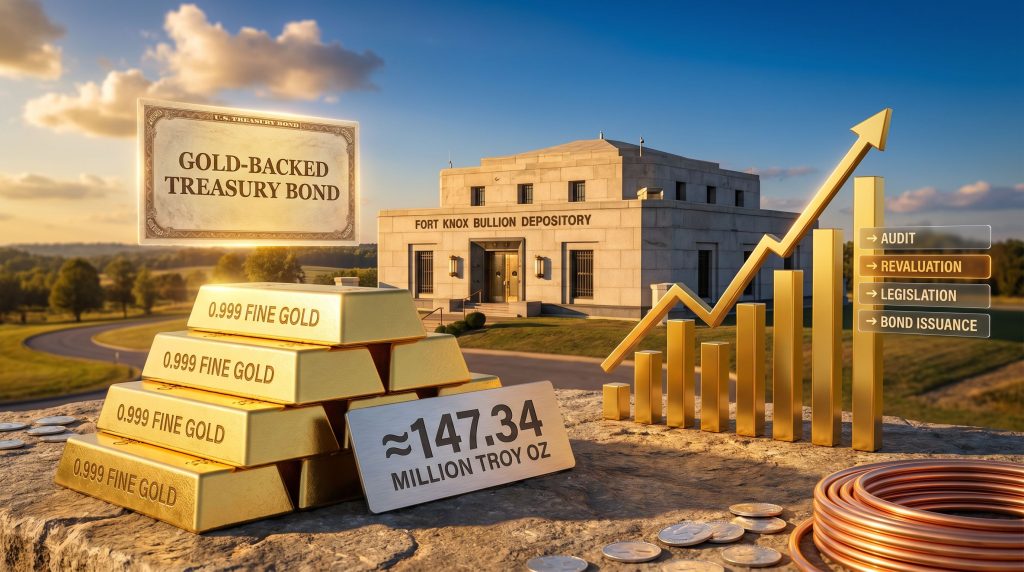
Across the long arc of monetary history, gold has repeatedly reasserted itself during periods of fiscal stress. Empires have debased their currencies, sovereign debts have ballooned beyond serviceable levels, and each time, the conversation about hard asset backing for financial systems has re-emerged. The current moment is no different. The Fort Knox audit and gold-backed Treasury bond debate sits at the centre of this reassessment, driven by a convergence of structural forces reshaping gold in the monetary system, central bank strategy, and U.S. fiscal policy planning.
When big ASX news breaks, our subscribers know first
Why U.S. Gold Reserve Transparency Has Become a Policy Flashpoint
The Gap Between Official Records and Physical Verification
There is a meaningful distinction between reviewing scheduled gold reserve figures and conducting a genuine bar-by-bar physical inspection. The United States has periodically published gold reserve data through the U.S. Treasury Department, which operates the Fort Knox Bullion Depository in Kentucky. However, the existing reporting framework does not satisfy the standards that independent auditors would typically require. Reviewing an inventory schedule is not the same as physically verifying each bar, testing its purity, and confirming it carries no third-party encumbrances.
The U.S. Treasury functions as the operating authority over Fort Knox, and internal reviews have been conducted at various intervals. Critics argue, however, that internal Treasury reviews and external independent audits are fundamentally different exercises. Furthermore, only the latter can provide the level of assurance required to support a new financial instrument backed by those reserves.
What the Numbers Actually Say About Fort Knox Holdings
| Metric | Reported Figure |
|---|---|
| Estimated gold held at Fort Knox | ~147.34 million troy ounces (as of July 2020) |
| Operator | U.S. Treasury Department |
| Location | Fort Knox, Kentucky |
| Last comprehensive independent audit | Disputed / not publicly verified |
| International purity benchmark | 0.999 fine gold |
| Current statutory book value of U.S. gold reserves | Far below current market value |
The reported figures are substantial on paper. However, the audit debate is not fundamentally about whether gold exists at Fort Knox. It centres on three unresolved questions: whether the holdings have been independently verified, whether the bars meet international purity standards, and whether any portion of the reserves has been lent or pledged to multiple counterparties simultaneously. Each concern carries significant implications for any proposed financial instrument relying on those reserves as collateral.
Key Insight: Questions about Fort Knox are not simply political theatre. The purity issue is technically significant. International gold markets operate on a minimum standard of 0.999 fine gold, and there are longstanding concerns that not all bars held at Fort Knox necessarily meet this threshold. If those reserves were ever to serve as collateral for a sovereign debt instrument, sub-standard purity would create both a legal and a credibility problem.
Could the U.S. Issue a Gold-Backed Treasury Bond? A Policy Analysis
Understanding the Structural Difference Between Gold Certificates and Treasury Bonds
Historically, U.S. Treasury gold reserves have served as backing for gold certificates issued to Federal Reserve Banks, not for publicly traded Treasury bonds. These gold certificates are an accounting mechanism within the Federal Reserve system, not instruments accessible to external investors. A Fort Knox audit and gold-backed Treasury bond arrangement would represent an entirely new category of debt instrument, requiring legislative action to create, not simply executive policy to implement.
This distinction is critical for investors and policy observers. The existing gold certificate mechanism cannot be repurposed into a publicly traded bond without congressional authorisation, a revaluation of the statutory gold price, and a verified audit of the underlying reserves.
The Fiscal Logic Behind the Proposal
With U.S. federal deficits continuing to expand and entitlement obligations representing long-duration fiscal commitments, alternative financing mechanisms are gaining traction in policy circles. A gold-backed Treasury bond could theoretically attract sovereign wealth funds, central banks, and inflation-sensitive institutional allocators who are increasingly reluctant to hold conventional dollar-denominated Treasuries.
This proposal aligns with a broader global monetary shift away from dollar-denominated reserves. Central bank gold demand has accelerated significantly, particularly among economies actively diversifying away from dollar-denominated reserve instruments. Consequently, issuing a bond with even partial gold backing could appeal directly to this expanding investor base.
Key Structural Considerations for a Gold-Backed Bond
| Consideration | Current Status |
|---|---|
| Legal basis for gold-backed bonds | Does not exist under current Treasury framework |
| Gold certificate mechanism | Active, issued to Federal Reserve Banks only |
| Required legislative action | New congressional authorisation needed |
| Prerequisite verification | Independent audit of quantity, purity, and encumbrance status |
| Investor appeal | High, particularly for sovereign and inflation-hedge buyers |
| Gold statutory book value | Carried at a fraction of current market price |
Policy Note: A gold-backed Treasury bond is not current practice. It would represent a novel sovereign debt instrument requiring new legislative authority, a formal revaluation of gold reserve accounting from its current statutory price to market value, and a credible independent verification framework. This is precisely why the Fort Knox audit and gold-backed Treasury bond proposal are strategically linked rather than separate conversations.
Why the Audit Must Come Before the Bond
No credible gold-backed instrument can be issued without first establishing the verified quantity, purity, and unencumbered status of the underlying reserves. The logical policy sequence runs as follows:
- Independent audit establishes verified holdings, purity levels, and encumbrance status.
- Formal revaluation moves gold from statutory book value to current market price on the national balance sheet.
- Congressional legislation creates the legal framework for a new gold-backed debt instrument.
- Bond issuance targets sovereign and institutional buyers seeking hard-asset-linked U.S. debt.
This sequencing explains why renewed interest in auditing Fort Knox may carry more policy substance than it initially appears. If the audit is purely symbolic, there is little reason for it to be tied, even informally, to discussions about new debt financing mechanisms.
What Would a Real Fort Knox Audit Actually Involve?
The Three Layers of Verification That Critics Are Demanding
A credible, independent audit of U.S. gold reserves would need to address three distinct dimensions, each of which presents its own logistical and institutional challenges:
- Physical bar count — Direct inspection of every gold bar stored within the vault, verifying presence and quantity against existing inventory records.
- Purity assay testing — Laboratory-grade verification that holdings meet the internationally recognised 0.999 fine gold standard. This is not a trivial process at the scale of Fort Knox holdings, and any shortfall would require either remediation or disclosure.
- Encumbrance review — Confirmation that no portion of the reserves has been lent, leased, or effectively pledged to more than one counterparty. Gold lending arrangements can create situations where the same physical bar is simultaneously claimed by multiple parties on paper, a structural vulnerability that a bar count alone would not detect.
This final point is particularly important and often overlooked in mainstream coverage. The gold lending and leasing market, historically centred in London, allowed commercial counterparties to borrow physical gold from central bank reserves. If those arrangements were not fully unwound, the audited quantity might technically exist while simultaneously being encumbered in ways that undermine its utility as sovereign collateral.
The Congressional Push for Greater Transparency
Legislative efforts calling for a new, independently conducted, comprehensive audit of U.S. gold reserves have been introduced in Congress at various points over the past two decades. However, these efforts have consistently stalled before reaching a formal mandate. An internal review answers to the same institutional hierarchy that manages the reserves, which does not meet the standard of independence that financial markets would require before accepting those reserves as verified collateral.
The Geopolitical Timing: Why This Debate Is Resurging in 2025
Renewed executive-level interest in physically verifying Fort Knox holdings has brought this long-dormant debate back into public discourse. The symbolic weight of a presidential-level call for an audit is considerable. It signals either a genuine policy intent to use those reserves in a new financial framework, or at minimum an acknowledgment that the opacity surrounding Fort Knox has become a credibility liability at a time when U.S. fiscal positioning is under intense international scrutiny.
The timing is not coincidental. U.S. federal deficits continue to expand, and the search for alternative mechanisms to manage the debt burden is intensifying. Against this backdrop, the Fort Knox audit conversation has accelerated alongside broader discussions about whether the U.S. balance sheet can be restructured in ways that reduce dependence on conventional Treasury market demand. For a detailed breakdown of gold's central bank drivers behind this trend, the structural factors are well worth examining.
How Global Gold Market Dynamics Are Reinforcing the Case for U.S. Reserve Transparency
Central Bank Accumulation as a Structural Demand Driver
Sovereign gold purchases by major central banks have been running at historically elevated levels. China's policy evolution allowing broader domestic access to gold investment channels represents a particularly significant demand shift. When a government with China's population and savings base opens the floodgates for citizen-level gold acquisition, the physical demand implications are substantial and durable.
The broader movement among BRICS-adjacent economies toward non-dollar reserve diversification has structurally elevated gold's monetary relevance. Furthermore, reviewing central bank gold reserves across major economies reveals these are not short-term trading flows but multi-year institutional reallocation decisions.
The Shift Away from Western Paper Market Dominance
For decades, London and New York-based paper gold markets, characterised by leveraged futures and synthetic exposure instruments, exerted significant downward influence on physical gold prices. The gravitational centre of gold price discovery has progressively migrated toward Asian physical markets, where settlement in actual metal, rather than cash, is the norm.
This structural shift has a meaningful long-term implication: the ability of paper-market participants to suppress physical gold prices for extended periods is diminishing. Short-duration price management, measured in hours or a day or two, remains possible. However, sustained multi-month suppression of the kind that characterised earlier decades is increasingly difficult to execute as Asian physical markets grow in liquidity and influence.
The Retreat of Speculative Digital Asset Competition
Capital that might otherwise have flowed into precious metals and junior resource equities was absorbed for several years by speculative digital asset cycles, including NFTs, meme coins, and high-profile token launches. As those speculative vehicles unwind and retail investors reassess their positioning, the potential for capital rotation toward monetary metals and resource equities becomes a plausible reallocation pathway.
North American retail investors remain structurally underweight physical gold relative to historical norms. This positioning gap represents a potential demand catalyst that has not yet fully materialised.
Frequently Asked Questions: Fort Knox Audit and Gold-Backed Treasury Bonds
Has Fort Knox Ever Been Independently Audited?
A fully independent, bar-by-bar physical audit of Fort Knox has not been publicly confirmed. Periodic internal reviews have been conducted by the U.S. Treasury and the U.S. Mint, but these do not meet the standard of an independent third-party verification. According to analysis from BullionVault, congressional efforts to mandate a more rigorous audit have been introduced but have not resulted in a completed independent review.
What Is a Gold-Backed Treasury Bond?
A gold-backed Treasury bond would be a U.S. government debt instrument where repayment or value is partially secured by physical gold reserves. This structure does not currently exist in U.S. Treasury markets. It would differ from the existing gold certificate system, which links Treasury gold to Federal Reserve balance sheet accounting rather than to publicly issued bonds accessible to external investors.
Why Does the Purity of Fort Knox Gold Matter?
International gold market standards require bullion to meet a minimum purity of 0.999 fine gold. Questions have been raised about whether all bars held at Fort Knox meet this standard, which would be material if those reserves were to be used as collateral for a new financial instrument or formally revalued on the national balance sheet. Sub-standard purity would require either remediation through refining or a disclosure that would affect the credibility of any gold-backed instrument.
Could Gold Reserves Be Lent Out Without Public Knowledge?
This is a central concern among serious gold market analysts. Gold lending and leasing arrangements allow physical gold to be lent to commercial counterparties, creating situations where the same physical bar is effectively claimed by more than one party simultaneously. An audit that only counts bars without verifying encumbrance status would not resolve this concern, which is why a comprehensive audit must include a full encumbrance review, not just a physical inventory.
How Would a Gold-Backed Bond Affect Gold Prices?
If the U.S. were to issue gold-backed Treasury bonds, it would require a formal revaluation of gold reserves from their current statutory price to market value and would signal a significant shift in U.S. monetary policy. Most market observers view this scenario as structurally bullish for gold prices, as it would formally re-anchor a major sovereign debt instrument to the metal and create new institutional demand for verified physical gold.
The next major ASX story will hit our subscribers first
The Broader Macro Argument: Why Gold's Monetary Role Is Expanding
Sovereign Debt Dynamics Are Forcing a Rethink of Reserve Asset Frameworks
Structurally elevated deficit spending across major economies is eroding confidence in fiat-denominated sovereign debt as a genuinely risk-free asset class. Gold's characteristic as a zero-counterparty-risk reserve asset is being reasserted across both emerging and developed market central banks. The Fort Knox audit and gold-backed Treasury bond proposals are symptomatic of a deeper reassessment of how sovereign balance sheets should be structured as the limits of conventional debt financing approach.
The Revaluation Argument: Book Value vs. Market Reality
U.S. gold reserves are currently carried on the national balance sheet at a statutory price that represents a small fraction of current market value. A formal revaluation of these reserves to market prices could materially alter the optics of U.S. fiscal positioning without requiring additional borrowing or spending cuts. This revaluation argument is separate from, but complementary to, the gold-backed bond proposal, and it represents an underappreciated lever in the broader U.S. fiscal debate.
Strategic Takeaway: The convergence of fiscal stress, sustained central bank accumulation, declining paper market influence over physical prices, and renewed political interest in gold reserve verification creates a multi-layered structural case for gold's long-term monetary relevance. This case holds independent of short-term price volatility and is reinforced by the specific policy dynamics surrounding the Fort Knox audit and gold-backed Treasury bond discussions.
Key Signals for Investors and Policy Observers to Monitor
| Theme | Signal to Monitor |
|---|---|
| Fort Knox audit progress | Congressional legislation or executive action mandating independent review |
| Gold-backed bond proposal | Treasury or White House statements on alternative debt instruments |
| Central bank gold accumulation | Monthly IMF reserve reporting and BRICS-member purchase disclosures |
| Silver industrial demand | China import data and export control developments on related inputs |
| Copper supply-demand balance | Mine supply data vs. AI and electrification infrastructure spending |
| Paper vs. physical gold markets | COMEX vs. Shanghai price premiums and physical settlement patterns |
| Uranium supply concentration | Active producer count and new mine development timelines |
| Retail gold positioning | North American ETF inflows and physical dealer demand data |
Disclaimer: This article is intended for informational and educational purposes only and does not constitute financial or investment advice. All forward-looking statements, price projections, and policy scenarios discussed herein involve uncertainty and should not be relied upon as predictions of future outcomes. Readers should conduct their own due diligence and consult qualified financial advisers before making any investment decisions.
Want to Track the Next Major Mineral Discovery Before the Market Does?
Discovery Alert's proprietary Discovery IQ model delivers real-time alerts on significant ASX mineral discoveries, transforming complex mineral data into clear, actionable investment insights for both short-term traders and long-term investors — explore the historic returns major discoveries have generated and begin a 14-day free trial to position yourself ahead of the broader market.