June 26, 2026
The Hidden Economics of Mining Without Offsets
Most large industrial companies approaching decarbonisation have one thing in common: a safety valve. When physical emissions reductions become too costly or technically complex, offset purchases provide a financial escape route. Carbon credits, reforestation certificates, and avoided-deforestation instruments allow companies to report net emissions figures that bear little resemblance to what their smokestacks and diesel engines actually produce.
Fortescue (ASX: FMG) has deliberately closed that escape route. Its Real Zero commitment demands the physical elimination of all Scope 1 and Scope 2 terrestrial emissions from its Australian iron ore operations by 2030, with no offset purchases permitted to bridge the gap. This is not semantics. It represents a fundamentally different capital allocation problem, one that demands physical infrastructure rather than financial instruments, and one that is currently being tested at scale in the Western Australian Pilbara.
The commencement of construction on the Fortescue 690MW solar farm at Turner River marks the most capital-intensive single step in that programme to date, and understanding its strategic logic requires looking well beyond the energy headline.
When big ASX news breaks, our subscribers know first
What Real Zero Actually Demands That Net Zero Does Not
The distinction between Net Zero and Real Zero is not merely philosophical. It carries direct consequences for how capital is deployed and how corporate accountability is measured.
Under a conventional Net Zero framework, a mining company can continue burning diesel across its haul truck fleet while purchasing carbon credits elsewhere in the global economy to offset those emissions on paper. The operational footprint remains unchanged. What changes is the accounting.
Real Zero eliminates that option entirely. Every tonne of carbon that currently comes from diesel combustion, electricity consumption, and other direct operational sources must be physically replaced with zero-emissions alternatives. For a Pilbara iron ore operation running 24 hours a day, seven days a week, across some of the most remote terrain in Australia, that is an engineering and infrastructure challenge without close precedent in global mining.
Real Zero is the offset-free benchmark that ESG-focused institutional investors increasingly use to distinguish credible industrial decarbonisation from reputational window dressing. It forces physical transformation rather than financial substitution.
Fortescue's self-imposed 2030 deadline sits approximately 20 years ahead of the 2050 Net Zero targets adopted by most of its global peers, making it one of the most aggressive decarbonisation timelines in heavy industry worldwide. Furthermore, the commodity price impact on cash flows means this timeline must be maintained even through periods of iron ore price weakness.
The Fortescue 690MW Solar Farm: Scale, Location, and Technical Complexity
Project Specifications and the Cloudbreak Battery System
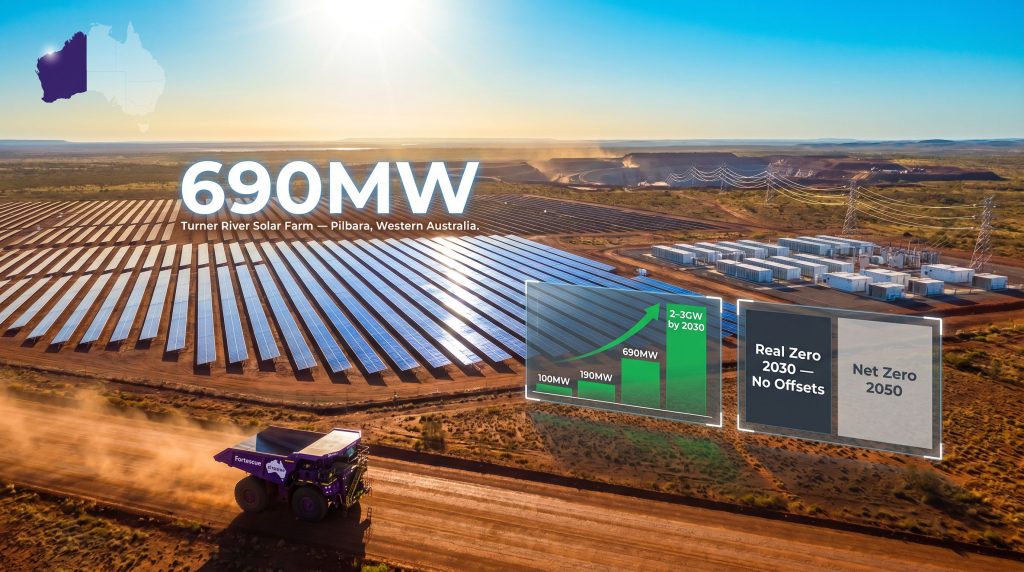
The Fortescue 690MW solar farm at Turner River is currently the largest solar construction project in Western Australia. It is not a standalone asset. The project is paired with a 650MWh battery energy storage system (BESS) at Cloudbreak, which addresses one of the central technical challenges of solar in a mining context: intermittency.
Mining operations cannot tolerate power interruptions. Haul trucks, conveyor systems, ore processing facilities, and port infrastructure all require continuous, dispatchable electricity. Solar generation alone, even at 690MW nameplate capacity, cannot guarantee that. The Cloudbreak battery system acts as a buffer, absorbing excess generation during peak solar hours and discharging during low-irradiance periods to maintain a stable supply profile.
The Pilbara's solar resource is one of the highest in Australia, with annual irradiance levels exceeding 2,200 kWh per square metre, making the region technically well suited to large-scale photovoltaic deployment. That physical advantage is central to the economic viability of the entire programme.
The Turner River farm sits within Fortescue's broader renewable energy portfolio:
| Renewable Asset | Capacity | Status |
|---|---|---|
| North Star Junction Solar Farm | 100MW | Operational |
| Cloudbreak Solar Farm | 190MW | Construction commenced 2025 |
| Turner River Solar Farm | 690MW | Construction commenced 2026 |
| Pilbara Energy Connect (transmission) | Network-scale | In development |
Progress Against the 2-3GW Target
Fortescue has publicly committed to deploying between 2GW and 3GW of combined renewable generation and battery storage across its Pilbara operations by 2030. With Turner River now under construction, total committed or operational renewable capacity approaches approximately 980MW, representing somewhere between one-third and one-half of the stated target ceiling.
That means Fortescue still needs to commission between 1GW and 2GW of additional renewable infrastructure within the next four years to fulfil its stated ambition. The pipeline between current commitments and the 2030 deadline remains one of the more important monitoring metrics for investors tracking the Real Zero programme's credibility. In addition, green iron production ambitions across the broader sector are placing increasing pressure on all major miners to accelerate their own renewable timelines.
Why Fortescue Builds Its Own Energy System Rather Than Buying Power
The Pilbara Grid Problem and the Vertical Integration Solution
A critical detail that often goes unappreciated by investors outside the resources sector is the fundamental infrastructure reality of Pilbara mining: there is no commercial electricity grid connecting these operations to the broader Western Australian network. Fortescue's mine sites at Christmas Creek, Cloudbreak, and associated facilities are entirely dependent on self-generated power.
This is not a preference for energy independence. It is a structural necessity. And it explains why Fortescue's approach to decarbonisation is inherently vertical rather than contractual. The company cannot simply sign a power purchase agreement with a renewable energy retailer the way an urban manufacturer or data centre operator might. It must physically build the generation, the storage, and the transmission infrastructure itself.
The Pilbara Energy Connect transmission network is the connective tissue of this strategy, linking solar farms, battery storage facilities, and mine sites into a single private renewable energy system. The full value chain runs from solar panel to haul truck, and all of it sits on Fortescue's balance sheet.
The Diesel Displacement Thesis: US$400 Million Per Year
The financial logic underpinning this capital-intensive approach rests substantially on fuel cost displacement. Fortescue's modelling indicates that fully substituting diesel consumption across its Pilbara operations with renewable electricity could generate annual savings of approximately US$400 million.
This figure deserves careful interpretation. Against a total decarbonisation capital budget of approximately US$6.2 billion, a US$400 million annual saving implies a theoretical payback period of roughly 15.5 years under stable energy price conditions.
The payback calculus changes dramatically when energy prices spike. During the 2022 global energy shock, diesel prices surged significantly. Had Fortescue's electrification programme been fully operational at that point, the annual savings would have been considerably higher, compressing the effective payback period. This creates an asymmetric return profile: the investment looks better precisely when global commodity markets are most volatile.
A key proof-of-concept milestone approaching this calendar year is the deployment of Fortescue's first operational battery-electric haul truck. Haul truck electrification is widely regarded as one of the hardest technical challenges in mining decarbonisation globally. These vehicles carry payloads exceeding 200 tonnes, operate around the clock, and require rapid high-capacity charging or battery-swap systems that are still being refined at commercial scale. A successful first deployment would validate the broader electrification roadmap and carry significant weight with institutional investors.
How Fortescue's Decarbonisation Ambition Compares to Global Mining Peers
A Sector-Wide Comparison of Emissions Targets
Placing Fortescue's commitment in a peer context reveals how far ahead of industry convention the Real Zero programme sits. However, it is also worth noting that Australia's iron ore leadership in global supply chains gives Fortescue a distinctive platform from which to drive these standards across the sector:
| Company | Emissions Target | Target Year | Offsets Permitted? | Renewable Capacity Committed |
|---|---|---|---|---|
| Fortescue (ASX: FMG) | Real Zero (Scope 1 & 2, Australian ops) | 2030 | No | 2-3GW by 2030 |
| BHP (ASX: BHP) | Net Zero (Scope 1, 2 & 3) | 2050 | Yes (partial) | Multiple wind/solar agreements |
| Rio Tinto (ASX: RIO) | Net Zero (Scope 1 & 2) | 2050 | Yes | Renewable energy partnerships |
| South32 (ASX: S32) | Net Zero (Scope 1 & 2) | 2050 | Yes | Various project-level initiatives |
The 20-year gap between Fortescue's 2030 deadline and the 2050 targets of its major peers is not an incremental difference. It demands a fundamentally different pace of capital deployment and a willingness to absorb infrastructure costs during a period when the full commercial benefit has not yet materialised.
Whether that represents visionary positioning or premature capital commitment depends largely on how quickly carbon pricing mechanisms, green iron production plans in competing regions, and ESG capital flows evolve over the next decade.
Financial Realities: FY25 Results and the Capital Allocation Tension
When Record Output Meets Falling Prices
Fortescue's FY25 financial results illuminate a structural tension that sits at the heart of the Real Zero investment case. The company shipped a record 198.4 million tonnes of iron ore, demonstrating operational excellence at scale. Yet net profit fell 41% to US$3.4 billion as iron ore price trends and broader price weakness overwhelmed volume gains.
Key FY25 financial metrics:
- Net profit: US$3.4 billion (down 41% year-on-year)
- Shipment volume: 198.4 million tonnes (record high)
- Full-year dividend: A$1.10 per share
- Trailing dividend yield: approximately 5.6% at prevailing share price
- Cash position: approximately US$4.3 billion
Dividend Sustainability and the Decarbonisation Budget
The US$6.2 billion decarbonisation budget does not sit in isolation. It competes with sustaining capital requirements for existing iron ore infrastructure, exploration expenditure, and shareholder return programmes. With a US$4.3 billion cash buffer providing near-term flexibility, the balance sheet can absorb the current pace of green infrastructure deployment without immediate distress.
However, a sustained decline in iron ore prices toward the lower end of the viable operating range would force explicit prioritisation decisions. At what iron ore price level does the decarbonisation budget begin to crowd out the dividend? That question does not have a precise public answer, but it is one institutional investors should be actively modelling.
The next major ASX story will hit our subscribers first
Three Scenarios for How Real Zero Shapes Fortescue's Long-Term Value
The strategic logic of Real Zero plays out differently depending on which external environment materialises over the next decade. Three distinct scenarios capture the range of plausible outcomes:
Scenario 1: Accelerated Carbon Pricing (Bull Case)
- Carbon border adjustment mechanisms mature in the EU and potentially in key Asian steel-producing markets
- Fortescue's offset-free iron ore earns a verifiable green premium in procurement processes
- Early mover positioning translates into supply chain preference among decarbonising steel producers
- The US$400 million fuel saving compounds with a pricing uplift for low-emissions ore
Scenario 2: Stable Commodity Environment (Base Case)
- Diesel displacement savings accumulate steadily, making the decarbonisation programme cost-neutral to marginally positive over a 15 to 20-year horizon
- ESG-oriented capital flows provide modest valuation support relative to offset-dependent peers
- The 2030 Real Zero deadline is met, reinforcing Fortescue's credibility in sustainability rankings that influence index inclusion and institutional mandates
Scenario 3: Prolonged Iron Ore Downturn (Bear Case)
- Compressed free cash flow forces a slowdown or phased deferral of renewable capital expenditure
- The 2030 deadline comes under pressure, creating reputational risk and potential exclusion from ESG-screened indices
- Dividend cuts reduce income investor appeal at precisely the time when commodity uncertainty is highest
Governance, Board Composition, and the Continuity of Long-Horizon Strategy
Why Board Credentials Matter for a 2030 Decarbonisation Deadline
Long-duration infrastructure programmes are uniquely vulnerable to strategic drift during leadership transitions. The Real Zero programme spans multiple commodity cycles, executive tenures, and geopolitical shifts. Its credibility depends not just on capital commitments but on governance structures that sustain strategic direction through changing conditions.
Fortescue has experienced meaningful senior leadership turnover in recent years, a pattern that warrants investor attention when evaluating whether a programme of this ambition and timeline will be maintained consistently regardless of short-term financial pressure.
The addition of Sigrid Kaag to the Fortescue board brings a governance profile that extends beyond conventional mining industry experience. Her background in international trade frameworks, multilateral finance, and sustainability policy positions her as a relevant voice in boardroom discussions about green iron ore trade frameworks being developed across the EU and parts of East Asia. Subject to regulatory approval, her appointment signals a governance intent to maintain strategic alignment with the global green transition agenda.
Institutional investors increasingly evaluate board-level sustainability expertise as a substantive signal of decarbonisation credibility, rather than treating it as symbolic ESG decoration. A director with direct experience navigating climate-aligned international trade and finance policy adds analytical depth to Fortescue's oversight of the Real Zero roadmap.
Frequently Asked Questions: Fortescue 690MW Solar Farm and Real Zero
What is the Fortescue 690MW solar farm?
The Turner River Solar Farm is a 690MW photovoltaic installation under construction in the Pilbara region of Western Australia. It is currently the largest solar construction project in the state and is paired with a 650MWh battery energy storage system at Cloudbreak. Both assets form part of Fortescue's private Pilbara Energy Connect renewable network. Furthermore, breaking ground on this 440MW+ solar park represented a significant milestone in demonstrating the company's commitment to physical decarbonisation at scale.
How does Real Zero differ from Net Zero?
Real Zero requires the physical elimination of all Scope 1 and Scope 2 terrestrial emissions from Fortescue's Australian iron ore operations by 2030, without using carbon offset purchases to compensate for residual emissions. Net Zero, by contrast, permits offset use to achieve a reported net emissions figure.
How much is Fortescue spending on decarbonisation?
The total decarbonisation capital budget is approximately US$6.2 billion, covering solar generation, battery storage, transmission infrastructure, and mining equipment electrification including haul trucks.
What are the projected fuel savings from electrification?
Fortescue's internal modelling estimates that fully replacing diesel consumption with renewable electricity across its Pilbara operations could save approximately US$400 million per year in fuel costs.
How much of the 2-3GW renewable target is currently committed?
With Turner River (690MW), Cloudbreak Solar (190MW), and North Star Junction (100MW) either operational or under construction, committed capacity stands at approximately 980MW, representing roughly one-third to one-half of the 2030 target range.
Does the decarbonisation programme affect the dividend?
The programme is funded from iron ore operating cash flows. In FY25, iron ore price weakness caused net profit to fall 41% to US$3.4 billion, and the full-year dividend was reduced to A$1.10 per share. Sustained commodity weakness could intensify the tension between funding Real Zero and maintaining distributions.
Key Takeaways for Long-Term Investors
The Fortescue 690MW solar farm is the largest single renewable energy commitment in the company's decarbonisation timeline, but it is best understood as one element within a multi-billion-dollar structural transformation, not a standalone ESG initiative.
Several points merit particular emphasis for investors evaluating FMG:
- Fortescue's share price remains fundamentally anchored to iron ore price movements, regardless of green energy progress
- The US$400 million annual fuel saving thesis provides a legitimate long-term cost reduction pathway, but the payback period is measured in decades, not years
- The 2030 Real Zero deadline creates a hard public accountability horizon that will be tested progressively as renewable capacity deployment is tracked against the 2-3GW target
- Board composition changes that strengthen sustainability governance expertise are worth monitoring as proxies for long-term strategic continuity
- Investors with a long time horizon and tolerance for commodity cycle volatility are structurally better positioned to benefit from the dual value proposition of fuel cost displacement and potential green iron ore pricing premiums
This article is general information only and does not constitute financial advice. Past performance is not indicative of future results. Readers should conduct their own independent research or consult a licensed financial adviser before making investment decisions. Forecasts, scenario projections, and financial modelling referenced in this article are speculative in nature and subject to material uncertainty.
Want To Stay Ahead of the Next Major ASX Mineral Discovery?
Discovery Alert's proprietary Discovery IQ model delivers real-time alerts on significant ASX mineral discoveries, turning complex mineral data into actionable insights for both short-term traders and long-term investors — explore the historic returns major discoveries have generated and begin your 14-day free trial today to position yourself ahead of the broader market.