
June 26, 2026
The Hidden Vulnerability Driving America's Most Unconventional Mining Strategy
There is a material that powers every lithium-ion battery ever manufactured, lubricates industrial machinery across every major sector, and sits at the heart of modern defence electronics. It is not lithium, cobalt, or rare earth oxides. It is graphite, and the United States produces none of it domestically at commercial scale. The Titan Mining graphite purification plant on US Army sites represents one of the most striking attempts yet to address this structural gap.
This is not a recently discovered problem. For decades, American policymakers tolerated near-complete dependence on foreign sources for natural flake graphite, while the broader critical minerals conversation fixated on lithium and cobalt. That oversight has compounded into a structural vulnerability that now requires unconventional solutions, including one that nobody in the minerals industry predicted: building commercial graphite purification facilities inside US military installations.
The selection of Empire State Mines, a subsidiary of Titan Mining, to develop the Kilbourne Graphite Purification Plant at two Army sites under the Enhanced Use Lease framework represents far more than a corporate milestone. It signals a fundamental reconfiguration of how the United States intends to rebuild its critical mineral processing capacity, and it raises important questions about what this model could mean for the broader mining sector.
When big ASX news breaks, our subscribers know first
Why Graphite Was Overlooked for So Long
Unlike lithium, which attracted enormous investor attention during the EV boom, graphite occupied an unglamorous corner of the minerals conversation despite being the single largest component by weight in a lithium-ion battery anode. A typical EV battery requires roughly 10 times more graphite than lithium by mass, yet the policy and investment community consistently underweighted its strategic importance.
Part of this neglect stems from graphite's dual identity as both a high-tech battery material and an industrial commodity used in everything from pencils to steel furnace linings. Its industrial ubiquity masked its battery-grade scarcity. The transformation from raw natural flake graphite into Coated Spherical Purified Graphite (CSPG), the anode-ready form required by battery manufacturers, involves sophisticated multi-stage chemical purification processes that China spent decades refining and scaling.
Furthermore, the global graphite shortage has only deepened these concerns, leaving the United States in an extraordinarily exposed position. The result is a supply chain architecture defined by the following realities:
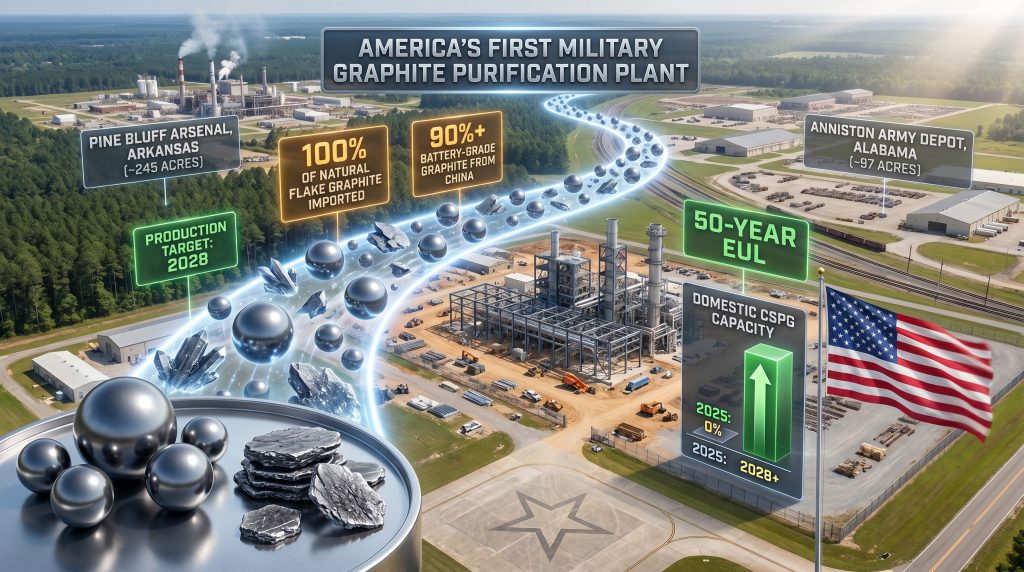
- The US imports 100% of its natural flake graphite requirements, with zero domestic commercial production
- More than 90% of battery-grade processed graphite consumed in the US originates from Chinese-controlled supply chains
- CSPG production, the most strategically critical form, requires hydrofluoric acid-based or thermal purification processes at carbon purity levels typically exceeding 99.95% carbon content
- China controls an estimated 70-80% of global natural graphite mining and an even higher share of downstream processing capacity
Graphite's strategic vulnerability is arguably more acute than lithium's, because the processing gap is wider. The US has identified lithium deposits and attracted investment in lithium processing. For graphite, the processing knowledge base, the equipment supply chains, and the commercial-scale infrastructure simply do not exist domestically in meaningful form.
Understanding CSPG: The Product at the Centre of the Competition
To appreciate why the Titan Mining graphite purification plant on US Army sites carries such strategic weight, it helps to understand what CSPG actually is and why it is so difficult to produce.
Natural flake graphite, as mined, typically carries carbon content of 85-97%, well below the threshold required for battery anode applications. The purification pathway to battery-grade CSPG involves several technically demanding steps:
- Micronisation: Reducing particle size to the specific distribution required for anode slurry preparation
- Spheroidisation: Mechanically reshaping irregular flake particles into the rounded morphology that maximises packing density in the anode
- Chemical or thermal purification: Elevating carbon purity above 99.95% through either hydrofluoric acid treatment or high-temperature thermal purification, both of which carry significant capital and environmental management requirements
- Carbon coating: Applying a thin carbon layer to the spheroidised particles to improve electrochemical performance and cycle stability
Each step requires specialised equipment, process chemistry expertise, and quality management systems capable of meeting battery manufacturer specifications. The difficulty of replicating this value chain outside China explains why import dependency has proven so persistent despite years of policy rhetoric about supply chain diversification.
The facilities to be built under the Empire State Mines EUL framework will target both Purified Micronised Graphite (PMG), used across industrial and defence manufacturing applications, and CSPG, the battery-grade product most directly exposed to geopolitical supply risk. Innovations such as a recycled graphite product are also emerging as complementary solutions to this processing challenge.
The EUL Framework: A New Instrument for Industrial Policy
The Enhanced Use Lease mechanism was not originally designed with critical minerals in mind. EUL arrangements have historically been used to allow commercial development of surplus or underutilised military land, generating economic activity and sometimes revenue for installation communities without requiring divestiture of government assets.
What the critical minerals executive order, signed in March 2025 as Executive Order 14241, accomplished was to redirect this existing legal tool toward strategic industrial objectives. By authorising the Army's Strategic Capital Initiatives programme to solicit private-sector mineral processors through competitive procurement, the executive order created a pathway for commercial-scale processing infrastructure to be established within secure, controlled environments.
The structural mechanics of the EUL arrangement matter significantly for understanding the risk and incentive profile of the programme:
| Feature | Detail |
|---|---|
| Lease Authority | US Army Enhanced Use Lease Programme |
| Maximum Lease Term | Up to 50 years |
| Land Ownership | Retained by US Army throughout lease |
| Capital Responsibility | Fully borne by Empire State Mines |
| Procurement Instrument | RFP No. DACA27-1-26-204 |
| Policy Mandate | Executive Order 14241 (March 2025) |
| Current Status | Conditional Selection Notices issued |
The 50-year maximum lease term is particularly significant from an infrastructure economics standpoint. Graphite purification plants represent long capital-cycle investments, where payback periods can extend across decades. A lease structure providing half a century of operational certainty changes the financing calculus substantially compared to shorter commercial tenure arrangements.
The Two Sites: Strategic Logic and Operational Differences
The selection of Pine Bluff Arsenal in Arkansas and Anniston Army Depot in Alabama reflects a sequenced development approach rather than simultaneous construction at both locations.
Pine Bluff Arsenal has been designated the primary site, with approximately 245 acres allocated for the Kilbourne Graphite Purification Plant infrastructure. Construction is targeted to begin in the second half of 2027, with production commencement anticipated in 2028, subject to the finalisation of lease and business terms.
Anniston Army Depot advances on a sequenced timeline following the primary Pine Bluff build-out, with approximately 97 acres designated for the secondary facility. Alabama's existing industrial base and proximity to Gulf Coast logistics networks provide complementary operational advantages for the longer-term production expansion.
| Attribute | Pine Bluff Arsenal (AR) | Anniston Army Depot (AL) |
|---|---|---|
| Designation | Primary Site | Secondary Site |
| Acreage | ~245 acres | ~97 acres |
| Development Sequence | First | Second |
| Construction Target | H2 2027 | Post-Pine Bluff |
| Production Target | 2028 | Following Pine Bluff |
The sequenced approach reduces simultaneous capital exposure for Empire State Mines while allowing operational learnings from Pine Bluff to inform the Anniston facility design and ramp-up. From a project management perspective, this is a prudent staging strategy for a company navigating a capital-intensive, first-of-kind deployment. More detail on the Kilbourne Graphite Project permitting status is publicly available for those seeking further technical background.
From Demonstration Facility to Defence Installation: The Technology Readiness Journey
One aspect of this development that deserves closer attention is the role of the Kilbourne Graphite Demonstration Facility in establishing the technology credibility that underpinned the EUL selection.
In December 2025, Empire State Mines commenced ore feeding at the demonstration facility, marking a critical transition from laboratory-scale process validation to pre-commercial production. In the mining and processing industry, this step is understood as a Technology Readiness Level (TRL) advancement, moving from bench-scale proof of concept toward the operational data required to support full commercial facility design.
The demonstration facility serves several functions that are often underappreciated by investors outside the sector:
- Generating production data on graphite recovery rates, particle size distributions, and carbon purity achievable from the specific feedstock
- Validating process chemistry at a scale sufficient to inform commercial plant sizing and reagent consumption estimates
- Producing product samples for qualification testing by potential off-take customers in the battery and defence supply chains
- Establishing operational credibility with the US Army and policymakers evaluating the company's capacity to deliver on the EUL commitment
The transition from demonstration-phase ore feeding to conditional selection for two military site installations within roughly six months suggests the demonstration facility generated sufficiently compelling process data to satisfy the Army's competitive evaluation criteria.
The next major ASX story will hit our subscribers first
Risk Factors Every Investor Should Understand
The strategic significance of this development is real, however several material uncertainties warrant careful consideration before drawing investment conclusions.
The conditional nature of the selection is the primary near-term risk. Conditional Selection Notices are not executed lease agreements. Business terms remain under negotiation, and construction cannot legally commence until those terms are formally agreed. If negotiations extend significantly beyond anticipated schedules, the 2027 construction target faces compression risk.
Capital financing is the structural challenge for a junior miner. Empire State Mines bears full development, construction, and operational financing responsibility across two military installations. For a company of Titan Mining's size, funding the design, permitting, construction, and commissioning of commercial-scale graphite purification plants on Army sites represents a substantial balance sheet undertaking. Capital raising activity, debt facility announcements, and potential strategic partnerships or off-take agreements with advance payment components will be the key signals to monitor.
Environmental permitting adds complexity to the 2027 timeline. Graphite purification, particularly if thermal purification pathways are employed, carries significant environmental management requirements. Military installations operate under their own environmental compliance frameworks, which intersect with federal and state environmental regulations in ways that can create permitting complexity and timeline variability.
Policy continuity risk is real but bounded. The EUL programme's expansion momentum depends on the continuation of Executive Order 14241's policy priorities. Executed leases, once finalised, would likely carry legal protections through subsequent administrations, but the broader programme's expansion to additional sites would remain contingent on policy continuity.
The Scalability Question: What This Template Could Mean for Other Minerals
Perhaps the most consequential long-term implication of the Titan Mining graphite purification plant on US Army sites is not the graphite itself, but the institutional template being established. The critical minerals demand surge across the battery and defence sectors makes this template increasingly urgent to replicate.
If the EUL model proves operationally and commercially viable at Pine Bluff and Anniston, the framework provides a replicable structure for deploying critical mineral processing infrastructure across the broader defence estate. The US Army alone manages millions of acres of land across hundreds of installations, much of it underutilised.
Minerals where similar processing gaps exist and where the EUL model could theoretically be applied include:
- Rare earth oxides, where Chinese processing dominance mirrors the graphite situation
- Lithium hydroxide, where conversion capacity remains insufficient domestically relative to projected battery demand
- Cobalt refining, where the Democratic Republic of Congo and Chinese-owned processing capacity represent analogous concentration risks
Titan Mining has publicly indicated openness to pursuing additional EUL opportunities at other US Army installations, positioning Empire State Mines as a potential first-mover operator in a defence-hosted mineral processing ecosystem that could expand significantly beyond its current two-site footprint. Indeed, critical minerals energy security concerns are precisely what lend this model its broader policy momentum.
The strategic scenario that critical minerals investors should model is not just a graphite purification plant. It is the establishment of a defence-anchored processing model that, if validated, could attract multiple operators across multiple mineral streams, fundamentally reshaping how domestic critical mineral value chains are built and financed in the United States.
Reports from Bloomberg Law confirm that this approach of hosting critical minerals plants at military bases is gaining institutional momentum well beyond a single company's initiative.
Key Takeaways for Investors and Industry Observers
- The Titan Mining EUL selection is a structural policy intervention targeting a documented national security vulnerability, not a routine commercial mining development
- The 50-year lease structure aligns private investment incentives with long-duration infrastructure economics in a way that shorter commercial tenures cannot replicate
- CSPG production capacity on US soil, within a secured military environment, addresses the most acute and least-solved element of America's battery supply chain exposure
- The 2027-2028 construction and production timeline is the critical near-term validation milestone, with business term finalisation the gating factor
- Investors should monitor capital raising activity, off-take agreement announcements, and environmental permitting progress as the substantive indicators of project advancement beyond the conditional selection stage
- The EUL model's success or failure at Pine Bluff and Anniston will likely determine whether broader adoption across other critical minerals becomes a serious policy pathway or remains a theoretical framework
This article contains forward-looking statements and analysis based on publicly available information. It does not constitute financial advice. Investors should conduct their own due diligence and consult qualified financial advisers before making investment decisions. All timelines, production targets, and financial projections referenced are subject to the finalisation of business terms between Empire State Mines and the US Army, and to regulatory, permitting, and financing outcomes that cannot be predicted with certainty.
Want to Stay Ahead of the Next Major Critical Minerals Discovery?
Discovery Alert's proprietary Discovery IQ model delivers real-time alerts on significant ASX mineral discoveries across graphite, rare earths, lithium, and more than 30 other commodities, instantly translating complex exploration data into actionable investment insights — explore historic discoveries and their returns to understand the magnitude of opportunity, then begin your 14-day free trial to position yourself ahead of the broader market.