June 4, 2026
Fortescue battery intelligence capabilities represent a revolutionary approach to industrial energy storage management, combining artificial intelligence, predictive analytics, and real-time control systems to optimize battery performance in extreme operational environments. As global energy markets undergo unprecedented transformation and regulatory pressures mount for decarbonisation, mining companies are increasingly seeking sophisticated technologies that can optimise energy storage performance while maintaining operational reliability in extreme environments. The convergence of artificial intelligence, predictive analytics, and real-time control systems has created opportunities for revolutionary advances in how industrial operations manage their energy infrastructure.
The integration of cloud-based analytics with on-site control mechanisms represents a fundamental shift from traditional reactive battery management approaches toward predictive, intelligent systems that can anticipate and prevent failures before they occur. Furthermore, this technological evolution becomes particularly critical in data-driven mining operations, where equipment downtime can result in millions of dollars in lost productivity and where extreme environmental conditions challenge conventional energy storage solutions.
What Makes Fortescue's Elysia Platform Revolutionary for Battery Management?
The development of advanced battery intelligence platforms marks a significant departure from traditional monitoring systems that primarily focus on basic parameter tracking. Modern industrial battery management requires sophisticated analytical capabilities that can process vast amounts of real-time data while providing actionable insights for operational optimisation.
Core AI-Driven Battery Analytics Capabilities
Advanced electrochemical modelling forms the foundation of intelligent battery management systems, utilising machine learning algorithms to predict battery behaviour under various operational conditions. These predictive models analyse cell chemistry performance across different temperature ranges, charge cycles, and load patterns to optimise charging protocols and extend operational lifespans.
Real-time performance monitoring capabilities encompass multiple battery chemistries, including lithium iron phosphate (LFP), nickel manganese cobalt (NMC), and emerging solid-state technologies. Moreover, this technology directly supports AI-powered mining efficiency initiatives across mining operations. The system continuously evaluates:
• Voltage and current characteristics across individual cells
• Temperature gradients and thermal management efficiency
• State of charge (SOC) and state of health (SOH) metrics
• Internal resistance changes indicating degradation patterns
• Gas emission levels for early fault detection
Machine learning integration enables fault prediction algorithms that learn from historical performance data to identify anomalous patterns that precede system failures. These algorithms can detect subtle changes in battery behaviour that human operators might overlook, providing early warning systems that prevent catastrophic failures and extend equipment life.
Cloud-based analytics dashboards provide fleet-wide visibility across multiple installations, allowing operators to compare performance metrics, identify optimisation opportunities, and coordinate maintenance activities across entire battery networks. This centralised approach enables pattern recognition across different operational environments and facilitates continuous improvement in battery management strategies.
Battery Life Extension Technologies
Optimised charging protocols represent one of the most significant advantages of intelligent battery management systems. By analysing real-time battery conditions and adjusting charging parameters accordingly, these systems can significantly extend operational lifespans through precision control of charge rates, voltage limits, and temperature management.
Advanced degradation modelling utilises sophisticated algorithms to predict how different operational strategies will affect long-term battery health. These models consider factors such as:
• Cycle depth and frequency patterns
• Temperature exposure profiles
• Charge and discharge rate optimisation
• Calendaring aging effects
• Capacity fade prediction models
Second-life battery applications emerge as a critical component of circular economy integration, where batteries that no longer meet primary application requirements can be repurposed for less demanding applications. In addition, this approach aligns with broader energy transition strategies that maximise the total value extracted from battery investments while reducing environmental impact.
Cost reduction implications for large-scale deployments become substantial when considering the cumulative effects of extended battery life, reduced maintenance requirements, and optimised energy utilisation. Industrial operations deploying intelligent battery management systems typically observe significant reductions in total cost of ownership over the equipment lifecycle.
When big ASX news breaks, our subscribers know first
How Does the Zitara Acquisition Enhance On-Site Control Systems?
The integration of cloud-based analytics with real-time on-premises control systems represents a fundamental advancement in industrial energy storage management. This hybrid approach combines the computational power and data storage capabilities of cloud infrastructure with the low-latency response requirements of industrial control systems.
Tim Engstrom, Fortescue Elysia managing director, emphasised that integrating real time on-site control systems with proven analytics creates a unique, globally scalable platform that positions companies at the cutting edge of battery intelligence while supporting decarbonisation missions profitably.
Real-Time Grid-Scale Energy Storage Management
On-premises control integration with cloud analytics enables sophisticated Battery Energy Storage System (BESS) optimisation that can respond to grid conditions within milliseconds while leveraging complex analytical models developed in the cloud environment. This architecture ensures that critical control decisions occur locally while benefiting from advanced algorithms and data analysis capabilities.
BESS optimisation protocols encompass multiple operational objectives, including:
• Peak demand management and load balancing
• Frequency regulation and grid stability services
• Energy arbitrage opportunities in volatile markets
• Renewable energy integration and smoothing
• Power quality improvement and harmonic filtering
Grid stability and frequency regulation capabilities become increasingly important as renewable energy penetration increases and traditional thermal generation capacity decreases. Advanced battery management systems can provide rapid response services that help maintain grid stability while generating revenue through ancillary service markets.
Revenue maximisation through intelligent trading algorithms enables battery operators to automatically participate in energy markets, buying electricity during low-price periods and selling during high-demand intervals. These algorithms consider multiple factors including electricity prices, battery state of charge, operational requirements, and market forecasts to optimise financial returns.
Bridging Cloud Intelligence with Physical Operations
Edge computing deployment enables millisecond response times for critical control functions while maintaining connectivity to cloud-based analytics platforms. This hybrid architecture ensures that safety-critical functions operate independently of network connectivity while benefiting from advanced analytical capabilities when communication links are available.
Hybrid cloud-edge architecture for industrial applications addresses the unique requirements of mining and heavy industry operations, where:
• Communication networks may be unreliable or intermittent
• Safety systems must operate independently
• Real-time control decisions cannot tolerate network latency
• Data security and intellectual property protection are paramount
Safety protocol automation and emergency response systems integrate with existing industrial safety infrastructure to provide comprehensive protection against battery-related hazards. These systems can automatically isolate faulty cells, activate fire suppression systems, and coordinate emergency response procedures.
Integration with existing power management infrastructure ensures compatibility with established electrical systems, control networks, and operational procedures. This approach minimises disruption during implementation while maximising the value of existing investments.
What Are the Technical Specifications of Fortescue's Pilbara Installations?
Industrial battery deployments in extreme environments require specialised technical approaches that address unique operational challenges. The Pilbara region of Western Australia presents particularly demanding conditions, with temperatures exceeding 40°C, significant dust exposure, and remote locations that limit maintenance access.
North Star Junction Battery System Architecture
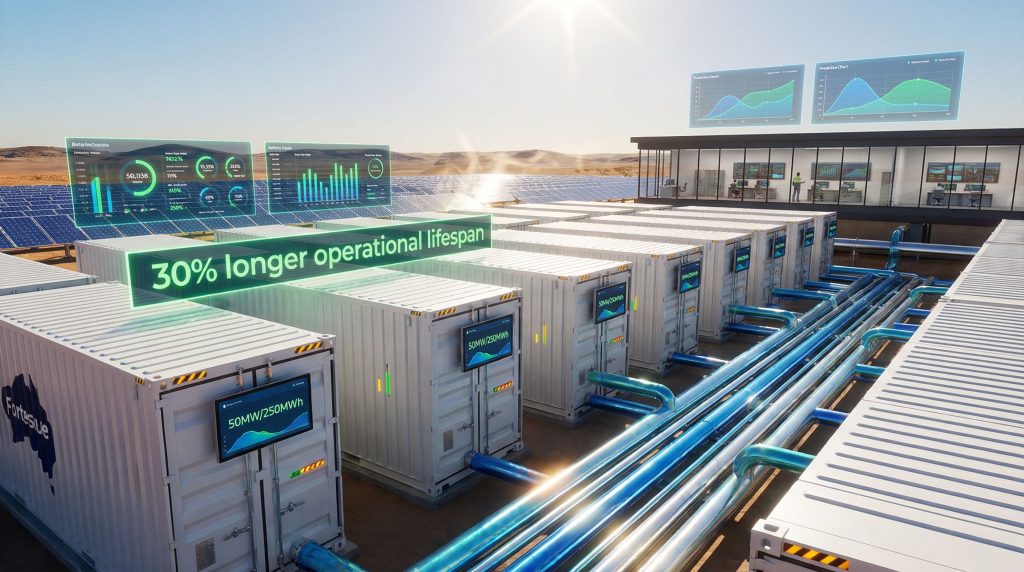
The North Star Junction installation demonstrates the practical implementation of advanced battery intelligence in a real-world mining environment. This system integrates multiple technologies to create a comprehensive energy storage solution:
| Component | Specification | Operational Benefit |
|---|---|---|
| Capacity | 50MW/250MWh | Peak demand management and grid stability |
| Technology | BYD Blade Battery (LFP chemistry) | Enhanced thermal stability and safety |
| Cooling System | Liquid cooling with redundant pumps | Extreme heat operation reliability |
| Solar Integration | Grid-tied renewable energy system | Carbon footprint reduction and cost optimisation |
| Control System | Hybrid cloud-edge architecture | Real-time response with advanced analytics |
BYD Blade Battery technology utilises lithium iron phosphate (LFP) chemistry, which offers superior thermal stability compared to traditional lithium-ion configurations. This chemistry choice proves particularly advantageous in high-temperature environments where thermal runaway risks are elevated.
The system's integration with renewable energy sources demonstrates how intelligent battery management can optimise the coordination between solar generation, energy storage, and industrial load requirements. This integration enables maximum utilisation of renewable energy while maintaining operational reliability.
Extreme Environment Performance Optimisation
Thermal management systems for operations exceeding 40°C require sophisticated engineering solutions that maintain optimal battery temperatures while minimising energy consumption. Advanced liquid cooling systems utilise:
• Variable-speed cooling pumps that adjust to temperature conditions
• Heat exchangers designed for high ambient temperatures
• Insulation systems that minimise thermal gain
• Backup cooling systems for redundancy
Dust and vibration resistance protocols address the challenging conditions present in mining environments. Battery enclosures must meet stringent ingress protection (IP) ratings while maintaining adequate ventilation for thermal management. Vibration isolation systems protect sensitive electronic components from mechanical stress caused by nearby heavy equipment operations.
Remote monitoring capabilities become essential in isolated locations where immediate physical access is not always possible. Advanced monitoring systems provide:
• Satellite or cellular communication links for data transmission
• Local data logging capabilities for communication outages
• Predictive maintenance alerts to optimise service schedules
• Remote diagnostic capabilities for troubleshooting
Maintenance scheduling optimisation through predictive analytics enables proactive maintenance approaches that minimise unscheduled downtime. These systems analyse equipment condition data to predict when maintenance will be required, allowing operators to schedule service activities during planned outages rather than responding to emergency failures.
How Does Battery Intelligence Support Fortescue's Decarbonisation Strategy?
The deployment of intelligent battery systems represents a cornerstone technology for industrial decarbonisation initiatives. These systems enable the integration of renewable energy sources into heavy industrial operations while maintaining the reliability and performance standards required for continuous production.
Real Zero Emissions Timeline and Targets
Fortescue's commitment to deploying 4-5 GWh of storage systems by 2030 represents one of the most ambitious industrial energy storage programmes globally. This deployment timeline supports the broader objective of decarbonising iron ore operations while maintaining operational efficiency and profitability.
The global market expansion into key regions including the United States, Australia, and Europe addresses markets expected to exceed 500 GWh combined capacity within five years. This expansion strategy positions Fortescue battery intelligence capabilities to serve multiple industrial sectors beyond mining operations.
Iron ore operations electrification milestones require sophisticated energy management systems that can coordinate multiple energy sources, storage systems, and industrial loads. Key electrification targets include:
• Mobile equipment fleet electrification
• Processing facility power optimisation
• Transportation infrastructure electrification
• Renewable energy integration across operations
Carbon accounting and ESG reporting automation becomes increasingly important as regulatory requirements evolve and stakeholder expectations rise. Advanced battery management systems contribute to these objectives by providing detailed energy utilisation data that supports carbon footprint calculations and sustainability reporting.
Operational Cost Reduction Through Smart Energy Management
Peak demand charge avoidance strategies utilise battery storage to reduce maximum power draw from the electrical grid during high-demand periods. This approach can result in substantial cost savings for industrial operations with significant electrical loads, as demand charges often represent a major component of electricity costs.
Energy arbitrage opportunities emerge in markets with volatile electricity pricing, where batteries can store energy during low-price periods and discharge during high-price intervals. Advanced algorithms consider multiple factors including:
• Real-time electricity market prices
• Battery state of charge and health
• Operational energy requirements
• Market price forecasts
• Grid stability service opportunities
Maintenance cost reduction through predictive algorithms enables proactive maintenance strategies that prevent costly emergency repairs and extend equipment lifespans. These algorithms analyse equipment condition data to predict when maintenance will be required, allowing operators to schedule service activities during planned outages.
Equipment lifespan optimisation across mining fleets becomes achievable through intelligent energy management that reduces stress on electrical systems, optimises charging cycles, and maintains optimal operating conditions for battery-powered equipment.
What Safety Enhancements Does Advanced Battery Monitoring Provide?
Industrial battery safety represents a critical concern for mining operations, where the consequences of battery failures can extend beyond equipment damage to pose significant risks to personnel and environmental systems. Advanced monitoring technologies provide multiple layers of protection that enhance safety while maintaining operational efficiency.
Early Warning Systems and Risk Mitigation
Thermal runaway prediction and prevention protocols utilise multiple sensor technologies to detect the early stages of battery thermal instability. These systems monitor:
• Cell-level temperature variations and trends
• Gas emission detection for hydrogen and other hazardous gases
• Voltage and current anomalies indicating internal faults
• Electrolyte leakage detection systems
Gas detection integration for hazardous environment monitoring addresses the unique risks associated with battery operations in confined spaces or areas with limited ventilation. Advanced gas detection systems can identify hydrogen accumulation, electrolyte vapours, and other potentially dangerous emissions before they reach hazardous concentrations.
Automated shutdown procedures for emergency situations ensure rapid response to potentially dangerous conditions. These systems can:
• Isolate individual battery cells or modules
• Activate ventilation systems to remove hazardous gases
• Trigger fire suppression systems when required
• Coordinate with facility-wide emergency response procedures
Compliance tracking for industrial safety standards ensures adherence to relevant regulations and industry best practices. This includes documentation of safety system tests, maintenance activities, and incident response procedures required for regulatory compliance.
Physically-Informed Safety Technologies
Multi-sensor fusion for comprehensive system awareness combines data from various monitoring technologies to provide a complete picture of battery system conditions. This approach integrates:
• Thermal imaging for hot spot detection
• Vibration monitoring for mechanical stress analysis
• Acoustic monitoring for early fault detection
• Chemical sensors for electrolyte monitoring
Anomaly detection algorithms trained on industrial datasets learn to identify subtle patterns that indicate developing problems. These algorithms consider the unique operating conditions present in mining environments and adapt their detection capabilities based on observed operational patterns.
Risk assessment scoring for preventive maintenance planning provides operators with prioritised maintenance schedules based on actual equipment condition and risk levels. This approach enables more efficient allocation of maintenance resources while maintaining high safety standards.
Integration with mine safety management systems ensures that battery safety monitoring coordinates with broader facility safety protocols. This integration enables comprehensive emergency response coordination and ensures that battery-related incidents are managed within the context of overall facility safety procedures.
How Does This Technology Compare to Traditional Battery Management Systems?
The evolution from traditional battery management systems (BMS) to intelligent, AI-driven platforms represents a fundamental shift in how industrial operations approach energy storage management. Traditional systems focused primarily on basic monitoring and protection functions, while modern platforms provide predictive capabilities and optimisation features that significantly enhance operational performance.
Competitive Advantages in Industrial Applications
| Traditional BMS | Fortescue's Elysia Platform |
|---|---|
| Monitoring Approach | Basic parameter tracking |
| Response Methodology | Reactive fault management |
| Operational Scope | Individual system focus |
| Maintenance Strategy | Scheduled maintenance intervals |
| Safety Systems | Basic protection functions |
| Data Integration | Limited connectivity |
Advanced analytics capabilities enable these modern platforms to identify optimisation opportunities that traditional systems cannot detect. This includes subtle patterns in battery performance that indicate developing problems or opportunities for improved efficiency.
Machine learning algorithms continuously improve their predictive accuracy by analysing historical data and learning from operational patterns. Consequently, this self-improving capability ensures that the system becomes more effective over time, adapting to specific operational conditions and requirements.
Integration capabilities with existing industrial systems represent a significant advantage for large-scale deployments. Modern platforms can interface with:
• Supervisory Control and Data Acquisition (SCADA) systems
• Enterprise Resource Planning (ERP) platforms
• Maintenance management systems
• Energy management platforms
Market Positioning and Scalability Potential
The global Battery Energy Storage System (BESS) market continues expanding rapidly, with projections indicating substantial growth across multiple regions. However, this expansion creates significant opportunities for advanced battery intelligence platforms that can demonstrate superior performance and reliability.
Technology licencing opportunities across industries extend beyond mining to include data centres, manufacturing facilities, renewable energy projects, and grid-scale storage deployments. The core technologies developed for extreme mining environments often exceed the requirements for less demanding applications.
Integration potential with renewable energy projects becomes increasingly important as industrial operations seek to reduce their carbon footprints while maintaining operational reliability. Advanced battery management systems enable optimal coordination between renewable generation, energy storage, and industrial loads.
Competitive advantages through proprietary algorithms create sustainable differentiation in an increasingly crowded market. Companies that develop superior predictive capabilities and optimisation algorithms can maintain technological leadership even as hardware components become commoditised.
The next major ASX story will hit our subscribers first
What Are the Future Applications Beyond Mining Operations?
The technologies developed for extreme mining environments often find applications across various industrial sectors, creating opportunities for broader market penetration and technology refinement. The demanding requirements of mining operations frequently drive innovations that exceed the needs of less challenging applications.
Cross-Industry Battery Intelligence Deployment
Automotive fleet management and optimisation represents a significant opportunity for battery intelligence technologies. Commercial vehicle fleets, particularly those transitioning to electric powertrains, require sophisticated battery management systems that can:
• Optimise charging schedules across fleet operations
• Predict maintenance requirements for individual vehicles
• Coordinate with charging infrastructure availability
• Maximise vehicle utilisation while preserving battery life
Grid-scale renewable energy storage projects benefit from advanced battery intelligence that can optimise the integration of variable renewable generation with energy storage systems. These applications require sophisticated algorithms that can balance multiple objectives including grid stability, revenue optimisation, and equipment longevity.
Heavy industry electrification initiatives across sectors such as steel production, cement manufacturing, and chemical processing require robust energy storage solutions that can handle high-power applications while maintaining reliability. The technologies developed for mining applications often translate directly to these demanding industrial environments.
Data centre backup power system enhancement represents another application area where advanced battery intelligence can provide significant value. Modern data centres require extremely reliable backup power systems, and intelligent battery management can enhance reliability while reducing operational costs.
Technology Roadmap and Development Priorities
Next-generation battery chemistry support will be essential as new technologies such as solid-state batteries, lithium-sulphur, and other advanced chemistries become commercially viable. Battery intelligence platforms must be designed to accommodate these evolving technologies while maintaining compatibility with existing installations.
Enhanced AI model training and deployment capabilities will continue improving the accuracy and effectiveness of predictive algorithms. This includes:
• Advanced neural network architectures
• Improved training methodologies
• Enhanced real-time inference capabilities
• Better integration with edge computing platforms
Expanded geographic market penetration requires adaptation to different regulatory environments, grid codes, and operational requirements. This expansion necessitates flexible platform architectures that can accommodate varying local requirements while maintaining core functionality.
Strategic partnership development with technology providers, system integrators, and end-users will be essential for market expansion and technology refinement. These partnerships enable access to new markets while providing feedback for technology improvement.
What Role Does This Technology Play in Mining Industry Evolution?
The broader context of mining industry evolution demonstrates how Fortescue battery intelligence capabilities contribute to sector-wide transformation. Similarly, technologies developed for battery optimisation complement other sustainability initiatives such as battery recycling facility developments.
Integration with Circular Economy Principles
Battery intelligence systems contribute to circular economy objectives by maximising the useful life of energy storage assets. Furthermore, predictive maintenance capabilities ensure optimal performance throughout the primary lifecycle, while second-life applications extend total value extraction from battery investments.
Recycling optimisation through performance data collection enables better planning for end-of-life battery processing. This data supports the development of more efficient recycling processes and helps determine optimal timing for battery retirement and recycling.
Frequently Asked Questions About Fortescue Battery Intelligence Capabilities
Implementation and Integration Considerations
What infrastructure requirements exist for deployment?
Modern battery intelligence platforms require robust communication networks, adequate computing infrastructure, and integration with existing control systems. The hybrid cloud-edge architecture typically requires local computing resources for real-time control functions and reliable network connectivity for cloud-based analytics.
How does the system integrate with existing energy management platforms?
Integration capabilities include support for standard industrial communication protocols such as Modbus, DNP3, and IEC 61850. The platform can interface with SCADA systems, building management systems, and other industrial control platforms through configurable communication interfaces.
What training and support services are available for operators?
Comprehensive training programmes typically include system operation, maintenance procedures, troubleshooting techniques, and optimisation strategies. Support services often encompass remote monitoring, technical assistance, and software updates to ensure optimal system performance.
What are the typical ROI timelines for industrial installations?
Return on investment timelines vary significantly based on application, electricity costs, operational requirements, and available incentive programmes. Industrial installations often achieve positive returns within 3-7 years through a combination of energy cost savings, reduced maintenance expenses, and revenue from grid services.
Technical Performance and Reliability
How accurate are the predictive maintenance algorithms?
Predictive accuracy continues improving as machine learning algorithms analyse more operational data. Modern systems typically achieve fault prediction accuracy rates exceeding 85-90% while maintaining low false positive rates that minimise unnecessary maintenance activities.
What cybersecurity measures protect industrial control systems?
Comprehensive cybersecurity frameworks include network segmentation, encrypted communications, multi-factor authentication, and regular security updates. The hybrid architecture enables air-gapped operation for critical control functions while maintaining secure connectivity for analytics and monitoring.
How does the platform handle communication failures or network outages?
Edge computing capabilities ensure that critical control functions continue operating during communication outages. Local data storage maintains operational continuity, while automatic synchronisation occurs when connectivity is restored.
What backup systems ensure continuous operation during maintenance?
Redundant system architectures include backup communication paths, redundant computing resources, and failover capabilities that maintain operational continuity during planned maintenance activities. Hot-swappable components minimise downtime for hardware replacement activities.
Fortescue's world-class battery intelligence capabilities represent a significant advancement in industrial energy storage management, positioning the technology as a cornerstone for sustainable mining operations globally.
Disclaimer: This analysis is based on publicly available information and industry knowledge. Specific performance claims, financial projections, and technical specifications should be verified through direct consultation with system providers. Market projections and technology roadmaps represent industry estimates and may vary based on technological developments and market conditions.
Looking to Identify Investment Opportunities in Australia's Energy Transition?
Discovery Alert's proprietary Discovery IQ model delivers real-time alerts on significant ASX mineral discoveries, instantly empowering investors to identify actionable opportunities in battery metals, lithium, and renewable energy companies ahead of the broader market. Explore how major mineral discoveries have historically generated substantial returns by visiting Discovery Alert's discoveries page and begin your 30-day free trial today to position yourself at the forefront of the energy transition.