July 31, 2026
When Volume Falls, Context Becomes Everything
Iron ore shipment data rarely tells a simple story. A headline number moving upward signals operational momentum, while a decline triggers questions about equipment performance, ore body quality, or the logistics chain holding everything together. For investors tracking large-cap Australian miners, understanding why volume moves matters at least as much as the direction itself. Fortescue fourth-quarter iron ore shipments for the period ending June 2026 delivered exactly this kind of interpretive challenge: a modest year-on-year decline that nonetheless managed to clear the bar set by institutional analysts.
When big ASX news breaks, our subscribers know first
What the Q4 Numbers Actually Show
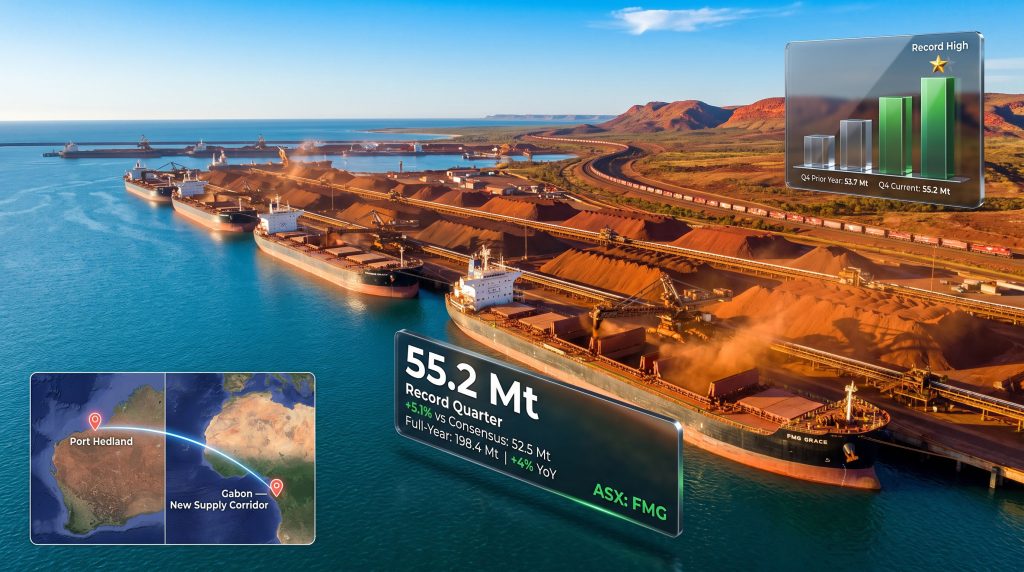
Fortescue shipped 52.7 million tonnes (Mt) of iron ore during the fourth quarter of fiscal year 2026, representing a 5% decrease compared with the 55.2 Mt shipped in the same quarter a year earlier. While a year-on-year contraction tends to attract cautious market sentiment, the result cleared the Visible Alpha consensus estimate of approximately 52.48 Mt, meaning the company narrowly outperformed what institutional analysts had collectively anticipated.
This distinction matters. A result that beats consensus, even while declining year-on-year, indicates that operational conditions were somewhat better than the market had priced in. The consensus framework exists precisely to separate expected from unexpected outcomes, and Fortescue's ability to edge above that benchmark provides a small but meaningful signal about near-term execution.
| Metric | Q4 FY2026 | Q4 FY2025 | Change |
|---|---|---|---|
| Quarterly Shipments | 52.7 Mt | 55.2 Mt | -5% YoY |
| Analyst Consensus (Visible Alpha) | ~52.48 Mt | N/A | Beat by ~0.22 Mt |
| Record Status | Below prior year | Prior benchmark | Decline reported |
Key Insight: Despite falling short of the prior year's quarterly figure, Fortescue's Q4 FY2026 result marginally exceeded institutional consensus, suggesting that the operational drag was anticipated and largely priced into forecasts before the announcement.
Hematite Operations: The Core Driver of the Shortfall
The underlying cause of the year-on-year volume decline was attributed to subdued performance at Fortescue's Hematite operations. This is an important detail for investors who follow the company's operational structure closely.
Hematite ore, the dominant iron-bearing mineral at Fortescue's Pilbara mines, is characterised by its high iron content and relatively straightforward processing requirements compared with magnetite deposits. Furthermore, understanding iron ore types and deposits helps clarify why hematite performance is so central to Fortescue's overall output. The Pilbara hematite portfolio encompasses major operations including the Chichester Hub and the Solomon Hub.
When hematite operations underperform, the causes typically fall into several categories:
- Equipment availability rates dropping below optimal thresholds across the truck and shovel fleet
- Ore body variability creating grade inconsistencies that slow processing throughput
- Planned maintenance shutdowns reducing available operating hours within the quarter
- Conveyor, crusher, or screening bottlenecks downstream of the mine face
- Adverse weather conditions impacting haul road productivity or port access windows
The Pilbara region experiences its highest operational risk during the wet season, broadly spanning November through April. The fourth quarter (April through June) typically represents a period of more stable conditions, yet residual operational disruptions from earlier in the year can carry through into Q4 productivity figures.
Product Grade and the Discount Dynamics Investors Often Underestimate
One dimension of Fortescue's shipment performance that warrants closer investor attention is the relationship between ore grade and realised pricing. Fortescue's standard Pilbara Blend product carries an average iron content typically in the 57-58% Fe range, meaningfully below the industry benchmark grade of 62% Fe used for international price referencing.
This grade differential creates what the industry terms a grade discount, meaning Fortescue's ore sells at a lower per-tonne price than the headline benchmark figure. The size of this discount is not fixed; it fluctuates based on Chinese steel mill demand patterns, blast furnace efficiency preferences, and the relative availability of higher-grade material from producers such as Vale and Rio Tinto. Indeed, iron ore price trends show how these grade dynamics interact with broader market forces.
Investor Consideration: When iron ore benchmark prices weaken, grade discounts often widen simultaneously, creating a compounding revenue effect for lower-grade producers. Fortescue's realised revenue per tonne can therefore move in a non-linear relationship with the 62% Fe spot price.
During periods when Chinese steel mills prioritise productivity and throughput, they tend to favour higher-grade ores that require less energy to process and generate less slag waste. Consequently, this preference dynamic can amplify the pricing disadvantage for blended, lower-grade product at precisely the moments when market conditions are already challenging.
### How Does the China Steel Market Shape Demand?
The China steel demand outlook remains a critical variable for any assessment of Fortescue's revenue trajectory. Chinese blast furnaces collectively consume the vast majority of globally traded seaborne iron ore, and shifts in their operating rates can move realised prices for Australian producers significantly within a single quarter.
Fortescue's Position in the Global Iron Ore Hierarchy
Context helps calibrate the significance of any single quarter's performance. Fortescue remains the world's fourth-largest iron ore miner by shipment volume, operating behind Vale, Rio Tinto, and BHP in the global rankings. This position reflects decades of infrastructure investment in the Pilbara, including the construction of dedicated heavy-haul rail corridors and the development of Herb Elliott Port at Port Hedland.
| Producer | Approximate Annual Volume | Global Rank |
|---|---|---|
| Vale (Brazil) | ~310-330 Mt | 1 |
| Rio Tinto (ASX: RIO) | ~320-330 Mt | 2 |
| BHP (ASX: BHP) | ~280-290 Mt | 3 |
| Fortescue (ASX: FMG) | ~200+ Mt range | 4 |
One structural advantage Fortescue holds relative to its Brazilian competitor Vale is shipping distance. Australia's iron ore advantages are particularly evident here — Australian iron ore reaches Chinese ports in approximately five to eight days, compared with twenty-five to thirty-five days for Brazilian cargoes. This freight differential translates into meaningful cost advantages for Chinese steel mills sourcing Australian material.
The Gabon Project: A New Geographic Growth Vector
Beyond the Pilbara, Fortescue has been advancing plans to establish iron ore production in Gabon, West Africa. The company has indicated its intention to complete its first iron ore shipment from Gabon by the end of 2026, a milestone that would mark a significant geographic diversification of its supply base.
This strategic move introduces a distinct set of considerations for investors:
- Infrastructure development requirements are substantial in West African contexts, including port access construction, rail corridor development, and power supply logistics
- Sovereign risk profiles differ considerably from Australia's stable regulatory and legal environment, requiring investors to apply an appropriate risk premium to African production volumes
- Ramp-up timelines for new greenfield or brownfield operations in frontier markets historically extend beyond initial projections
- Initial volume contributions from Gabon are expected to be modest relative to the Pilbara base, meaning the asset functions as an incremental growth option rather than a near-term volume driver
The Gabon deposit is understood to contain high-grade iron ore, which could prove commercially attractive given the grade discount dynamics discussed earlier. Higher-grade ore from a new supply source would carry a different pricing structure than Fortescue's existing Pilbara blend, potentially improving the company's overall realised price per tonne over time if volumes scale meaningfully.
The next major ASX story will hit our subscribers first
Volume Decline in the Context of Price and Revenue Realities
A 5% quarterly shipment decline does not occur in isolation. Its financial impact depends heavily on the prevailing iron ore price environment and currency dynamics at the time of reporting.
Several interconnected variables shape the revenue outcome for any given quarter:
- Spot price of iron ore (62% Fe CFR China) as the benchmark reference point
- Grade discount applied to Fortescue's specific product blend
- AUD/USD exchange rate, since iron ore is priced in US dollars while operating costs are largely denominated in Australian dollars
- Freight rate movements, which affect the delivered cost competitiveness of Australian versus Brazilian supply
- Chinese steel mill utilisation rates, which drive near-term demand for seaborne ore
A falling AUD/USD exchange rate can partially offset lower volumes or weaker benchmark prices, since Australian dollar-denominated revenue rises when the local currency depreciates. This currency buffer has historically provided some protection to Fortescue's earnings during soft iron ore price environments.
How Do Analysts Estimate Shipment Volumes?
The mechanics of how analysts arrive at iron ore shipment estimates for a producer of Fortescue's scale deserve some explanation. Consensus forecasting models for bulk commodity miners typically incorporate:
- Historical quarterly throughput averages adjusted for announced capacity changes
- Port throughput data from publicly available shipping intelligence services
- Vessel tracking data that approximates cargo volumes in real time
- Management guidance ranges issued at the start of each financial year
- Weather and seasonal adjustment factors based on historical disruption patterns
Despite these inputs, forecasting Fortescue fourth-quarter iron ore shipments remains inherently imprecise. Final-week vessel loading windows, tide-dependent port scheduling, and last-minute equipment availability changes can all shift a quarterly total by one to two million tonnes in either direction. This explains why even relatively small beats against consensus carry informational value. For additional context, recent shipment data from Fortescue illustrates how the company's half-year performance has also attracted close market scrutiny.
Dividend Implications and Capital Allocation Priorities
Fortescue's dividend history reflects a high payout culture that has periodically delivered some of the largest yield figures among ASX-listed companies. The company's ability to sustain shareholder returns depends on the combination of shipment volumes, realised prices, and operating cost discipline.
A quarterly shipment decline of 5% year-on-year, if accompanied by softer iron ore prices, creates a narrower earnings base from which to fund distributions. Investors should consequently track the company's C1 cash cost per wet metric tonne shipped alongside volume data, as this figure captures the direct mining and processing costs that most directly influence margin outcomes.
Fortescue has also been allocating substantial capital toward its energy transition ambitions, encompassing green iron production initiatives, renewable energy generation, and electrification of mining equipment. These commitments represent a long-duration capital deployment that competes with near-term dividend capacity, and their scale relative to iron ore cash flows becomes more relevant during periods of volume or price softness.
However, it is worth noting that the company's full-year performance provides important context for interpreting any single quarter's data. Fortescue's annual shipment trajectory demonstrates how individual quarterly outcomes can diverge meaningfully from longer-term operational trends.
Frequently Asked Questions
What were Fortescue's fourth-quarter iron ore shipments for FY2026?
Fortescue fourth-quarter iron ore shipments totalled 52.7 million tonnes during fiscal year 2026, down 5% from 55.2 Mt in the same quarter of the prior year.
Did Fortescue beat analyst expectations for Q4 FY2026?
Yes. The institutional consensus estimate compiled by Visible Alpha stood at approximately 52.48 Mt. Fortescue's result of 52.7 Mt marginally exceeded this benchmark.
Why did Fortescue's Q4 shipments fall year-on-year?
The decline was attributed to subdued performance at Hematite operations within the Pilbara, which reduced throughput relative to the prior corresponding period.
How does Fortescue's ore grade affect its pricing?
Fortescue's Pilbara Blend product typically contains approximately 57-58% iron, below the 62% Fe benchmark. This results in a grade discount that reduces realised revenue per tonne below headline spot price references.
What is Fortescue's global ranking among iron ore miners?
Fortescue is the world's fourth-largest iron ore producer by shipment volume, behind Vale, Rio Tinto, and BHP.
What is the Gabon project?
Fortescue is developing iron ore production assets in Gabon, West Africa, with an intention to complete a first shipment from that operation by the end of calendar year 2026.
Key Takeaways for Market Participants
- 52.7 Mt shipped in Q4 FY2026, down 5% year-on-year from 55.2 Mt
- Result narrowly exceeded Visible Alpha consensus of approximately 52.48 Mt
- Shortfall driven by subdued Hematite operations performance in the Pilbara
- Grade discount dynamics mean realised pricing remains below the 62% Fe benchmark headline
- Gabon project represents a future geographic diversification option, with first shipment targeted by end of 2026
- Investors should assess realised price per tonne, C1 costs, and AUD/USD movements alongside raw volume data for a complete earnings picture
- Capital allocation tension between shareholder returns and energy transition investment commitments remains a structural consideration for Fortescue positioning
This article is intended for informational purposes only and does not constitute financial advice. Iron ore price forecasts, shipment projections, and financial estimates involve inherent uncertainty. Investors should conduct independent due diligence before making investment decisions.
Want to Spot the Next Major ASX Mineral Discovery Before the Broader Market Does?
While large-cap iron ore producers like Fortescue dominate volume headlines, some of the most significant investment returns in Australian resources history have come from early-stage mineral discoveries — and Discovery Alert's proprietary Discovery IQ model delivers real-time alerts the moment significant ASX discoveries are announced, turning complex geological data into actionable insights. Explore Discovery Alert's dedicated discoveries page to understand how historic finds have generated exceptional returns, and begin your 14-day free trial today to position yourself ahead of the market.