July 31, 2026
The Hidden Mechanics Behind Mining's Profit Paradox
When a company reports revenue growth of nearly 20% in a single quarter, most investors expect profit to follow in the same direction. The reality of large-scale commodity mining is far more complex. Cost structures, pricing cycles, capital obligations, and non-operational charges interact in ways that can produce a deeply counterintuitive result: a business generating more revenue than ever while simultaneously reporting a sharp decline in net earnings.
This is not a failure of the business model. It is a diagnostic feature of how commodity-exposed conglomerates absorb macro-level pricing shocks through their income statements before shareholders see the bottom line. Understanding how Vale Q2 net profit falls and narrows nickel copper output outlook helps investors interpret these dynamics with greater precision.
Vale's Q2 2026 financial results illustrate this dynamic with unusual clarity. As one of the world's largest producers of iron ore, nickel, and copper, Vale operates at a scale where even modest commodity price shifts can generate enormous swings in net profitability. Understanding the gap between what Vale produced, what it earned operationally, and what ultimately reached shareholders is essential context for evaluating whether the company's underlying business is deteriorating, or simply absorbing a temporary pricing cycle.
When big ASX news breaks, our subscribers know first
Q2 2026 Financial Performance: Reading Between the Lines
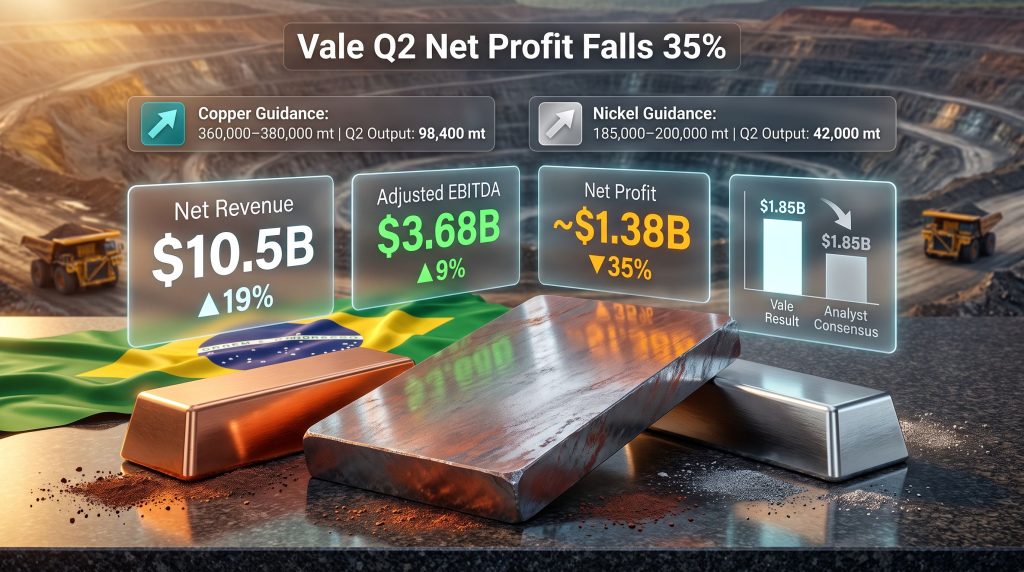
Vale recorded a net profit of approximately $1.38 billion for the April to June 2026 quarter, a 35% decline compared to the same period in 2025. Against analyst consensus tracked by LSEG, which had forecast net profit of around $1.85 billion, Vale's result came in roughly 25% below market expectations.
What makes this result particularly instructive is that it occurred alongside genuinely strong operating metrics:
- Net revenue rose 19% year-on-year to $10.5 billion
- Adjusted EBITDA climbed 9% to $3.68 billion
- Cost reductions were achieved across iron ore, copper, and nickel divisions
| Financial Metric | Q2 2026 Result | Year-on-Year Change |
|---|---|---|
| Net Profit | ~$1.38 billion | Down 35% |
| Adjusted EBITDA | $3.68 billion | Up 9% |
| Net Revenue | $10.5 billion | Up 19% |
| Analyst Consensus (Net Profit) | ~$1.85 billion | Below by ~25% |
The simultaneous rise in EBITDA and revenue alongside a sharp net profit decline points to below-the-line factors absorbing operational gains. This pattern, where EBITDA and net profit diverge significantly, is a hallmark of periods in which commodity pricing pressure, depreciation charges from large capital programmes, and financing costs converge to suppress earnings per share even as the core business operates efficiently.
Why EBITDA and Net Profit Tell Different Stories
The Below-the-Line Effect in Large Mining Operations
EBITDA strips out interest, tax, depreciation, and amortisation to reveal operational cash generation capacity. For capital-intensive businesses like Vale, which operates enormous open-cut and underground mining systems across multiple continents, depreciation charges on existing asset bases can be substantial. When these are added back in the move from EBITDA to net profit, the gap can be significant even when operations are running efficiently.
Vale's capital expenditure programmes in recent years, particularly across its base metals expansion and iron ore system maintenance, have accumulated a large asset base subject to ongoing depreciation. This structural feature of mining accounting means that operationally sound quarters can still produce disappointing net profit figures, particularly when realised commodity prices are under pressure. The relationship between commodity prices and mining profits is, consequently, far more nuanced than headline revenue figures suggest.
Commodity Pricing as the Primary Variable
Nickel represents one of the most significant pricing headwinds Vale faces in 2026. The global nickel market has been in structural oversupply for several years, driven largely by the rapid scaling of Indonesian nickel oversupply processing capacity using High-Pressure Acid Leach (HPAL) and Rotary Kiln Electric Furnace (RKEF) technology. Indonesia's output growth has fundamentally altered the seaborne nickel supply curve, pushing benchmark prices well below levels that most traditional sulphide nickel producers require for strong margins.
Vale's nickel assets are primarily sulphide-based, a geological distinction that matters enormously for cost and quality profiles. Sulphide nickel ore, found in deposits like Vale's Sudbury operations in Canada, typically produces a higher-grade, lower-impurity product suitable for battery-grade applications. However, sulphide deposits are geologically less abundant and more expensive to mine than laterite deposits, meaning that when laterite-derived supply floods the market, sulphide producers face a double compression: falling prices combined with structurally higher unit costs.
This nuance is often missed in surface-level analysis. The nickel market outlook in 2026 is not simply one of oversupply in volume terms. It is experiencing a quality bifurcation, where Class 1 nickel (refined, battery-grade) and Class 2 nickel (lower purity, used in stainless steel) are pricing differently, creating complex realised-price dynamics for diversified producers like Vale.
Production Guidance Revisions: What the Tightened Ranges Signal
Vale's decision to narrow its full-year 2026 production guidance for both copper and nickel carries more information than a simple range adjustment suggests.
| Commodity | Previous Guidance Range | Revised 2026 Guidance | Q2 2026 Quarterly Output |
|---|---|---|---|
| Copper | 350,000 to 380,000 mt | 360,000 to 380,000 mt | 98,400 mt |
| Nickel | 175,000 to 200,000 mt | 185,000 to 200,000 mt | 42,000 mt |
Copper: The Outperformer in Vale's Portfolio
Copper production of 98,400 metric tons in Q2 2026 alone represents a strong quarterly delivery, supporting the revised full-year guidance floor of 360,000 metric tons. Vale's copper assets, which span operations in Brazil and its Salobo mine in particular, benefit from relatively low strip ratios and established processing infrastructure.
The copper market context matters here. Unlike nickel, the looming copper supply crunch means the market faces a structurally tightening supply environment. Major mining analysts and commodity banks have consistently flagged that new copper mine development is lagging behind forecast demand growth from electrification, grid infrastructure, and EV manufacturing.
Codelco, the world's largest copper producer by historical output, has publicly acknowledged that returning to peak production levels is not a realistic near-term objective, a signal that has contributed to price support across the copper complex. For Vale, stronger copper output during a period of constructive pricing provides a meaningful partial offset to nickel's headwinds, even if the segment's scale remains smaller relative to iron ore.
Nickel: Operational Confidence in a Difficult Market
Raising the nickel guidance floor from 175,000 to 185,000 metric tons reflects improved mine planning and processing reliability rather than any change in the commodity price environment. Vale's Q2 nickel output of 42,000 metric tons annualises to approximately 168,000 tons, suggesting that H2 2026 production will need to accelerate to meet the revised guidance range. The upward floor revision indicates management confidence that this ramp is achievable.
What the revised guidance does not address is the pricing environment. Even with stronger volumes, nickel's contribution to Vale's overall profitability is constrained by market prices that reflect persistent oversupply. This creates an unusual operational scenario: Vale can produce more nickel, demonstrate better operational execution, and still see the segment contribute less to net earnings than shareholders might expect.
Capital Allocation Strategy: Buybacks as a Confidence Signal
Understanding Vale's Share Repurchase Programme
Vale announced authorisation to repurchase up to 100 million shares over an 18-month window, alongside a shareholder distribution of 2.03 Brazilian reais per share delivered through a combination of traditional dividends and interest on equity (IOE).
IOE is a Brazil-specific capital return mechanism that is not widely understood outside of Brazilian corporate finance. Under Brazilian tax law, companies can distribute notional interest on their equity capital to shareholders as a deductible expense, reducing the company's taxable income while providing shareholders with a return that is taxed at a flat rate. This structure effectively allows Vale to return capital more efficiently than dividend-only programmes, and is a feature of Vale's remuneration approach that represents genuine value creation relative to peers operating under different tax jurisdictions.
Authorising a buyback of this scale during a period of reported profit decline is a calculated communication to the market. It signals that management views the earnings weakness as cyclical rather than structural, and that the company's cash generation capacity, as evidenced by its EBITDA performance, remains robust enough to support both ongoing capital expenditure and shareholder returns simultaneously.
What the Dual Remuneration Approach Tells Investors
Running buybacks and dividend distributions concurrently is a capital allocation posture that requires confidence in forward cash flows. The combination suggests Vale's treasury function is modelling a scenario where current commodity price pressures are temporary. Furthermore, it implies the company's iron ore and base metals businesses will generate sufficient cash to service these commitments without balance sheet strain.
Peer Comparison: Vale Within the Global Mining Landscape
| Dimension | Vale | BHP / Rio Tinto | Anglo American |
|---|---|---|---|
| Iron Ore Concentration | Very High | Moderate to High | Lower |
| Nickel Exposure | Significant | Minimal | Minimal |
| Copper Growth Focus | Increasing | Established | Restructuring |
| Capital Return Mechanism | Dividends + IOE + Buybacks | Dividends + Buybacks | Dividends + Buybacks |
| Q2/H1 2026 Profit Position | $1.38bn net profit | Not yet reported | $(858)m H1 loss |
Anglo American's reported first-half 2026 loss of $858 million, even as that figure represented an improvement from its prior-year loss of $1.9 billion, provides useful context for Vale's result. Vale's $1.38 billion net profit, despite falling 35% year-on-year, still represents a meaningfully positive earnings outcome relative to at least one major peer navigating the same commodity pricing environment. According to Mining Weekly, Vale's cost outlook improvements across copper and nickel divisions further distinguish its operational performance from many industry peers.
The next major ASX story will hit our subscribers first
Strategic Themes Emerging From Vale's Q2 Disclosure
Three broader industry dynamics crystallise when Vale's Q2 results are examined through a structural rather than a purely quarterly lens:
-
The EBITDA-to-net-profit conversion gap is a sector-defining challenge in 2026. Across major diversified miners, operational efficiency gains and revenue growth are not translating proportionally into net earnings because pricing, capital structure costs, and depreciation are dominating the equation. This pattern is likely to persist until commodity price cycles turn more broadly constructive.
-
Production guidance tightening mid-year reflects genuine operational maturity. Vale's ability to raise guidance floors for both copper and nickel after just two quarters suggests improved systems-level visibility across its operations. This is a qualitative signal that the business is executing well even if the financial results are obscured by external pricing dynamics.
-
The quality differentiation within nickel markets is an underappreciated risk factor for producers. As battery chemistry evolves and manufacturers refine their specifications for cathode materials, the distinction between Class 1 and Class 2 nickel is likely to become more commercially significant. Producers with sulphide-based nickel assets may find themselves better positioned in a future battery supply chain than current spot prices suggest.
In addition, broader shifts in iron ore price trends continue to exert considerable influence on Vale's overall earnings profile, given the commodity's dominant contribution to group revenue.
FAQ: Vale Q2 2026 Key Questions Answered
Why did Vale's net profit fall 35% when revenue grew 19%?
Revenue growth does not automatically produce proportional profit growth. Non-operational costs, including depreciation on large asset bases, financing charges, and tax effects, reduce the conversion rate from operating earnings to net profit. Vale's EBITDA growth of 9% confirms the operating business performed well. The net profit decline reflects below-the-line factors rather than operational weakness. As Reuters reported, however, subsequent quarters demonstrated Vale's capacity to recover when pricing conditions improved.
What is interest on equity and why does Vale use it?
Interest on equity is a Brazilian corporate finance mechanism allowing companies to distribute notional interest on equity capital as a tax-deductible expense. It is more capital-efficient than pure dividends for Brazilian-registered entities and is a standard feature of how large Brazilian companies structure shareholder remuneration.
Does nickel oversupply affect all producers equally?
No. The oversupply is primarily driven by Indonesian laterite nickel production, which produces a different quality of nickel than Vale's sulphide-based assets. The pricing pressure is felt broadly, but the long-term quality positioning of sulphide producers may differ from laterite producers as battery manufacturer specifications evolve.
Is Vale's earnings weakness likely to persist?
The operational metrics suggest the business fundamentals are intact. Whether net profit recovers depends primarily on commodity price trajectories, particularly for nickel, and on whether below-the-line cost pressures normalise. The buyback authorisation and maintained distributions suggest management views current weakness as cyclical. For context, the broader pattern of how Vale Q2 net profit falls and narrows nickel copper output outlook reflects an industry-wide dynamic rather than a company-specific failing.
Disclaimer: This article is intended for informational and educational purposes only and does not constitute financial advice. All financial figures referenced are sourced from publicly available disclosures and analyst consensus data as reported at the time of publication. Commodity markets are subject to significant volatility and uncertainty. Past performance is not indicative of future results. Readers should conduct their own due diligence before making any investment decisions.
Want To Spot the Next Major ASX Mineral Discovery Before the Market Does?
Discovery Alert's proprietary Discovery IQ model delivers real-time alerts on significant ASX mineral discoveries, transforming complex commodity data into clear, actionable insights for investors at every experience level — start your 14-day free trial today and gain a genuine market edge, or explore Discovery Alert's dedicated discoveries page to understand how historic mineral discoveries have generated substantial returns for well-positioned investors.