July 31, 2026
When Volume and Decarbonisation Converge: Understanding Fortescue's Industrial Inflection Point
The iron ore industry has long operated under an unspoken assumption: that extracting and shipping more material inevitably deepens a company's fossil fuel dependency. Heavy haul trucks burning diesel across vast distances, gas-fired power stations supplying remote mine sites, and diesel-intensive processing circuits have defined the operational blueprint of Pilbara mining for decades. Fortescue iron ore shipments and Real Zero pathway represent a direct structural challenge to this assumption, and one of the world's largest producers is now testing it at scale.
Fortescue's FY26 result is significant not simply because it delivered record volumes, but because it achieved those volumes while simultaneously advancing one of the most ambitious decarbonisation programmes in global resources history. Understanding how these two trajectories are being pursued in parallel, and what the combined result signals for the future of the Pilbara, requires looking beyond the headline tonne figures.
When big ASX news breaks, our subscribers know first
FY26 Performance: The Numbers That Defined a Record Year
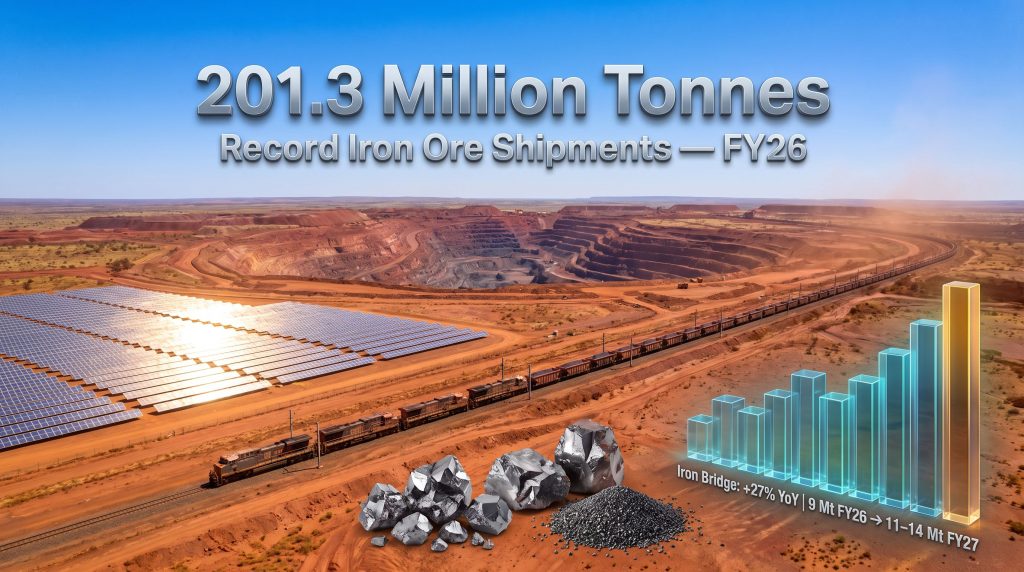
Fortescue crossed the 200 million tonne threshold for the first time in its operating history during FY26, a milestone that reflects the maturation of an integrated mining, rail, and port system operating at peak synchronisation across the Pilbara.
The detailed performance breakdown tells a multi-layered story:
| Metric | FY26 Result | Context |
|---|---|---|
| Total iron ore shipments | 201.3 million tonnes | First time exceeding 200 Mt |
| June quarter shipments | 52.7 million tonnes | Record quarterly result |
| Hematite shipments | 192.3 million tonnes | Core Pilbara production base |
| Iron Bridge concentrate | 9 million tonnes | Up 27% year-on-year |
| Hematite C1 unit cost | US$18.74/wmt | Within full-year guidance |
| Year-end cash balance | US$5.1 billion | Post-capital expenditure position |
| Net debt | US$1.1 billion | After US$5.1 billion capex cycle |
Several dimensions of this result warrant closer examination. The Hematite C1 unit cost of US$18.74 per wet metric tonne was maintained within guidance despite persistent inflationary headwinds affecting labour, fuel, and consumables costs across the Western Australian mining sector. For a producer operating at this scale, holding the cost line while simultaneously deploying billions in green infrastructure capital represents a meaningful operational discipline achievement.
The US$5.1 billion cash balance, held alongside US$1.1 billion in net debt after a capital expenditure programme of equivalent magnitude, signals financial resilience that is particularly relevant to investors assessing the sustainability of the ongoing energy transition investment cycle.
Metals and operations CEO Dino Otranto attributed the record result to the collective performance of the company's fully integrated supply chain, encompassing mining, processing, rail corridors, and port operations working in concert. This level of system-wide coordination is not incidental. Pilbara iron ore logistics involve some of the longest private heavy-haul rail networks on earth, and optimising ore movement across those distances requires significant operational sophistication.
Iron Bridge: From Ramp-Up Complexity to Growth Engine
Perhaps the most technically interesting component of Fortescue's FY26 result is the performance trajectory of Iron Bridge, the company's magnetite iron ore operation situated in the Pilbara region of Western Australia.
Understanding Magnetite vs. Hematite: A Product Quality Distinction
Most casual observers of the iron ore market conflate all iron ore shipments as equivalent, but the distinction between hematite and magnetite is commercially and technically material. Hematite, Fortescue's core product, is a direct-shipping ore typically grading around 56–62% iron content and requiring relatively minimal processing before export.
Magnetite, by contrast, is a lower-grade ore in its natural state, often grading 25–35% iron, but it is processed and concentrated into a product that can reach 66–68% iron content or higher. This higher-grade concentrate commands premium pricing in steel markets, particularly among customers operating blast furnaces or direct-reduction iron facilities that require elevated iron feedstock purity.
As global steelmakers face increasing pressure to reduce carbon intensity, higher-grade inputs that require less coking coal per tonne of steel produced are becoming structurally more valuable. Furthermore, the steel market outlook points to sustained demand for premium-grade feedstocks as decarbonisation pressures intensify across major producing economies.
Iron Bridge delivered 9 million tonnes of magnetite concentrate during FY26, representing 27% growth compared to the prior year. FY27 guidance of 11 to 14 million tonnes on a 100% basis points to continued acceleration.
| Dimension | Hematite Operations | Iron Bridge Concentrate |
|---|---|---|
| FY26 Volume | 192.3 Mt | 9 Mt |
| FY27 Guidance | Part of 197–207 Mt total | 11–14 Mt (100% basis) |
| Iron Content (approx.) | 56–62% as shipped | 66–68%+ after concentration |
| Processing Intensity | Low (direct ship) | High (grinding, magnetic separation) |
| Strategic Role | Core revenue base | Premium product diversification |
| Growth Trajectory | Stable to incremental | Accelerating ramp-up |
The magnetite concentration process involves energy-intensive grinding and magnetic separation circuits, which makes Iron Bridge's energy consumption profile substantially higher per tonne of output than hematite operations. This is precisely why the renewable energy grid being constructed across the Pilbara has direct commercial significance for Iron Bridge's long-term cost competitiveness. Powering magnetite processing with solar-generated electricity rather than diesel or gas is not simply an emissions story; it is a unit cost story.
Defining Real Zero: Why the Terminology Matters
The phrase net zero has become so widely used in corporate sustainability communications that it has lost much of its analytical precision. Understanding how Fortescue's Real Zero target differs from conventional net-zero pledges requires engaging with the mechanics of emissions accounting.
Real Zero vs. Net Zero: A Framework Distinction
- Net Zero frameworks allow companies to continue burning fossil fuels provided they purchase an equivalent volume of carbon offsets, such as credits from forestry or soil carbon projects, to compensate for those emissions.
- Real Zero requires the physical elimination of fossil fuel combustion from targeted operations. No offset purchasing is permitted to bridge the gap.
Fortescue's Real Zero commitment applies to Scope 1 and Scope 2 emissions from its Australian terrestrial iron ore operations, with a target year of 2030. Scope 1 emissions are direct combustion emissions from equipment and vehicles operated by the company. Scope 2 emissions arise from purchased electricity. Shipping emissions are addressed under a separate target: a 50% reduction in shipping emissions intensity from FY21 baseline levels by 2030.
The significance of the offset-exclusion clause extends beyond marketing differentiation. Carbon offset markets have attracted sustained scrutiny regarding the integrity of credits, with research published in peer-reviewed journals including Science raising questions about whether many forestry offsets deliver the permanent carbon storage they claim. A company committing to physical elimination of emissions rather than purchased compensation is making a structurally different and, in important respects, more verifiable commitment.
The Four Operational Pillars of Real Zero
Reaching Real Zero by 2030 requires transforming the energy inputs across four operational domains:
-
Green power generation – Replacing diesel generators and gas-fired power stations at mine sites with utility-scale solar, wind, and battery storage infrastructure.
-
Mining fleet electrification – Transitioning heavy earthmoving equipment including haul trucks and excavators from diesel combustion to battery-electric or hydrogen-electric drivetrains.
-
Haulage and rail decarbonisation – Eliminating diesel consumption across the rail corridor connecting Pilbara mine sites to Port Hedland, one of the world's highest-volume bulk export ports.
-
Processing and infrastructure transformation – Decarbonising ore processing circuits, including the energy-intensive concentration processes at Iron Bridge.
Each of these pillars presents distinct engineering and commercial challenges. Heavy haul trucks operating in Pilbara conditions carry payloads exceeding 200 tonnes across terrain that demands both power density and thermal management performance that current battery technology is only beginning to approach at commercial scale.
Turner River Solar Farm: The Capstone Infrastructure Project
Construction commencement on the 690-megawatt Turner River solar farm marks a critical structural milestone in the Real Zero timeline. Fortescue has described this project as the final solar installation required to complete the green energy grid designed to power Pilbara operations.
The scale of 690 MW is worth contextualising. For reference, a facility of this capacity would rank among the largest solar installations in Australia's National Electricity Market grid. Deploying infrastructure of this magnitude in a remote Pilbara location involves logistical complexity that most utility-scale solar developers in populated grid-connected regions do not encounter.
The green grid, once fully operational, is also positioned to supply renewable electricity beyond Fortescue's own operational footprint. This creates a potential third-party energy revenue stream that, if realised at scale, could partially offset the capital cost of the renewable infrastructure through commercial energy supply agreements with other industrial operators in the region.
The Green Metal Project: An Under-Discussed Potential Breakthrough
While Turner River and fleet electrification attract the majority of analyst attention, the Green Metal Project may represent the most consequential long-term element of Fortescue's decarbonisation strategy, and it remains relatively underappreciated in mainstream market commentary.
The project involves the development of an electric smelting furnace technology capable of producing iron using renewable electricity rather than the coking coal-dependent blast furnace process that dominates global steel production today. First hot metal production from this furnace was described as imminent following the FY26 reporting period. Consequently, green iron production at commercial scale could reshape how the entire iron ore value chain is assessed by downstream steelmakers.
Why This Matters for Global Steel: Conventional steelmaking via the blast furnace route is one of the most carbon-intensive industrial processes on earth, responsible for approximately 7–9% of global CO2 emissions according to estimates from the World Steel Association. Electric smelting furnace technology, if commercially scaled, could fundamentally alter the carbon profile of the iron ore-to-steel value chain, creating a new category of green iron product that commands premium pricing in decarbonisation-conscious steel markets.
The commercial viability of green iron at scale remains unproven at the production volumes required to influence global steel markets. However, if Fortescue achieves demonstration-scale proof of concept with its electric smelting furnace, the strategic implications extend well beyond its own operations. Furthermore, advances in hydrogen iron ore reduction are developing in parallel, adding another potential pathway for low-carbon iron production that could complement electric smelting approaches.
The next major ASX story will hit our subscribers first
FY27 Guidance and What Cost Movements Signal
Fortescue's FY27 production guidance reflects the dual reality of sustaining volume while absorbing the financial weight of the energy transition:
| FY27 Guidance Metric | Guided Range |
|---|---|
| Total iron ore shipments | 197–207 million tonnes |
| Hematite C1 unit cost | US$20.50–US$21.75/wmt |
| Iron Bridge shipments | 11–14 million tonnes (100% basis) |
The step-up in Hematite C1 guidance from FY26's realised US$18.74/wmt to a midpoint of approximately US$21.13/wmt in FY27 is significant. This increase reflects the ongoing absorption of decarbonisation capital deployment into the operational cost structure rather than deferring those costs to a future period. This is a deliberate accounting and operational philosophy: the transition investment is being treated as a current-period operational reality, not a future liability.
For investors assessing the long-term cost trajectory, the critical question is at what point the renewable grid delivers sufficient diesel displacement to reverse the upward cost pressure. If green energy generation capacity reduces diesel expenditure materially across operations, C1 costs could compress in future years even as shipment volumes grow. This scenario is not yet confirmed by guidance but represents the structural logic underpinning the entire Real Zero investment thesis.
How Fortescue's Approach Compares to Major Peers
Placing Fortescue's decarbonisation ambition in competitive context clarifies why the Real Zero structure is analytically distinct. In addition, the broader context of China steel and iron ore demand dynamics adds further weight to the commercial significance of low-emissions iron supply chains.
| Company | Emissions Target | Offset Dependency | Primary Mechanism |
|---|---|---|---|
| Fortescue | Real Zero Scope 1 and 2 by 2030 (Australian ops) | None – physical elimination required | Renewable grid, fleet electrification, green hydrogen |
| BHP | Net Zero Scope 1 and 2 by 2050 | Partial offset use permitted | Electrification, operational efficiency programmes |
| Rio Tinto | Net Zero Scope 1 and 2 by 2050 | Offset mechanisms included | Renewable energy, technology partnerships |
Note: Scope 3 downstream emissions commitments vary significantly across all operators and are not included in this comparison. The table reflects publicly disclosed corporate targets as of the time of writing and is subject to revision.
The timeline differential is as significant as the structural difference. A 2030 Real Zero target versus 2050 net-zero commitments represents a 20-year acceleration in ambition. Whether this timeline is achievable at the operational scale of the Pilbara is a legitimate question that the industry is watching closely. Green steelmaking technology developments across the broader sector suggest that the technical pathways are advancing, even if commercial viability at scale remains to be demonstrated.
Indigenous Partnership: Social Licence as Operational Foundation
Fortescue executed a new Native Title Agreement and Co-Management Agreement with the Puutu Kunti Kurrama and Pinikura (PKKP) people during FY26, deepening Traditional Owner involvement in active mining decisions and creating structured economic participation pathways.
This development carries practical operational significance beyond its ESG optics. In Western Australia, Traditional Owner relationships increasingly affect the pace and ease of project approvals, community consultation processes, and the ability to expand operational footprints across culturally significant land. A structured co-management framework that genuinely incorporates Traditional Owner decision-making reduces the uncertainty that can affect mine development timelines, making social licence a direct contributor to operational predictability.
The PKKP agreement reflects a broader shift in how major Pilbara operators are approaching Indigenous engagement, moving from transactional agreement structures toward longer-term co-management frameworks that create genuine economic participation rather than one-time financial settlements.
Key Analytical Takeaways
Drawing together the threads of Fortescue iron ore shipments and Real Zero pathway progression, the following points warrant particular attention:
-
The 200 Mt milestone and decarbonisation investment occurred simultaneously, demonstrating that volume growth and transition investment are not mutually exclusive operational priorities at this scale.
-
Iron Bridge's product quality premium is commercially linked to the green grid, because the energy-intensive magnetite concentration process benefits disproportionately from lower-cost renewable electricity replacing diesel and gas inputs.
-
The Green Metal Project represents an underappreciated strategic variable, with electric smelting furnace commercialisation potentially creating an entirely new green iron product category that extends Fortescue's value chain well beyond ore shipment.
-
FY27 cost guidance reflects deliberate transition absorption, and the long-term cost thesis depends on diesel displacement from the renewable grid eventually compressing C1 costs back toward or below current levels.
-
Real Zero's offset-free structure sets a verification standard that conventional net-zero frameworks do not meet, positioning Fortescue differently in markets where institutional investors and steel customers are demanding evidence-based rather than credit-compensated emissions reductions. Fortescue's climate disclosures provide a detailed account of progress made against these commitments for those seeking further verification.
This article contains forward-looking statements and analysis relating to Fortescue's operational targets, production guidance, and decarbonisation strategy. These statements involve inherent uncertainty and should not be construed as financial advice. Readers should conduct independent research and consult qualified financial advisers before making investment decisions. All financial figures are sourced from Fortescue's publicly disclosed quarterly production report for the June 2026 quarter.
Want to Identify the Next Major ASX Mineral Discovery Before the Market Does?
Discovery Alert's proprietary Discovery IQ model delivers real-time alerts on significant ASX mineral discoveries, cutting through complex data across more than 30 commodities to surface actionable investment opportunities the moment they are announced — explore historic discoveries and the returns they generated to understand what early positioning can mean, then begin your 14-day free trial to gain a market-leading edge.