August 21, 2026
When the Mine Becomes the Power Station: A New Industrial Logic
The global energy landscape is undergoing a structural transformation that extends well beyond the traditional utility sector. Fortescue Pilbara green grid power sales to data centres represents one of the most ambitious intersections of industrial decarbonisation and commercial energy strategy in the Australian resources sector. Industrial facilities that once consumed enormous quantities of fossil-fuel-derived power are increasingly becoming the architects of their own energy systems, and in some cases, the suppliers of energy to entirely new categories of customers. This shift is not driven purely by environmental ideology. It is driven by hard economics, geographic necessity, and the emergence of a new class of energy-hungry tenants: hyperscale data centres and artificial intelligence infrastructure.
Within this context, Fortescue's Pilbara green grid sits at a genuinely unusual intersection. It is simultaneously a cost-reduction tool for one of the world's largest iron ore producers, a decarbonisation instrument for Australia's most ambitious miner on emissions targets, and a prospective commercial power platform targeting the data centre economy. Understanding how these three functions interact, and which is most likely to drive shareholder value, requires unpacking the strategy layer by layer.
When big ASX news breaks, our subscribers know first
The Architecture of the Pilbara Green Grid
Scale, Capacity, and the 2028 Target
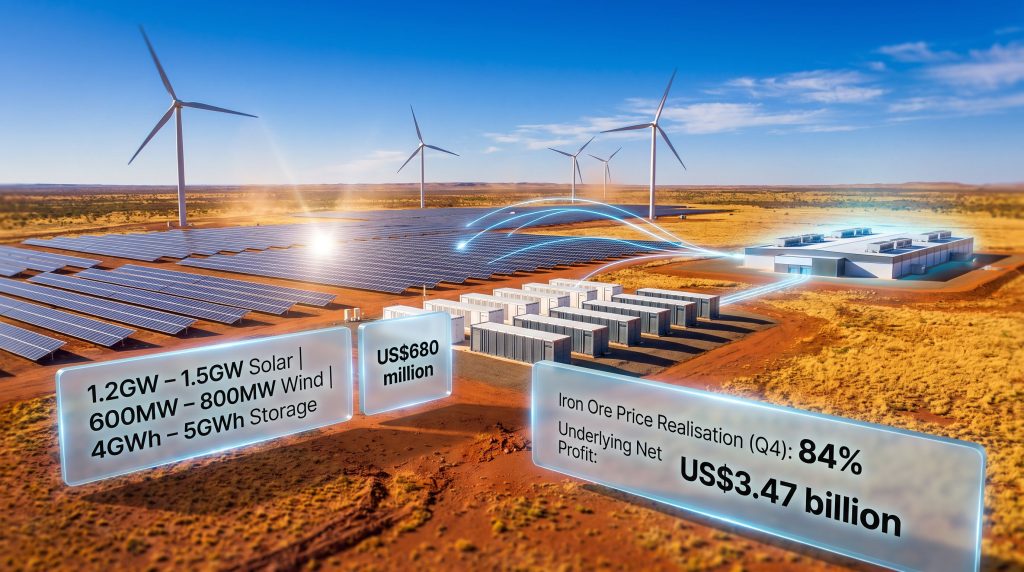
The Pilbara green grid is not a modest pilot project. Fortescue is committing US$680 million to build renewable energy infrastructure across its Western Australian operations, with a buildout timeline targeting 2028 as the key milestone year. The scale of what is being constructed is significant by any measure.
| Energy Component | Projected Capacity |
|---|---|
| Solar Generation | 1.2GW to 1.5GW |
| Wind Generation | 600MW to 800MW |
| Battery Storage | 4GWh to 5GWh |
| Capital Committed | US$680 million |
To contextualise this, 1.5GW of solar capacity is sufficient to power hundreds of thousands of homes under ideal conditions. In the Pilbara, where solar irradiance is among the highest on the planet, generation efficiency is structurally advantaged. The combination of solar, wind, and grid-scale battery storage creates what engineers call a dispatchable renewable system, meaning power can be delivered on demand rather than only when the sun is shining or the wind is blowing.
Geographic Isolation as a Strategic Asset
The Pilbara's remoteness is conventionally viewed as a logistical liability. Diesel must be transported thousands of kilometres. Grid connectivity to Australia's main electricity network does not exist. However, this same isolation creates a self-contained energy environment where Fortescue controls the entire supply chain from generation to consumption.
There is no incumbent utility to negotiate with, no regulated tariff structure to navigate for internal use, and no competing energy supplier to undercut on price. Once the renewable infrastructure is built, the marginal cost of generation is structurally low, creating conditions where surplus energy becomes a genuine commercial asset rather than wasted capacity. Furthermore, renewable energy in mining is increasingly proving its financial merits beyond environmental compliance alone.
The Data Centre Angle: Convergence of Two Mega-Trends
Why AI Infrastructure Needs What the Pilbara Can Offer
The global rollout of artificial intelligence is creating electricity demand at a pace that legacy grid infrastructure was not designed to accommodate. Data centres require stable, 24/7 baseload power with extremely high reliability thresholds. Even brief outages can corrupt processing tasks worth millions of dollars. This creates a demand profile that closely mirrors what Fortescue's renewable-plus-storage grid is designed to deliver.
The structural alignment between dispatchable renewable energy and data centre power requirements is not coincidental. Both systems prioritise continuous, predictable output over intermittent high-peak supply. This makes industrial renewable grids a logical candidate for data centre power supply, provided the regulatory and commercial frameworks can be made to work.
Hyperscale data centre operators, including those supporting major cloud computing and AI training workloads, have become increasingly aggressive in seeking dedicated power supply arrangements that sit outside traditional utility networks. The reasons are practical:
- Grid connection queues in many jurisdictions now stretch to five to ten years
- Utility-scale renewable power purchase agreements are increasingly competitive and over-subscribed
- Data centre operators face growing pressure from investors and regulators to demonstrate genuine green energy provenance
- Dedicated off-grid supply eliminates the grid congestion risk that increasingly affects large industrial consumers
In addition, the energy transition mineral demand surge is compounding pressure on energy systems globally, making reliable off-grid solutions even more strategically relevant.
Why No Offtake Agreements Have Been Signed Yet
Despite the strategic logic, Fortescue had not signed any supply agreements with data centre operators as of its most recent earnings disclosure. This is not unusual for infrastructure at this stage of development, but it is an important distinction for investors to understand.
Several conditions must align before commercial power sale agreements can be executed:
- Regulatory clearance under Western Australian frameworks, particularly around the Mining Act, which may restrict the sale of electricity generated under mining-related infrastructure to non-mining third parties
- Grid buildout completion or at least sufficient capacity commissioning to support reliable supply at commercial volumes
- Anchor tenant commitment from a data centre operator willing to co-design a supply structure for a remote, off-grid location
Regulatory Risk: Under current legislative frameworks in Western Australia, electricity generated through infrastructure built under Mining Act provisions may require specific regulatory amendments before it can be sold to non-mining customers. This is a material gating factor that investors should monitor independently of the commercial opportunity itself.
The company's stated commercialisation philosophy follows a sequential logic: develop the technology internally, validate performance at scale within its own operations, then extend the commercial offering to external markets once viability is proven. This approach reduces the risk of over-promising on third-party revenue before the infrastructure has demonstrated operational reliability.
The Primary Business Case: Iron Ore Cost Reduction
Why the Green Grid Makes Financial Sense Even Without External Sales
Before assigning any value to potential data centre power sales, investors should understand that the Pilbara green grid carries a standalone financial justification rooted in Fortescue's core iron ore business. Consequently, Australia's iron ore advantages extend well beyond geology and into the structural cost benefits that renewable energy integration can deliver.
Diesel fuel costs are a significant component of hematite C1 unit costs across Pilbara mining operations. Middle East supply instability has elevated global diesel prices, and remote mining operations in Western Australia face additional transport cost premiums on top of commodity price movements. Transitioning from diesel to internally generated renewable power is projected to reduce iron ore production costs by an estimated $2 to $4 per tonne.
At Fortescue's annual shipment volumes, which reached a record 201.3 million metric tonnes in the most recent financial year, a $2 to $4 per tonne cost saving translates to between $400 million and $800 million in annual cost reductions at full scale. That figure alone provides a compelling internal rate of return on the US$680 million capital commitment, independent of any commercial power sales revenue.
Financial Context: Record Volumes, Dividend Cuts, and Margin Pressure
The broader financial picture at Fortescue provides important context for why the energy pivot is accelerating now.
| Metric | Result |
|---|---|
| Underlying Net Profit (FY) | US$3.47 billion |
| Annual Iron Ore Shipments | 201.3 million metric tonnes (record) |
| Final Dividend | A$0.46 per share (8-year low) |
| Iron Ore Price Realisation (Q4) | 84% of benchmark |
| Iron Ore Price Realisation (Full Year) | 88% of benchmark |
The dividend reduction to an eight-year low is a deliberate signal about capital allocation priorities. Higher capital expenditure on green infrastructure is being funded in part through reduced shareholder distributions. At the same time, price realisation compression, with Q4 iron ore revenue at only 84% of benchmark pricing, illustrates the margin pressure that makes operational cost reduction through renewable energy more urgent.
The CMRG Negotiations and Their Implications
Fortescue's ongoing price negotiations with China Mineral Resources Group (CMRG) add another dimension to the financial calculus. The evolving China steel and iron ore market dynamics mean that if CMRG succeeds in extracting pricing concessions through consolidated buying leverage, Fortescue's iron ore margins face structural compression over the medium term. In that scenario, every dollar of cost reduction achieved through the green grid, and every dollar of non-iron-ore revenue eventually generated through commercial power sales, becomes proportionally more valuable to the earnings base.
Benchmarking Fortescue Against Peers
How Major Miners Compare on Renewable Energy Commercialisation
Fortescue's ambition to sell surplus renewable power to third parties is not entirely without precedent, but it is ahead of the broader industry curve in terms of stated intent and capital commitment at this scale.
| Company | Region | Renewable Focus | Third-Party Sales Status |
|---|---|---|---|
| Fortescue (FMG) | Pilbara, WA | Solar, Wind, Battery | No agreements signed (as of 2025) |
| BHP | Multiple | Solar, Wind | Limited commercial pilots |
| Rio Tinto | Multiple | Hydro, Solar | Selective third-party supply |
| S32 | Multiple | Mixed renewables | Early-stage exploration |
What differentiates Fortescue's approach is the explicit targeting of data centres as anchor customers, rather than industrial neighbours or regional communities. This is a bet on a specific demand category that is growing faster than almost any other electricity-consuming sector globally.
Green Iron Production at Christmas Creek: Progress and Delays
Fortescue produced green iron production results at its Christmas Creek facility, though the milestone arrived nearly a year behind its original schedule. This process, which involves replacing coal-based reduction with hydrogen or renewable electricity, is critical to the long-term utilisation case for the Fortescue Pilbara green grid power sales to data centres strategy. A fully operational green iron production process at scale would consume significant renewable electricity internally, reducing the surplus available for commercial sale but validating the technology stack that Fortescue intends to export commercially.
The delay at Christmas Creek is a reminder that industrial-scale clean energy technology is still maturing, and that the transition from demonstration to commercial deployment involves meaningful execution risk.
Scenario Analysis: Three Pathways for Commercial Power Sales
How Investors Should Think About the Optionality
The commercial power sales component of the Pilbara green grid is best understood as a real option embedded within an infrastructure asset that already has a primary financial justification. The optionality should be valued, but not as near-term revenue.
| Scenario | Trigger Conditions | Timeline Estimate | Revenue Potential |
|---|---|---|---|
| Base Case | Regulatory clarity plus data centre anchor tenant | 2027 to 2028 | Moderate supplementary revenue |
| Bull Case | Multiple offtake agreements plus grid expansion | 2026 to 2027 | Material revenue diversification |
| Bear Case | Regulatory delays plus weak data centre demand | Post-2029 | Minimal near-term contribution |
Key risks that investors should monitor independently include:
- Regulatory amendment timelines in Western Australia governing electricity sales under Mining Act infrastructure
- Data centre operator appetite for remote, off-grid power supply versus traditional co-location or grid-connected alternatives
- Green iron production ramp at Christmas Creek and its effect on internal renewable energy consumption
- Iron ore price realisation trends and whether margin pressure accelerates or forces a reassessment of capital allocation toward the green grid
The next major ASX story will hit our subscribers first
Frequently Asked Questions
Has Fortescue signed any power supply agreements with data centres?
No. As of the most recent earnings announcement, Fortescue had not signed any offtake agreements with data centre operators. The company has stated its intention to sell surplus renewable energy to third parties including data centres, but commercial agreements remain pending regulatory clarity and sufficient infrastructure completion.
What is the total planned capacity of the Pilbara green grid?
The green grid targets between 1.2GW and 1.5GW of solar generation capacity, supplemented by 600MW to 800MW of wind and 4GWh to 5GWh of battery storage, with full buildout targeted by 2028.
Why are data centres being targeted as customers for surplus renewable energy?
Data centres require continuous, reliable power with high uptime requirements, a demand profile that aligns well with dispatchable renewable-plus-storage systems. They also face increasing difficulty securing grid connections in major markets, making off-grid dedicated supply arrangements attractive.
What regulatory changes are needed for Fortescue to sell power to non-mining customers?
Under current Western Australian frameworks, there may be legislative restrictions on selling electricity generated through infrastructure built under Mining Act provisions to non-mining third parties. Specific regulatory amendments or licensing arrangements may be required before commercial power sales can proceed.
How does the green grid reduce Fortescue's iron ore production costs?
By replacing diesel-powered operations with internally generated renewable electricity, Fortescue projects a reduction of $2 to $4 per tonne in hematite C1 unit costs. This saving is particularly significant given the elevated diesel prices resulting from Middle East supply disruptions.
When could commercial power sales realistically begin?
Under a base case scenario, commercial power sales could begin between 2027 and 2028, contingent on regulatory clarity and the securing of at least one anchor tenant agreement. More optimistic scenarios place the timeline at 2026 to 2027, while regulatory delays could push meaningful revenue contribution beyond 2029.
From Mining Giant to Energy Provider: The Structural Shift Underway
The Pilbara green grid represents something genuinely new in the Australian resources sector. It is not simply a decarbonisation initiative dressed up as a commercial strategy. The financial logic of cost reduction through renewable energy is sound and independently justified by the scale of Fortescue's diesel consumption. The Fortescue Pilbara green grid power sales to data centres ambition adds a layer of optionality that, if regulatory and commercial conditions align, could contribute a meaningful new revenue stream to a business that is otherwise highly exposed to iron ore price cycles.
What makes this strategy credible is precisely the sequencing. By building the infrastructure primarily to serve its own operations, Fortescue avoids the trap of constructing a commercial power business that depends on customers who have not yet committed. Furthermore, Fortescue's accelerating green grid development signals a long-term institutional commitment that goes well beyond a single capital expenditure cycle. The surplus energy available for external sale is a byproduct of a capex programme that makes sense regardless of whether a single data centre operator ever signs a contract.
For investors, the appropriate framing is not whether Fortescue will become an energy company, but whether the embedded optionality of the green grid is being priced into the stock at all. In a market that has been slow to value pre-revenue energy infrastructure within mining businesses, the answer is likely no. However, as RenewEconomy has noted, this may represent a longer-term asymmetric opportunity as regulatory clarity emerges and data centre demand continues its structural growth trajectory.
This article is intended for informational purposes only and does not constitute financial advice. Forecasts, scenario analyses, and timeline estimates discussed herein involve significant uncertainty and should not be relied upon as predictions of future performance. Readers should conduct independent research and consult a qualified financial adviser before making investment decisions.
Want to Stay Ahead of the Next Major ASX Mineral Discovery?
Discovery Alert's proprietary Discovery IQ model delivers real-time alerts on significant ASX mineral discoveries, transforming complex data across more than 30 commodities into clear, actionable insights for investors at every level — explore Discovery Alert's discoveries page to see how historic finds have generated extraordinary returns, and begin your 14-day free trial today to secure your market-leading edge.