June 17, 2026
Remote industrial operations across Australia's mineral-rich regions face escalating pressure to transition from conventional fossil fuel power systems to renewable energy architectures capable of supporting 24/7 mining activities. Fortescue's Pilbara wind project represents a pivotal development in demonstrating how advanced wind technology can integrate with energy transition fundamentals to power continuous mining operations. The challenge extends beyond simple energy substitution, requiring integrated generation and storage solutions that match the demanding operational profiles of heavy machinery, processing facilities, and continuous extraction processes.
This transformation involves complex technical considerations including power quality, system reliability, extreme weather resilience, and economic viability across multi-decade operational timelines. Mining companies must balance capital investment strategies with evolving regulatory frameworks while maintaining production continuity during energy system transitions. Furthermore, the integration of cutting-edge mining innovation trends plays a crucial role in optimising operational efficiency during this transition period.
What Makes the Nullagine Wind Project a Strategic Game-Changer for Industrial Mining?
Fortescue's Pilbara wind project represents a fundamental shift in how large-scale mining operations approach energy independence and operational sustainability. The initiative moves beyond incremental renewable additions to establish comprehensive wind generation infrastructure designed specifically for industrial applications in remote locations. Moreover, this development aligns with broader energy partnerships strategy trends emerging across the global mining sector.
Breaking Down the 133MW Capacity and Hub Height Innovation
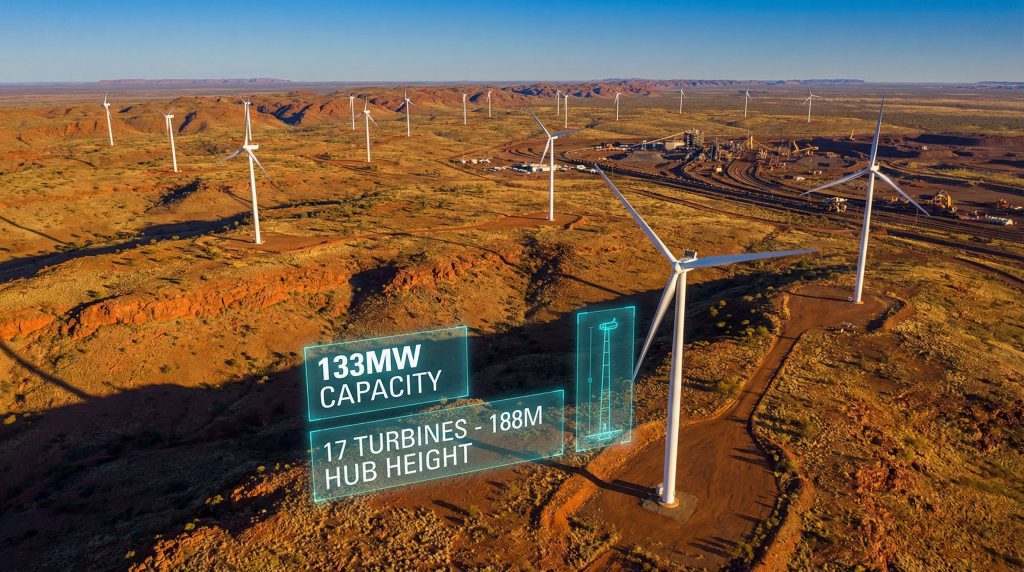
The Nullagine wind development incorporates 17 advanced turbines configured with 188-metre hub heights, establishing what industry observers characterise as a new global benchmark for onshore wind applications in mining contexts. This specification enables wind capture efficiency at elevated altitudes where atmospheric conditions provide substantially more consistent energy generation compared to standard tower configurations.
Envision Energy supplies the turbine technology with specialised design parameters for low-wind environment optimisation and extreme weather resilience, including cyclone-resistant engineering appropriate for Pilbara regional conditions. The integration incorporates Nabrawind's self-erecting tower technology following Fortescue's acquisition of the Spanish company, enabling advanced installation capabilities without dependence on external heavy-lift crane equipment.
Key Technical Specifications:
• Total Capacity: 133MW across 17 turbines
• Hub Height: 188 metres (new global onshore benchmark)
• Technology Integration: Nabrawind Nabralift self-erecting system
• Environmental Rating: Cyclone-resistant for extreme weather conditions
• Installation Method: Integrated lifting system eliminating external crane requirements
Strategic Location Analysis Within Pilbara Energy Connect
The project's positioning within Fortescue's broader Pilbara Energy Connect infrastructure enables direct integration with existing renewable energy networks and mining operational centres. This connectivity provides strategic advantages for industrial-scale power distribution across multiple mine sites and processing facilities throughout the region.
Grid connectivity architecture supports the integration of wind generation with existing solar installations and battery storage systems, creating a coordinated renewable energy ecosystem designed to match the complex power demand profiles of continuous mining operations.
When big ASX news breaks, our subscribers know first
How Does Wind Generation Balance Fortescue's 24/7 Mining Energy Demands?
Industrial mining operations require consistent power supply across varying operational phases, from continuous ore extraction and processing to equipment charging and facility management. Wind generation provides strategic complementarity to solar power by maximising energy production during periods when photovoltaic systems experience reduced output.
Day-Night Energy Complementarity Strategy
Mining operations typically maintain continuous 24-hour schedules with varying power demand patterns throughout daily cycles. Fortescue's Pilbara wind project positions wind generation to strengthen power supply during nighttime operations when solar generation capacity is minimised.
The Nullagine project feeds directly into the Pilbara Energy Connect network, enabling strategic load balancing between daytime solar generation peaks and nighttime wind production periods. This complementarity reduces dependence on battery storage cycling while maintaining operational continuity across all mining activities. Additionally, data-driven operations enable precise demand forecasting and energy allocation optimisation.
Energy Generation Profile Optimisation:
• Daytime: Solar generation peaks during equipment operation and processing activities
• Nighttime: Wind power maximisation supports continuous extraction and charging operations
• Seasonal Variations: Wind resources complement solar generation during weather pattern changes
• Storage Integration: Battery systems provide temporal buffering for demand-supply synchronisation
Seasonal Wind Patterns and Mining Operation Alignment
The Pilbara region experiences distinct seasonal wind resource variations that align strategically with mining operational requirements throughout the year. Wind generation typically strengthens during periods when solar irradiance may be reduced due to weather patterns, providing consistent renewable energy availability across seasonal cycles.
Mining equipment power requirements fluctuate based on extraction phases, ore processing volumes, and transportation demands. The integrated wind-solar-battery architecture enables flexible power allocation matching these operational variations while maintaining system reliability.
What Role Does Advanced Tower Technology Play in Project Economics?
Self-erecting tower technology represents a significant innovation in wind project deployment, particularly for remote industrial applications where conventional installation methods face substantial logistical and economic challenges.
Nabrawind Self-Erecting System Advantages
Traditional wind turbine installation requires specialised heavy-lift crane equipment, skilled operators, and complex logistical coordination to transport and position large components in remote locations. The Nabrawind Nabralift system integrates lifting capability directly into the tower structure, fundamentally changing deployment economics and timeline requirements.
This technological approach reduces construction complexity by eliminating external crane dependencies, potentially lowering installation costs and accelerating project timelines. For Pilbara locations where equipment mobilisation represents substantial project expenses, self-erecting capability provides significant economic advantages. Consequently, this innovation aligns with current renewable energy developments across the Australian mining sector.
Installation Technology Comparison:
| Technology Type | Hub Height | Installation Method | Equipment Dependencies | Deployment Timeline |
|---|---|---|---|---|
| Traditional External Crane | 120-150m | Heavy-lift crane required | Multiple specialised vehicles | Extended mobilisation |
| Nabrawind Self-Erecting | 188m | Integrated lifting system | Reduced external equipment | Accelerated installation |
| Hybrid Systems | Variable | Partial crane assistance | Moderate dependencies | Intermediate timeline |
Hub Height Optimisation for Energy Yield
The 188-metre hub height specification enables access to wind resources at altitudes where atmospheric conditions typically provide higher average wind speeds and reduced turbulence compared to lower elevations. This optimisation directly correlates with increased energy production and improved capacity factors across annual operational cycles.
Higher hub heights capture wind resources above ground-level obstructions and atmospheric boundary layer effects that can reduce generation efficiency. For mining applications requiring consistent power output, this elevation advantage translates to improved system reliability and economic performance.
"The combination of advanced hub height and self-erecting technology establishes new benchmarks for remote industrial wind applications, potentially influencing deployment strategies across the global mining sector."
How Will This Project Accelerate Fortescue's Real Zero Timeline?
Fortescue's comprehensive decarbonisation strategy positions renewable energy infrastructure as fundamental to achieving net-zero emissions across Pilbara operations. Fortescue's Pilbara wind project establishes technical and operational foundations for broader electrification initiatives spanning multiple mining systems.
Diesel and Gas Replacement Strategy
Current mining operations rely extensively on diesel-powered haul trucks, drilling equipment, and auxiliary systems, along with natural gas for processing plant operations. Transitioning to renewable electricity requires coordinated infrastructure development enabling equipment electrification across all operational categories.
The wind project contributes to a growing renewable energy portfolio designed to support electrified mining equipment including battery-powered haul trucks, electric drilling systems, and fully renewable-powered processing facilities. This transition involves substantial operational transformation beyond simple fuel substitution. Furthermore, these developments complement broader lithium supply strategy initiatives across the region.
Electrification Target Categories:
• Mobile Equipment: Haul trucks, drilling rigs, auxiliary vehicles
• Processing Systems: Ore crushing, concentration, materials handling
• Rail Infrastructure: Locomotive electrification, charging stations
• Facility Operations: Lighting, HVAC, control systems
Integration with Existing Renewable Infrastructure
The Nullagine development builds upon established renewable energy projects across Fortescue's Pilbara operations, creating an integrated power generation and distribution network. The Cloudbreak solar farm has deployed over 300,000 solar panels and approaches completion, providing substantial daytime generation capacity.
Large-scale battery storage systems delivered at North Star Junction enable temporal load balancing and grid stability management. This coordinated infrastructure represents what Fortescue characterises as a baseload renewable energy system designed for real operational conditions rather than grid-connected applications.
What Are the Broader Implications for Pilbara Mining Decarbonisation?
The Nullagine project establishes technical and economic precedents that may influence renewable energy adoption patterns across Australia's mining sector. Success in integrated wind-solar-battery deployment demonstrates operational viability for large-scale industrial decarbonisation in remote locations.
Industry Benchmark Setting for Remote Mining Operations
Mining companies across Australia's resource regions face similar challenges in transitioning from fossil fuel dependence whilst maintaining operational continuity and economic competitiveness. The Fortescue model provides a scalable framework for renewable energy integration that other operators may adapt to their specific operational requirements.
The project demonstrates technical solutions for extreme weather resilience, remote installation logistics, and 24/7 power supply reliability that address common concerns about renewable energy adequacy for heavy industrial applications.
Supply Chain and Operational Transformation
Successful deployment of self-erecting wind technology in the Pilbara establishes supply chain capabilities and operational expertise that can support broader industry adoption. The development of specialised installation techniques, maintenance protocols, and integration systems creates transferable knowledge for similar projects.
Rail electrification possibilities emerge as renewable generation capacity expands across mining regions. Processing plant renewable energy integration becomes economically viable as technology costs decline and operational reliability improves through demonstrated performance.
How Does the 2-3GW Renewable Target Reshape Regional Energy Infrastructure?
Fortescue's commitment to deploy 2-3GW of renewable energy generation and battery storage by 2030 represents a substantial expansion from current capacity levels, requiring coordinated infrastructure development across multiple project sites throughout the Pilbara region.
Portfolio Expansion Strategy Through 2030
The Nullagine project establishes foundational infrastructure for a comprehensive renewable energy portfolio spanning multiple wind and solar developments. This expansion involves strategic site selection, technology deployment, and grid integration across Fortescue's operational footprint.
Renewable Energy Development Pipeline:
• Wind Projects: Multiple sites leveraging proven Nabrawind technology
• Solar Installations: Expanded photovoltaic capacity beyond Cloudbreak
• Battery Storage: Grid-scale systems enabling 24/7 renewable operations
• Integration Infrastructure: Advanced power management and distribution systems
Grid Infrastructure Development Needs
Achieving 2-3GW renewable capacity requires substantial transmission and distribution infrastructure expansion to connect generation sites with mining operational centres. The Pilbara Energy Connect network must accommodate increased power flows whilst maintaining system reliability and power quality standards.
Regional energy security improves as renewable generation capacity exceeds immediate operational requirements, potentially enabling power export opportunities or industrial development initiatives beyond mining applications.
The next major ASX story will hit our subscribers first
What Challenges and Opportunities Exist for Remote Wind Development?
Large-scale renewable energy deployment in remote mining regions faces unique technical, logistical, and regulatory considerations that differ substantially from conventional wind project development in populated areas.
Regulatory and Land Access Considerations
Environmental approval processes for Pilbara wind developments require coordination with federal and state regulatory frameworks addressing environmental impact, Indigenous land use agreements, and community consultation requirements. Project timelines depend on successful navigation of these approval pathways.
Land access agreements with Traditional Owners and stakeholder engagement protocols represent essential project development components. Regional planning coordination ensures renewable energy infrastructure aligns with broader Pilbara development strategies.
Technical and Logistical Deployment Factors
Equipment transportation to remote mining sites involves specialised logistics for oversized wind turbine components across challenging terrain and infrastructure limitations. Self-erecting technology reduces some transportation complexity but requires coordinated supply chain management.
Skilled workforce availability for specialised installations remains a critical factor in project deployment timelines. Maintenance and service infrastructure development requires long-term operational planning to ensure system reliability across multi-decade project lifecycles.
Critical Success Factors:
• Transportation: Oversized component logistics across remote terrain
• Installation: Specialised technical capabilities and equipment
• Maintenance: Long-term service infrastructure and workforce planning
• Integration: Power system coordination and grid management
How Will This Project Influence Australia's Critical Minerals Strategy?
Energy security for strategic resource production becomes increasingly important as global demand for critical minerals expands and supply chain resilience gains strategic significance. Renewable energy infrastructure supports Australian mining competitiveness through reduced operational costs and emissions profiles.
Energy Security for Strategic Resource Production
Iron ore export competitiveness benefits from lower energy costs achieved through renewable generation, potentially improving margin sustainability as global steel production evolves toward lower-carbon processes. Future critical minerals processing operations may require substantial electricity inputs where renewable energy provides cost and sustainability advantages.
Regional energy independence from fossil fuel markets reduces operational cost volatility and supply chain risks associated with diesel and natural gas procurement for remote mining operations.
Investment and Economic Development Implications
Capital allocation efficiency for mining operations improves as renewable energy infrastructure demonstrates reliable return-on-investment profiles and operational cost reductions. Regional employment opportunities expand in renewable energy installation, maintenance, and system management roles.
Technology export potential emerges for Australian companies developing expertise in remote industrial renewable energy applications. The Fortescue model may influence similar projects in other resource-rich regions globally where mining companies face comparable decarbonisation challenges.
Frequently Asked Questions About Fortescue's Wind Strategy
When Will the Nullagine Wind Project Begin Operations?
Construction commenced in January 2026 following regulatory approvals and final engineering preparations. A prototype turbine incorporating Nabrawind's integrated design completed testing at Envision Energy facilities in China and is scheduled for relocation to the Pilbara site in June 2026 for operational validation.
Full project commissioning targets mid-to-late 2027, subject to installation progress and grid integration completion. The extended timeline reflects the complexity of deploying advanced wind technology in remote locations with specialised equipment requirements.
How Does This Compare to Other Mining Company Renewable Projects?
The 188-metre hub height specification and self-erecting tower technology establish new benchmarks for industrial mining wind applications. Most existing mining renewable projects focus on solar generation or smaller-scale wind installations without comparable technical specifications.
The integrated approach combining wind, solar, and battery storage for 24/7 industrial operations represents a more comprehensive renewable energy strategy than typical mining sector renewable additions, potentially influencing sector-wide adoption patterns.
What Are the Long-term Expansion Plans Beyond Nullagine?
Fortescue's strategic roadmap targets 2-3GW of renewable generation and storage deployment across the Pilbara by 2030, subject to regulatory approvals and land access agreements. This expansion involves multiple wind and solar project sites coordinated through the Pilbara Energy Connect infrastructure network.
The broader vision includes complete electrification of mining operations, rail systems, and processing facilities powered entirely by renewable energy sources. Success at Nullagine provides technical validation and operational experience supporting this comprehensive transformation strategy.
This analysis incorporates information from Australian Mining Review coverage of Fortescue's renewable energy developments and represents current understanding of project specifications subject to operational validation and regulatory completion.
Ready to Capitalise on Australia's Mining Energy Transition?
Discovery Alert's proprietary Discovery IQ model delivers real-time alerts on significant ASX mineral discoveries in the energy transition and critical minerals sectors, instantly empowering subscribers to identify actionable opportunities ahead of the broader market. Begin your 30-day free trial today and secure your market-leading advantage in this rapidly evolving landscape.