August 20, 2026
When Volume Becomes a Structural Statement: Understanding the 200 Mt Threshold in Iron Ore
There is a reason the mining industry watches shipment milestones so closely. In bulk commodity operations, throughput volume is not just a production metric — it is a proxy for the health of an entire logistics ecosystem. Reaching 200 million tonnes of iron ore in a single financial year requires every link in the supply chain to perform at or near its theoretical ceiling simultaneously: blast patterns at mine sites, ore processing and blending, the capacity utilisation of rail corridors stretching hundreds of kilometres, and the loading rates at deepwater port facilities.
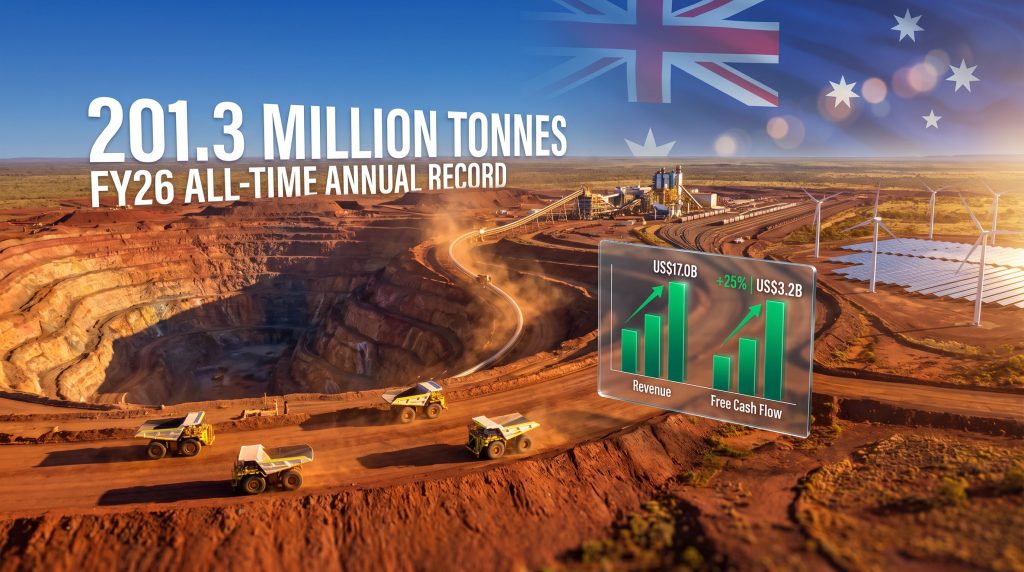
Fortescue record iron ore shipments of 201.3 million tonnes in FY26 represent the first time the company has crossed this threshold in its operating history. What makes the milestone analytically interesting is not the round number itself, but the pattern of records that preceded it. A first-half record of 100.2 million tonnes, followed by a third-quarter record of 48.4 million tonnes, points toward a system that is becoming more reliable and more consistent at high throughput — not one that produced a statistical outlier.
Since dispatching its inaugural cargo in 2008, Fortescue has now cumulatively exported more than 2.5 billion tonnes of iron ore from the Pilbara. That compounding scale, built over less than two decades, provides important context for interpreting the FY26 result not as a singular event, but as the product of sustained operational maturation.
When big ASX news breaks, our subscribers know first
FY26 Financial Performance: Reading Beyond the Headline Numbers
The FY26 result was notable across multiple financial dimensions simultaneously, which is rarer than it might appear. Volume growth, revenue improvement, margin stability, and cash flow expansion do not always arrive together — particularly in a commodity business exposed to price cycles beyond the producer's control.
| Metric | FY25 | FY26 | Change |
|---|---|---|---|
| Iron Ore Shipments | 198.4 Mt | 201.3 Mt | +1.5% (new record) |
| Revenue | ~US$15.6B | US$17.0B (A$24.3B) | +9% |
| Underlying EBITDA | ~US$7.9B | US$8.6B (A$12.3B) | +9% |
| EBITDA Margin | ~50% | 51% | Stable/improving |
| Underlying NPAT | ~US$3.4B | US$3.5B (A$5.0B) | +3% |
| Operating Cash Flow | ~US$5.4B | US$6.8B (A$9.7B) | Significant uplift |
| Free Cash Flow | ~US$2.6B | US$3.2B (A$4.6B) | +25% |
| Capital Invested | — | US$3.6B (A$5.1B) | — |
Note: FY25 figures are estimates based on publicly available reporting. All figures should be independently verified before use in investment decision-making.
The 51% underlying EBITDA margin is the metric deserving the most analytical attention. Sustaining this margin at 201.3 Mt of throughput, while simultaneously deploying US$3.6 billion in capital across the business, suggests that unit cost performance has not deteriorated as production has scaled. In many large mining operations, pushing toward production ceilings introduces marginal cost creep — requiring additional equipment, higher maintenance intensity, or greater energy expenditure per tonne moved. The FY26 margin data suggests this dynamic has been managed effectively.
What the Free Cash Flow Signal Means for Capital Markets
The 25% increase in free cash flow to US$3.2 billion is arguably the most significant figure for investors evaluating the business's capital allocation capacity. Free cash flow, defined as operating cash flow less capital expenditure, is the pool from which dividends are funded, debt is reduced, and growth investments are sourced. Generating US$3.2 billion after spending US$3.6 billion on the business within the same year illustrates a high-return operational model.
Furthermore, understanding iron ore price trends is essential when contextualising these margins, as commodity pricing cycles remain the primary external variable affecting revenue per tonne.
A 51% EBITDA margin combined with a US$900 million net debt position provides significant financial headroom to absorb commodity price volatility — a critical buffer in an environment where iron ore pricing remains acutely sensitive to Chinese steel demand signals.
The Architecture Behind Sustained High-Throughput Operations
It is worth understanding why 200 Mt is an operationally demanding target for any single producer. The Pilbara is not a single mine — it is a network of geographically dispersed mine sites, connected by dedicated heavy-haul rail lines, feeding into multiple port terminals. At the volumes Fortescue achieved in FY26, the system was effectively loading, transporting, and shipping more than 550,000 tonnes of iron ore every single day on average across the financial year.
A Shipment Trajectory That Tells a Systems Story
| Period | Shipment Volume | Record Status |
|---|---|---|
| FY25 Full Year | 198.4 Mt | Prior annual record |
| H1 FY26 | 100.2 Mt | Highest-ever first half |
| Q3 FY26 | 48.4 Mt | Highest-ever third quarter |
| Q2 FY26 | 50.5 Mt | Strong sequential performance |
| FY26 Full Year | 201.3 Mt | All-time annual record |
| Cumulative since 2008 | 2.5+ billion tonnes | Historical milestone |
The sequential nature of these records matters to technical analysts of mining operations. A spike in a single quarter can often be explained by weather catch-up, stockpile drawdown, or vessel scheduling. However, consecutive quarterly records — particularly one in Q2 followed by another in Q3 — indicate that the underlying operating system performed consistently at elevated rates, rather than producing a temporary surge. Fortescue's 200 million tonne milestone has been widely recognised as a landmark achievement within the Australian mining industry.
Iron Bridge and the Product Mix Shift
One element of the FY26 production story that deserves closer examination is the contribution of the Iron Bridge magnetite project. Unlike the hematite ore that forms the core of Pilbara production, magnetite requires considerably more processing to produce a saleable concentrate. The ore itself typically grades at around 20–25% iron, requiring beneficiation through magnetic separation to produce a concentrate that can reach 67–68% iron — a product that commands a meaningful price premium over standard Pilbara fines in steel markets.
This product grade distinction matters for two reasons. First, high-grade magnetite concentrate reduces the slag burden in blast furnaces and improves energy efficiency in steel production, making it increasingly attractive to Chinese steelmakers under environmental operating constraints. Second, integrating magnetite processing into an otherwise hematite-dominated operation adds operational complexity — including water management for wet processing circuits and tailings storage considerations — which makes sustaining overall throughput records more technically demanding. For broader context, understanding iron ore types and deposits helps illustrate why magnetite processing differs so significantly from conventional hematite operations.
Balance Sheet Architecture: Debt, Cash, and Strategic Flexibility
Fortescue's end-of-FY26 balance sheet positions the company with considerable strategic optionality:
- Cash on hand: US$5.1 billion (A$7.3 billion)
- Gross debt: US$5.9 billion (A$8.4 billion)
- Net debt: US$900 million (A$1.3 billion)
The net debt figure of US$900 million, set against cash reserves of US$5.1 billion, reflects a liability management posture that preserves financial flexibility. For a company deploying US$3.6 billion in capital within a single year, maintaining net debt below US$1 billion indicates either very strong operating cash conversion, careful debt scheduling, or both. In the context of iron ore price cycles, which have historically swung by 40–60% within multi-year periods, this balance sheet structure reduces refinancing risk significantly.
A gross debt position of US$5.9 billion against cash of US$5.1 billion means the company could, in theory, retire nearly all of its debt obligations from existing cash reserves — a degree of liquidity that provides meaningful protection against sustained commodity price weakness.
The Green Grid: Decarbonisation as Cost Strategy, Not Just Compliance
Most media coverage of mining decarbonisation frames renewable energy investment primarily through an ESG or regulatory compliance lens. This framing, while not inaccurate, misses the more compelling long-term economic logic. In addition, the push toward green iron production is reshaping how major producers think about energy costs, feedstock quality, and long-term competitiveness.
Diesel fuel represents one of the largest variable costs in remote Pilbara mining operations. The Pilbara is not connected to Australia's eastern grid, meaning that historically, mining operations have depended on either diesel generation or dedicated gas-fired power — both of which carry commodity price exposure of their own. A renewable energy system, once constructed, converts a variable operating cost into a predominantly fixed capital cost, with fuel price risk effectively eliminated.
The Green Grid program addresses this directly through a 2.4-gigawatt renewable energy infrastructure build comprising:
- 1.5 GW of solar generation capacity
- 900 MW of wind generation capacity
- 4–5 GWh of battery energy storage to manage intermittency across generation cycles
The battery storage component deserves particular technical attention. At 4–5 GWh of storage, the system needs to buffer renewable intermittency against the continuous, 24-hour power demand of mining, processing, and rail operations. This is not a grid-scale storage challenge in an urban context — it is an industrial load management problem where power interruptions translate directly into lost production throughput and equipment stress.
How Decarbonisation Capex Compares to Other Investment Categories in FY27
| Investment Category | FY27 Guidance Range |
|---|---|
| Total Metals Capex | US$3.7B – US$4.7B (A$5.3B – A$6.7B) |
| Decarbonisation Allocation | US$0.9B – US$1.3B (A$1.3B – A$1.9B) |
| Exploration and Studies | US$300M – US$500M (A$429M – A$714M) |
Allocating between US$0.9 billion and US$1.3 billion specifically to decarbonisation within a total metals capex envelope of US$3.7–4.7 billion means renewable energy infrastructure represents roughly 20–28% of all planned capital deployment in FY27. This is not incidental spending — it reflects a deliberate reconfiguration of the cost base.
Copper and Gabon: Interpreting the Multi-Commodity Pivot
Perhaps the least-discussed but most strategically significant development embedded in Fortescue's FY26 results is the company's deliberate movement beyond Pilbara iron ore as its sole operational identity. Consequently, monitoring copper market trends has become increasingly relevant for understanding how Fortescue's diversification strategy aligns with broader metals demand cycles.
The completion of the Alta Copper acquisition and its associated Cañariaco copper project in Peru places Fortescue into direct exposure to copper demand driven by electrical grid expansion, renewable energy infrastructure deployment, and electric vehicle manufacturing. Copper's conductivity properties make it irreplaceable in these applications — there is no commercially viable substitute at scale — which gives the metal a structurally different demand profile from iron ore, which is more tightly correlated with construction activity and steel output.
The Cañariaco deposit in Peru's Cajamarca region is a large-scale porphyry copper system. Porphyry deposits are the dominant source of the world's copper production, typically characterised by large tonnage, lower grades (often 0.3–0.6% copper), and significant by-product credits from gold and molybdenum. The economics of porphyry development are heavily influenced by ore grade consistency across the orebody, which drives the importance of extensive infill drilling programs before committing to construction capital.
Meanwhile, the Belinga Iron Ore Project in Gabon has now exceeded 230,000 metres of drilling — a scale of exploration activity that signals serious long-term commitment rather than speculative positioning. Belinga is understood to host a significant banded iron formation (BIF) deposit, a geological type common across West Africa and the Pilbara. BIF deposits can carry high iron grades, and the region's infrastructure investment trajectory may eventually support viable export logistics — though this remains a longer-dated development proposition.
The combination of a copper acquisition in South America and advanced iron ore exploration in West Africa signals a structural transition from single-basin producer to geographically diversified metals company — a shift with meaningful implications for how the market assigns a valuation multiple to the overall asset base over the coming decade.
Speculative note: Whether this diversification ultimately enhances or dilutes shareholder value depends heavily on the capital efficiency of each new asset and the iron ore price environment at the time new projects reach production. These outcomes remain uncertain and should not be interpreted as a forward investment recommendation.
The next major ASX story will hit our subscribers first
FY27 Guidance and the Logic of Volume Stability Over Growth
Fortescue's guidance for FY27 sets iron ore shipments in a 197–207 million tonne range, which — when viewed against the FY26 record of 201.3 Mt — suggests management is prioritising operational consistency over aggressive volume expansion.
| Metric | FY27 Guidance |
|---|---|
| Total Iron Ore Shipments | 197 – 207 Mt |
| Iron Bridge Contribution | 11 – 14 Mt |
| Total Metals Capex | US$3.7B – US$4.7B |
| Decarbonisation Capex | US$0.9B – US$1.3B |
| Exploration and Studies | US$300M – US$500M |
The Iron Bridge contribution of 11–14 Mt within the total represents a growing share of higher-grade magnetite concentrate — a product that typically commands a premium over standard Pilbara fines due to its elevated iron content and lower impurity levels. As steelmakers in China steel and iron ore markets face increasing pressure to reduce blast furnace emissions intensity, demand for higher-grade iron ore feedstocks is expected to strengthen relative to lower-grade alternatives. This grade-driven premium dynamic could prove increasingly relevant to Fortescue's revenue per tonne metric over the medium term.
The Hematite life-of-mine plan incorporating the Blacksmith project is also expected to improve cost efficiency and capital productivity across the core iron ore operation, reinforcing the long-term economic sustainability of Pilbara hematite mining. Blacksmith-style pit sequencing typically refers to the planned integration of new open-pit development into existing mine infrastructure corridors, reducing pre-strip capital and haul distances.
Frequently Asked Questions: Fortescue Record Iron Ore Shipments
What was Fortescue's iron ore shipment record in FY26?
Fortescue achieved 201.3 million tonnes of iron ore shipments in FY26, surpassing the 200 Mt threshold for the first time in the company's history and establishing a new all-time annual record.
How much revenue did Fortescue generate from its FY26 record shipments?
Total revenue reached US$17.0 billion (A$24.3 billion) in FY26, representing a 9% increase on the prior financial year.
What is Fortescue's iron ore shipment target for FY27?
The company has guided for 197–207 million tonnes in FY27, with 11–14 Mt of that total expected to come from the Iron Bridge magnetite operation.
How does Fortescue's FY26 free cash flow compare to the previous year?
Free cash flow rose 25% to US$3.2 billion (A$4.6 billion) in FY26, supported by record operating cash flow of US$6.8 billion (A$9.7 billion). According to Fortescue's official reporting, this performance reflects the strongest cash conversion in the company's history.
What is the Green Grid and why is Fortescue building it?
The Green Grid is a 2.4-gigawatt renewable energy program comprising 1.5 GW of solar, 900 MW of wind, and 4–5 GWh of battery storage. It is designed to progressively replace diesel and gas-based power generation across Pilbara operations, reducing both emissions and long-term energy costs.
How much has Fortescue shipped in total since its first cargo?
Since its inaugural shipment in 2008, Fortescue has cumulatively exported more than 2.5 billion tonnes of iron ore from the Pilbara.
What the FY26 Record Reveals About the Broader Iron Ore Industry
Fortescue record iron ore shipments, taken as a composite of production records, revenue growth, margin discipline, and cash generation, set a new operational benchmark for large-scale iron ore producers. The ability to simultaneously hit an all-time shipment record, expand free cash flow by 25%, and deploy US$3.6 billion in capital within a single financial year is an uncommon combination in any commodity sector.
What is less frequently discussed — but arguably more consequential for long-term investors — is the product mix evolution underway. The gradual increase in magnetite concentrate volumes through Iron Bridge, combined with the price premium this product attracts in quality-sensitive steel markets, introduces a margin improvement pathway that is independent of iron ore spot price movements. As environmental compliance costs increase for Chinese steelmakers operating high-emission blast furnace processes, the economic logic of paying a grade premium for higher-iron, lower-impurity feedstocks strengthens.
The copper acquisition in Peru, the Gabon iron ore drilling program, the Green Grid renewable build, and the Blacksmith-integrated hematite life-of-mine plan collectively suggest a company in transition — moving deliberately from a single-commodity, single-basin identity toward a diversified, lower-emission metals business. Whether that transition creates or transfers value for shareholders will depend on execution quality, commodity price trajectories, and the capital discipline applied to each new project.
This article is intended for informational purposes only and does not constitute financial advice. Forward-looking statements, guidance figures, and investment commentary involve uncertainty and should not be relied upon as predictions of future performance. Readers are encouraged to conduct their own research and consult a qualified financial adviser before making investment decisions. Further reporting on Fortescue's Pilbara operations and iron ore sector developments is available at australianmining.com.au.
Want to Catch the Next Major ASX Mineral Discovery Before the Market Does?
Discovery Alert's proprietary Discovery IQ model delivers real-time alerts on significant ASX mineral discoveries — instantly transforming complex resource data into actionable investment insights for traders and long-term investors alike. Explore how historic discoveries have generated extraordinary returns on Discovery Alert's dedicated discoveries page, and begin your 14-day free trial today to position yourself ahead of the broader market.