
August 20, 2026
The Jurisdictional Competitiveness Trap: When Fee Recovery Crowds Out Exploration Capital
There is a well-documented tension in resource economics between governments seeking to recover the administrative costs of regulating mineral exploration and the underlying investment logic that makes exploration possible in the first place. Exploration is not a revenue-generating activity. It is a capital-destruction phase in which money flows outward, uncertainty is high, and the probability of discovering an economically viable resource is statistically low.
Fee structures that treat exploration as a mature, cash-generating industry rather than as the high-risk precursor to future royalty wealth fundamentally misread where value is created in the mining lifecycle. Understanding the importance of mineral exploration makes this distinction especially clear.
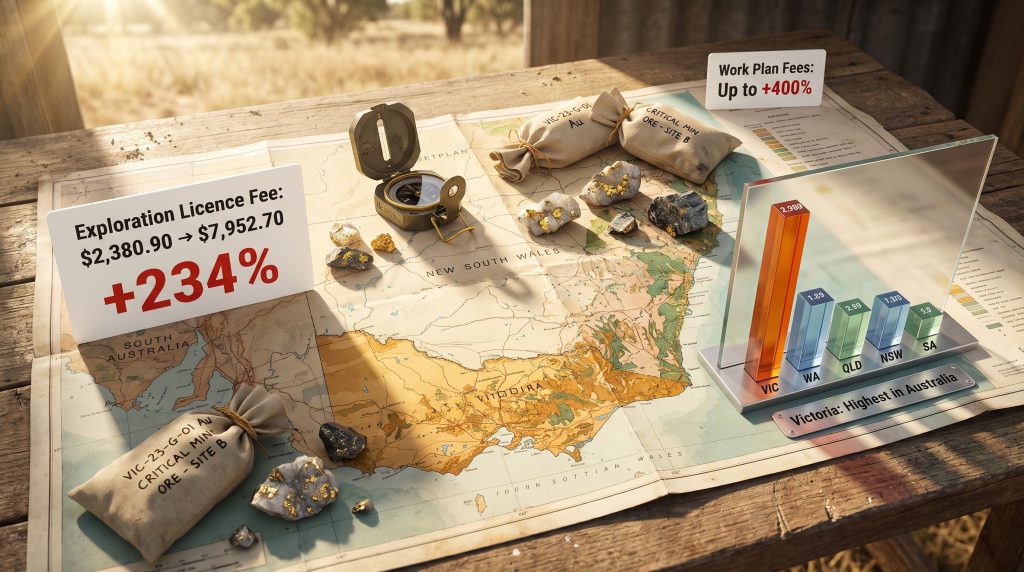
This distinction matters enormously right now in Victoria, where a proposed Victoria exploration licence fee increase of 234% across application, renewal, and grant categories has drawn significant pushback from the minerals sector. Understanding why this proposal is so consequential requires looking beyond the raw numbers to the broader competitive architecture of the junior exploration investment landscape.
When big ASX news breaks, our subscribers know first
What Exactly Is Being Proposed? Breaking Down Victoria's New Fee Structure
The Victorian Government's Resources Victoria, through a Regulatory Impact Statement process, has put forward a preferred option involving a sweeping uplift across all major exploration licence fee categories. The public consultation period for this RIS closed on 23 June 2025, with amended regulations proposed to take effect on 1 January 2027.
The Full Scale of Victoria's Proposed Exploration Licence Fee Changes
The scale of the proposed changes is best understood through direct comparison:
| Fee Category | Current Fee | Proposed Fee | Percentage Increase |
|---|---|---|---|
| Exploration Licence Application | $2,380.90 | $7,952.70 | +234% |
| Exploration Licence Renewal | $1,246.00 | $4,160.90 | +234% |
| Exploration Licence Grant | $2,380.90 | $7,952.70 | +234% |
| Work Plan Fee | Baseline rate | Up to 400% increase | +400% |
Key Policy Context: The Victorian Government's preferred option under the Resources Victoria Regulatory Impact Statement is a uniform 234% increase across all exploration fee categories, with amended regulations proposed to take effect on 1 January 2027. The public consultation period closed on 23 June 2025.
Why the "40% Increase" Figure Appears in Industry Coverage
Some industry reporting has referenced a 40% increase figure, which has created confusion in public discussion. This figure applies to a narrower subset of exploration licence charges and does not reflect the full scope of the preferred policy option detailed in the official RIS. The 234% figure represents the government's stated preferred pathway across the core licence fee categories, while work plan fees face increases of up to 400% under the same proposal.
When mineralisation fees and native title assessment fees are layered on top of the base licence fee increases, the total cost burden facing an exploration company operating in Victoria grows substantially beyond what the headline percentage alone suggests. For junior explorers managing tight budgets across multiple tenements, these cumulative charges can materially alter project economics before a single drill hole is completed. The Mining Industry slams Victorian Government over these massive fee hikes, reflecting the scale of industry concern.
How Does Victoria Compare to Other Australian States for Exploration Fees?
A Jurisdictional Benchmarking Analysis: Victoria vs. WA, NSW, Queensland, and South Australia
The proposed Victoria exploration licence fee increase does not occur in a vacuum. It compounds a pre-existing competitive disadvantage that Victoria already carries relative to every other Australian jurisdiction.
| Jurisdiction | Exploration Licence Application Fee (Approx.) | Competitive Grants Program Available? | Relative Cost Ranking |
|---|---|---|---|
| Victoria (Current) | $2,380.90 | No | Highest in Australia |
| Victoria (Proposed) | $7,952.70 | No | Significantly higher |
| Western Australia | Lower | Yes | Competitive |
| Queensland | Lower | Yes | Competitive |
| New South Wales | Lower | Yes | Competitive |
| South Australia | Lower | Yes | Competitive |
Critical Finding: Victoria currently holds the distinction of charging the highest exploration licence application fee of any Australian state or territory, and the second highest exploration licence renewal fee, before the proposed 234% increase is applied. It is also the only jurisdiction in Australia without a competitive exploration grants program.
The combination of these two structural deficits is significant. Victoria is not merely expensive relative to peers; it is expensive without offering any of the offsetting mechanisms that other states use to remain attractive to exploration capital.
The Grants Gap: What Victoria Is Missing That Every Other State Has
Competitive exploration grants programs operate across Western Australia, Queensland, New South Wales, and South Australia. These programs typically involve co-funded arrangements in which government contributions partially subsidise drilling, geophysical surveys, or geochemical sampling undertaken by private exploration companies, with the data frequently made publicly available to improve regional geological understanding.
The economic rationale is straightforward: governments that invest in exploration promotion accelerate the discovery pipeline, which in turn brings forward mine development timelines and ultimately generates royalty revenue streams that dwarf the initial grant expenditure. It is an investment model, not a cost centre.
Victoria's absence from this framework means that explorers operating in the state face both higher baseline costs and no mechanism for cost recovery through co-funding. The Minerals Council of Australia has formally called on both the Victorian Government and the Victorian Opposition to jointly introduce a competitive exploration grants program modelled on the interstate frameworks that have demonstrably supported exploration activity in peer jurisdictions.
What Are the Investment Implications of Victoria's Exploration Fee Increase?
Compounding Cost Pressures on Junior Exploration Companies
Junior exploration companies, not the large diversified miners, are the primary drivers of discovery in Australia. Majors typically acquire proven resources; juniors take the geological and financial risk to find them. This asymmetry means that fee increases fall disproportionately on the sector least equipped to absorb them. Furthermore, the Junior Minerals Exploration Incentive framework, which exists at a federal level, may do little to offset state-level cost increases of this magnitude.
The proposed Victoria exploration licence fee increase arrives alongside a separate headwind from federal policy. Changes to the Federal Government's capital gains tax settings are projected to reduce investor returns in junior exploration companies by approximately 19%, according to analysis cited by the Minerals Council of Australia. This federal-level drag on exploration equity investment, combined with a state-level surge in operating licence costs, creates a compounding deterrent that could meaningfully shift exploration capital allocation decisions.
Key pressure points for junior explorers include:
- Higher upfront licence application costs reducing the number of tenements that can be economically maintained within a given budget envelope
- Work plan fee increases of up to 400% adding material costs to already resource-intensive regulatory compliance processes
- Reduced investor appetite for Victorian exploration equity driven by the CGT settings reducing after-tax returns
- The availability of lower-cost, grant-supported environments in Western Australia and Queensland as direct alternatives for exploration capital allocation
Victoria's Underexplored Mineral Potential: The Opportunity Cost of Fee Deterrence
What makes the proposed fee structure particularly counterproductive from a policy standpoint is the geological context it operates within. Victoria remains substantially underexplored relative to its geological prospectivity, particularly for gold and a range of critical minerals that are increasingly central to domestic supply chain strategy. In addition, Australia's critical minerals agenda makes Victoria's underexploration an issue of national strategic concern, not merely a state-level fiscal debate.
Victoria's geological heritage is anchored by the Victorian Goldfields, which produced enormous quantities of alluvial and hard-rock gold during the nineteenth century gold rush era and continue to host significant mineralised systems that have received comparatively limited modern exploration coverage. Beneath the surface, the state's Lachlan Fold Belt geology shares structural characteristics with highly productive mineral provinces elsewhere in southeastern Australia.
Analyst Framing: Applying full cost recovery to exploration rather than to production is structurally inconsistent with royalty-based revenue models. Explorers generate no revenue until a resource is discovered, developed, and brought into production. Fee recovery at the exploration stage effectively taxes the risk-taking phase of the mining value chain before any economic return is realised.
To illustrate the stakes: if Victoria's exploration licence fee increase deters sufficient activity to produce even a 20-30% contraction in exploration investment over a decade, the royalty revenue foregone from discoveries that were never made could vastly exceed the cost-recovery amounts captured through the fee uplift. This is speculative modelling, and outcomes would depend heavily on commodity prices, discovery rates, and development timelines, but the directional logic is sound and consistent with how exploration economists assess jurisdictional competitiveness.
What Does Industry Want? The MCA Victoria Policy Position Explained
The Four-Point Reform Agenda from MCA Victoria
The Minerals Council of Australia's Victorian chapter has articulated a clear and structured response to the proposed fee changes. Their position is not simply to oppose cost recovery in principle, but to argue for a more sophisticated policy design that balances fiscal recovery with investment incentives.
The four core asks are:
- Reject or substantially reduce the proposed 234% exploration licence fee increase, which the MCA argues is disproportionate and economically damaging given Victoria's already uncompetitive fee baseline
- Link any approved fee increases directly to measurable, verifiable improvements in service delivery from Resources Victoria, ensuring that higher fees translate into faster processing times, better technical support, and more efficient regulatory interactions
- Delay implementation until at least 2027, aligned with the planned removal of work plans under reforms to the Mineral Resources (Sustainable Development) Act, which will transition to a less administratively intensive duties-based model
- Introduce a co-funded competitive exploration grants program in partnership with the Victorian Opposition, consistent with programs operating in every other Australian state and territory
Why Timing Matters: The 2027 Regulatory Reform Window
The planned transition away from work plans under amendments to the Mineral Resources (Sustainable Development) Act is a significant and often underappreciated part of this debate. Work plans currently require exploration companies to prepare detailed documentation of planned activities before commencing ground-based work, a process that carries both time and cost burdens. The shift to a duties-based model is intended to reduce this administrative overhead by replacing prescriptive pre-approval with clear operational obligations.
The MCA's argument is that implementing major fee increases before this architectural change takes effect creates a double-cost burden: explorers face both the new higher fees and the existing administrative costs of the work plan system simultaneously. Waiting until the duties-based model is operational would allow the government to set fees against a reformed cost base, producing a more accurate and defensible cost-recovery calculation.
Implementing fees against the current regulatory architecture and then restructuring that architecture creates a situation where the fee justification is built on a cost structure that is about to become obsolete. The government's own exploration licence guidelines make clear that the regulatory environment is in active transition, which further underscores the MCA's case for delaying implementation.
How Should the Victorian Government Respond? A Policy Scenario Analysis
Scenario Modelling: Three Possible Government Responses
| Scenario | Government Action | Industry Outcome | Jurisdictional Competitiveness |
|---|---|---|---|
| Status Quo Implementation | 234% fee increase proceeds on 1 January 2027 | Significant deterrent to junior exploration; capital outflow risk | Victoria remains least competitive jurisdiction in Australia |
| Phased Increase with Service Benchmarks | Staged fee increases tied to Resources Victoria service improvements | Reduced short-term deterrent; industry engagement maintained | Moderate improvement if grants program introduced concurrently |
| Fee Renegotiation + Grants Program | Reduced fee increase aligned with 2027 regulatory reform; competitive grants introduced | Exploration investment stabilised; royalty pipeline protected | Victoria repositioned as a credible exploration destination |
Policy Recommendation Framework: The most economically rational outcome balances the government's legitimate cost-recovery objectives against the long-term royalty revenue foregone if exploration activity contracts. A phased approach tied to the 2027 regulatory transition, combined with a grants program, represents the lowest-risk policy path for both government and industry.
The next major ASX story will hit our subscribers first
Frequently Asked Questions: Victoria Exploration Licence Fee Increase
What is the proposed increase to Victoria's exploration licence fees?
The Victorian Government's preferred proposal under the Resources Victoria Regulatory Impact Statement is a 234% increase across exploration licence application, renewal, and grant fees, raising the application fee from $2,380.90 to $7,952.70. Work plan fees are proposed to increase by up to 400%. Amended regulations are scheduled to take effect on 1 January 2027.
Why is the Victoria exploration licence fee increase controversial?
Several factors combine to make this proposal contentious:
- Victoria already charges the highest exploration licence application fee in Australia before the proposed increase takes effect
- The state is the only Australian jurisdiction without a competitive exploration grants program to offset operator costs
- The fee increase compounds existing investor headwinds from federal CGT changes, estimated to reduce returns for junior exploration investors by approximately 19%
- The increase is proposed ahead of a major regulatory restructure, creating a potential double-cost burden during the transition period
When did the consultation period for Victoria's fee changes close?
The public consultation period closed on 23 June 2025.
What is the MCA Victoria asking the government to do?
MCA Victoria is asking the government to reject or substantially reduce the proposed fee increases, link any approved increases to measurable service delivery improvements, delay implementation until 2027, and introduce a co-funded exploration grants program consistent with those operating in every other Australian jurisdiction. Furthermore, the question of junior explorers funding at both state and federal levels remains central to industry's case for a more balanced policy response.
How does Victoria compare to other states for exploration fees?
Victoria currently charges the highest exploration licence application fee of any state or territory and the second highest renewal fee. Every other Australian jurisdiction operates a competitive grants program that partially offsets exploration costs. Victoria offers neither fee competitiveness nor grant support.
What minerals are at stake in Victoria's underexplored regions?
Victoria's geology holds prospectivity for gold and a range of critical minerals, both of which carry strategic significance for Australia's domestic supply chain ambitions and export positioning in global battery and clean energy material markets.
Balancing Cost Recovery with Long-Term Mineral Wealth Creation
The Royalty Revenue Paradox at the Heart of This Debate
The Victorian Government's fee review presents itself as a cost-recovery measure, but its deeper economic consequence is a decision about whether Victoria competes for exploration capital or cedes it to jurisdictions with more investment-positive regulatory settings.
The royalty revenue paradox is central here. Cost recovery applied at the exploration stage may, over time, reduce the size of the royalty base it is ostensibly designed to fund. If higher fees deter the discovery of new resources, then the long-term royalty revenue stream shrinks. The government collects more from each licence application while licensing fewer discoveries. This is not cost recovery in any meaningful economic sense; it is a trade of future wealth for present administrative revenue.
A best-practice regulatory framework for exploration fee design would likely include:
- Fees calibrated against the reformed cost base of the duties-based regulatory model, not the current work plan architecture
- Service delivery benchmarks embedded in any fee increase, giving industry measurable accountability from government
- A competitive grants co-funding mechanism that recycles a portion of regulatory revenue back into exploration promotion
- Periodic jurisdictional benchmarking reviews to ensure Victoria's fee structure remains within a competitive range relative to peer states
The 2027 regulatory reform transition offers a genuine reset point. If the Victorian Government chooses to redesign its exploration fee architecture in alignment with the new duties-based model rather than ahead of it, the result could be a fee structure that is both fiscally defensible and investment-positive. That outcome serves the long-term interests of both the state budget and the exploration sector.
Whether Victoria takes that opportunity or locks in a fee regime that accelerates the migration of exploration capital to Western Australia and Queensland will say a great deal about how seriously the state views its own mineral potential.
This article contains forward-looking analysis, scenario modelling, and projections regarding exploration investment, royalty revenue, and regulatory outcomes. These represent analytical frameworks and are not financial advice. Readers should conduct independent research before making investment or business decisions related to mineral exploration activity in Victoria or any other jurisdiction.
Further Reading: Readers seeking additional context on Victoria's mineral exploration regulatory environment and the broader policy debate around exploration fee structures in Australia can refer to ongoing coverage at Australian Mining.
Want to Track ASX Mineral Discoveries Before the Broader Market Does?
Discovery Alert's proprietary Discovery IQ model delivers real-time alerts the moment significant ASX mineral discoveries are announced, transforming complex geological data into clear, actionable insights for both short-term traders and long-term investors. Start your 14-day free trial today and explore historic discovery returns that demonstrate why getting in early on a major find can be a genuinely transformative investment outcome.