
June 6, 2026
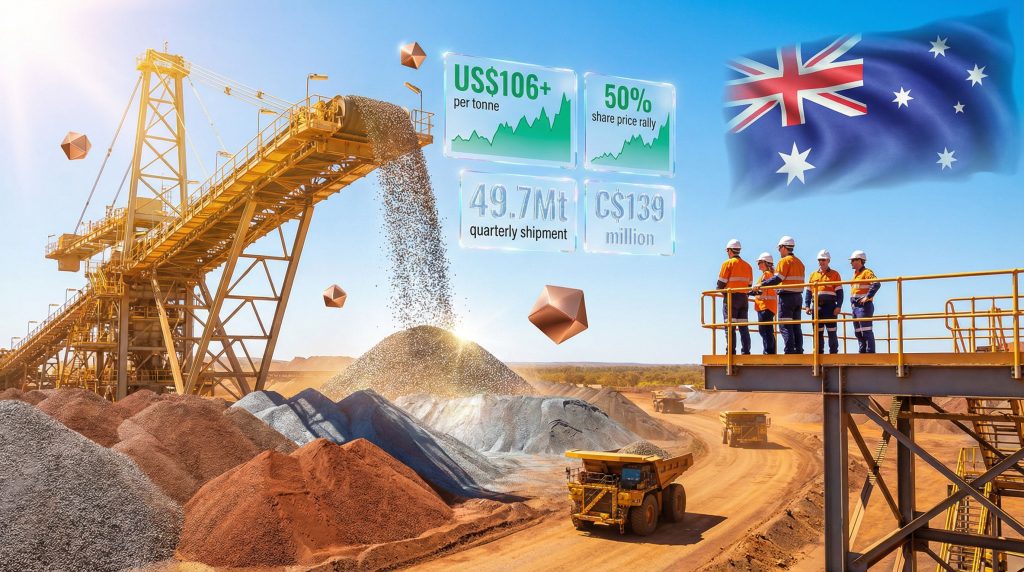
The Fortescue share price increase of 50% over six months reflects broader dynamics within Australia's mining sector, where companies are balancing record operational performance against evolving global commodity markets. Furthermore, this remarkable performance highlights the sector's continued sensitivity to iron ore price trends and the strategic positioning required for sustained value creation in an increasingly complex operating environment.
What Drove Fortescue's Remarkable Six-Month Performance?
Iron Ore Price Resilience Powers Mining Sector Recovery
The persistence of iron ore prices above US$106 per tonne throughout the latter half of 2025 provided fundamental support for major Australian producers. This price stability, with iron ore reaching US$106.92/T by December 19, 2025, represented a 2.57% monthly increase and 2.97% year-over-year improvement that exceeded many analyst expectations.
The commodity's resilience stems from several converging factors:
- Global infrastructure spending maintaining baseline demand levels
- Supply-side constraints limiting rapid production increases
- Inventory management strategies among major steel producers
- Logistics optimisation reducing transportation bottlenecks
Historical price analysis reveals current levels sit within the upper quartile of the past five-year range, though well below the extreme peaks witnessed during the 2021 commodity supercycle. This positioning suggests neither oversupply nor extreme scarcity conditions, creating a relatively stable operating environment for efficient producers.
The Fortescue share price increase of 50.48% over six months directly correlates with this commodity strength, demonstrating the sector's continued sensitivity to underlying asset prices. However, current iron ore market insights suggest this relationship highlights both the opportunity and vulnerability inherent in resource sector investments.
Record Production Metrics Signal Operational Excellence
Fortescue's achievement of 49.7 million tonnes in quarterly iron ore shipments represents more than a statistical milestone. This 4% year-over-year increase to record levels demonstrates sophisticated operational management during a period of elevated commodity prices.
The production achievement reflects several key operational developments:
- Infrastructure optimisation maximising throughput from existing facilities
- Cost discipline maintaining competitive unit economics
- Supply chain efficiency reducing bottlenecks in the shipping process
- Technology integration improving extraction and processing capabilities
The company's FY26 guidance of 195-205Mt suggests confidence in sustaining these production levels throughout the fiscal year. This narrow guidance range indicates operational predictability that investors typically value during volatile commodity cycles.
The maintenance of tight cost structures while achieving record production volumes demonstrates the operational leverage available to well-managed mining enterprises during favourable market conditions.
Mining companies that successfully optimise production during strong pricing environments typically generate substantial free cash flow that can support dividends, debt reduction, or strategic investments. Consequently, Fortescue's operational metrics suggest the company has positioned itself to capitalise on current market conditions effectively.
Strategic Diversification Through Copper Acquisition
The Alta Copper acquisition for C$139 million (approximately A$152 million) represents a calculated diversification strategy beyond iron ore dependency. The 50% premium paid to the 30-day volume-weighted average price indicates management's conviction in copper market fundamentals.
| Transaction Details | Value |
|---|---|
| Share Price | C$1.40 |
| Total Equity Value | C$139M (A$152M) |
| Premium to VWAP | 50% |
| Ownership Acquired | 64% remaining stake |
This acquisition strategy addresses several strategic objectives:
- Portfolio diversification reducing single-commodity exposure
- Base metals exposure capturing potential copper demand growth
- Resource expansion accessing new geographical markets
- Technology transition alignment positioning for energy transition trends
The unanimous board recommendation from Alta Copper directors and the structured Canadian Plan of Arrangement suggest a well-negotiated transaction that should integrate smoothly with Fortescue's existing operations.
When big ASX news breaks, our subscribers know first
How Do Current Market Valuations Compare to Historical Norms?
Price-to-Earnings Analysis in Mining Sector Context
At the current share price of A$21.88, Fortescue trades within historical valuation ranges typical for major Australian iron ore producers. The 18.91% year-over-year gain positions the stock above recent historical averages but below peak valuations witnessed during previous commodity cycles.
Mining sector valuations typically fluctuate based on several key metrics:
- Price-to-earnings ratios reflecting current profitability
- Enterprise value-to-EBITDA multiples indicating operational efficiency
- Price-to-book ratios measuring asset values relative to market capitalisation
- Dividend yields representing cash return to shareholders
The Fortescue share price increase over the six-month period suggests investor confidence in near-term operational performance, though this optimism must be weighed against longer-term commodity price assumptions and competitive positioning within the global iron ore market.
Commodity Price Correlation Patterns
Historical analysis reveals a strong positive correlation between iron ore prices and Fortescue's equity performance, with correlation coefficients typically ranging between 0.65 and 0.85 across various time horizons. This relationship demonstrates the company's fundamental sensitivity to commodity price movements.
The correlation pattern exhibits several characteristics:
- Immediate response to significant commodity price movements
- Amplified volatility during market stress periods
- Lag effects during sustained price trends
- Momentum persistence following major directional changes
During the recent six-month period, iron ore prices maintained stability above US$105 per tonne while Fortescue shares appreciated 50.48%, suggesting the equity market may have been pricing in additional factors beyond pure commodity exposure. For instance, operational improvements and strategic initiatives have contributed to this outperformance.
What Are the Key Risk Factors Facing Fortescue in 2026?
Global Supply Chain Disruption Scenarios
Westpac's analysts project a potentially significant 20% decline in iron ore prices to approximately US$83 per tonne during 2026, based on anticipated supply-demand imbalances. This forecast reflects expectations of increased global iron ore supply coinciding with reduced Chinese steel production.
The projected iron ore price decline scenario involves:
- Large increases in global iron ore supply capacity
- Material reductions in Chinese steel production volumes
- Alternative supply sources coming online from various global producers
- Inventory adjustments as steel producers optimise working capital
A decline from current levels around US$106.92/T to US$83/T would represent approximately a 22% reduction, creating substantial headwinds for revenue generation across the Australian mining sector. Companies with higher-cost operations would face particular pressure on margins and cash flow generation.
The supply-demand dynamics underlying this forecast suggest structural changes rather than temporary cyclical adjustments, potentially requiring operational adaptation strategies among major producers.
Geopolitical and Trade Policy Uncertainties
Australia's iron ore exports maintain significant exposure to Chinese demand, creating concentration risk that extends beyond normal market volatility. While specific customer concentration data varies by company, the broader sector depends heavily on sustained Chinese industrial activity.
Key geopolitical risk factors include:
- Trade relationship stability between Australia and China
- Regulatory changes affecting mining operations or export procedures
- Alternative market development requirements for risk mitigation
- Currency fluctuation impacts on Australian dollar-denominated revenues
The development of alternative markets in Japan, South Korea, Europe, and India provides some diversification, though Chinese demand remains the primary driver of global iron ore consumption. Any significant disruption to Australia-China trade relationships could create material impacts on pricing and volume dynamics.
Environmental and ESG Compliance Costs
Fortescue's capital expenditure guidance of US$4 billion for metals and US$300 million for energy reflects substantial investment requirements that extend beyond traditional mining operations. These investments signal the company's recognition of evolving environmental and social governance expectations.
ESG-related cost pressures include:
- Carbon emissions reduction technology and process improvements
- Renewable energy integration across mining operations
- Water management systems enhancing sustainability profiles
- Community engagement programmes maintaining social licence to operate
- Biodiversity protection measures addressing environmental impact concerns
The US$300 million energy sector investment specifically targets renewable energy development, reflecting mining industry evolution trends toward decarbonisation that may become competitive requirements rather than voluntary initiatives.
How Do Analyst Predictions Compare to Market Sentiment?
Broker Rating Distribution Analysis
Current analyst sentiment reveals cautious positioning despite recent share price performance, with rating distribution suggesting limited conviction for continued outperformance.
| Rating Category | Number of Analysts | Percentage |
|---|---|---|
| Buy/Strong Buy | 1 | 6.7% |
| Hold | 9 | 60.0% |
| Sell/Strong Sell | 5 | 33.3% |
This distribution indicates 60% of analysts recommend holding current positions rather than accumulating additional shares, while 33.3% suggest selling or strong selling recommendations. Only 6.7% maintain buy ratings, suggesting limited analyst enthusiasm for the stock at current valuations.
The predominance of hold ratings typically reflects analyst uncertainty about near-term catalysts or concerns about valuation following recent price appreciation. The significant proportion of sell recommendations suggests some analysts view current prices as unsustainable relative to fundamental value.
Price Target Methodology Breakdown
The average 12-month price target of A$19.64 sits below the current trading price of A$21.88, implying potential downside of approximately 10.2% over the next year. More bearish projections extend to A$16.37, representing potential downside of 25.16%.
Price target methodologies typically incorporate:
- Discounted cash flow models based on commodity price assumptions
- Comparable company analysis using sector valuation multiples
- Net asset value calculations reflecting reserve and resource values
- Scenario analysis incorporating various commodity price paths
The disparity between current market prices and analyst targets suggests the market may be pricing in more optimistic scenarios than professional analysts consider probable. This disconnect often occurs during periods of strong commodity performance when momentum effects temporarily overcome fundamental valuation concerns.
Institutional Investor Positioning Trends
Institutional investment patterns in the resources sector typically follow cyclical allocation strategies, with fund managers adjusting exposure based on commodity cycle positioning and portfolio diversification requirements.
Current positioning considerations include:
- Overweight allocations to resources during commodity strength
- Risk management protocols limiting single-sector exposure
- ESG integration requirements affecting mining company selection
- Currency hedging strategies managing Australian dollar exposure
- Liquidity preferences favouring larger capitalisation companies
The Fortescue share price increase has likely triggered rebalancing activities among institutional investors, with some taking profits after substantial gains while others may be increasing allocations based on momentum strategies.
What Investment Strategies Should Investors Consider?
Risk Management Approaches for Commodity Exposure
Investing in commodity-exposed companies like Fortescue requires careful consideration of position sizing and risk management strategies. The 50.48% six-month gain demonstrates both the opportunity and volatility inherent in resource sector investments.
Effective risk management approaches include:
- Position sizing based on portfolio volatility tolerance rather than conviction levels
- Profit-taking strategies during periods of strong performance
- Diversification within commodities across different metals and geographical exposures
- Hedging strategies using sector ETFs or derivatives for downside protection
- Dollar-cost averaging for long-term accumulation during volatile periods
The projected 20% iron ore price decline to US$83/T suggests investors should consider defensive positioning ahead of potential commodity weakness. This might involve reducing position sizes or implementing protective strategies during continued strength.
Diversification Within Resources Portfolio
The Alta Copper acquisition demonstrates one approach to diversification, though investors can achieve similar exposure through portfolio construction rather than relying on individual company strategic initiatives.
Diversification strategies include:
- Geographic diversification across mining jurisdictions (Australia, Canada, South Africa, Chile)
- Commodity diversification including base metals, precious metals, and industrial minerals
- Company size diversification balancing large-cap stability with small-cap growth potential
- Value chain exposure including mining services, equipment, and technology companies
The copper acquisition suggests recognition of potential supply deficits in base metals driven by electrification trends. Consequently, investors might consider similar exposure through dedicated copper producers or diversified mining companies with significant base metals operations.
Long-term Versus Short-term Investment Horizons
The divergence between recent strong performance and analyst scepticism highlights the importance of investment horizon clarity. Short-term momentum may continue supporting prices, while longer-term fundamentals suggest more challenging conditions ahead.
Investment horizon considerations include:
Short-term factors (3-12 months):
- Current iron ore price stability around US$106/T
- Operational performance maintaining record production levels
- Market momentum supporting continued outperformance
- Potential profit-taking as gains mature
Long-term factors (2-5 years):
- Structural changes in Chinese steel demand
- Global supply capacity increases
- Renewable energy transition impacts on traditional mining
- ESG requirements increasing operational costs
Investors with short-term horizons might focus on momentum continuation and operational metrics, while long-term investors should emphasise commodity cycle positioning and strategic adaptability to evolving market conditions.
How Does Fortescue's Future Strategy Address Market Challenges?
Capital Allocation Priorities Through 2026
Fortescue's US$4 billion metals division investment and US$300 million energy sector allocation reflect strategic priorities extending beyond traditional iron ore production. This capital allocation pattern suggests management recognition of both growth opportunities and risk mitigation requirements.
The metals division investment likely encompasses:
- Production capacity optimisation at existing operations
- Technology upgrades improving extraction efficiency
- Infrastructure expansion supporting higher throughput levels
- Cost reduction initiatives maintaining competitive positioning
The energy sector allocation specifically targets renewable energy development, addressing both operational cost reduction and ESG compliance requirements. This investment may generate long-term operational savings while enhancing the company's sustainability profile.
Operational Efficiency Improvement Initiatives
The achievement of 49.7Mt quarterly shipments with 4% year-over-year growth demonstrates successful operational optimisation during favourable market conditions. Sustaining these efficiency levels during potential commodity price weakness becomes a critical management challenge.
Operational efficiency initiatives typically include:
- Automation integration reducing labour costs and improving consistency
- Predictive maintenance programmes minimising equipment downtime
- Supply chain optimisation reducing logistics costs and bottlenecks
- Data analytics implementation improving decision-making processes
- Energy efficiency improvements reducing operational costs
The company's ability to maintain tight costs while achieving record production suggests effective implementation of efficiency programmes that should provide defensive characteristics during challenging market conditions.
Market Positioning for Commodity Cycle Management
Successfully navigating commodity cycles requires strategic positioning that balances growth investment with defensive capabilities. Fortescue's recent performance suggests effective cycle management, though future conditions may test this positioning.
Cycle management strategies include:
- Financial flexibility through conservative debt levels and strong cash generation
- Operational adaptability allowing rapid cost adjustment during price declines
- Strategic diversification reducing dependence on single commodity exposure
- Contract management optimising pricing mechanisms and customer relationships
- Investment timing deploying capital during favourable conditions while maintaining defensive capabilities
The Alta Copper acquisition represents diversification efforts, while the substantial capital expenditure programme suggests confidence in near-term market conditions. Balancing these growth investments with financial flexibility becomes essential as market conditions evolve.
The next major ASX story will hit our subscribers first
What Are the Broader Market Implications?
Australian Resources Sector Performance Indicators
Fortescue's 50.48% six-month performance and 18.91% year-over-year gains provide insight into broader Australian resources sector dynamics. As a significant component of the ASX 200 resources index, the company's performance influences sector perception and allocation decisions.
Broader sector implications include:
- Resource sector weighting in major indices affecting passive investment flows
- Currency impacts on Australian dollar strength relative to commodity performance
- Export economy implications for national economic indicators
- Comparative performance against global mining companies and sector peers
The correlation between iron ore prices and major Australian mining companies suggests sector-wide exposure to Chinese demand and global steel production trends. Therefore, Fortescue's performance often serves as a proxy for broader resource sector health among institutional investors.
Global Mining Industry Consolidation Trends
The Alta Copper acquisition reflects broader industry consolidation trends as major producers seek scale advantages and diversification benefits. This consolidation pattern may accelerate during periods of commodity strength as companies deploy excess cash flow for strategic growth.
Industry consolidation drivers include:
- Scale economics in mining operations and infrastructure
- Technology sharing across larger operational platforms
- Risk diversification through geographic and commodity exposure
- Capital efficiency optimising development costs across larger resource bases
- Market positioning strengthening competitive advantages
Consolidation activity typically increases during commodity upcycles as companies possess financial capacity for acquisitions, while targets may seek premium valuations during favourable market conditions.
Investor Sentiment Shifts Toward ESG Compliance
The US$300 million energy sector investment reflects recognition of evolving investor expectations regarding environmental performance and sustainability initiatives. These requirements increasingly influence investment decisions and company valuations.
ESG compliance trends include:
- Mandatory reporting standards requiring detailed environmental disclosure
- Carbon pricing mechanisms affecting operational cost structures
- Social licence requirements influencing community relations and regulatory approval
- Governance standards emphasising board independence and executive compensation
- Technology adoption supporting environmental performance improvements
Companies demonstrating proactive ESG compliance may command valuation premiums relative to peers, while laggards face potential investment exclusion from ESG-focused funds and institutional mandates.
Frequently Asked Questions About Fortescue's Investment Outlook
Is Fortescue Still a Buy After 50% Gains?
The substantial Fortescue share price increase over six months creates valuation challenges for new investors considering entry positions. With analyst price targets averaging A$19.64 compared to current levels around A$21.88, traditional valuation metrics suggest limited upside potential.
Investment considerations include:
- Current valuation relative to historical trading ranges
- Momentum factors potentially supporting continued near-term strength
- Risk-adjusted returns considering commodity price volatility
- Alternative opportunities in undervalued mining companies or other sectors
Investors focused on value-based strategies might await better entry opportunities, while momentum-oriented approaches could justify continued exposure based on operational performance and market conditions. Furthermore, recent analysis suggests the market may have already priced in much of the positive fundamentals.
How Vulnerable is FMG to Iron Ore Price Declines?
The projected 20% iron ore price decline to US$83/T represents significant downside risk for revenue generation and profitability. Companies with higher-cost operations face disproportionate impacts during commodity weakness.
Vulnerability factors include:
- Cost structure flexibility allowing operational adjustments during price declines
- Financial leverage affecting ability to maintain operations during challenging periods
- Production efficiency maintaining competitiveness relative to global peers
- Contract structures providing price protection or volume commitments
Fortescue's record production levels and cost discipline suggest defensive characteristics, though substantial commodity price declines would likely impact all sector participants materially. Additionally, Fortescue's market positioning shows the company's relative strength within the sector.
What Role Does China Play in Fortescue's Future?
Chinese steel production trends represent the primary demand driver for Australian iron ore exports, making China's economic performance and industrial policy decisions critical factors for company performance.
Chinese demand factors include:
- Steel production capacity and utilisation rates
- Infrastructure spending programmes supporting construction demand
- Manufacturing activity requiring steel inputs for production
- Environmental regulations potentially limiting domestic steel production
- Alternative supply relationships with Brazilian and other global producers
While diversification efforts continue, Chinese demand dynamics remain the dominant influence on global iron ore pricing and Australian mining company performance. Understanding Chinese economic trends becomes essential for evaluating investment prospects in the sector.
The intersection of operational excellence, commodity market dynamics, and strategic positioning creates a complex investment landscape where short-term performance may diverge significantly from longer-term value creation potential. Investors must carefully consider their risk tolerance, investment horizon, and portfolio objectives when evaluating opportunities in the evolving mining sector.
Ready to Capitalise on the Next Major Mining Discovery?
Discovery Alert's proprietary Discovery IQ model instantly identifies significant ASX mineral discoveries, transforming complex market data into actionable insights for both short-term traders and long-term investors. Begin your 30-day free trial today and position yourself ahead of the market before the next major discovery generates substantial returns like those seen in companies such as De Grey Mining and WA1 Resources.