August 7, 2026
Why Most Investors Read Gold and Uranium Markets Backwards
There is a persistent tension in resource investing between how markets behave in the short term and what the underlying fundamentals actually demand over a longer horizon. Most retail participants chase price momentum, treating rising asset prices as confirmation of a thesis and falling prices as a signal to exit. Experienced resource investors, particularly those who have navigated multiple commodity cycles, tend to operate from an almost opposite framework.
Understanding that divergence is essential before evaluating what sophisticated practitioners currently think about gold, uranium, and the equities tied to both. This analysis draws on a framework articulated by veteran resource investor Rick Rule during a recent Rick Rule gold and uranium stocks interview at the Vancouver Resource Investment Conference, synthesising his views with broader market data and independent industry context.
When big ASX news breaks, our subscribers know first
Gold as a Savings Vehicle, Not a Speculation
The Counterintuitive Case for Accumulating During Price Weakness
Most market commentary treats a declining gold price as a bearish signal. Within a savings-oriented investment framework, however, price consolidation or weakness represents an opportunity to accumulate more of an asset at a lower cost rather than a reason to exit. This distinction matters enormously because it reflects a fundamentally different objective: preserving purchasing power over a decade or more rather than generating a short-term paper return.
The mechanical explanation for gold's recent relative weakness is fairly straightforward. Rising U.S. interest rates increase the appeal of yield-generating instruments, drawing capital toward dollar-denominated assets. Since gold is priced in U.S. dollars, a stronger dollar creates downward pressure on the gold price in dollar terms, even when the underlying demand for gold as a store of value remains intact. Seasoned resource investors tend to interpret this as a structural entry point, reinforcing the case for gold as a strategic investment rather than a reason to exit positions.
The Real Inflation Problem Hidden Inside Official Data
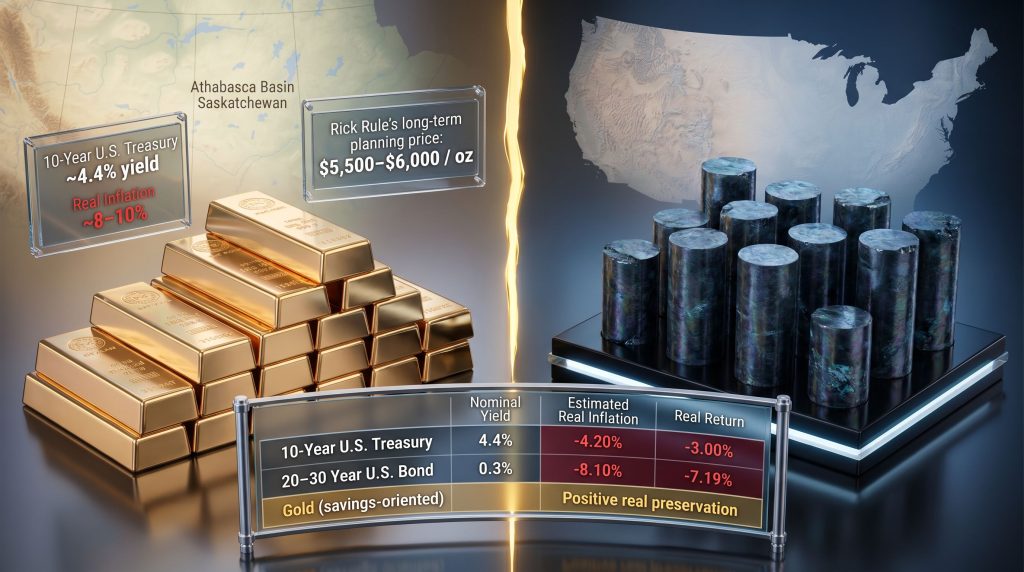
Perhaps the most consequential analytical divergence in the current environment sits between official inflation figures and the actual erosion of household purchasing power. The U.S. Consumer Price Index has been reporting annual inflation in the range of approximately 2.6 to 2.7%. However, when households benchmark their spending basket against what similar goods and services cost in 2020, the deterioration in real purchasing power appears closer to 8 to 10% annually for many families.
This gap produces a critical distortion in how bond yields are perceived. A 10-year U.S. Treasury yielding approximately 4.4% appears, on paper, to be a modestly positive real return. When adjusted against a more realistic household inflation rate, however, that same instrument delivers a real return of approximately negative 4 to 5% per year. The table below illustrates this dynamic across duration segments:
| Asset | Nominal Yield | Estimated Real Inflation | Estimated Real Return |
|---|---|---|---|
| 10-Year U.S. Treasury | ~4.4% | ~8–10% (household basket) | -3.6% to -5.6% |
| 20–30 Year U.S. Bond | ~4.5–4.7% | ~8–10% | -3.3% to -5.5% |
| Gold (savings-oriented) | 0% nominal yield | Maintains purchasing power | Positive real preservation |
Within this framework, the U.S. long bond is not a conservative asset. It is, from a real-return perspective, a structurally loss-making instrument when evaluated against genuine household purchasing power changes. Short-duration Treasuries of two years or less offer a more defensible position because they carry significantly less duration risk and can be rolled as conditions evolve.
Gold, despite generating no nominal yield, functions as a long-duration inflation hedge precisely because it is not subject to the same erosion dynamic. As Rick Rule has noted in his broader market commentary, this distinction is fundamental to understanding why sophisticated capital-preservation investors continue to favour gold over extended Treasury positions.
The U.S. fiscal outlook adds another layer of pressure. With annual deficits projected to approach or exceed $2.5 trillion, bond market participants are demanding incrementally higher yields to hold long-duration government debt, further reinforcing this dynamic.
The Gold Mining M&A Cycle Is No Longer a Forecast
Two Distinct Acquisition Archetypes Now Driving Sector Consolidation
For several years, resource market commentators predicted an impending mergers and acquisitions wave in gold mining. That wave has arrived. Furthermore, two structurally different types of acquisition are now simultaneously active in the market, and understanding the distinction between them is important for evaluating individual company trajectories.
The first archetype is synergistic acquisition, where a major producer acquires a deposit within logistical proximity to an existing processing facility. The economics here are compelling: sunk capital in a functioning mill is leveraged by adding throughput, meaning the acquirer captures both the mine's standalone economics and an infrastructure utilisation dividend. Agnico Eagle's recent activity in Finland exemplifies this model, and broader gold mining M&A activity reflects this same consolidation logic playing out globally.
The second archetype is tactical scale acquisition, driven not by operational adjacency but by the capital markets benefits of increased size. In today's passive-investing-dominated equity environment, a producer that crosses certain market capitalisation and trading liquidity thresholds achieves automatic inclusion in broader equity indices. Equinox Gold's sequential acquisitions of Caliber and Orla Mining reflect this logic.
What the G Mining and G2 Mining Deal Reveals About Hidden Value
A particularly instructive case study in current M&A valuation dynamics is the acquisition of G2 Mining by G Mining. G Mining was able to pay approximately a 70% premium on the G2 share price, and the transaction remained accretive on a per-share basis to G Mining shareholders. The economics were made possible because G2 Mining held a deposit of nearly 3 million ounces that was demonstrably viable as a standalone construction project, located adjacent to G Mining's own operations in Ghana.
This deal established a template with important implications for mid-tier developers: a project that can credibly stand alone as a financeable, buildable mine commands a materially stronger negotiating position than one dependent on a single strategic acquirer. When the seller can credibly say it does not need to be taken over, the buyer is compelled to pay fair value.
Equinox Gold's Path From Intermediate to Major Producer
Equinox Gold's trajectory illustrates the tactical acquisition thesis in practice. The company has executed a sequential growth strategy: acquiring Hard Rock, then Caliber, and most recently Orla Mining. Each acquisition has been followed by a predictable period of share price sideways movement as transactionally oriented shareholders from the acquired company exit their positions. This pattern is a temporary digestion phase, not a fundamental deterioration in value.
The combined entity will produce substantially more than one million ounces annually, crossing the threshold that reclassifies Equinox from an intermediate-tier producer to a major. That reclassification carries meaningful passive index buying consequences. Simultaneously, management is expected to execute portfolio rationalisation, divesting second-tier assets to reduce net acquisition costs and concentrate capital in the highest-return operations.
A Framework for Evaluating Junior and Developer Gold Stocks
The Abitibi Greenstone Belt Reassessment
For decades, sub-million-ounce deposits in the Abitibi Greenstone Belt of Canada struggled to justify standalone mill construction. The economics simply did not stack up: insufficient net present value to attract project finance, no infrastructure to reduce build costs, and no neighbouring operations to absorb production. That calculus has shifted materially.
Four decades of infrastructure investment have transformed the Abitibi. Today, the density of mills, roads, power infrastructure, and water access means that any deposit located within roughly 50 kilometres of an existing operating facility carries fundamentally different economics than it did a generation ago. Proximity-based consolidation value has consequently emerged as an equally legitimate investment thesis alongside standalone viability.
Mayfair Gold represents an instructive example. The company holds a probable reserve of approximately 1 million ounces and an additional 3 million ounces in the indicated category. Even if the full resource is not upgraded to reserve status, the proximity to existing infrastructure means a neighbouring producer could integrate the deposit without constructing a new mill.
When Political Risk Becomes a Geological Irrelevance
One of the most psychologically demanding disciplines in resource investing involves holding positions through periods of severe negative news flow in politically complex jurisdictions. The fundamental insight is that mineralisation placed in the earth tens of millions of years ago is entirely indifferent to the geopolitical environment operating at the surface.
Visla Silver presents a case study in this dynamic. The company holds what is considered among the third, fourth, or fifth best undeveloped silver deposits globally, located in Sinaloa, Mexico. Key questions any investor must honestly answer before establishing a position include:
- Does the company have sufficient working capital to survive an extended period without operational progress?
- What is a realistic minimum timeline to some form of de facto stability returning?
- Can the deposit attract project financing once demonstrable security is restored?
- Can an investor psychologically sustain holding a position through continued negative news flow without making reactive decisions?
Uranium: Energy Security Rewrites the Investment Thesis
The 1973 Parallel and What It Means for Nuclear Demand Today
The French and Japanese nuclear fleets were both constructed as a direct policy response to the energy insecurity exposed by the 1973 Arab oil embargo. A structurally similar dynamic appears to be re-emerging. Renewed concerns about access through critical maritime chokepoints, including the Strait of Hormuz, have brought energy security back to the forefront of national strategic planning.
Uranium possesses a unique characteristic that no other energy source can match: the energy density required to store multiple years of a nation's electricity generation needs in a single warehouse-scale facility. Furthermore, no volume of oil, liquefied natural gas, wind generation capacity, solar infrastructure, or grid-scale battery storage can replicate this property, making uranium investment strategies increasingly relevant for long-horizon portfolio construction.
The Supply-Demand Gap That Refuses to Close
Despite uranium spot prices crossing approximately $85 per pound, a level widely considered the theoretical incentive price for new mine development, primary supply growth has remained structurally constrained. The uranium supply deficit continues to deepen as the global market consumes more than primary mines produce, and above-ground inventory transparency remains limited.
The AI infrastructure buildout adds an additional demand vector that was not present in earlier uranium investment cycles. Data centres require reliable, continuous base-load power, and no non-carbon-generating technology can deliver that at the required scale other than nuclear. This convergence of energy security and digital infrastructure demand reinforces the structural case for uranium over a 10-year investment horizon.
A critical feature of the uranium market is the long-duration offtake contract structure. Uranium developers can pre-sell production to utility customers on 10 to 20-year contracts, locking in pricing visibility that substantially reduces the cost of debt capital, transforming a speculative development project into a bankable financing proposition.
Evaluating Major Uranium Equities: A Differentiated Assessment
NextGen Energy: World-Class Deposit, Capital Discipline Concerns
The Rook I deposit in Saskatchewan is broadly regarded as the best undeveloped uranium asset in the world. The strategic acquirer universe has expanded significantly, now including the entity formed by the Anglo American and Teck merger, Rio Tinto (already active in uranium and operating an $8 billion potash mine in Saskatchewan), and potentially others.
However, the feasibility study economics require important updating. The build cost estimate is now more than two and a half years old, and with compound annual construction cost inflation running at approximately 10%, the realistic build cost is approaching $6 billion. Concerns around general and administrative expenditure, including discretionary spending on activities such as Formula 1 sponsorship during the development phase, reduce confidence in shareholder capital stewardship. Current assessment: 5 out of 10.
Denison Mines: The ISR Question That Defines Everything
Denison Mines' investment thesis hinges almost entirely on whether in-situ recovery mining extraction works at depth. ISR has a well-established track record in shallow, sandstone-hosted uranium deposits, where the permeability characteristics of the host rock allow lixiviant injection and uranium-bearing solution recovery to function reliably. Applying ISR methodology at depth, in different geological conditions, has not been demonstrated at commercial scale.
Denison's permitted and operational mill represents a genuinely scarce asset in uranium development. However, until the ISR technical question is resolved through field demonstration rather than bench-scale testing, establishing a definitive investment position remains premature.
UEC: The U.S.-Centric Production Advantage
Uranium Energy Corp has executed one of the more remarkable strategic transformations in the junior uranium sector. Today, with higher spot and contract prices, a strengthened balance sheet, and a portfolio of U.S.-domiciled assets in Texas and Wyoming, UEC has a credible pathway to becoming an 8 to 10 million pound per year uranium producer.
The strategic foresight in assembling American uranium assets before the current political premium for domestic uranium supply was widely recognised has proven to be a significant competitive advantage. In the current policy environment, regardless of which administration occupies Washington, domestically produced uranium commands a financial and strategic premium.
Uranium Royalty Companies: Portfolio Shift Considerations
A major acquisition in soda ash and trona minerals has shifted the composition of at least one leading uranium royalty vehicle such that uranium royalties now represent less than half of committed capital. The acquisition also included a substantial fee simple real estate package covering hundreds of thousands of acres across Utah, Wyoming, and adjacent states. However, the dilution from a significantly expanded share count and the reduced relative weighting of uranium exposure has warranted a rating downgrade from 4 to 5 in the assessment framework.
| Uranium Equity | Primary Consideration | Current Assessment |
|---|---|---|
| NextGen Energy | Deposit quality vs. G&A discipline | 5 out of 10 |
| Denison Mines | ISR technology validation required | Under review |
| Uranium Energy Corp | U.S.-centric production platform | Strategically well-positioned |
| Uranium Royalty Vehicle | Portfolio dilution from soda ash acquisition | Downgraded from 4 to 5 |
The next major ASX story will hit our subscribers first
Key Risk Factors Investors Must Independently Evaluate
No investment thesis in a Rick Rule gold and uranium stocks framework is complete without a rigorous assessment of the risks that could delay or undermine the underlying value creation story. Across both gold and uranium, the following factors merit careful independent evaluation:
- Construction cost inflation has materially eroded feasibility study economics across the sector, with some projects seeing realistic build costs increase by 20% or more relative to published studies
- Management capital allocation discipline at development-stage companies can significantly affect the net present value available to shareholders at the point of acquisition or production
- The pace of passive index buying relative to M&A-driven share price re-ratings affects the timing, though not the ultimate direction, of value realisation
- ISR technology risk at depth in unconventional uranium deposit configurations remains an unresolved technical variable for certain developers
- Political and security disruptions in sensitive jurisdictions require investors to honestly assess both their financial staying power and their psychological capacity to hold through extended periods of negative news flow
You can explore further insights from Rick Rule's broader commodity outlook covering oil, uranium, and precious metals for additional context on these themes.
Disclaimer: This article is intended for informational and educational purposes only. It does not constitute financial advice, a solicitation to buy or sell securities, or a recommendation of any specific investment. All investments in resource equities involve significant risk, including the potential loss of capital. Forecasts, price assumptions, and rating frameworks referenced herein reflect one practitioner's analytical perspective and should not be treated as definitive projections. Readers should conduct their own due diligence and consult qualified financial advisers before making any investment decisions.
Want to Catch the Next Major ASX Mineral Discovery Before the Broader Market Does?
Discovery Alert's proprietary Discovery IQ model delivers real-time alerts on significant ASX mineral discoveries, instantly transforming complex mineral data into actionable insights for both short-term traders and long-horizon investors — explore historic discoveries and the returns they generated, then begin your 14-day free trial at Discovery Alert to position yourself ahead of the market.