
June 6, 2026
The Global Funding Machine That Runs Through Tokyo
For most investors in London, New York, or Sydney, the daily mechanics of Japanese monetary policy feel distant and abstract. Yet for roughly three decades, a quiet financial architecture built in Tokyo has been pumping cheap capital into nearly every major asset class on Earth. Understanding the Japan yen carry trade unwind, and what happens when it begins to fail, is arguably the most important macro literacy exercise available to any serious investor in 2025.
The story begins not with a policy decision, but with a collapse. Japan's asset bubble burst at the turn of the 1990s, dragging its equity markets into a three-decade wilderness and setting in motion a monetary experiment that would eventually reshape global finance. What Japan did next, out of necessity and desperation, became the template that the rest of the developed world would later adopt by choice.
When big ASX news breaks, our subscribers know first
Japan as the World's Monetary Pioneer: A Legacy of Unconventional Tools
Japan's descent into stagnation after 1990 forced its policymakers to break new ground repeatedly. The sequence of firsts is striking:
- Japan cut its benchmark interest rate to zero in 1999, nearly a full decade before the U.S. Federal Reserve reached the same threshold in 2008.
- The Bank of Japan launched the world's first quantitative easing programme in March 2001, seven years before the phrase entered mainstream American economic conversation.
- In 2016, Japan introduced yield curve control, a mechanism by which the central bank abandons market price discovery for government bonds entirely, instead pledging to purchase unlimited quantities of debt to pin yields at a predetermined level.
Each of these tools was pioneered under duress. And each was later adopted, refined, and deployed by Western central banks during their own crises. Washington did not invent the modern emergency monetary playbook. It imported it from Tokyo, roughly a decade after Tokyo proved it could function, at least temporarily.
What three decades of running that playbook produced is a sobering balance sheet. Japan's government debt now stands at approximately 250% of GDP, roughly double the United States ratio of approximately 125%. Yet for reasons rooted in the structure of Japanese society rather than government competence, this debt load did not produce the sovereign crisis that equivalent figures would trigger in most other economies.
The Two-Wallet Paradox: Government Debt vs. National Wealth
The feature of Japan's fiscal position that most confuses outside observers is the coexistence of extreme government indebtedness with extraordinary national wealth. The resolution lies in recognising that the Japanese government and the Japanese people operate, in financial terms, as entirely separate entities.
Japanese households and corporations are among the most disciplined savers on the planet. Decades of manufacturing export surpluses in automobiles, electronics, and industrial equipment built an enormous domestic savings pool. That pool was large enough to simultaneously finance much of the government's borrowing and still leave substantial capital available to deploy internationally.
For 34 consecutive years, Japan held the title of the world's largest net creditor nation — the country to which the rest of the world owed the most money in aggregate. Japan only surrendered that ranking to Germany in 2024, a transition worth noting as a leading indicator rather than a footnote.
Japan's 250% debt-to-GDP ratio has historically been sustainable precisely because the debt was held domestically. Foreign creditors were not the ones financing Tokyo. The savings of Japanese citizens were. That distinction is foundational to understanding why the system is now cracking from within rather than being attacked from outside.
What Exactly Is the Yen Carry Trade?
The mechanism that connected Japan's domestic monetary conditions to global asset prices is known as the yen carry trade. Despite its systemic importance, it remains poorly understood outside professional finance circles. Furthermore, the gold and bonds dynamics that emerge during these episodes reveal just how interconnected global markets have become.
The core logic is straightforward. When borrowing costs in one currency are near zero while returns available in another currency are substantially higher, a profitable arbitrage exists. Investors borrow in the cheap currency, convert the proceeds, deploy them into higher-yielding assets, and pocket the difference — known as the carry.
Step-by-Step: How the Trade Functions in Practice
- An investor borrows Japanese yen from a financial institution at near-zero interest rates.
- The borrowed yen are exchanged for U.S. dollars or other higher-yielding currencies in the foreign exchange market.
- The converted dollars are deployed into assets offering meaningful returns: U.S. Treasuries, equities, real estate, or corporate bonds.
- The profit margin is the interest rate differential between Japan's near-zero borrowing cost and the yield generated by the foreign asset.
- The trade remains profitable as long as the yen stays weak and Japanese rates stay low.
- When the yen strengthens or Japanese rates rise meaningfully, the yen cost of repaying the original loan surges in foreign currency terms, forcing rapid and simultaneous asset liquidation.
The analogy of borrowing from a relative at zero interest and lending to a friend at five percent captures the essential attraction. The logical extension is also accurate: the more cheap capital available, the more investors scale the trade. Over thirty years, this dynamic compounded into a position of extraordinary scale.
Why Nobody Knows the True Size of the Carry Trade
One of the most underappreciated risks embedded in yen carry trade exposure is its fundamental opacity. There is no central registry. No regulatory database captures the full scope of outstanding positions. The trade exists across thousands of private contracts, embedded in currency swaps, derivatives, and portfolio-level hedging arrangements that never consolidate into any single ledger.
| Carry Trade Component | Market Visibility | Estimated Scale |
|---|---|---|
| Direct yen borrowing by hedge funds | Partially visible | Hundreds of billions USD |
| FX forward and swap contracts | Low visibility | Trillions USD (estimated) |
| Embedded currency exposure in portfolios | Largely invisible | Unquantifiable |
| Japanese institutional hedging positions | Partially disclosed | Multi-trillion USD |
The opacity is not incidental. It is structural. And it means that when conditions shift, no market participant, regulator, or central bank has an accurate picture of how large the unwinding pressure will be.
The Macro Forces Now Driving the Reversal
Three distinct forces are converging to make the Japan yen carry trade unwind increasingly difficult to avoid.
The Bank of Japan's Policy Pivot
After decades of holding rates at or near zero, the Bank of Japan has begun — cautiously and incrementally — to normalise monetary policy. Each upward move in Japanese interest rates compresses the interest rate differential that makes carry trades profitable, and simultaneously raises the cost of maintaining existing borrowed positions. Consequently, those considerations are directly shaping the gold price outlook for 2025 and beyond.
Japan's Energy Dependency as a Structural Amplifier
Japan's vulnerability to currency weakness is uniquely acute because of its energy import dependency. The figures are striking:
- Japan produces approximately 100,000 barrels of oil per day while consuming close to 3 million barrels daily.
- Approximately 97% of Japan's oil is imported, with the majority transiting through the Strait of Hormuz.
- Because oil is priced in U.S. dollars, a weaker yen directly inflates Japan's energy import bill in domestic currency terms.
This creates a self-reinforcing dynamic. Yen weakness increases the yen cost of oil imports. Paying those import bills requires selling yen to acquire dollars, which further weakens the yen. The feedback mechanism requires no external catalyst to persist. It feeds on itself.
Rising Japanese Government Bond Yields
For years, the Bank of Japan's commitment to purchasing unlimited quantities of Japanese government bonds kept yields artificially suppressed. That commitment is now being withdrawn. As private investors demand real compensation for holding debt issued by a government running a 250% debt-to-GDP ratio with a depreciating currency, yields are rising to levels not seen in decades. A currency falling and borrowing costs rising simultaneously is the classic signature of a country losing lender confidence — a dynamic historically associated with fragile emerging markets, now visible in the world's third-largest economy.
August 2024: A Case Study in Systemic Contagion
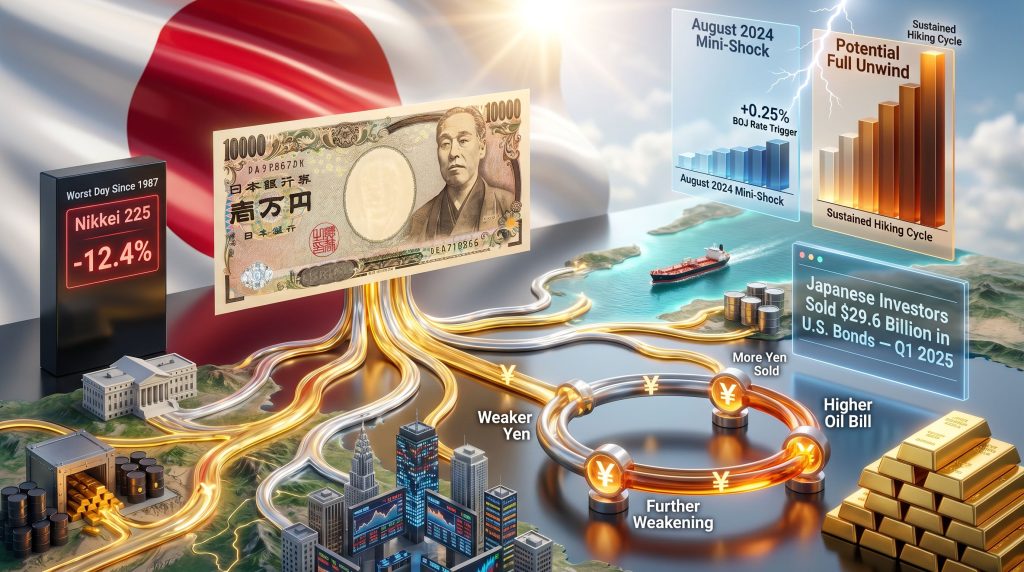
The theoretical risks of a yen carry trade unwind were given vivid empirical form in August 2024. The trigger was minimal by any historical standard: the Bank of Japan raised its policy rate by just 0.25 percentage points, the smallest increment possible.
The market response was disproportionate and global:
| Market or Asset | Recorded Impact | Timeframe |
|---|---|---|
| Japan's Nikkei 225 | Fell 12.4% in a single session | Worst day since 1987 |
| S&P 500 | Worst single-day drop in two years | Same trading session |
| CBOE Volatility Index (VIX) | Spiked to near-record levels | Within hours of open |
| Global equities (Seoul to New York) | Broad simultaneous selloff | Same afternoon |
| Cryptocurrency markets | Sharp correlated decline | Same session |
Analysis of the episode, including work from Wellington Management, suggests the August 2024 unwind was driven primarily by Japanese institutional investors and hedge funds reducing currency hedging exposure rather than outright liquidating U.S. Treasury holdings. This interpretation is supported by an important data point: U.S. Treasury yields fell during the episode rather than rising, which would be the expected outcome if large-scale bond liquidations were occurring. Capital appears to have flowed into Treasuries as a safe haven, not out of them.
A quarter-point rate increase — the gentlest tap imaginable — was sufficient to send shockwaves from Tokyo to New York within a single trading afternoon. That was not a stress test. That was the warmup.
Is Another Unwind Coming? Current Risk Indicators
Analysis from StoneX, a global financial services firm, indicates that USD/JPY positioning continues to accumulate leverage that creates material downside risk. The three conditions that would trigger a more severe unwind are structurally identifiable:
- A sustained BOJ rate hiking cycle that raises yen borrowing costs above carry trade margins across a broad range of asset classes.
- A sharp yen appreciation event, whether through direct intervention or market rerating, that renders existing positions immediately loss-making.
- A global risk-off episode that simultaneously reduces foreign asset yields while increasing yen demand as a safe-haven currency.
Comparing the August 2024 event with a potential full-scale unwind reveals meaningful differences in scope and duration:
| Factor | August 2024 Event | Potential Full Unwind |
|---|---|---|
| BOJ rate change trigger | +0.25% (minimal) | Sustained hiking cycle |
| Carry trade positioning at trigger | Elevated | Rebuilding per StoneX analysis |
| Duration of disruption | Days to weeks | Potentially months |
| Asset classes affected | Equities, FX, crypto | Equities, bonds, FX, credit |
| U.S. Treasury impact | Yields fell (safe haven inflow) | Ambiguous, repatriation risk present |
The Treasury repatriation risk deserves particular attention. In the first quarter of 2025, Japanese investors sold approximately $29.6 billion in U.S. bonds, their largest exit in nearly four years. While a single quarter does not confirm a trend, it is consistent with the structural logic of a creditor nation under pressure beginning to recall its foreign assets.
The next major ASX story will hit our subscribers first
The Transmission Mechanism: How Tokyo's Problems Reach Every Portfolio
The pathway from a Japanese monetary policy decision to selling pressure in U.S. equities, European bonds, or emerging market currencies runs through the carry trade unwinding mechanism. When yen borrowing costs rise or the yen strengthens:
- Carry trade positions become loss-making or insufficiently profitable.
- Investors must sell foreign assets to generate proceeds for loan repayment.
- Asset liquidation occurs simultaneously across multiple geographies and asset classes.
- Currency conversion back into yen creates additional upward pressure on the yen, which further compounds carry trade losses and accelerates the cycle.
U.S. technology stocks carry a disproportionate exposure in this dynamic because they represent a significant component of the high-return foreign assets that carry trade capital has historically targeted. A broad carry trade unwind is not a sector-neutral event. In addition, those watching global recession risks will note that these transmission channels make Japan's monetary policy decisions a truly global concern.
Hard Assets, Gold, and the Debasement Thesis
The structural lesson embedded in Japan's three-decade monetary experiment points toward a consistent historical pattern. When sovereign debt burdens force central banks to choose between defending their currency and maintaining bond market function, policymakers consistently prioritise bond market stability. Currency erosion is accepted as the manageable, gradual cost of avoiding an immediate debt market crisis.
When governments resolve debt problems by weakening their currency, assets priced in that currency tend to rise in nominal terms. Not because their intrinsic value increases, but because the unit of measurement is contracting. The measuring stick is shrinking.
Gold as a safe haven has long demonstrated its value during precisely these periods of sovereign currency erosion, and the behaviour of gold during market volatility reinforces why many investors are reassessing hard asset allocations in light of Japan's trajectory. Gold, energy assets, and productive real assets have historically served as hedges against this form of gradual currency debasement. They do not require cheap money to maintain their value. They require only that the currency used to price them continues to depreciate relative to their tangible utility.
Japan's experience offers a live demonstration of this dynamic. For investors watching the trajectory of Western sovereign debt, the Japanese case is not a historical curiosity. It is a leading indicator — a preview of the terminal stages of a monetary policy path that multiple advanced economies are now travelling.
Frequently Asked Questions
What is the yen carry trade in simple terms?
The yen carry trade involves borrowing Japanese yen at near-zero interest rates, converting those funds into higher-yielding currencies such as the U.S. dollar, and investing in assets that generate returns exceeding the borrowing cost. The profit is the spread between Japan's borrowing rate and the foreign asset's yield.
Why does a Japan yen carry trade unwind cause global market selloffs?
When the yen strengthens or Japanese interest rates rise, the cost of maintaining carry positions increases sharply. Investors are forced to sell foreign assets, convert proceeds back into yen, and repay loans simultaneously, creating synchronised selling pressure across multiple asset classes and geographies at the same moment.
What happened during the August 2024 unwind?
A 0.25% BOJ rate increase triggered rapid carry trade unwinding. Japan's Nikkei fell 12.4% in a single session, its worst day since 1987. The S&P 500 recorded its worst day in two years. The VIX spiked to near-record levels. Markets from Seoul to New York sold off within the same trading hours.
How does the unwind affect U.S. Treasuries?
The impact depends on the nature of the unwind. In a risk-off scenario, capital may flow into U.S. Treasuries as a safe haven, pushing yields lower as observed in August 2024. However, if Japanese institutions are compelled to repatriate capital to cover domestic obligations, selling pressure on Treasuries could emerge and push yields higher. The $29.6 billion in U.S. bond sales recorded from Japanese investors in Q1 2025 suggests the latter dynamic is already operating at the margin.
Key Takeaways for Investors
- Japan's three-decade near-zero rate environment created the world's largest and most geographically distributed carry trade funding mechanism, with effects embedded in asset prices globally.
- The August 2024 event demonstrated that even a 0.25% BOJ rate increase is sufficient to trigger rapid global contagion across equities, foreign exchange, and crypto markets simultaneously.
- The true scale of outstanding carry trade exposure remains unmeasurable due to the fragmented, private nature of the contracts that constitute it.
- Japanese investors sold approximately $29.6 billion in U.S. bonds in Q1 2025, their largest such exit in nearly four years, signalling active repatriation pressure that could intensify.
- Japan's doom loop — in which yen weakness inflates energy import costs, which forces more yen selling, which further weakens the yen — requires no external shock to perpetuate.
- Hard assets, energy, and gold have historically served as hedges during periods of sovereign currency erosion, not because their intrinsic value changes, but because the currency used to price them loses purchasing power.
This article is intended for informational and educational purposes only. It does not constitute financial advice. All forecasts, projections, and scenario analyses involve inherent uncertainty and should not be relied upon as predictions of future market outcomes. Past market events are not necessarily indicative of future results. Readers should conduct their own due diligence and consult qualified financial advisers before making investment decisions.
Want to Position Ahead of the Next Major Market-Moving Discovery?
When macro forces like the yen carry trade unwind reshape global capital flows, identifying significant ASX mineral discoveries early becomes a critical edge — and Discovery Alert's proprietary Discovery IQ model delivers real-time alerts the moment transformative discoveries are announced, turning complex market signals into actionable opportunities. Explore Discovery Alert's dedicated discoveries page to see how historic mineral discoveries have generated substantial returns, and begin your 14-day free trial today to ensure you're positioned ahead of the broader market.