June 6, 2026
India's Grid Storage Moment: Why Battery Economics Are Reshaping Public Sector Energy Strategy
For decades, the standard playbook for state-owned energy enterprises in developing economies followed a predictable arc: extract the resource, burn it for power, repeat. That model built industrial economies, but it also created infrastructure locked into a single fuel source with finite reserves and rising environmental costs. What is unfolding across India's public sector power landscape today represents something structurally different — a deliberate, capital-intensive transition where legacy extraction assets are being used to fund an entirely new generation of energy infrastructure, including utility-scale battery storage systems that did not exist at commercial scale even five years ago.
NLC India FY27 capex and BESS projects sit at the centre of this transition, representing one of the most ambitious single-year capital deployment plans announced by an Indian public sector undertaking in the energy space. Understanding what the numbers mean, how the capital is being allocated, and what it signals for India's broader energy architecture requires moving beyond headline figures and into the strategic logic underneath them.
When big ASX news breaks, our subscribers know first
From ₹9,131 Crore to ₹23,600 Crore: Decoding the Capex Acceleration
NLC India's FY26 capex of approximately ₹9,131 crore was itself a record at the time, representing an 18% increase over FY25. The jump to ₹23,600 crore in FY27 is therefore not a marginal step-up — it is a structural gear change, representing roughly 2.6 times the prior year's deployment.
To appreciate why this matters, consider the five-year context. Over the period leading into FY27, NLC India invested approximately ₹27,000 crore in cumulative capex. The FY27 plan alone almost matches that entire five-year figure. This compression of capital deployment into a single fiscal year is a deliberate signal: the infrastructure groundwork has been laid, project pipelines have matured, and the enterprise now has the institutional capacity to execute at scale.
NLC India's status as a Navratna Public Sector Enterprise is a structural enabler that is often underappreciated in public commentary. Navratna classification grants management significant operational and financial autonomy, including the ability to form joint ventures, incur capital expenditure, and establish subsidiaries without requiring case-by-case ministerial approval up to defined thresholds. This reduces decision-making friction considerably, allowing large-scale capital plans to move from board approval to execution without the administrative delays that constrain many public sector entities.
How the ₹23,600 Crore Is Actually Being Deployed
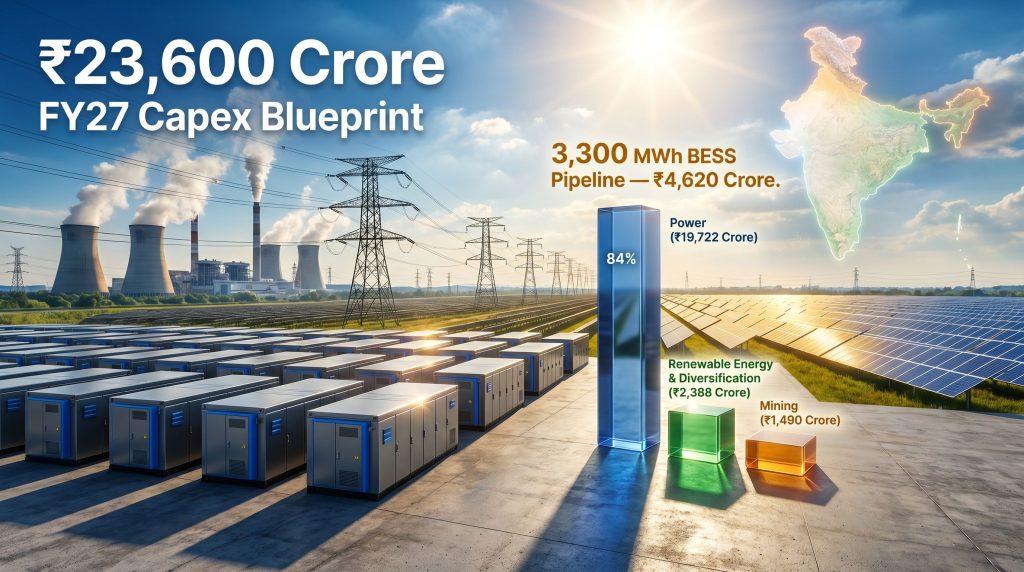
The FY27 capital plan is structured across three distinct operational pillars, each serving a different role in NLC India's integrated energy model.
| Segment | FY27 Allocation (₹ Crore) | Share of Total Capex |
|---|---|---|
| Power (including JVs) | ₹19,722 crore | ~83.6% |
| Renewable Energy and Diversification | ₹2,388 crore | ~10.1% |
| Mining | ₹1,490 crore | ~6.3% |
| Total | ₹23,600 crore | 100% |
Power: The 83% Allocation and What It Really Means
The dominance of conventional power in the FY27 budget is often misread as a contradiction of clean energy ambitions. It is not. India's grid faces a fundamental reliability challenge: as variable renewable capacity scales rapidly, the grid requires firm dispatchable power to manage frequency and voltage stability. Thermal generation, for all its emissions challenges, remains the primary source of that firmness in the near to medium term.
The inclusion of joint venture structures within the power allocation also matters. JV frameworks allow NLC India to co-invest with state electricity boards and other public sector partners, effectively stretching the capital reach of each rupee deployed from its own balance sheet. This amplification effect means the real infrastructure value created by the ₹19,722 crore power allocation likely exceeds what a standalone investment of equivalent size would generate.
Mining: The Hidden Infrastructure Layer
The ₹1,490 crore allocated to mining is easy to overlook against the scale of the power and renewables figures, but it performs a critical function. NLC India's thermal generation fleet is vertically integrated with its lignite mining operations, primarily in Tamil Nadu. Disruption to lignite supply would cascade directly into generation capacity.
Mining capex in FY27 is focused on a combination of operational modernisation and extraction continuity — ensuring that the fuel supply chain underpinning thermal assets remains reliable even as the energy transition reshapes the longer-term outlook for lignite demand. It is worth noting that lignite, as a lower-rank coal with higher moisture content and lower calorific value than bituminous coal, requires careful mine management to maintain consistent fuel quality for power generation. Furthermore, investments in mechanisation and drainage systems at lignite mines directly affect plant efficiency metrics downstream.
Renewables and Diversification: The Strategic Growth Frontier
The ₹2,388 crore earmarked for renewable energy and diversification may appear modest relative to the power segment, but its strategic weight is disproportionate to its size. This allocation seeds the infrastructure and project development pipeline that NLC India needs to meet its target of renewables comprising 50% of its own generation mix by 2030.
Achieving that target from a predominantly lignite-and-thermal base within four years requires not just capital, but project development velocity and technology integration capability. The renewable allocation in FY27 builds both. Consequently, this segment's importance will only grow as the 2030 deadline approaches.
NLC India's BESS Pipeline: A Closer Look at the ₹4,620 Crore Storage Strategy
Among all the components of NLC India FY27 capex and BESS projects, the battery energy storage pipeline is arguably the most structurally significant for India's grid future. The company has assembled a 3,300 MWh BESS pipeline across three distinct contracts with a combined value of approximately ₹4,620 crore. This aligns closely with the broader trend of battery storage expansion reshaping energy infrastructure investment across Asia.
| Project | Capacity | Contract Value | Location | Status |
|---|---|---|---|---|
| Tamil Nadu BESS | 500 MWh | ₹700 crore | Tamil Nadu | Contract signed |
| Punjab BESS | 1,000 MWh | ₹1,400 crore | Punjab | Pipeline |
| SECI BESS | 1,800 MWh | ₹2,520 crore | SECI-designated | Pipeline |
| Total | 3,300 MWh | ₹4,620 crore |
The Pricing Architecture: What ₹1.40 Crore per MWh Reveals
One of the more analytically interesting features of NLC India's BESS pipeline is the pricing consistency across all three contracts.
| Project | MWh Capacity | Total Cost | Cost per MWh |
|---|---|---|---|
| Tamil Nadu | 500 MWh | ₹700 crore | ₹1.40 crore/MWh |
| Punjab | 1,000 MWh | ₹1,400 crore | ₹1.40 crore/MWh |
| SECI | 1,800 MWh | ₹2,520 crore | ₹1.40 crore/MWh |
The uniformity of ₹1.40 crore per MWh across projects of significantly different scale is unusual. Normally, larger storage projects benefit from economies of scale, pushing the per-unit cost downward. The absence of any such discount in the pipeline figures suggests one of two dynamics: either these contracts were structured under a standardised procurement framework, or the pricing reflects a fixed-rate supply agreement with battery technology vendors that locks in unit costs regardless of project size.
Globally, utility-scale BESS project costs have been declining significantly, with some large-format projects in North America and Asia-Pacific pricing below USD 200 per MWh in recent procurement rounds. NLC India's ₹1.40 crore per MWh translates to approximately USD 165-170 per MWh at current exchange rates, placing the projects broadly within the competitive range of global benchmarks for 2025-2026 vintage procurements.
The evolution of these cost dynamics is deeply connected to the battery raw materials market, where lithium, cobalt, and nickel pricing continues to influence procurement economics for large-format storage installations worldwide.
Tamil Nadu: Why the First Project Sets the Template
The Tamil Nadu 500 MWh BESS contract, already formally signed at ₹700 crore, is more than an operational milestone. Tamil Nadu has one of India's highest renewable penetration levels, with significant installed solar and wind capacity that creates genuine grid management challenges around evening peak demand when solar generation drops. A 500 MWh storage installation in this grid context is not a demonstration project; it is functional infrastructure.
Successful delivery here establishes NLC India's credibility as an operational BESS developer rather than simply a project developer on paper. That credibility is a prerequisite for winning larger and more complex storage contracts going forward. Notably, NLC India's arm has already secured a TNGECL contract to develop standalone BESS projects, reinforcing this operational momentum.
Punjab and SECI: Scale and Strategic Positioning
The Punjab 1,000 MWh project addresses a different grid challenge. Northern India's grid has historically experienced significant seasonal variability, with agricultural pump loads creating irregular demand patterns that make storage economically attractive for system operators. A 1,000 MWh BESS installation in Punjab represents serious grid infrastructure with direct implications for how the northern regional grid manages peak load events.
The SECI-linked 1,800 MWh project at ₹2,520 crore is the flagship of the three. SECI functions as India's central procurement agency for renewable energy and storage, aggregating demand from multiple state discoms and structuring large-format tenders. Participating in a SECI-designated storage project places NLC India in a different competitive tier — one that signals alignment with national-level renewable integration priorities rather than just bilateral state agreements.
At 1,800 MWh, this project would rank among the largest single battery storage installations in South Asia when completed, comparable to large-format projects being developed across Australia and Southeast Asia in the same period. The technology approaches being evaluated for such projects, including direct lithium extraction methods, are influencing battery supply chain economics at a global level.
The ₹1.01 Lakh Crore Vision: Architecture of a Decade-Long Transition
The FY27 capex plan exists within a much larger investment architecture. NLC India has announced a ₹1.01 lakh crore investment roadmap through 2030, covering all four operational verticals.
To execute this plan over the remaining years to 2030, the implied average annual capex requirement runs well above ₹20,000 crore per year. FY27's ₹23,600 crore is therefore not an outlier — it is close to the run-rate required for plan execution.
The capital allocation across the 2030 plan reflects a deliberate sequencing logic:
- 44% allocated to thermal power projects — maintaining baseload reliability and cash generation capacity during the transition period
- 33% directed toward renewable energy — building the clean generation portfolio that will eventually carry the majority of NLC India's output
- Remaining allocation split across mining and diversification initiatives
This 44/33 thermal-to-renewables ratio is not a contradiction of NLC India's decarbonisation goals. It reflects the engineering reality that a grid cannot be decarbonised faster than dispatchable capacity can be replaced by reliable clean alternatives. Thermal assets generate the cash flows that fund renewable buildout, and they provide the grid services that variable generation cannot yet replicate at scale.
The risk factors that could affect execution of the 2030 plan are worth acknowledging clearly. These include:
- Land acquisition complexity for large solar and wind projects, particularly in states with active agricultural land use
- Grid interconnection timelines that may lag generation capacity additions
- Technology supply chain constraints for battery storage, particularly lithium-ion cell availability given global EV demand competing for the same supply
- Financing structure for a ₹1.01 lakh crore programme, which will require debt market access at competitive rates over multiple years
- Execution bandwidth within the organisation to manage simultaneous large-scale projects across multiple states
In addition, the global lithium market continues to evolve rapidly, with supply and pricing dynamics that could materially influence the cost trajectory of battery procurement over the planning horizon.
NLC India Renewables Ltd: Reading the IPO Signal
The Government of India has approved the listing of NLC India Renewables Ltd (NIRL), which will consolidate NLC India's renewable energy operations as a standalone listed entity. The proposed IPO will combine a fresh equity issue with an offer for sale involving dilution of up to 25% of NLCIL's stake in NIRL in the domestic market, with the launch targeted during the current fiscal year.
The structural logic here is straightforward: a pure-play renewable energy vehicle commands a materially different valuation multiple in public markets than a diversified lignite-and-power conglomerate. By carving out the renewables business, NLC India creates a vehicle that can attract capital from ESG-focused institutional investors who cannot or will not invest in a parent entity with significant fossil fuel exposure.
There is a deeper strategic dimension as well. An independently listed NIRL can raise equity capital directly from public markets to fund its own expansion, reducing the financial burden on the NLCIL parent balance sheet. This creates a self-reinforcing capital structure: NIRL's IPO proceeds fund renewable capacity additions, which in turn strengthen NIRL's revenue base and support future capital raising rounds.
Key metrics that institutional investors will scrutinise in the NIRL IPO include:
- Installed and committed renewable capacity at the time of listing
- Revenue visibility from long-term power purchase agreements
- The BESS project pipeline as evidence of next-generation storage capability
- Debt-to-equity structure and interest coverage ratios
- The management team's track record on project delivery timelines
The progress of BESS project execution, particularly the Tamil Nadu 500 MWh installation, will directly influence the pre-IPO valuation narrative. Demonstrable operational capability in grid-scale storage could be a meaningful valuation differentiator in a market where most renewable IPO candidates offer only solar and wind assets. Furthermore, India's lithium supply strategy will play a significant role in determining the long-term cost competitiveness of domestic battery storage deployments like those underpinning NIRL's growth case.
The next major ASX story will hit our subscribers first
Frequently Asked Questions
What is NLC India's total FY27 capex plan?
NLC India has outlined total capital expenditure of approximately ₹23,600 crore for FY27, inclusive of joint ventures, allocated across power (₹19,722 crore), renewable energy and diversification (₹2,388 crore), and mining (₹1,490 crore).
How large is NLC India's BESS pipeline?
The battery energy storage pipeline totals approximately 3,300 MWh across three contracts with a combined value of around ₹4,620 crore. The Tamil Nadu 500 MWh contract worth ₹700 crore has already been formally signed. Pace Digitek's recent ₹709.9 crore BESS contract award illustrates how competitive the Indian grid storage contracting environment has become.
What is NLC India Renewables Ltd and when is the IPO expected?
NIRL is NLC India's dedicated renewable energy subsidiary. The Government of India has approved its listing, and the IPO comprising a fresh equity issue plus an offer for sale of up to 25% of NLCIL's stake in NIRL is expected to launch during the current fiscal year.
What is NLC India's long-term investment target through 2030?
NLC India has announced a ₹1.01 lakh crore investment roadmap through 2030 spanning mining, thermal power, renewable energy, and diversification initiatives.
What renewable share is NLC India targeting by 2030?
The company is targeting renewables representing 50% of its own generation mix by 2030, supported by solar, wind, and battery storage capacity additions. NLC India FY27 capex and BESS projects represent the most significant single-year step toward that target yet undertaken by the enterprise.
Disclaimer: This article is intended for informational purposes only and does not constitute financial advice. Forecasts, targets, and investment plans referenced are based on publicly available corporate disclosures and are subject to execution risk, regulatory change, and market conditions. Readers should conduct independent research before making any investment decisions.
Want To Stay Ahead of the Next Major Energy Minerals Discovery?
As battery storage economics reshape global energy infrastructure and demand for lithium and critical minerals accelerates, Discovery Alert's proprietary Discovery IQ model delivers real-time ASX mineral discovery alerts — turning complex data across 30+ commodities into actionable investment insights the moment announcements hit the market. Explore historic discoveries and their market returns, then start your 14-day free trial at Discovery Alert to position yourself ahead of the next major find.